


You’ve already met Fred Millholin. He’s the Sun man who pulled Nanna Smithwick Donaldson’s “Requiescat” back into print for New Year’s 1974, in A Texas Daughter in Georgetown, and the one who explained Georgetown’s “Whattizit” on the front page in May 1975, in The Curiosity at 8th and Ash. If you read the sources on The Town That Called Itself a City, he’s there too, with a 1973 column on the public schools.
For decades he wrote a column for the Williamson County Sun called “Yesteryears.” By 1960 the Austin American could say that everyone in the Sun’s circulation area knew him as Mr. Fred, and that old-timers who’d moved away addressed their letters and their news to him.
It turns out Fred lived through a good deal of what I’ve been writing about here, and he often wrote about it in the paper. This is the first of what will likely be a series of his recollections, and it starts where he started: 8 years old, running messages for the telephone company.
One thing before we start: what follows is how Fred remembered it, mostly in columns he wrote in his seventies, about 70 years after the fact. The Sun’s own pages from the time give a firmer timeline, and where the two disagree I’ll mention it. That’s not a knock on Fred. Things blur together over 70 years, dates slide, two companies become one. It happens to everybody’s memory, and it will happen again in this series. Where the paper is sure, I’ll trust the paper. Where only Fred was in the room, we have Fred.
The family
Fred Whipple Millholin was born April 3, 1896, at Hutto. His mother, Blanche Cashe, had come to Texas from Virginia in 1891 to visit an uncle and stayed to teach. In December 1893 she married James M. Millholin at the home of her cousin, Mrs. R. H. Montgomery, in Georgetown, with Rev. M. C. Hutton officiating. James had been a Georgetown photographer for several years by then (the Sun had announced his Art Photo Company, with a partner, in 1890) and had lately moved to Hutto. The couple took the morning train home.
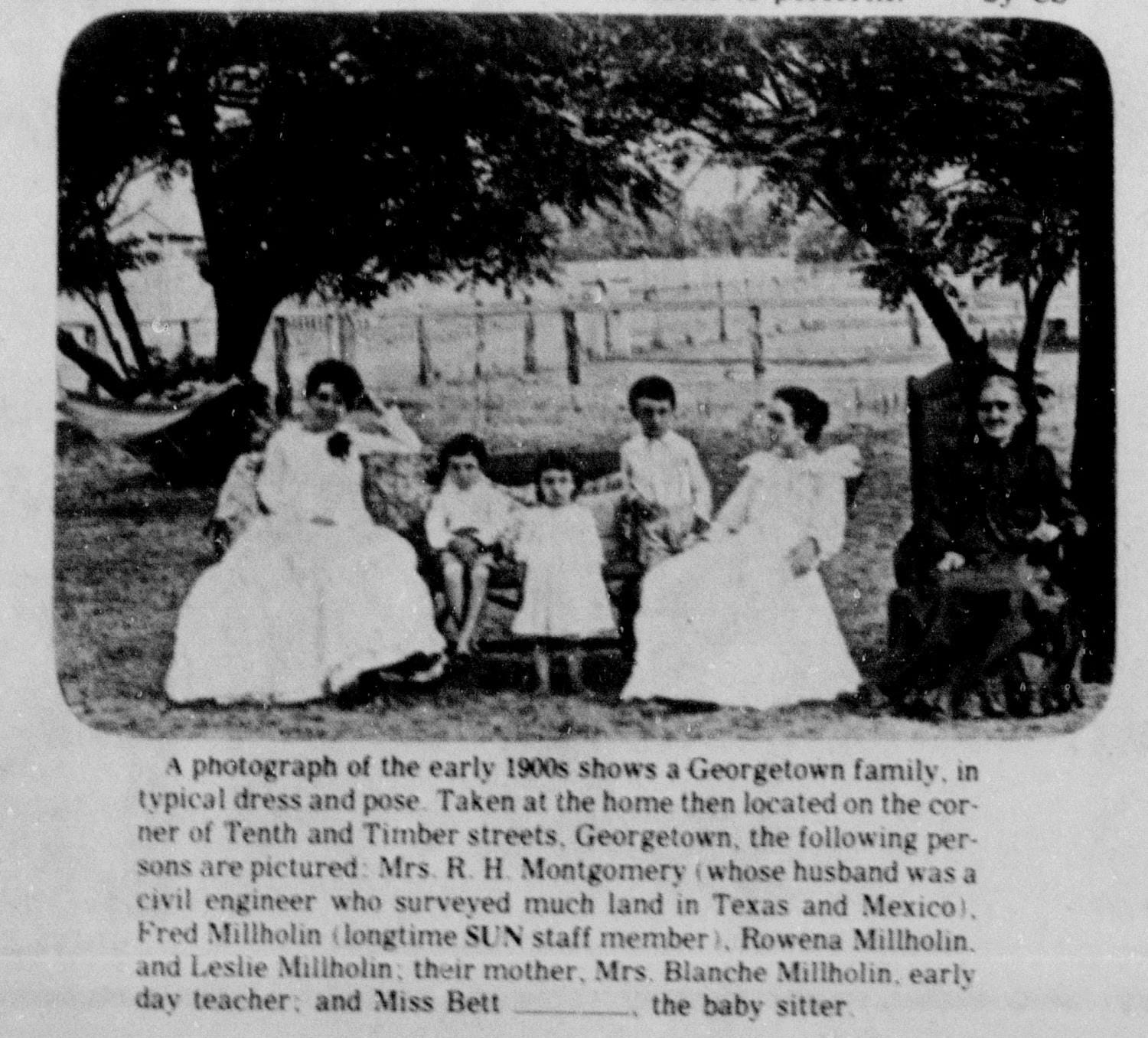
The family came back to Georgetown in 1902, when Fred was 6, and stayed six years. A photograph from those years, printed in the Sun in 1977, shows them at the house on the corner of Tenth and Timber: Mrs. Montgomery, the three older children, their mother, and the babysitter. The 1900 and 1910 censuses both list the father as a photographer. By 1910 there were four children: Les, Fred, Rowena and Foster.
Eight years old and on the payroll
Here’s Fred, in August 1972:
It was away back in the early twentieth century when Ye Yesteryears editor was a mere broth of a lad of eight just entering the business world as an humble messenger boy for the Southwestern Telephone Company…
That’s about 1904. Two months later, in October, he came back to the subject because readers had written in to ask what on earth a telephone company needed with a messenger boy. Fair question.
The company he worked for was a long-distance line only. It had an office and two pay booths, one in the old courthouse and one in the Commercial Hotel on West 7th Street, and that was the extent of it. If somebody in Taylor or Austin wanted to talk to you, they called the office, and the office sent the boy. His job was “to summon citizens to the telephone office or to one of the booths when they were called by out-of-towners.” For this he was paid $10 a month, which “seemed quite a neat sum to an eight year old messenger.”
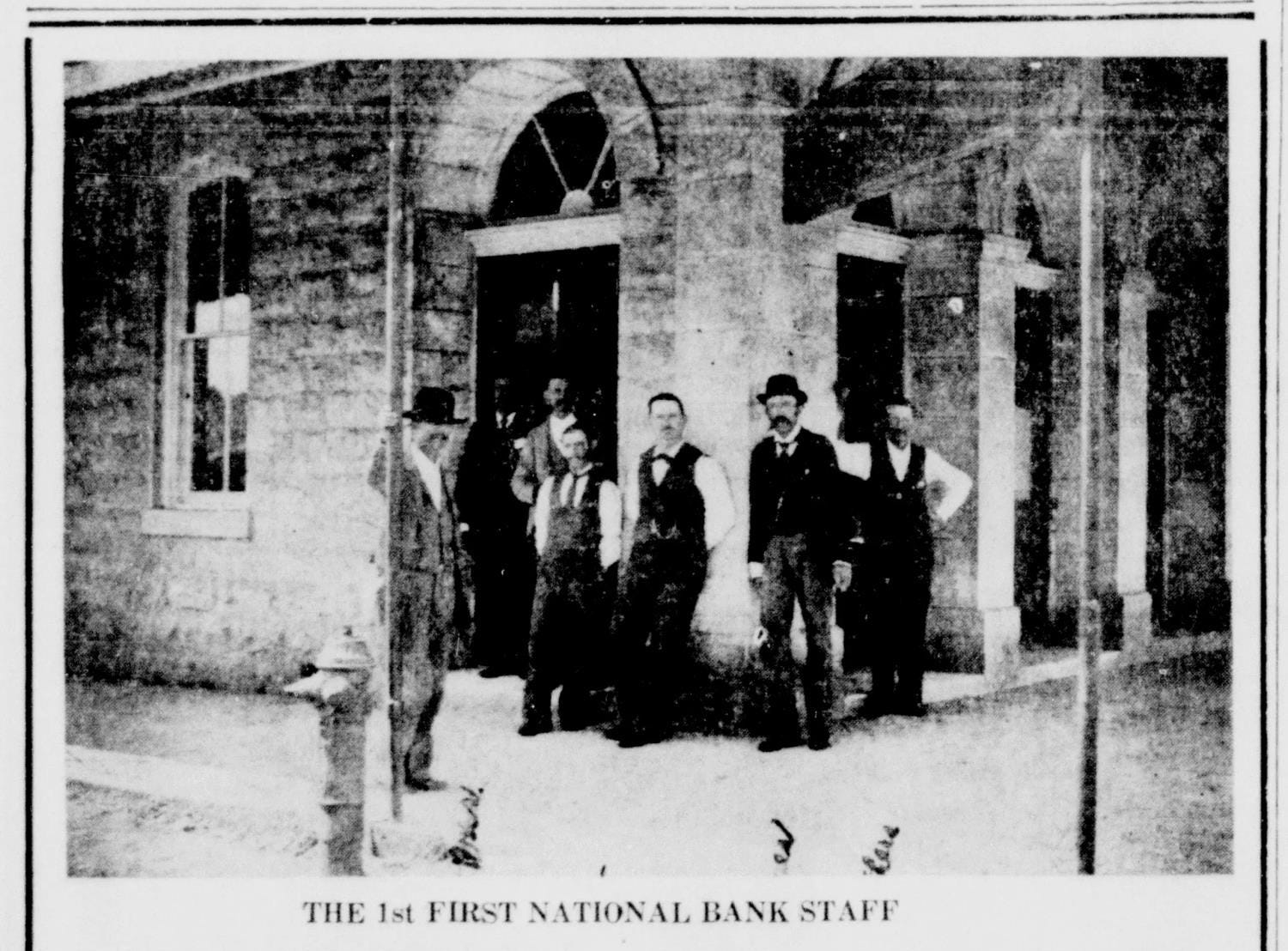
The office was the southwest upstairs room of the old First National Bank building on the northwest corner of the square. By the time Fred wrote about it, that building was gone. The bank tore it down in 1964 and built a new one on the same corner. Fred remembered his neighbors up there: a lawyer, Judge George W. Glasscock, a real estate firm, Judge Cooper Sansom, and his uncle, R. H. “Hal” Montgomery, a civil engineer who surveyed railroad rights-of-way in Texas and Mexico. The uncle once came home from Mexico with enough silver dollars to have a Georgetown silversmith named Eubank make them into a full set of flatware. The King’s Daughters had a meeting room on the same floor, and the messenger boy was a member of their Children’s Circle, so he was upstairs on meeting day whether anybody called or not.
The chief operator was Miss Sallie Stubblefield, with her sister Amy as relief. The Stubblefields were an old Georgetown family, four unmarried sisters and a bachelor brother in one of the town’s oldest cottages at the northeast corner of Brushy and 6th. Miss Sallie was Fred’s boss, and the other boys in town knew it. His brother Les put it this way in a letter to the Sun in 1972:
All the kids called Fred ‘Sallie’ which irked him no end and kept him in a dither most of the time.
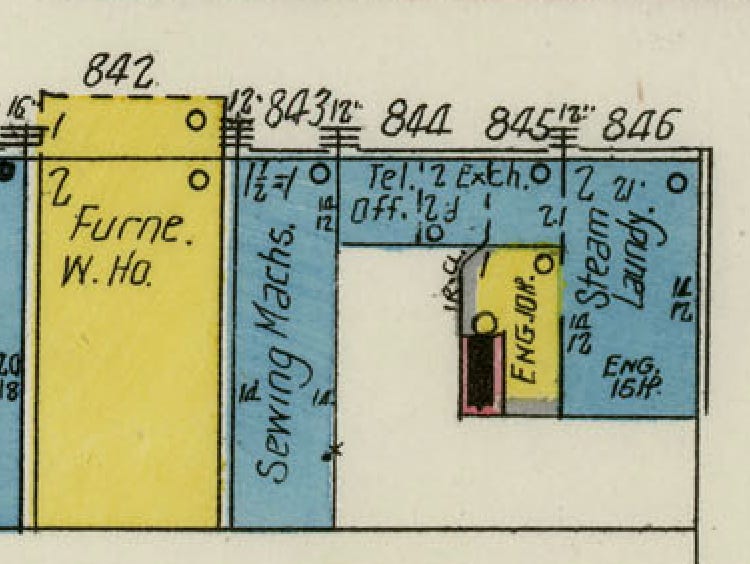
Fred wrote that the first local exchange in Georgetown was set up by a Mr. Sweet and his son “in the very early 1900’s.” That’s the first place his memory and the paper part ways. The Sun was running the subscriber list of a Georgetown exchange in 1885, and I wrote about it in The Town Rules for the Phone. What Fred may have been remembering is a later company that took the business over. The Sanborn map of November 1905 shows a telephone office with an exchange upstairs on East 8th Street, off the square’s southeast corner near where 600 Degrees Pizza stands today, so during Fred’s messenger years the town had a local exchange on one side of the square and the long-distance office on the other. His $10 a month came from the one that reached out of town.
His brother at the depot
Les Millholin was a little more than a year older, and around 1906 he had the other messenger job in town: Western Union, at the I&GN depot, under agent J. D. Jenkins. The boys who’d had it before him included Edwin Battke, Sam Brady and Charlie Forgy. You met Charlie a couple of weeks back; he’s the 8-year-old who lost four front teeth to a horse on the school grounds in 1897, grown now into a depot job. The perks were worth having. “I liked my job,” Les wrote, “as we all got passes when Gentry Bros. Circus came to town.”
For a sense of the pay, Hamilton Wright had held the depot job a few years earlier, in 1902, at $8 a month plus 15 cents for every telegram he delivered outside the free zone. Fred’s $10 for walking people to the phone was the better deal.
What two messenger boys got out of it wasn’t the money. Les again:
As messenger boys, Fred and I knew almost everybody in Georgetown and vicinity; all the business and professional men, cattle barons, the sick, the poor, the good, the bad and the inbetween, also most of the faculty of SW University and many of her residents.
Among the good, he counted Senator Joseph W. Bailey. Among the bad, “Cole Younger, notorious outlaw, cousin of Jessie James. He had done his time and I hope reformed.”
Among the bad
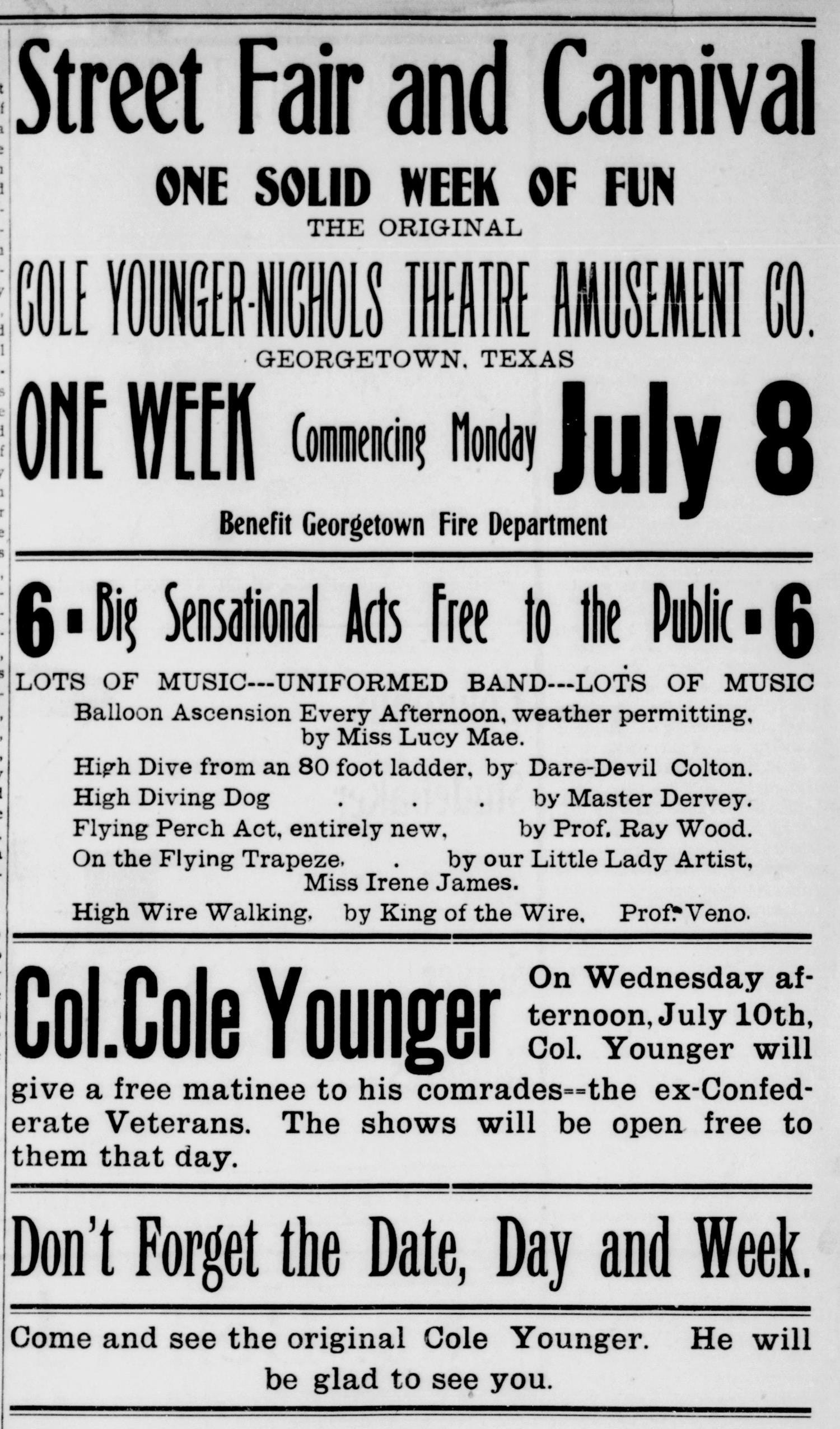
Les put Cole Younger in 1906, and Clara Scarbrough, who heard from both brothers for Land of Good Water, wrote that the Younger carnival came through “for several years around the turn of the century.” The Sun has one visit, and the date. In June 1907 the Fire Department signed a contract with “the Original Cole Younger & Nichols Theatre-Amusement Co.” for a Mid-Summer Street Fair and Carnival, July 8 to 13, for the benefit of the department. The paper assured readers the company was “moral, refined, and high class.”
The ad in the July 4 issue promised one solid week of fun: six free acts, a uniformed band, a balloon ascension every afternoon by Miss Lucy Mae, a high dive from an 80-foot ladder by Dare-Devil Colton, and a high-diving dog. On Wednesday, July 10, Col. Younger would give a free matinee to his comrades, the ex-Confederate veterans. The Sun checked in on July 11 and found nine shows, all crowded, and “Cole Younger—the undoubted original Cole” making “a fine impression by his affable manners and intelligent conversation.”
Fred was 11 that week and Les about 12. Les remembered it in a letter to the Sun in 1970: “Fred and I knew him personally… we contacted him often when he was in Georgetown with Cole Younger and Nichols Carnivals.” He went on to manage the VA’s supply depot in Chicago, and in that same letter he listed the people his “long public career” had let him know: admirals, generals (“one 5 star”), governors, senators, congressmen, “one Maharaja, and one notorious outlaw, namely Cole Younger.” You can picture a boy from the telephone office walking into the carnival with a note for the man who’d ridden with Quantrill and robbed banks with the James brothers, done 25 years in a Minnesota prison for it, and was now shaking hands with Georgetown’s old soldiers.
The cars come in
Fred’s August 1972 column, the one with the “broth of a lad” line, was about the arrival of the automobile, and he placed his messenger years right at the switch from “hay burning” to gasoline. He remembered the ordinance that made drivers pull to the edge of the street and stop until a team passed, and drivers who kept yelling “whoa” at the car. Best of all, he remembered what happened when a new car parked on the square: “the merchants would hurriedly leave their places of business and run out to view them from the front, back, top and underneath.” That’s a boy’s eye view from a boy that was standing right there as it happened.
His mother’s school
The Austin American profile of Fred in 1960 says he quit school at 8 to take the messenger job and went back at 11, “after his mother opened a private school.”
Fred wrote about the school in 1975. Blanche Millholin held her school in a frame building on West 10th Street. Some of her pupils rode in on horseback: Bryant Hall, Bond and Philip Sneed, Garland Fowler, Derrell Cody, and Ed and Duncan Cooper. She coached high school students in Latin, Spanish and mathematics, and she’d won a gold medal for Latin as a girl in Virginia. Tuition was $1.50 a month. Fred knew the figure because John N. Ellyson Jr. found his parents’ receipt, written in her hand, going through old family papers. One afternoon after dismissal the horseback pupils decided to race up 10th Street, and at Brushy one of them ran “smack dab” into the phaeton of Mrs. F. T. Roche, wife of the man who was then editing the Sun. She got off with scratches. The parents paid for the buggy.
The same column has the two brothers in a livery rig with their aunt, a red-haired woman who “was not afraid of the old boogerman himself.” The horse bolted in front of Coffee’s stable on Brushy. Men ran out to catch it, and she waved them off, reached for the whip, and laid it on. Fred and Les hung on “for dear life” all the way down Brushy Street to the bottom of Jail Hill, where she brought the horse under control and drove it back “as docile as a lamb.”
After the telephone office
The family left Georgetown for Weir in 1908, and the telephone went with them. That year Blanche went to work for the Walburg-Weir Telephone Company, a branch of the Georgetown exchange. In 1910 she moved to the Weir Telephone Union, and the census taker that April wrote her down as “Operator, Telephone.” She ran the Weir switchboard for the next 25 years, until 1935, when the company was turned over to her outright. Her obituary says it was “in consideration of her past services.” A 1966 Sun story on Weir put it more plainly: “they gave it to her in payment of back wages.”

Fred, at 14, was a hired farm hand. By 21 he was a country schoolteacher, and he gave the $10 a month its ending himself: the messenger’s pay seemed a neat sum “until he, a number of years later, pulled down the munificent sum of $40 per month for teaching his first term of six months in one of the Williamson County schools.” Then came the Navy, but that’s another story.
Thanksgiving week, 1921
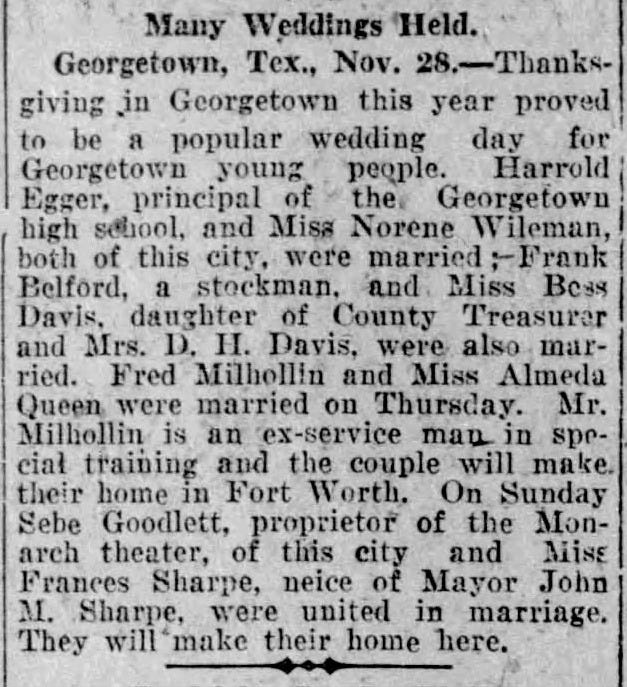
If you read The Park Between the Rivers, you were at the wedding of Sebe Goodlett and Frances Sharpe on Sunday, November 27, 1921. Fred Millholin married Almeda Queen four days earlier, on Wednesday, November 23, at the home of Rev. M. C. Hutton, the same minister who had married his parents nearly 28 years before. The county clerk issued Fred and Almeda license number 313. Sebe and Frances, three days later, got 323.
The San Antonio Light covered Georgetown’s Thanksgiving under the headline “Many Weddings Held” and got the whole week into one paragraph: the high school principal, a stockman named Frank Belford, Fred and Almeda, and Sebe and Frances. It’s one of the many times I’m reminded what a small town this was. Two couples I’ve been writing about turn out to have been married in the same week, and reported in the same paragraph.
More to come
Fred had about 60 years of Georgetown ahead of him in 1921: the Sun, “Yesteryears,” the readers who wrote to Mr. Fred, and a backyard cellar that made the headline of a 1960 Austin American profile piece. Those are other tales. For now, picture an 8-year-old who, as his brother said, knew almost everyone in town, climbing down the stairs over the bank with a message for somebody who had received an important long-distance call.
Sources
The Williamson County Sun
“The Telephone Exchange” [Georgetown’s first directory], 12 March 1885, p. 2.
[Local item, F. S. Minier and J. M. Millholin, the Art Photo Company], 11 December 1890, p. 2.
[Wedding notice, Jas. M. Millholin and Blanch V. Cashe], 21 December 1893, p. 2.
“Kicked By A Horse,” 16 September 1897, p. 1.
“Big Mid-Summer Carnival,” 13 June 1907, p. 1.
“Street Fair and Carnival” [advertisement, Cole Younger-Nichols Theatre Amusement Co.], 4 July 1907, p. 4.
“The Carnival,” 11 July 1907, p. 1.
“Mrs. B. Millholin Dies Monday of Brief Illness,” 19 July 1940, p. 1.
“First National Starts Move Saturday Noon,” 3 September 1964, p. 3.
“Weir, Once a Thriving Town With Two Telephones In Every Home, is Beginning To Grow Again,” 28 April 1966, p. 6.
Les Millholin, letter to the editor, “Our readers write,” 12 February 1970, p. 2.
Les Millholin, letter to the editor, “Our readers write,” 20 January 1972, p. 15.
Hamilton Wright, “Was fired for tampering with telegraph keys and sounder,” 3 February 1972, p. 11.
Fred Millholin, “Fred Millholin’s Yesteryears: Wheels Start To Spin When Cars Come In,” 24 August 1972, p. 2.
Fred Millholin, “Saga of the telephone—particularly in Georgetown,” 26 October 1972, p. 2.
Fred Millholin, “Fred Millholin recalls turn-of-the-century here,” 21 August 1975, sec. 2, p. 3.
[Photograph and caption, the Millholin family at Tenth and Timber], 19 May 1977, p. 33.
Other printed sources
“Georgetown Girl Weds Dallas Man,” The Austin American, 26 November 1921, p. 8.
“Many Weddings Held,” San Antonio Light, 28 November 1921, p. 2.
Vera Allan, “Cellar Digger Finds Solitude,” The Austin American, 18 July 1960, pp. 1 and 3.
Clara Stearns Scarbrough, Land of Good Water: Takachue Pouetsu, A Williamson County, Texas, History (Georgetown: Williamson County Sun Publishers, 1973), pp. 300, 317–318, 465.
County and federal records
Marriage license no. 313, Fred W. Millholin and Almeda Glenn Queen, issued and solemnized at Georgetown 23 November 1921, returned 25 November 1921. Williamson County Clerk.
Marriage license no. 323, Sebe Goodlett and Frances Rachel Sharpe, issued 26 November 1921, solemnized 27 November 1921. Williamson County Clerk.
1900 U.S. census, Williamson County, Texas, Justice Precinct 8, enumeration district 140, sheets 3B–4A, dwelling 68, James M. Millhollin household.
1910 U.S. census, Williamson County, Texas, Justice Precinct 1, enumeration district 116, sheets 9A–9B, dwelling 168, James M. Millholin household.
World War I draft registration card, Fred Whipple Millholin, Williamson County, 5 June 1917.
Maps
Sanborn Fire Insurance Map, Georgetown, Tex., November 1905, sheet 3, block 52. Original at the Dolph Briscoe Center for American History, University of Texas at Austin.
Photographs
First National Bank advertisement, “The Old, and the New” [photograph, “The 1st First National Bank Staff”], Williamson County Sun, 16 September 1965, p. 16.
Old Town Echoes is independently researched using primary historical sources. AI tools assist in drafting and editing; all content is reviewed, sourced, and verified by the author.