


In April of 1889, Georgetown told the Austin Weekly Statesman it had “all the necessary adjuncts which go to make up the full list of a full-fledged metropolitan city.” A year later, almost to the day, on April 17, 1890, the Williamson County Sun ran this on page 2:
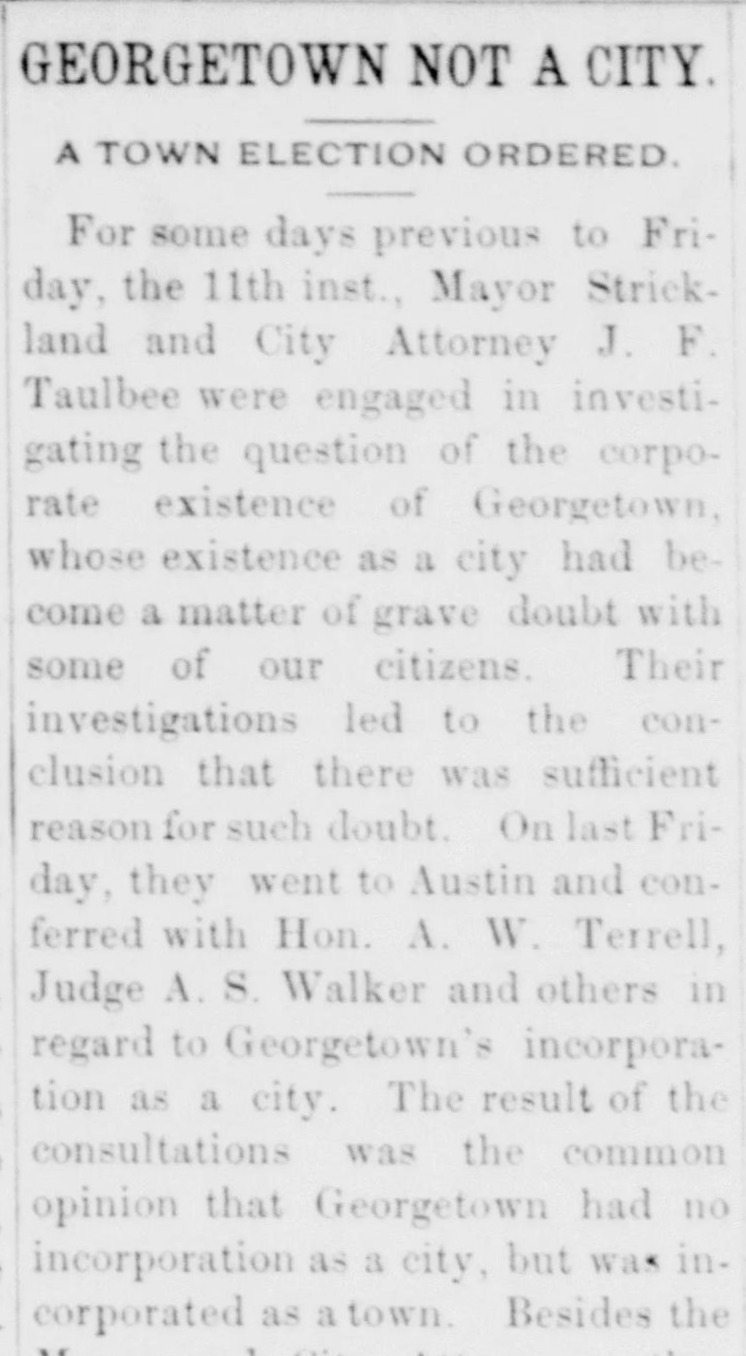
GEORGETOWN NOT A CITY. A TOWN ELECTION ORDERED.
Nothing had happened to the town. The stores were open and the mayor was still the mayor, more or less. What had happened was that somebody finally reviewed the paperwork.
I promised you this one back in August, at the end of the first Booster Shot post on Facebook, so here it is.
The Question
J. F. Taulbee had just been elected city attorney. By his own account the question “was being generally discussed” when he took office: was Georgetown legally a city at all? He went looking, and what he found went into an open letter to the voters dated April 12.
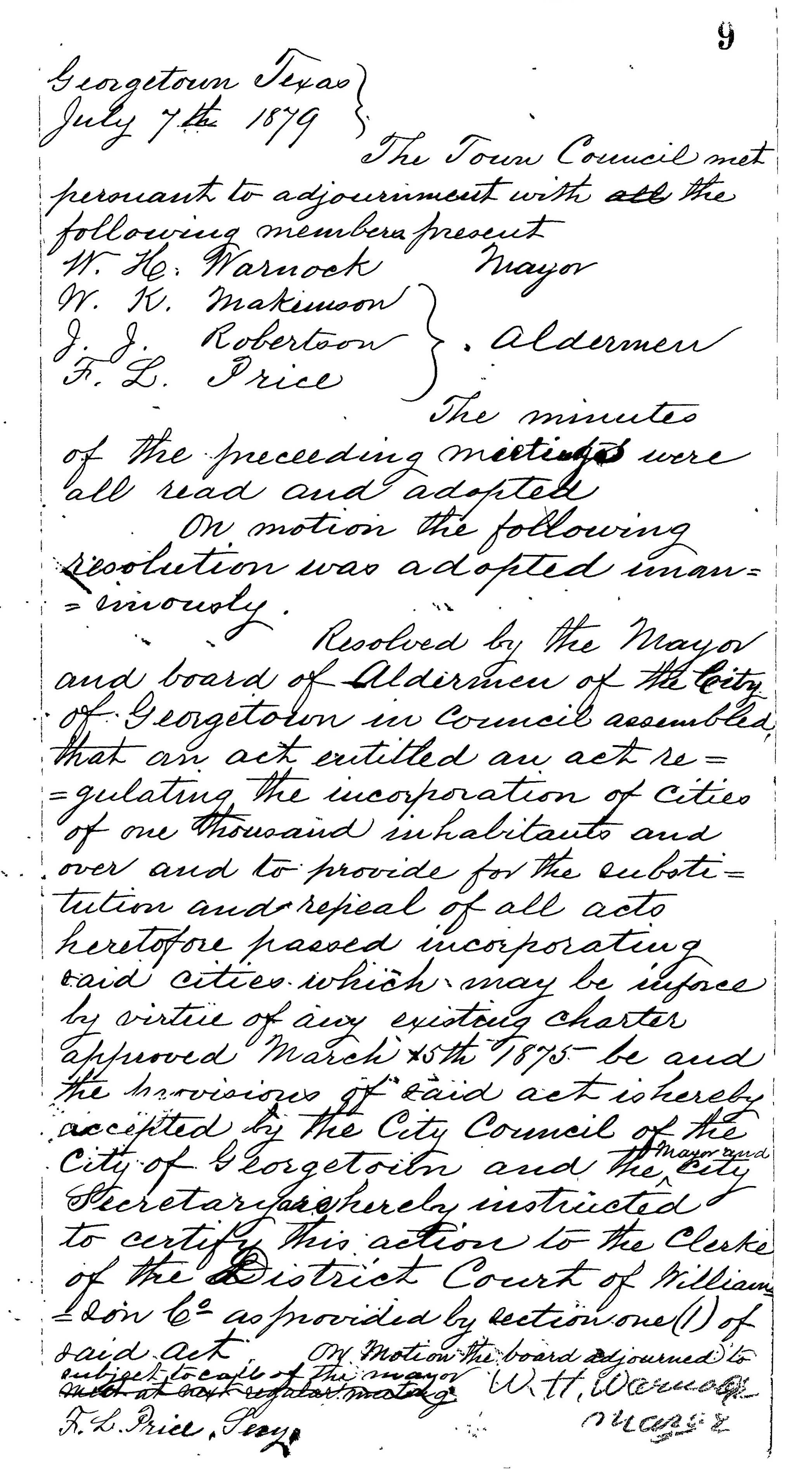
The Legislature had chartered the town of Georgetown on March 8, 1871. On July 7, 1879, the town council had voted to accept a state law that let a place trade its special charter for the general law governing cities, and from that night on Georgetown called itself a city: city council, city attorney, city secretary, four wards with an alderman each. The trouble was with that single word. The 1875 law was open to “any city” of 1,000 people or more. Georgetown’s charter said it was a town. Size had nothing to do with it. The law simply didn’t apply to towns, and the Legislature didn’t pass one that did until 1885.
Taulbee put it plainly: “we have an incorporated town without officers.”
The 1879 minute book, which the City Secretary's office has online in its public records, shows the moment it went wrong. The clerk headed the entry “The Town Council met,” then recorded a resolution passed “by the Mayor and board of Aldermen of the City of Georgetown.” They called it a city in the act of trying to become one. The certificate they sent to the courthouse that December was signed “with scrolls for seals,” because the city didn’t have a seal. One of the three aldermen voting yes that night was W. K. Makemson.
Saturday’s Paperwork
Mayor E. A. Strickland and Taulbee went down to Austin on Friday, April 11, and talked it over with A. W. Terrell, Judge A. S. Walker “and others.” Everyone agreed. Not a city, only a town, and a town whose officers had all been elected under the wrong law.
Saturday’s paper trail, every piece of it dated April 12, is quite entertaining.
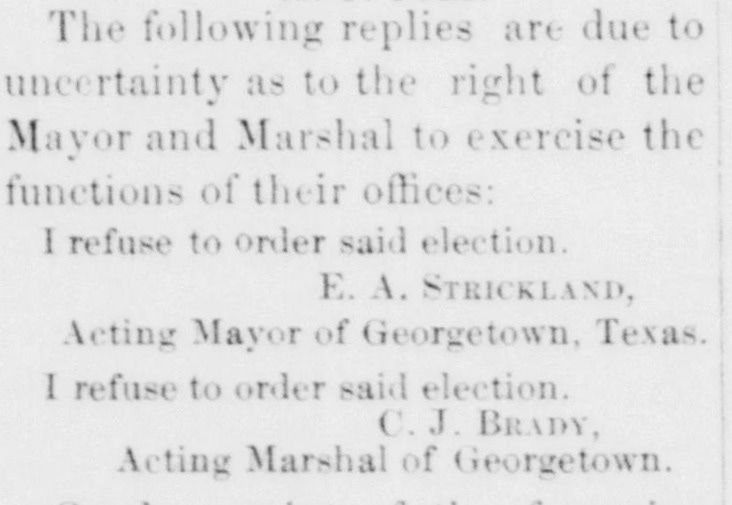
The 1871 charter had a clause for exactly this situation. Five citizens could call a town election on 5 days’ notice, but only “should said mayor and marshal fail or refuse” to call one themselves. Five citizens, W. K. Makemson first among them, with J. E. Cooper, Cooper Sansom, S. T. Atkin and H. C. Purl, duly asked the mayor and the marshal to order an election. Both men answered in the same 6 words: “I refuse to order said election.” Strickland signed as Acting Mayor. C. J. Brady signed as Acting Marshal. The five citizens then gave notice of an election for Friday the 18th.
The Sun explained the refusals as “uncertainty as to the right of the Mayor and Marshal to exercise the functions of their offices,” which was true. It’s also true that the charter only handed those five men their power after a refusal, and that the plan they were carrying out was Strickland’s own. I read the refusals as the mayor holding a door open.
Taulbee, meanwhile, signed his letter “City Attorney.” The same issue of the paper noted that the law for towns “makes no provision for the office of ... city attorney.” Makemson, who had voted Georgetown into a city 11 years earlier, was now the first name on the petition to undo it.
Tuesday Night
The citizens met at the courthouse on Tuesday, April 15. J. E. Cooper took the chair. Cooper had founded the Sun, so the newspaper covering the meeting belonged to the man who was running the meeting.
Two plans were on the table. Strickland’s was to elect town officers on Friday and then use the 1885 law to become a city, properly this time. T. B. Cochran’s was to keep the town charter and ask the next Legislature for a new one with bigger limits. Makemson thought Cochran’s law “would be unconstitutional” and backed the mayor, and R. H. Price sided with Makemson. “The meeting adjourned without reaching any conclusion.” The Sun then reached one: “the Sun thinks the latter course is the most advisable.”
By press time, a ticket had been agreed on for Friday. W. Y. Penn for mayor (the jeweler, “an elastic fountain Penn” in the 1889 article), C. J. Brady for marshal, and J. R. Roberts, J. L. Brittain, Fred R. Scott and W. Patrick for aldermen. Strickland wasn’t on it. “So far as the Sun is aware,” the paper said, “no other citizens intend to be candidates.”
The last line of the column: “Mr. George Irvine authorizes the Sun to state that he is a candidate for alderman.”
Friday
The election “passed very quietly.” Penn got 249 of 250 votes for mayor and Brady 248 for marshal.
The aldermen were another matter. George Irvine, the man from the last line, topped the poll with 192. J. W. Whittle, whose name hadn’t appeared anywhere the week before, took 161. Two of the agreed ticket’s four went home: Fred R. Scott with 69 votes and W. Patrick with 114.
Wednesday Night
The new town council held its first regular meeting on Wednesday, April 23, and worked through its own charter in order.
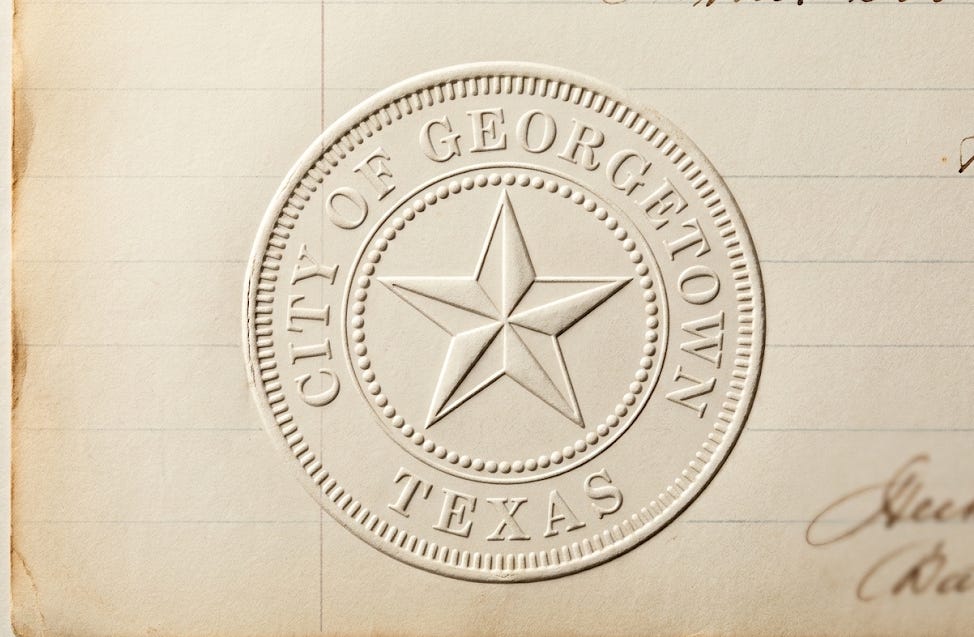
Section 6 said the council should elect one of its members treasurer and secretary at its first regular meeting. They elected Whittle, the surprise alderman. Then they adopted a corporate seal, “a five pointed star encircled by the words ‘Georgetown Texas.’” As far as the records show, it was the first seal the corporation had ever owned; the 1879 paperwork had made do with scrolls. The 1885 law required the town’s copy to be certified “under the corporate seal,” and the town made one the night it needed one.
Brittain moved and Irvine seconded that the town accept Title 17 of the Revised Statutes “in lieu of the existing charter of this town approved March 8, 1871, and that this town be hereafter known as the City of Georgetown.” Ayes and nays, unanimous. That was 5 days after the election, well inside the 30 days Taulbee had promised.
The minute book’s last lines for the Town of Georgetown, in Whittle’s hand: “No further business appearing the Council adjourned sine die.” Sine die is Latin for “without a day.” An ordinary meeting adjourns to the next one. A body that adjourns sine die is adjourning with no date to meet again, because it’s finished for good. That’s the phrase a legislature uses when a session ends, and Whittle underlined it. The town council had no reason to meet again, because the next time it met, it would be the city council.

Thursday, 2 p.m.
The 1885 law didn’t make the change take effect at the vote. It took effect “from and after the filing.” Georgetown became a city not at the council table but at the county clerk’s desk, when J. W. Hodges took the certified copy at 2:00 on Thursday afternoon, April 24, 1890. He recorded it the following Monday under the heading Town of Georgetown Changed to City of Georgetown, in volume 53 of the deed records, pages 56 to 58, in among everybody’s land.
On Friday the city council met. Mayor Penn appointed J. F. Taulbee city attorney, the office he had been signing under all along, and the council confirmed him unanimously. A city needed 5 aldermen where a town had 4, so an election was called for a fifth. On Monday the council passed a police ordinance and put the printing out to bid. The Gazette underbid the Sun. The paper whose founder had chaired the meeting, signed the petition, and endorsed the whole plan lost the contract to print it.


The Money
The reason anyone cared was money (because of course it was). In 1883 the “city” of Georgetown had issued $36,000 in bonds to build the waterworks, the “perfect system of water works” the 1889 article bragged about. A town charter gave no power to borrow like that. If Georgetown had never legally become a city, then legally it had never had the power to issue those bonds, and the people who’d bought them were holding paper signed by a government that hadn’t existed. That was the real problem behind the April 1890 headline. Whether the mayor was really the mayor could be fixed with an election, but the waterworks debt couldn’t.
The Legislature fixed that part in March 1891 with a general act declaring that towns which had “attempted” to become cities without the right to were cities after all, and that what they’d done in the meantime counted. There was one limit. Their past acts were only good as far as a proper city could have gone under the general law, and a proper city could only borrow what its tax base would support. Georgetown’s in 1883 wouldn’t support $36,000. City Attorney R. E. Brooks did the sums that October and told the council each bond was good “in the proportion of $21,518.15 to $36,000.00,” or about 60 cents on the dollar. The way out was the waterworks themselves. In June 1893 the Sun reported a telegram from the bondholders saying they’d be in town as soon as the papers were ready “to close the contract for transferring the water works to them.” The city that had bragged in 1889 about owning its “perfect system of water works” sold the system. The buyer, that October, was a New York investment house, W. N. Coler & Co., which promised to extend the mains and, as a bonus, put in electric lights. By the summer of 1894 the city was certifying under its seal that it owed nothing on the old bonds at all, the Attorney General had looked over the 1890 paperwork twice and pronounced Georgetown “legally Incorporated,” and the council was issuing $21,000 in new bonds for a public school. The Sun summed up the whole episode that December in one line: “with their sale the difficulties vanished.”
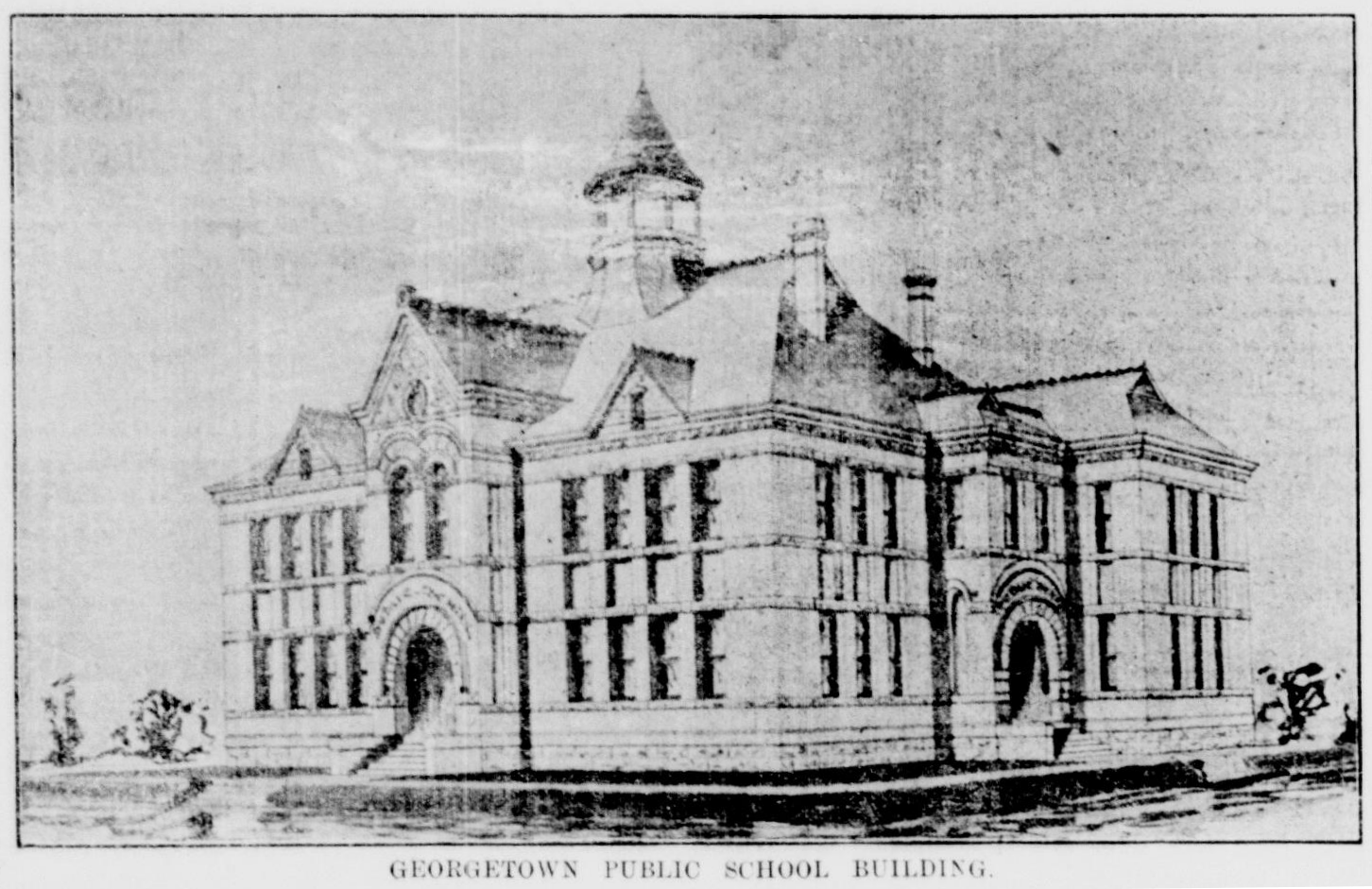
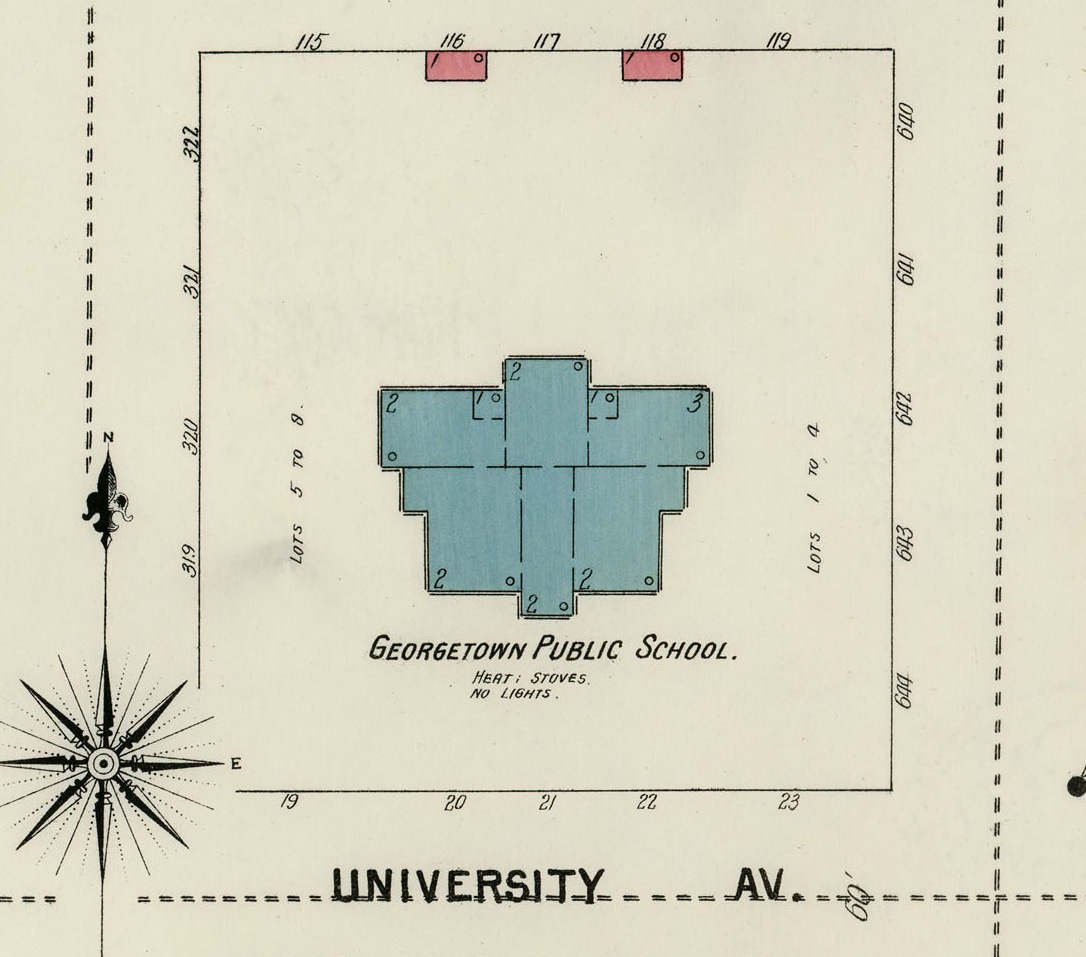
The Georgetown Public School building sat on University between Austin and Main (on the block where Dos Salsas is today) from 1894 until it was demolished in 1957, but I’ll save the rest of its story for another day.
Pick a Date
If you ask when Georgetown was incorporated, you have options.
September 26, 1866, when the Legislature first chartered a town of a few blocks between Glasscock’s addition and Rolling Street.
March 8, 1871, when it repealed that act and re-chartered the town a mile square, with the governor appointing the first officers.
July 7, 1879, when the town voted itself a city without a law to support it.
April 24, 1890, at 2 p.m., when it became one.
In 1935 the City Secretary certified on an official form that the City of Georgetown was “incorporated in 1871,” and I can’t technically say that was wrong.
The 1889 booster article, for what it’s worth, said Georgetown was “organized as a city in 1868; Esquire Page the first mayor.” I’ve found no record that supports that (which isn’t surprising, since the Sun doesn’t go back that far), but we could add it to the pile of dates.
The town that called itself a city for 11 years fixed it in 6 days, at a clerk’s desk, in the time it took to write the word 'Filed.' Then it got on with being a city, which it had been doing all along.
Sources
Newspapers
“GEORGETOWN. The Principal Points and Surroundings About a Live Texas Town,” Austin Weekly Statesman, 18 April 1889, p. 10; digital images, Newspapers.com.
All Sun items below are from The Williamson County Sun (Georgetown, Texas); digital images, Newspaper Archive (newspaperarchive.com : accessed July–September 2026). Untitled local items are described in brackets.
“Georgetown Not a City. A Town Election Ordered” [with City Attorney J. F. Taulbee’s address to the voters, the five citizens’ application, the mayor’s and marshal’s refusals and the election notice], 17 April 1890, p. 2.
“Citizen’s Meeting,” 17 April 1890, p. 2.
“The Election” [returns of the 18 April town election], 24 April 1890, p. 4.
“Proceedings of the Town Council” and “City Council,” 1 May 1890, p. 2.
“The City and the Waterworks” [City Attorney R. E. Brooks’s opinion to the council], 15 October 1891, p. 2.
[Local item, telegram from the holders of the water works bonds], 29 June 1893, p. 3.
[Local item, W. N. Coler & Co. of New York buy the waterworks from the city], 12 October 1893, p. 2.
“Thousands Invested in Georgetown,” 2 November 1893, p. 2.
“New Public School Building. Corner Stone Laid,” 13 December 1894, p. 3.
“Cornerstone Relocated” [photograph and caption; the old school “torn down a few months ago”], 30 May 1957, p. 4.
Fred Millholin, “Former SUN editor writes of public education in Georgetown,” 13 September 1973, sec. 2, p. 3.
City and county records
City records are from the City of Georgetown records archive, City Secretary’s historic documents (records.georgetowntexas.gov), with Laserfiche document numbers in parentheses.
Town Council minutes, 7 July 1879, minute book p. 9 (539912).
“Corporation of Georgetown Adoption of Title XVII. Revised Statutes,” the council’s certificate of its 7 July 1879 resolution, signed “with scrolls for seals” and filed with the county clerk 1 December 1879; certified copy of Williamson County record book p. 338 (459958).
Town Council minutes, 23 April 1890, minute record pp. 7–9 (677971).
“Town of Georgetown Changed to City of Georgetown,” certified copy of the town council’s resolution of 23 April 1890, filed 24 April 1890 at 2 p.m. and recorded 28 April 1890. Williamson County, Texas, Deed Records, vol. 53, pp. 56–58, instrument 24318; Williamson County Clerk’s Office, Georgetown. The images in this post are from pp. 56 and 58, with the “Unofficial Document” watermark on the digital copy removed for legibility.
Bond transcript for the city’s 1893 waterworks bonds and 1894 public school building bonds, February to July 1894, including the Attorney General’s certificates of 21 February and 25 July 1894 and the “Statement of the Indebtedness of the City of Georgetown, Texas, on July 16th, 1894” (507514).
M. L. Cates, City Secretary, certificate of incorporation and tax rate, 25 June 1935 (469228).
Laws
“An Act to incorporate the town of Georgetown, in Williamson County,” ch. XX, Special Laws, 11th Legislature, approved 26 September 1866; reprinted in H. P. N. Gammel, comp., The Laws of Texas, 1822–1897 (Austin: Gammel Book Co., 1898), vol. 5.
“An Act to reincorporate and grant a new charter to the town of Georgetown ...,” ch. V, Special Laws, 12th Legislature, approved 8 March 1871, pp. 9–11; digital images, Legislative Reference Library of Texas (lrl.texas.gov).
“An Act regulating the incorporation of cities of one thousand inhabitants and over ...,” ch. C, General Laws, 14th Legislature, approved 15 March 1875; Gammel, The Laws of Texas, vol. 8.
Article 340b, Revised Civil Statutes (towns and villages of 1,000 or more may adopt the general law for cities), ch. 60, General Laws, 19th Legislature, approved 27 March 1885; Gammel, The Laws of Texas, vol. 9.
Article 340c, Revised Civil Statutes (validating earlier attempts to become cities), ch. 25, General Laws, 22nd Legislature, 1891; Gammel, The Laws of Texas, vol. 10.
Other printed sources
Clara Stearns Scarbrough, Land of Good Water: A Williamson County, Texas, History (Georgetown, Texas: Williamson County Sun Publishers, 1973), p. 263.
Maps
Sanborn Fire Insurance Maps, Georgetown, Williamson County, Texas. Georgetown, Tex., September 1900, sheet 4 (“Georgetown Public School,” on the block bounded by Brushy [now Austin Avenue], Main, Cedar [11th] and University Avenue). Originals at the Dolph Briscoe Center for American History, University of Texas at Austin.
Photographs
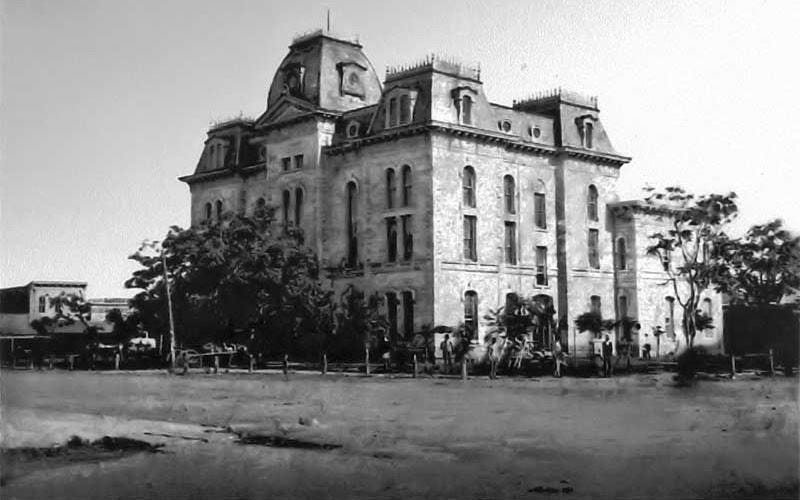
Williamson County Courthouse, 1878–1910, undated photograph. Williamson County, Texas, county history pages, “1870 to 1879, Part II” (wilcotx.gov/1641).
Old Town Echoes is independently researched using primary historical sources. AI tools assist in drafting and editing; all content is reviewed, sourced, and verified by the author.