

In April 1889, Georgetown claimed to The Austin Weekly Statesman that Georgetown had “the biggest if not the best mayor in Texas.”
Our town was not quite 50 years old and feeling very proud of itself.
The same article promised our mineral waters were second only to Carlsbad, Germany. It said our new chair factory could turn out 1,000 chairs a day. It described the Ladies’ Annex at Southwestern “sitting like a royal queen in the midst of her thirty acres of campus.” It counted seven church spires, three orderly saloons, and an ice factory keeping the whole city “cool and in a good humor.”
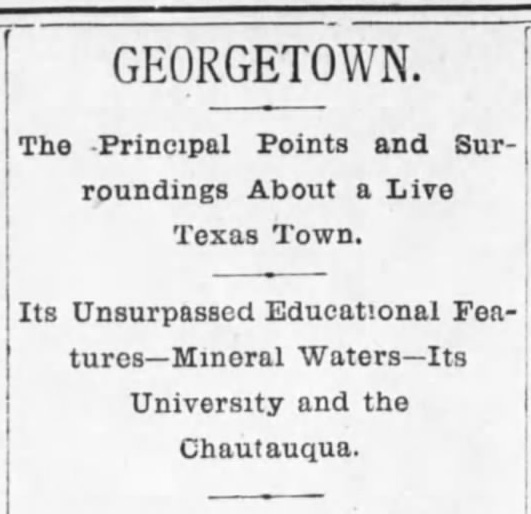
The entire article is nearly a full page in the Austin Weekly Statesman of April 18, 1889. I’ve referenced it before, but I want to share more of this historic snapshot of our little town.
What’s a Booster Shot?
I’m traveling this week, so I don’t have a Weekly Tea post for you. Hopefully I’ll be back in your inbox with one next weekend. But starting today, I’ll be posting Booster Shots on the Old Town Echoes Facebook page; these will be small doses of Georgetown’s booster press, each one a historic brag from a booster article that gives us a glimpse into the lives of our historic Georgetown neighbors.
Wait, the what press?
Booster journalism was its own genre in the 1880s. Papers ran glowing “special correspondence” about up-and-coming towns, written to catch the eye of investors, railroads, and restless families. They were part news, part chamber-of-commerce ad, part poetry. Our correspondent describes the San Gabriel’s forks as “the twin purling Gabriels, as they wind their poetic way” to the sea. He wasn’t being paid by the fact.
And therein lies the fun of it. A booster piece is typically two things: a description of what a town actually had, and a summary of what the town wanted others to believe about itself. In April 1889, Georgetown had both in abundance. The Texas Chautauqua had just accepted 200 acres and $10,000 to locate here, and the cornerstone of its first temple was laid that very week, with the Masonic Grand Lodge of Texas presiding. The town was literally dressed for company.
Familiar faces
Regular readers and local history buffs will spot old friends all through this article. John H. Leavell is here in his three-story building, “the first one to introduce lady clerks.” The law firm of Glasscock & Strickland appears in a list of lawyers reaching “out after hooks on fame’s ladder.” George Glasscock gets credit for donating the townsite. There’s a Chessher in the lawyer list. Other names familiar to those that pay attention to local history include F A Mood, George Irvine, Captain Emzy Taylor, M B Lockett, J. H. Hodges, W Y Penn, and J E Cooper, just to name a few.
That’s the other thing a booster piece turns out to be: a census of a whole town’s ambitions, frozen in one week of 1889. In this series you'll meet the chair factory man with his thousand chairs, the druggist with "a den of doctors above him," and the barber they called the immortal "Carl."
How to follow along
The Booster Shots will live on the Old Town Echoes Facebook page, so give it a follow if you haven’t. And if a friend sent you here, this newsletter is free and one click gets the Weekly Tea deep dives right to your inbox.
Source
"GEORGETOWN. The Principal Points and Surroundings About a Live Texas Town," Austin Weekly Statesman, 18 April 1889, p. 10; digital images, Newspapers.com.
Old Town Echoes is independently researched using primary historical sources. AI tools assist in drafting and editing; all content is reviewed, sourced, and verified by the author.