


On June 19, 1906, the city marshal of Georgetown walked into a justice of the peace’s office and filed perjury charges against the Williamson County sheriff. He didn’t want to be there. The justice didn’t want to take the complaint. The whole thing was, in the marshal’s telling, a job nobody else would do… and it was all over $4.00. To understand how a $4.00 mileage dispute turned into a perjury charge, I need to introduce Sam Connell.
The Sheriff
Sheriff Sampson Connell III had held the office, on and off, since 1888, and by all accounts was a popular figure. One Leander correspondent would later describe him as “big-hearted, big-bodied Sam Connell.” By the summer of 1906 he was seeking his fifth consecutive term since returning to office in 1898.
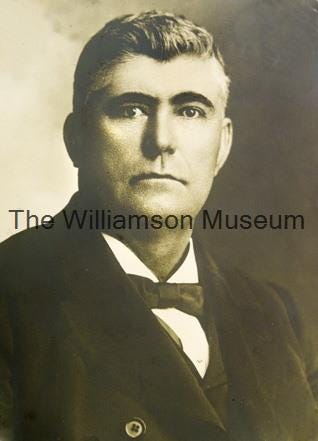
He was also, in a very real sense, a son of the Republic. His grandfather, Sampson Connell Sr., was a War of 1812 veteran who, family tradition holds, served with the Texas Army as a wagonmaster during the Battle of San Jacinto, later receiving a Republic of Texas land grant for his service. His father, Sampson Connell II, came of age during the Republic years and was recognized as a Citizen of the Republic of Texas for the period 1836–1846; a bronze DRT plaque marks his headstone at the Connell Cemetery at Bear Creek, near Liberty Hill. The sheriff’s family name was one of the closest living links Williamson County voters had to the founding of the state.
According to a group of Georgetown citizens who called themselves “the committee,” he was also a grafter (a word commonly used at the time to describe a corrupt person, swindler, or someone who made money through dishonest means, particularly through the abuse of political or official influence).
Specifically, they accused him of padding his mileage. When his deputies served subpoenas out in the county, Connell submitted accounts to the county charging for miles that, the committee alleged, nobody had actually traveled. The sums involved were not exactly Watergate-level scandalous. One of the two perjury complaints centered on $4.00 in mileage. But the principle, they insisted, was the thing.
So, they did what any reasonable group of concerned citizens would do in 1906: they started publishing articles about it in the newspaper.
Meet the papers
Georgetown had at least two papers at the time: the Williamson County Sun was the establishment paper, and the Georgetown Commercial was... another one. The committee’s articles ran in the Commercial under the heading “Public Issues,” signed by various citizens, laying out the case against Connell.
For what it’s worth, the Commercial does not appear to have enjoyed a sterling reputation for fairness outside Williamson County. In July 1906, right in the middle of the Connell fight, the Houston Chronicle ran a piece titled “Fairness in the Campaign” accusing the Commercial of doctoring its coverage of a political speech. The Chronicle noted, with some amusement, that the Commercial was in the habit of boasting that it was “the fairest journal in the whole state of Texas.”
Maybe this tells us something about the paper the committee chose as its venue.
Here’s where it gets spicy. When the committee tried to place the same articles in the Sun, the Sun said sure… but you’ll have to pay for them as advertising.
The Sun’s editor explained his position, the 1906 equivalent of “we don’t do sponsored content”:
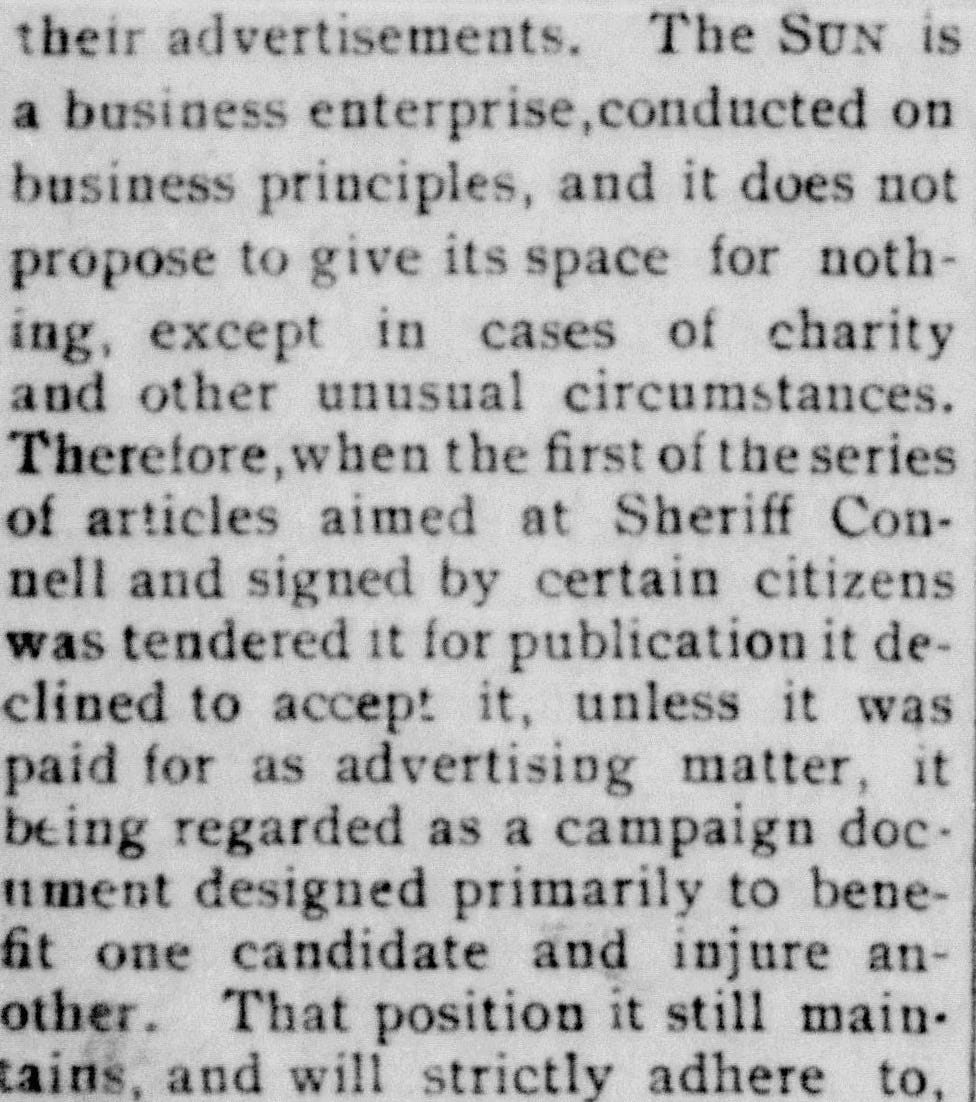
Translation: We see what you’re doing, and we’re not doing it for free.
The committee declined to pay the Sun, so the attacks ran in the Commercial, and the Sun maintained what it called “non-interference.”
“Fair Play” writes in
On June 14, the Sun published a letter from Leander titled “The War on Connell.” It was signed “Fair Play” and it made an argument that will sound familiar to anyone who has ever watched a political scandal break in an election year:
If Sam Connell has been grafting, and these “dictators” have known about it for so long, why didn’t they go to the grand jury months ago? Why did they wait until he announced for re-election and then “explode their bomb” mid-campaign? The timing gives the scheme away.

Fair Play had a point; it’s the same point every politician in history has made when opposition research drops in October.
The reluctant city marshal
A week later, the committee made their move. On Tuesday, June 19, City Marshal R.Y. Secrest of Georgetown walked into Justice of the Peace W.T. Starnes’s office and filed two perjury complaints against Sheriff Connell.
The two complaints covered separate subpoena accounts Connell had submitted to the county back in August 1905, both for witnesses in the R.W. Thompson murder case. The first alleged he’d falsely sworn to $4.00 in mileage for 80 miles Deputy Bauchman supposedly traveled to serve three witnesses. The second alleged he’d falsely sworn to $7.50 in mileage for 150 miles Deputy F. T. Turner supposedly traveled to serve five more. Combined, the committee was alleging about $11.50 in padded mileage, though only the first complaint — the $4.00 Bauchman account — would eventually carry the indictment into court.
Justice Starnes, apparently unable to contain himself, immediately told the Sun reporter that Secrest “acted very reluctantly, and that he would not have appeared as complainant had anyone else been found willing to do so.” Starnes also revealed that the committee had told him directly: if you refuse to receive these complaints, we’ll go to some other peace officer, and then we’ll tell the public you failed to do your duty.
So. The city marshal didn’t want to file. The justice of the peace didn’t want to receive them. The committee was essentially going door-to-door in the county courthouse trying to find someone, anyone, willing to pull the trigger.
Connell showed up the same afternoon, waived examination, posted $500 bond on each complaint, and went back to work.
Connell answers his accusers
The following week, on June 28, 1906, the Sun ran Sheriff Connell’s response. And when I say “ran his response,” I mean it in the most literal possible sense: Connell’s letter took up the entire front page of the paper. All six columns. Every inch. Then it continued onto page 8 and took up that entire page too — six more columns, top to bottom. Twelve full newspaper columns across two full pages, devoted to one man’s defense of himself.
This is more than a tweet thread or even a blog post. This is small-town equivalent of taking out a two-page spread in the New York Times.
The detail that makes the whole thing sing? It ran as a paid advertisement. Remember the Sun’s editorial from two weeks earlier, the one where the editor declared that any campaign material from either side would have to be paid for at regular advertising rates? Connell paid. The committee had refused to pay to run their "Public Issues" articles in the Sun and had taken them to the Commercial instead. Connell bought twelve columns. Whatever the merits of his defense, the man was willing to put his money where his mouth was in a way his accusers evidently were not.
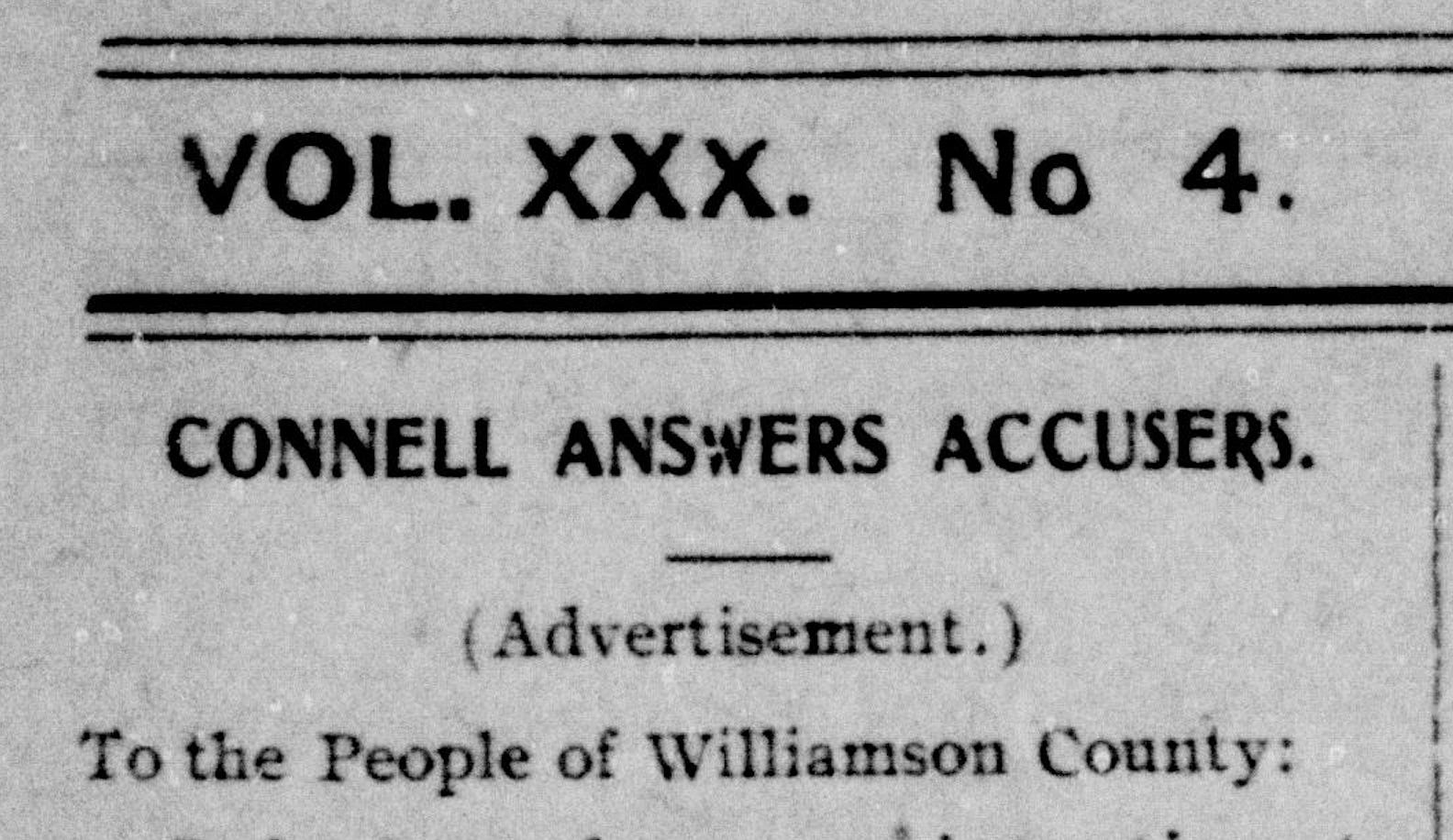
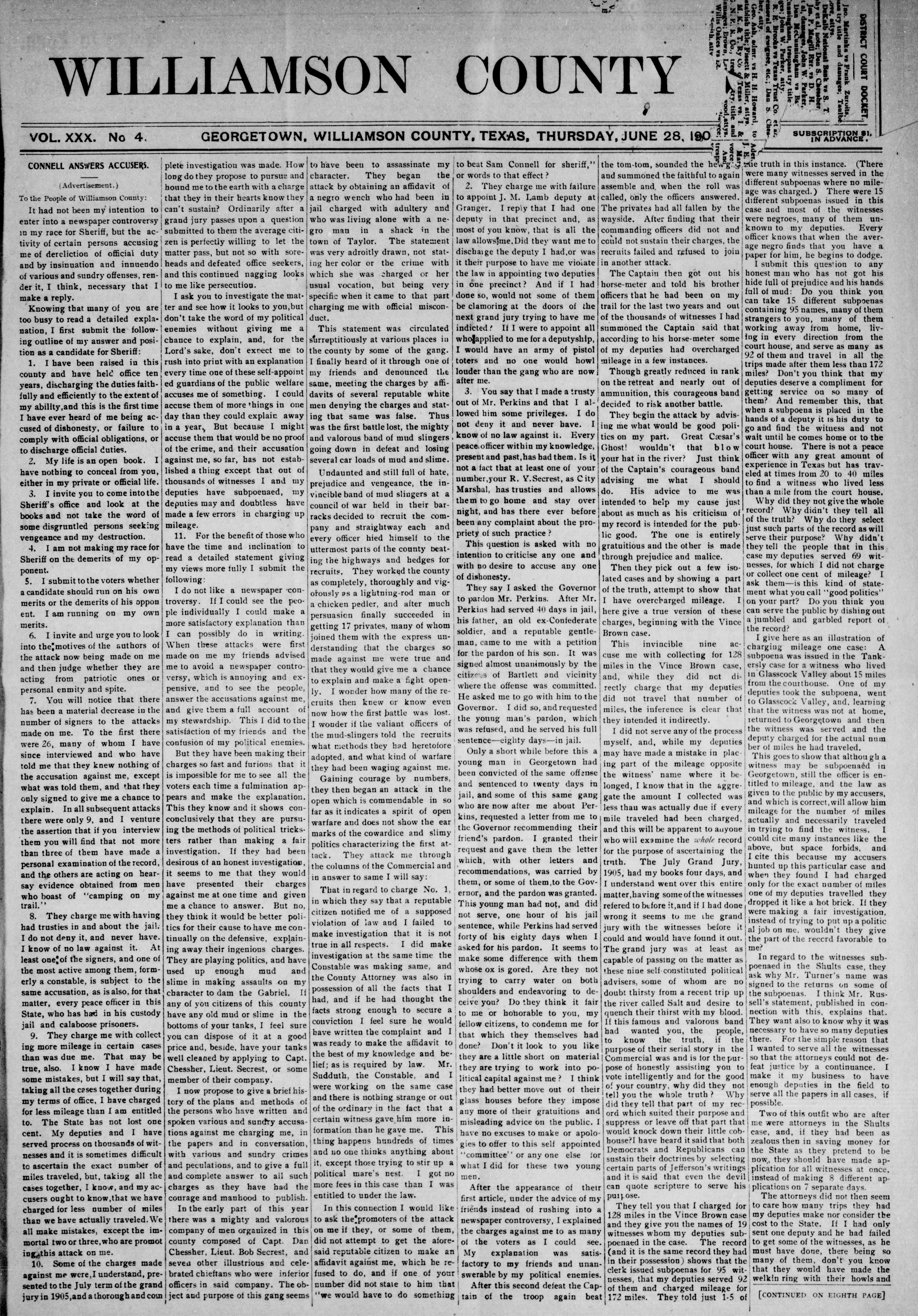
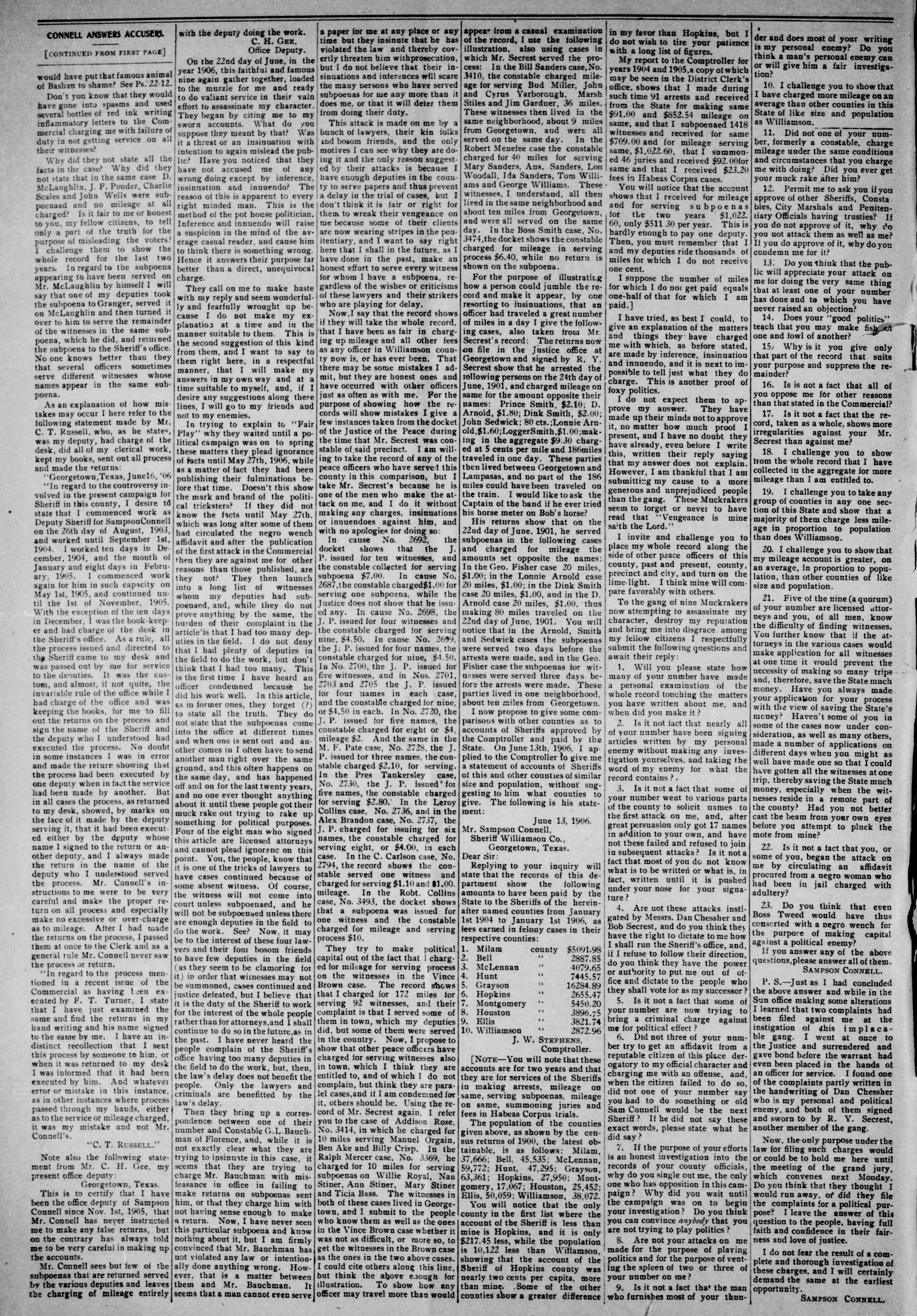
As for the content of those twelve columns: Connell’s argument was, essentially, my deputies did the actual traveling, I signed the accounts based on what they told me, if there are errors they’re honest ones, and they’re the deputies’ fault anyway because I’m not “morally or legally responsible” for their mistakes. He also spent a considerable amount of ink on the theory that the whole thing was a political hit job — noting, pointedly, that the committee had sat on their complaints for months and only acted once the campaign was underway.
And he didn’t write the letter alone. At the top of page 8, the defense continues with an included statement from Connell’s Office Deputy — the man who kept the books, compiled the accounts, and handled the paperwork the committee was attacking. His name was C. H. Gee.
The reluctant grand jury
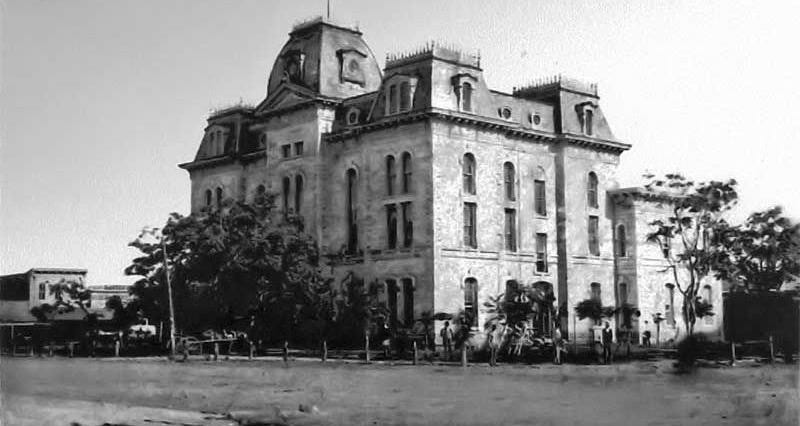
District Court opened its summer term on Monday, July 2, with Judge V.L. Brooks on the bench and a grand jury of twelve men impaneled.
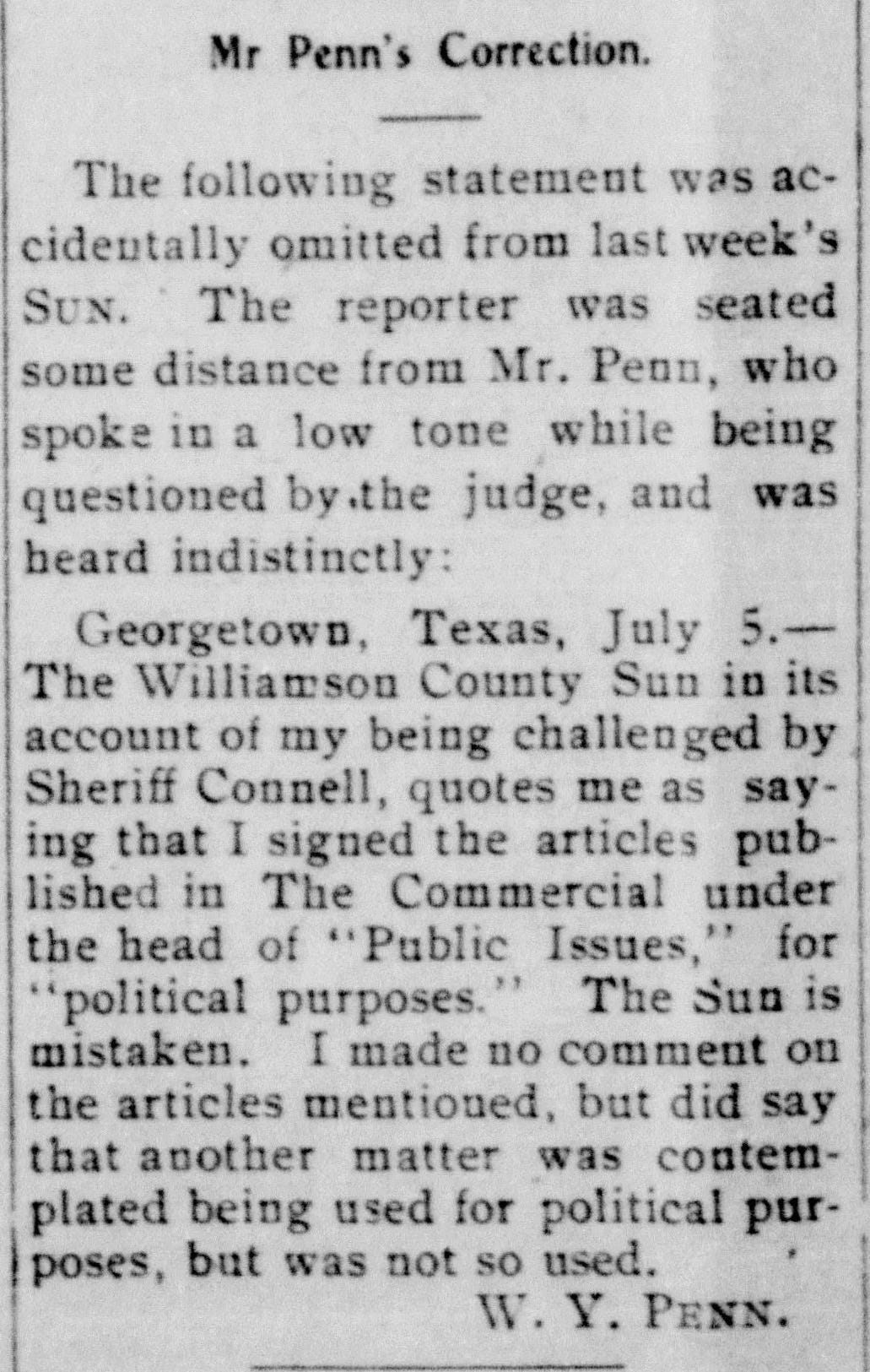
Almost immediately, the sheriff’s lawyers challenged one of the grand jurors, W.Y. Penn, on the grounds that he was prejudiced. Connell handed the judge a written challenge alleging Penn had signed some of the Commercial articles.
Penn, under questioning, was reported to have admitted it. The judge asked if he’d signed them for “a political purpose.” Penn said yes. The judge excused him.
Penn would write in the next week to correct the record.
With Penn gone, the grand jury went to work. Remember the neutral paper, the one that wouldn’t take sides? When the indictment came down on Saturday, July 14, the Sun reported not just the indictment but the street talk about how it had been obtained:
It is street talk that the required nine of the grand jury to find a true bill were difficult to secure, that three of the members held out to the last, and that the ninth man’s consent was not obtained until Saturday morning.
In other words: the grand jury nearly didn’t do it. They barely got to nine. And the paper that wasn’t taking sides felt compelled to report that.
The indictment falls apart
The indictment charged perjury — specifically, that Connell had sworn falsely to an account for serving subpoenas in the Thompson murder case, to the tune of $5.50, of which $4.00 was mileage.
It lasted about ten days.
District Attorney Moore looked at the document, which had been drafted not by him but by County Attorney Jim Neal, working with “a member of the committee,” and immediately spotted problems. He asked Judge Brooks to reconvene the grand jury to fix it. The grand jury reconvened. A new indictment was returned on July 14.
That one didn’t survive either. On July 23, Connell’s attorneys moved to quash. The motion laid out all the ways the indictment was defective. The indictment didn’t actually say Connell was sheriff when the alleged perjury happened, didn’t say the account was false, and didn’t say the mileage was actually excessive — three fairly important things to leave out of a perjury indictment.

District Attorney Moore agreed with three of the defense’s four points. Judge Brooks quashed the indictment. The crowd that had gathered to watch “slowly dispersed.”
And then the Sun, which was definitely neutral, dropped the following in its coverage of the quashed indictment:
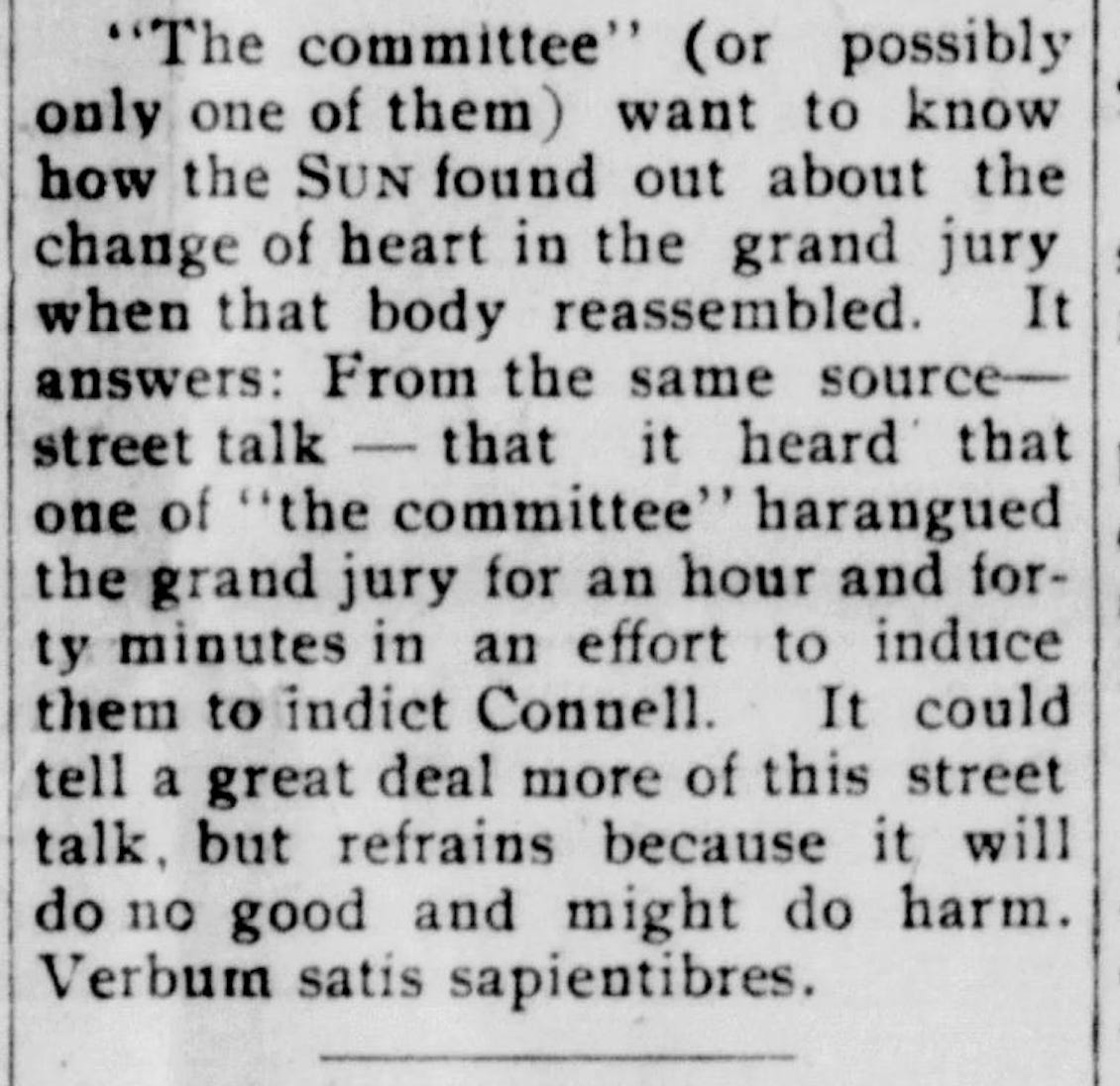
That last phrase is Latin for “a word to the wise is sufficient.” The Sun is saying, on the record: We want it known that we know a lot more than we’re telling you but we’re choosing not to say it.
The paper also used the occasion to clear up a small matter: the committee had apparently been denying that one of their own helped draft the indictment. The Sun named names. It wasn’t County Attorney Jim Neal who’d done the drafting alone, Dan Chessher, former County Attorney and a member of “the committee,” drafted two-thirds of the indictment. Chessher, to my knowledge, never responded in print.
The voters decide
The voters rendered their own verdict on Saturday, August 4, 1906, in the Democratic primary — which in Texas at the time was the real election. The official count ran in the Sun on August 9:
Sampson Connell: 2,156 votes
C.J. Brady: 1,586 votes
Connell’s majority: 570
The Leander correspondent, writing the following week, summed it up:
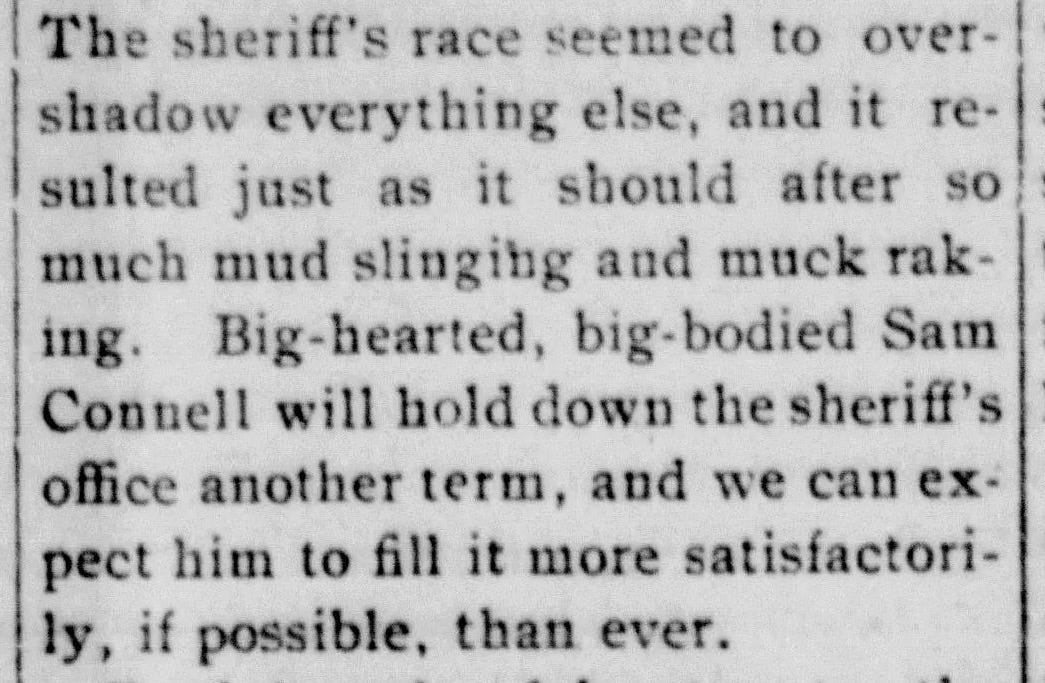
This is the part where I’d love to tell you there was a dramatic trial, a stirring verdict, a resolution of some kind. There wasn’t. After the July 23 quash, the perjury case seems to have evaporated. I can find no evidence it was ever refiled. The committee appears to have given up, or run out of willing complainants, or both. The scandal didn’t sink Sheriff Connell. It may have helped him.
It’s worth remembering, too, what the committee was actually asking voters to do. They were asking them to throw out a man who had been the voters’ personal choice for sheriff in four prior elections, whose father and grandfather had helped build the Republic of Texas, over $4.00 in disputed mileage charges. Four dollars in 1906 was about two days’ wages — real money, but not sheriff-unseating money. Whatever the merits of the mileage accounting, that was a hard sell, and the vote totals suggest the voters weren’t buying.
The lesson, if there is one
If you swap out the newspapers for Twitter and “the committee” for a group chat, this story is completely contemporary. Everything that makes modern political scandals feel exhausting and familiar was already fully operational in 1906:
The opposition research drop timed to the campaign. Fair Play was right: the committee had been sitting on this for months.
The friendly newspaper and the hostile newspaper, each pretending to be the objective one. The Sun genuinely believed it was being neutral while running Connell’s defense on page 1 and dropping Latin subtweets about the grand jury.
The reluctant witness pressured into going on the record. R.Y. Secrest did not want to file those complaints. The committee pressured him.
The corrections and clarifications from people who felt misquoted. W.Y. Penn’s “the reporter was seated too far away” is every politician who has ever said “the clip was taken out of context.”
The pseudonymous letter to the editor defending the embattled official. Every single comment section on every local news site. “Fair Play” would have a blue checkmark today.
The indictment that falls apart on technicalities and gets quietly dropped. Sounds familiar.
The base rallying around the accused in defiance of the charges. Connell ran up his biggest margin ever after being indicted. The committee’s campaign against him was, in the end, the best thing that ever happened to his vote totals.
And the best part? The whole thing played out not on smart phones or in feeds but in weekly newspapers read by people who knew each other in person, passed on the street, traded at the general store, and argued with each other after church on Sunday.
The medium changes over time, but small-town drama doesn’t change.
A footnote on the paper
One last thing, because I couldn’t resist. The Georgetown Commercial — the paper the committee chose as its venue, the paper the Houston Chronicle caught doctoring political speeches in July 1906, the paper that existed specifically to be the Sun‘s scrappy alternative — did not outlast Sheriff Connell’s political career for too long.
On November 30, 1918, the Taylor Daily Press ran a short item under the heading “Newspaper Changes”:
“Georgetown Commercial: A deal was closed this week wherein the Georgetown Commercial was sold to the Georgetown Sun Publishing Company, and the two plants will be consolidated. Next week’s issue of the papers will be under one management, the subscriptions and business interest consolidated.”
Two weeks later, on December 13, 1918, the Williamson County Sun came out with a new line on its masthead: “CONSOLIDATED WITH THE GEORGETOWN COMMERCIAL.” The Commercial, established 1897, had been bought by the paper it had spent its early years competing against.
Newspaper consolidations happen for all sorts of reasons — economics, changing readership, an aging owner wanting out. But I do think it’s worth noting which paper was still standing in 1918, and which one got folded into the other.
Sam Connell, for his part, served another term. And another after that. The courthouse where the perjury indictment fell apart was torn down in 1910 and replaced by the one that still stands in the middle of the Square today; if you walk past it now, you’re standing on the same ground where, 120 summers ago, a crowd gathered to watch a case against their sheriff collapse and then dispersed to go home and gossip about it over dinner.
What came next
Sam Connell’s 1906 victory was not his last. He served several more terms as sheriff and in 1914 was elected to represent Williamson and Burnet counties in the Texas Legislature.
But the story doesn’t quite end there, not in a small town.
Remember C. H. Gee, Connell’s Office Deputy, the man who co-signed the paid defense on June 28, 1906? He would later go on to become Williamson County District Clerk. He was also the father of Hays Gee, whose story I told in The Many Lives of Hays Gee. And Sampson Connell’s granddaughter, Halsey Virginia Davis — daughter of Connell’s daughter Beulah Virginia and Tax Collector Halsey Davis — would grow up to marry Charlie Gee, Hays Gee’s son. Which means that the sheriff and his office deputy would, two generations later, share great-grandchildren.
The small world of historic Georgetown keeps getting smaller.
As with most of our historic neighbors, I found that there’s more to Sampson Connell’s story than the 1906 smear campaign, including what happened in the strange, quiet months between his legislative election and his death, and what the newspapers chose not to print about either. We’ll dive into that next week.
Thanks for reading Old Town Echoes! Subscribe for free to get new posts and support my work.
Sources & Research Notes
Sampson Connell’s Background
Clara Stearns Scarbrough, Land of Good Water: A Williamson County, Texas, History (Georgetown: Williamson County Sun Publishers, 1973), p. 80.
Find a Grave, memorial for Sampson Connell II (1822–1873), Connell Cemetery at Bear Creek, Liberty Hill, Williamson County, Texas, memorial ID 34009655; database with images, Find a Grave (findagrave.com : accessed 16 April 2026), photograph by Smilydino; notes the bronze DRT plaque reading “Citizen of the Republic of Texas, 1836–1846.”
“Sampson Connell” (Family Story), contributed by Ancestry user cheryl77581, 21 June 2008; Ancestry (ancestry.com : accessed 16 April 2026). The contributor’s account attributes the San Jacinto wagonmaster service and subsequent Republic of Texas payments to Sampson Connell Sr. (the sheriff’s great-grandfather), citing Audited Military Claims and General Land Office records at the Texas State Archives, and the War of 1812 muster rolls at the Tennessee State Archives.
“Sheriffs of Williamson County, Texas,” in Williamson County Historical Commission Scrapbook, Volume 3 (Georgetown: Williamson County Historical Commission, 1975); digital PDF, Williamson Museum (https://williamsonmuseum.org/wp-content/uploads/2025/02/WCHC-Scrapbook-Vol-3-1975-reduced-Size.pdf : accessed 16 April 2026). Lists Sampson Connell as sheriff from 1888–1890 and again from 1898–1912.
“Death of Sampson Connell,” The Williamson County Sun (Georgetown, Texas), 14 January 1915, p. 1; digital image, Newspaper Archive (newspaperarchive.com : accessed 16 April 2026).
The Papers Themselves
“Fairness in the Campaign: Houston Chronicle Report Was Distorted by Georgetown Paper,” The Houston Chronicle (Houston, Texas), 17 July 1906, p. 8; digital image, Newspapers.com (newspapers.com : accessed 13 April 2026).
“Newspaper Changes” [Georgetown Commercial sold to Georgetown Sun Publishing Company], Taylor Daily Press (Taylor, Texas), 30 November 1918, p. 4; digital image, Newspapers.com (newspapers.com : accessed 13 April 2026).
The Williamson County Sun masthead, 13 December 1918, reading “Consolidated with the Georgetown Commercial”; digital image, Newspaper Archive (newspaperarchive.com : accessed 13 April 2026).
The “Public Issues” Controversy & Perjury Case
“The War on Connell,” The Williamson County Sun (Georgetown, Texas), 14 June 1906, p. 1; digital image, Newspaper Archive (newspaperarchive.com : accessed 12 April 2026).
“As to the Sheriff’s Race,” The Williamson County Sun (Georgetown, Texas), 14 June 1906, p. 4; digital image, Newspaper Archive (newspaperarchive.com : accessed 12 April 2026).
“Complaints Filed Against Sheriff Connell,” The Williamson County Sun (Georgetown, Texas), 21 June 1906, p. 7; digital image, Newspaper Archive (newspaperarchive.com : accessed 12 April 2026).
“Connell Answers Accusers,” The Williamson County Sun (Georgetown, Texas), 28 June 1906, pp. 1, 8; digital image, Newspaper Archive (newspaperarchive.com : accessed 4 April 2026).
“Indictment of Sheriff Connell,” The Williamson County Sun (Georgetown, Texas), 28 June 1906, p. 11; digital image, Newspaper Archive (newspaperarchive.com : accessed 12 April 2026).
“The District Court” [including “Challenging a Juror” and “The Judge’s Charge”], The Williamson County Sun (Georgetown, Texas), 5 July 1906, p. 1; digital image, Newspaper Archive (newspaperarchive.com : accessed 12 April 2026).
“Mr Penn’s Correction,” The Williamson County Sun (Georgetown, Texas), 19 July 1906, p. 2; digital image, Newspaper Archive (newspaperarchive.com : accessed 12 April 2026).
“Connell Indictment Quashed,” The Williamson County Sun (Georgetown, Texas), 26 July 1906, p. 1; digital image, Newspaper Archive (newspaperarchive.com : accessed 12 April 2026).
The Election
“Leander Locals,” The Williamson County Sun (Georgetown, Texas), 2 August 1906, p. 1; digital image, Newspaper Archive (newspaperarchive.com : accessed 13 April 2026).
“Primary Election Returns” [official count, 4 August 1906], The Williamson County Sun (Georgetown, Texas), 9 August 1906, p. 8; digital image, Newspaper Archive (newspaperarchive.com : accessed 13 April 2026).
Connell–Gee Family Connections
“Kilgore Bride,” The Shreveport Journal (Shreveport, Louisiana), 15 August 1936, p. 11; digital image, Newspapers.com (newspapers.com : accessed 16 April 2026).
Images
“Williamson County’s 4th Courthouse, 1878–1910,” photograph, Williamson County Historical Commission, Georgetown, Texas.
Photograph of Sheriff Sampson Connell, Williamson Museum, Georgetown, Texas.
Research Note
The Georgetown Commercial‘s “Public Issues” series, which carried the committee’s original allegations against Sheriff Connell, does not appear to survive in any digital collection. The available run of the Commercial begins in 1907, and no physical holdings have been located for the relevant 1906 issues. Consequently, the committee’s specific charges are known only through Connell’s rebuttal in the 28 June 1906 issue of the Sun and through the Sun‘s own summary coverage.
Old Town Echoes is independently researched using primary historical sources. AI tools assist in drafting and editing; all content is reviewed, sourced, and verified by the author.
Amazing read! Thank you for all your hard work.