


Yes, I know. It's called the Weekly Tea, and yet here we are, my first post in a month. Consider this the cup that took a while to steep. Two things kept me: this story is far bigger than I expected, and also a Preservation Georgetown project took up most of my available research hours. I'm not ready to spill that one yet, but soon. For now, pour yourself something warm, because this is an interesting one.
Content note: This story discusses suicide in a historical context.
The city was shocked Tuesday morning.
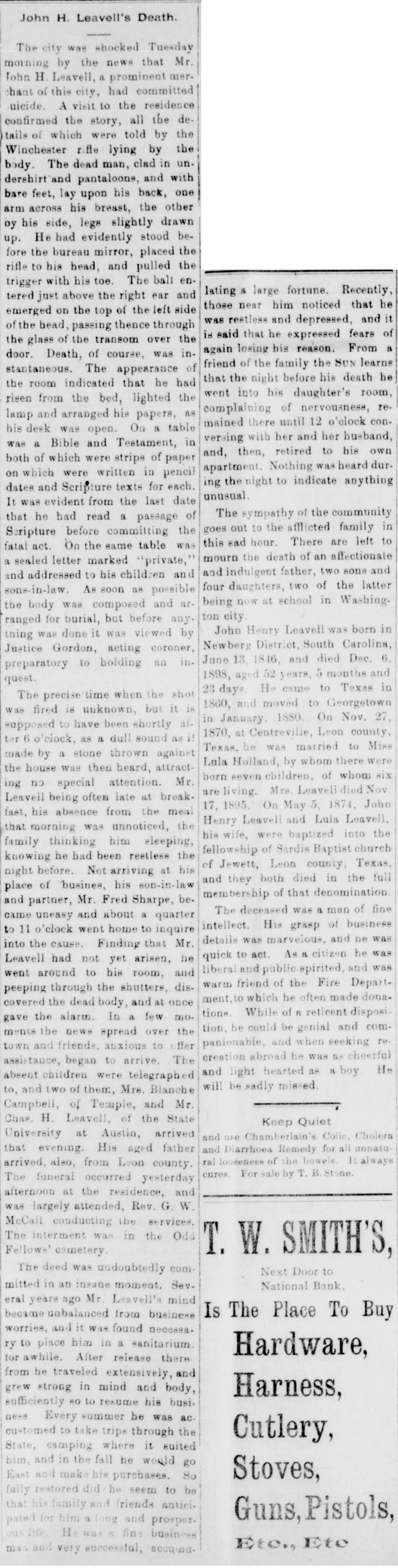
That was how the Williamson County Sun began its account on December 8, 1898. John H. Leavell, one of Georgetown’s most prominent merchants, was dead by his own hand. He had risen early that morning, lit the lamp at his desk, opened a Bible and a Testament, and arranged his papers. On the table beside him lay a sealed letter, addressed to his children and sons-in-law, marked “private.”
He was 52 years old. He left behind six children, an aged father, two mercantile businesses, a fortune in land and promissory notes, and a house on College Street that still stands today.
The Leavell House was one of the first historic homes I researched when I moved to Georgetown in 2023. I wasn’t the Historian for Preservation Georgetown yet, just fascinated by the old homes. Everyone recognizes the huge Queen Anne on College, and the town definitely has opinions about the more recent renovations. When I dove into the research, one of the first things that caught my attention was a line in an article covering that renovation, a passing mention that subsequent owners never seemed to stay for long. That told me the house had a story, and it turned out to be a bigger one than I expected.
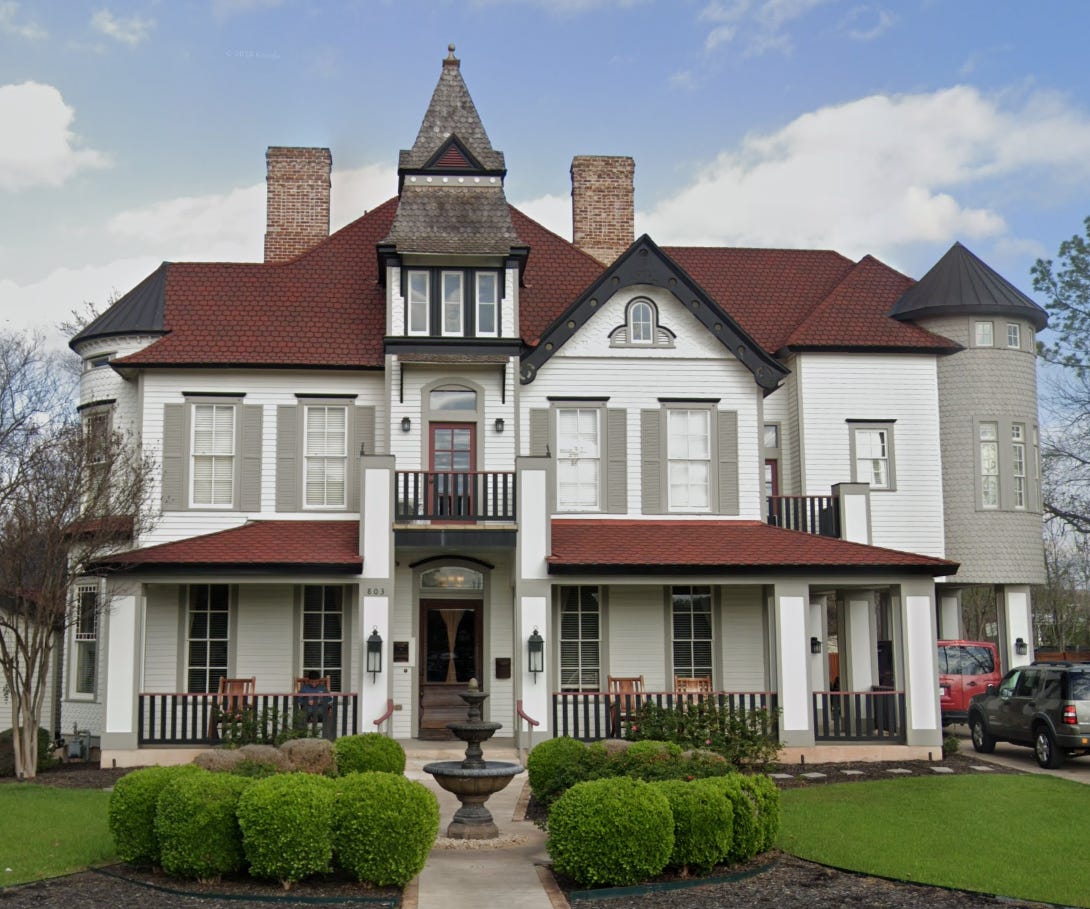
The House at the Foot of 8th Street
To find the start of the house’s story, we need to go back to the year it went up. In January 1880, a merchant named John Henry Leavell arrived in Georgetown with his household. He had come a long way to get there. Born in Newberry District, South Carolina, in 1846, he crossed into Texas as a boy of fourteen and grew up in Leon County, where he married Lula Holland in 1870. Six of their seven children lived. By the time the family reached Georgetown, the railroad had been in for three years and the town was on the rise.
That spring, Leavell paid C.A.D. Clamp $325 for a pair of bare lots at the foot of 8th Street, across College from the original grounds of Southwestern University, and built on them, of cypress, the house that still anchors the corner. Stand on the Square today and look east down 8th, and the house is there at the end of it, framed by the street and closing the view. It was not the house we know today. The earliest photographs of it, taken in 1886, show a tall two-story Victorian without the distinctive third-floor tower rising over the entry that we are familiar with today.
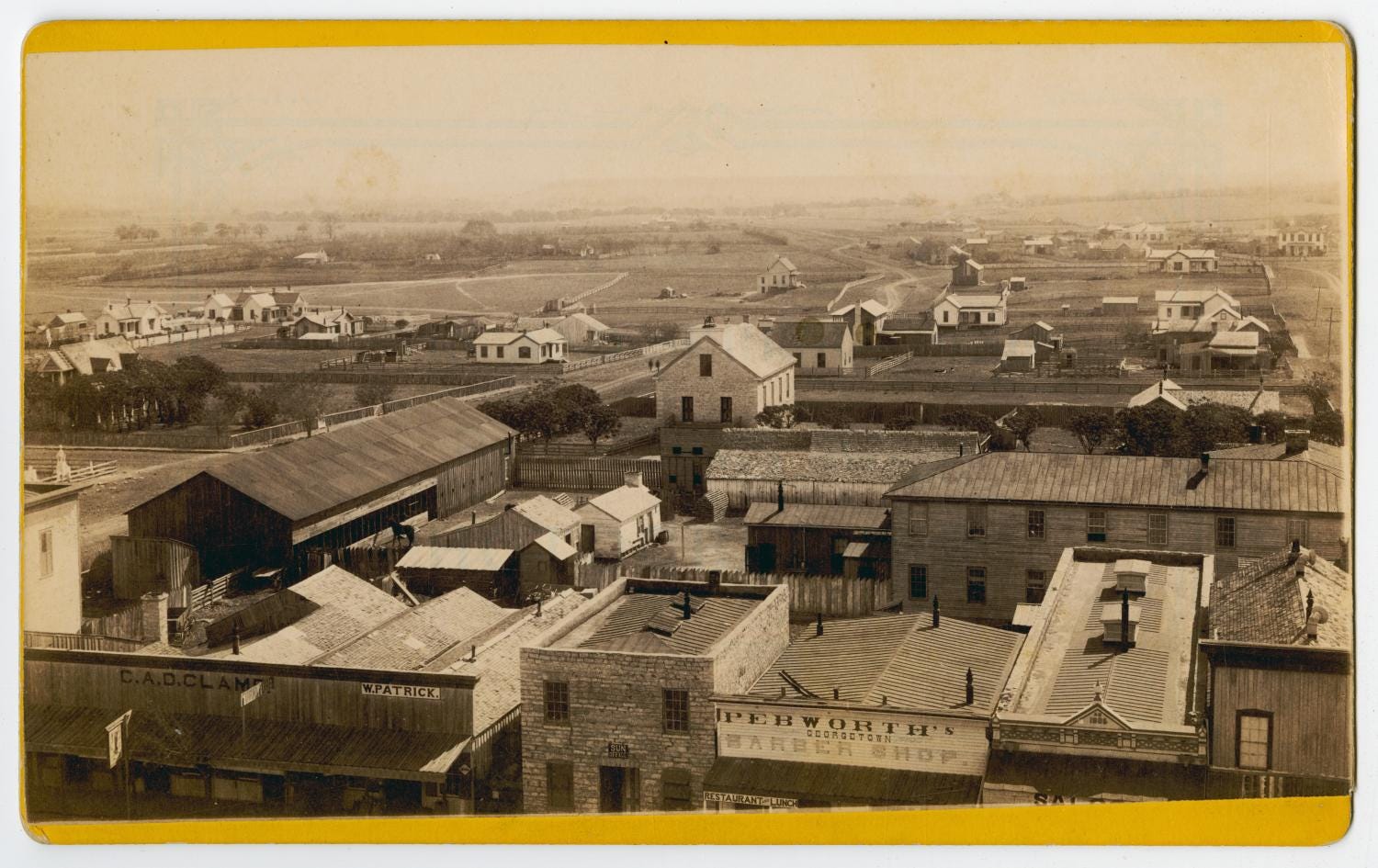
Do you see it? No? I didn’t see it at first either, but it’s there in the far back right corner.
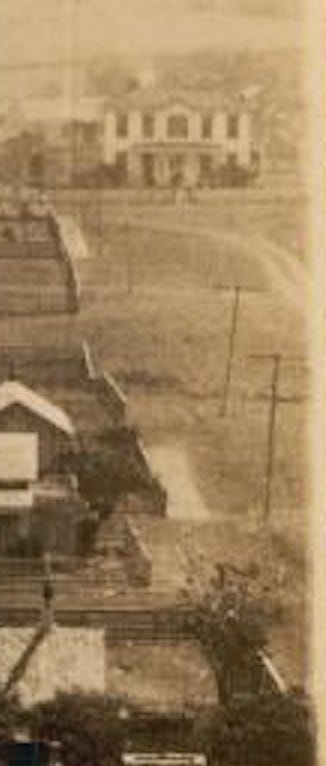
The house can also be seen in the 1886 photo below, looking northeast from the roof of the preparatory school that stood where the GISD Hammerlun Center is today.
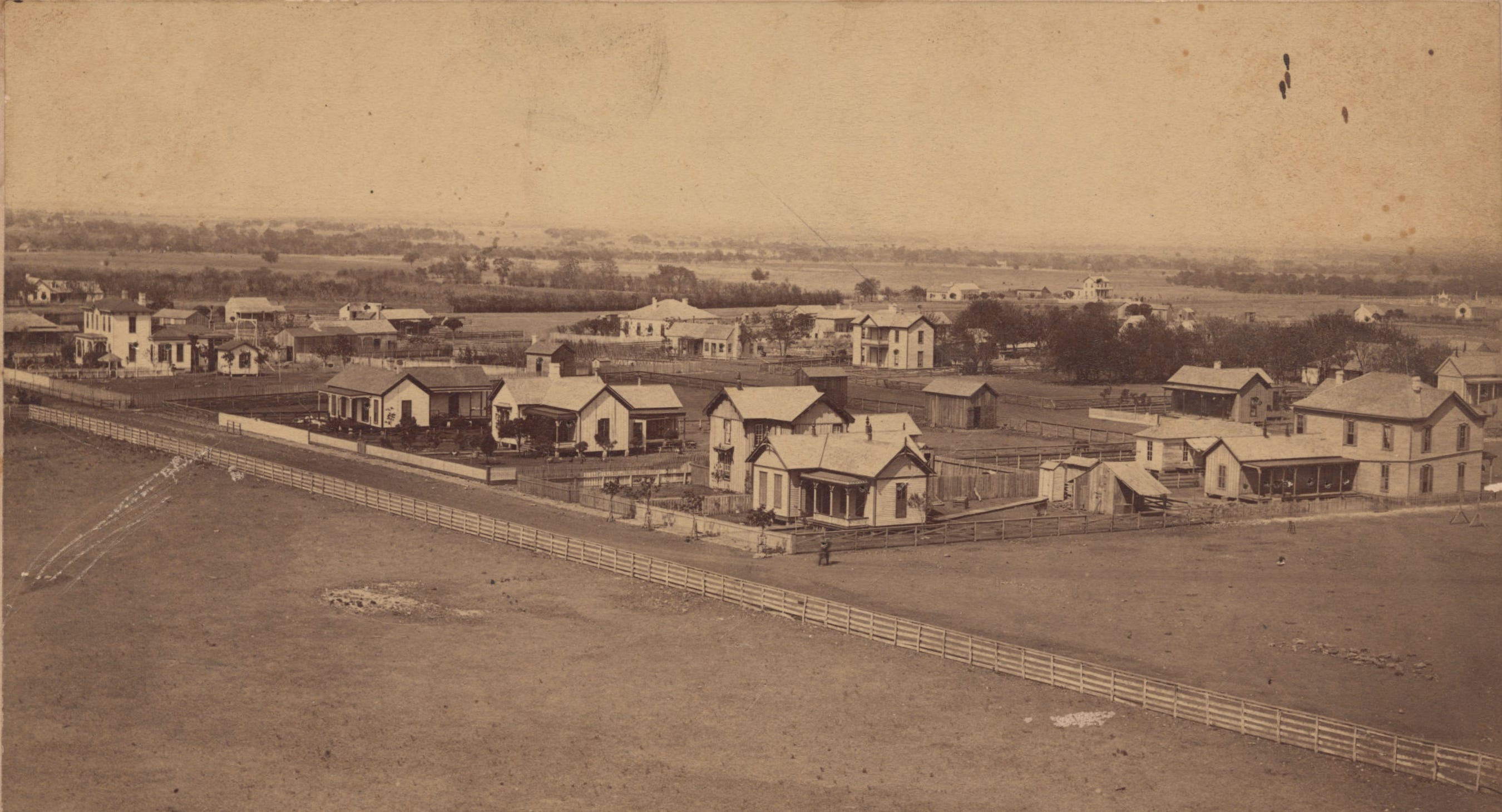
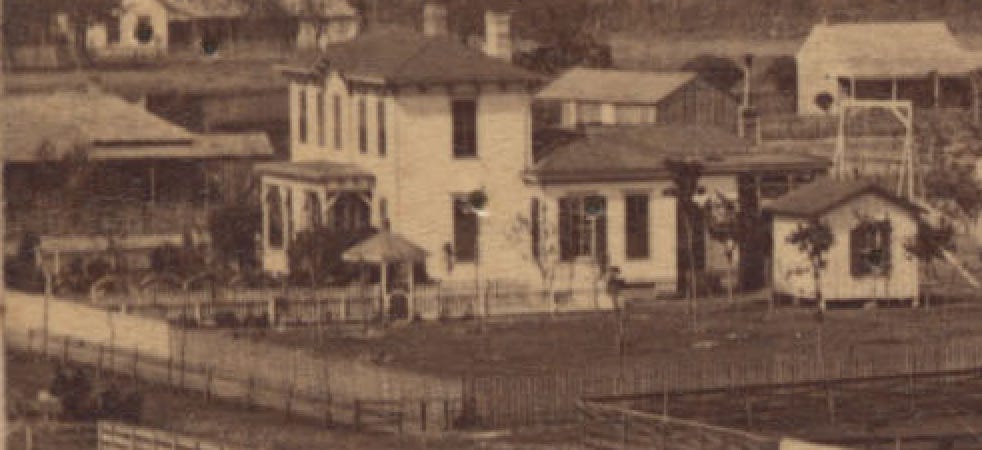
The house stood behind the picket fence nearly every Georgetown house kept against the animals that would wander the streets. The fuller life of the house, its architecture, and the families who came after the Leavells, will come later. For now it is enough to know that Leavell built big, and built to last, in his first year in town.
The Rise of a Merchant
John Leavell arrived in Georgetown at a moment when the town was transforming. The International-Great Northern Railroad had reached Georgetown in 1878, and by 1880 the population was approaching 3,000, the Square was filling up with limestone commercial buildings, and Southwestern University had recently opened. It was a place where an ambitious merchant could build something.
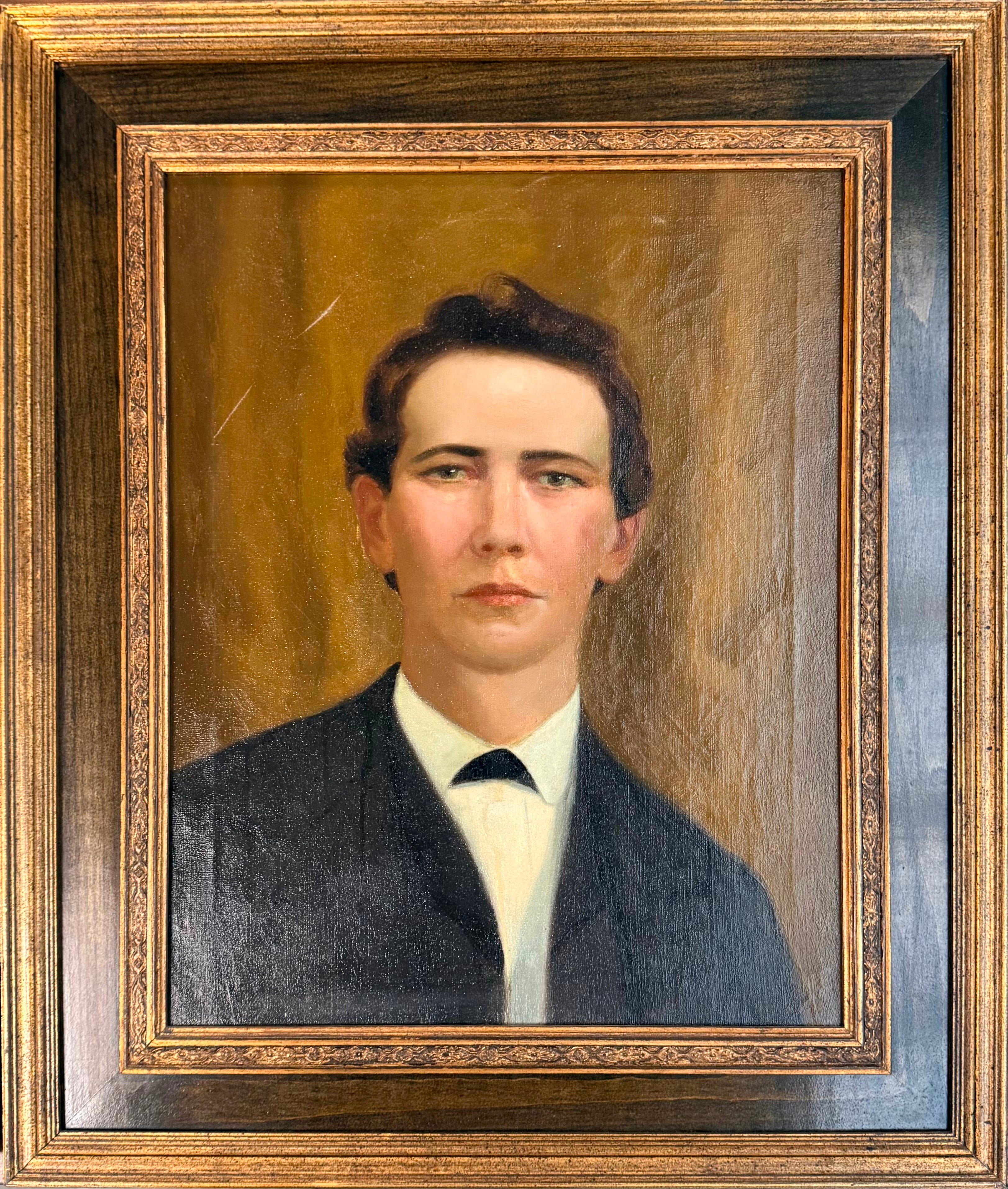
He did. By the spring of 1880, barely months after arriving, Leavell was already advertising in the Williamson County Sun: “Jno. H. Leavell, Wholesale and Retail Dealer in General Merchandise. Also, Regular Cash Buyer of Hides, Cotton, Wool, Ets.” That first ad ran in May 1880. By December, his advertisements had grown bolder and more playful, filling columns with itemized lists of goods and prices under the headline “GET OFF THE SIDE WALK!!! Into Jno. H. Leavell’s Store!!!! And Buy.”
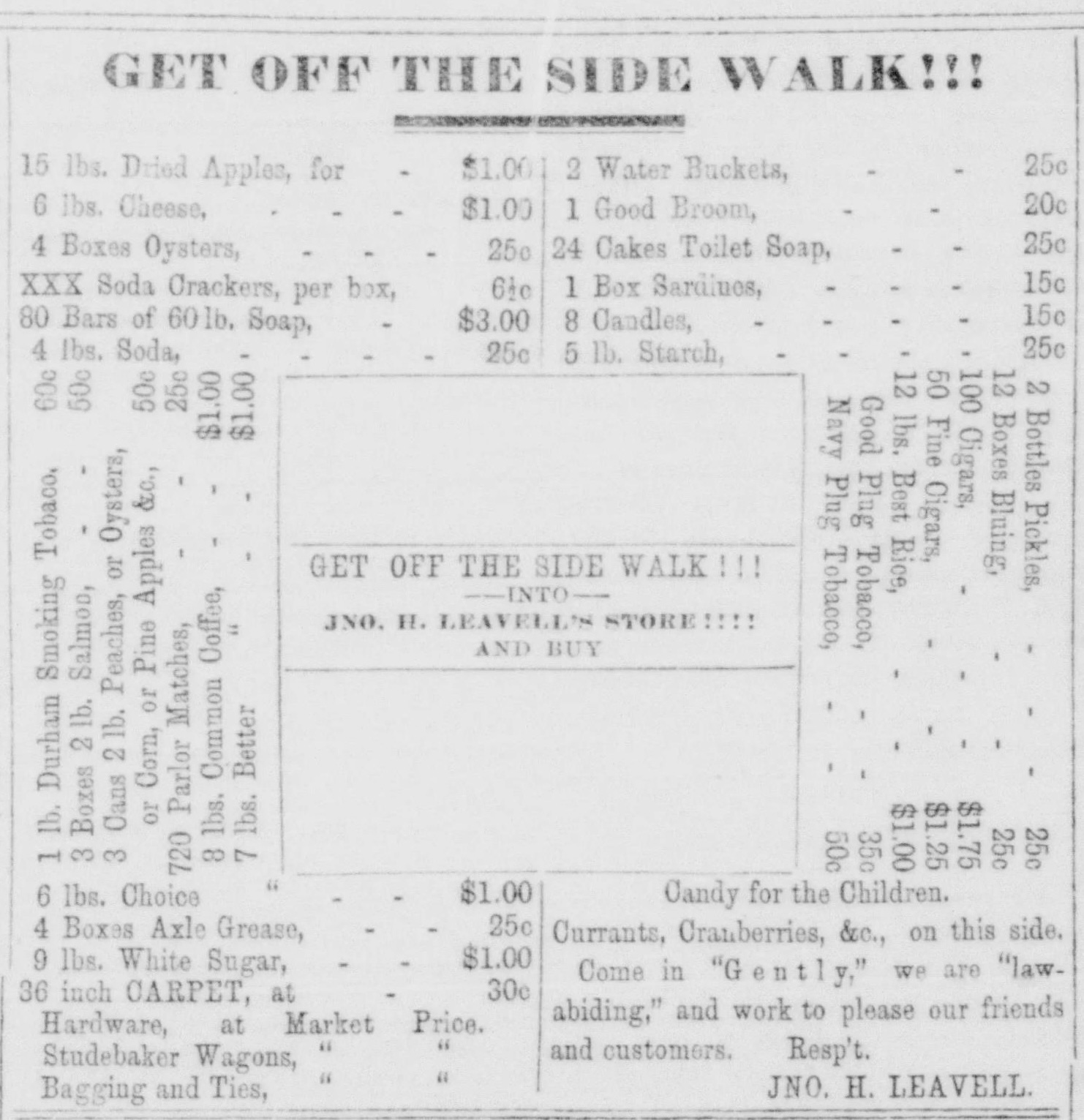
He sold everything. Dried apples, cheese, oysters, soda crackers, soap, carpet, hardware, tobacco, candy for the children. His ads made it clear he was competing on price and personality both, closing with lines like: “Come in ‘Gently,’ we are ‘law-abiding,’ and work to please our friends and customers.”
In April 1889, the Austin Weekly Statesman ran a long booster-style feature titled “GEORGETOWN: The Principal Points and Surroundings About a Live Texas Town,” cataloging the city’s hotels, churches, mineral waters, university, and merchants for Austin readers who might be persuaded to visit, invest, or relocate. The piece moved through Georgetown’s leading businesses in turn, and when it reached Leavell, it described him as one of the town’s essential figures: he carried a large and lately acquired stock of general merchandise and country trade goods, and was among the first in town to adopt new business technology. He was also, the article noted, among the first Georgetown merchants to hire women as clerks. That same year, the San Marcos Free Press reported that Leavell had equipped his store with a National Cash Register, described as a wonderful machine that recorded cash and credit sales and exposed mistakes with “unfearing certainty.” It was worth a trip to his store just to see it.
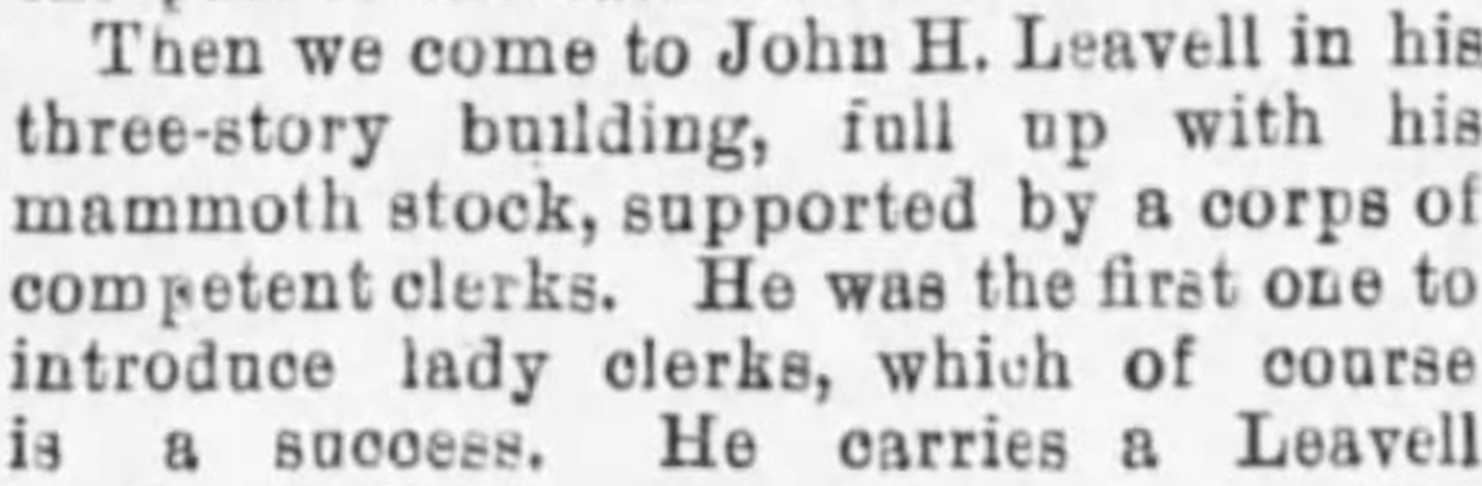
Over the next decade, Leavell’s operations expanded into a small commercial empire. He ran at least two businesses simultaneously: a mercantile interest in W.F. Magee & Co., known locally as “The Good Luck Store,” on the south side of the Public Square, and a second firm, Leavell & Sharpe, located in Block 51 near the corner of Locust and Brushy streets. His son-in-law Alfred L. Sharpe was his partner in the latter. In April 1898, the Sun reported that Leavell left for St. Louis and Chicago “for the second time this year to buy goods for the firm of Leavell & Sharpe and W.F. Magee & Co.” He was supplier and buyer, wholesaler and retailer, and by the mid-1890s he had branched well beyond dry goods into farming implements, wheel goods, land, and money lending.
In 1891, Leavell sold off his hardware, wheel goods, and farming implements stock to Jack Steele for $5,000, retaining only the dry goods department. The Austin American-Statesman reported the reason: “Mr. Leavell finds himself physically unable to manage so extensive a business as he has heretofore conducted.” It was August 1891. The language was polite, but something was already beginning to give way.
Beyond the stores, Leavell was a civic presence. He led the first hook and ladder company of the Georgetown Fire Department and was known for making frequent donations to the department. His obituary called him “liberal and public spirited,” and added that when seeking recreation, “he was as cheerful and light hearted as a boy.” He was, by all the evidence, a man who threw himself fully into whatever he was doing, whether it was selling soda crackers or fighting fires. The Sun also noted his reticent disposition, a man who kept his own counsel but could be genial and companionable when he chose.
He also invested heavily in land. By the time of his death, the estate held promissory notes valued at over $80,000, most of them secured by land. He extended credit to farmers and fellow businessmen across Williamson County, bought and sold rural acreage, and held a 10-year wood-cutting privilege on timberland northwest of Georgetown that allowed eight of his tenant families to gather firewood. He was not just a shopkeeper. He was a landlord, a creditor, and a one-man financial institution.
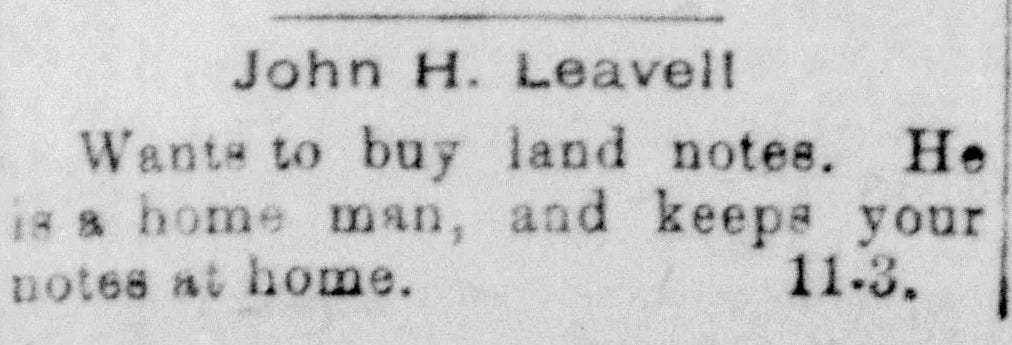
In April 1898, just eight months before his death, he petitioned the city for permission to erect a metallic shed for the storage of vehicles. And a month before the end, in November 1898, he placed a small ad in the Sun: “John H. Leavell. Wants to buy land notes. He is a home man, and keeps your notes at home.” It was the last advertisement he would ever run.
The Family on College Street
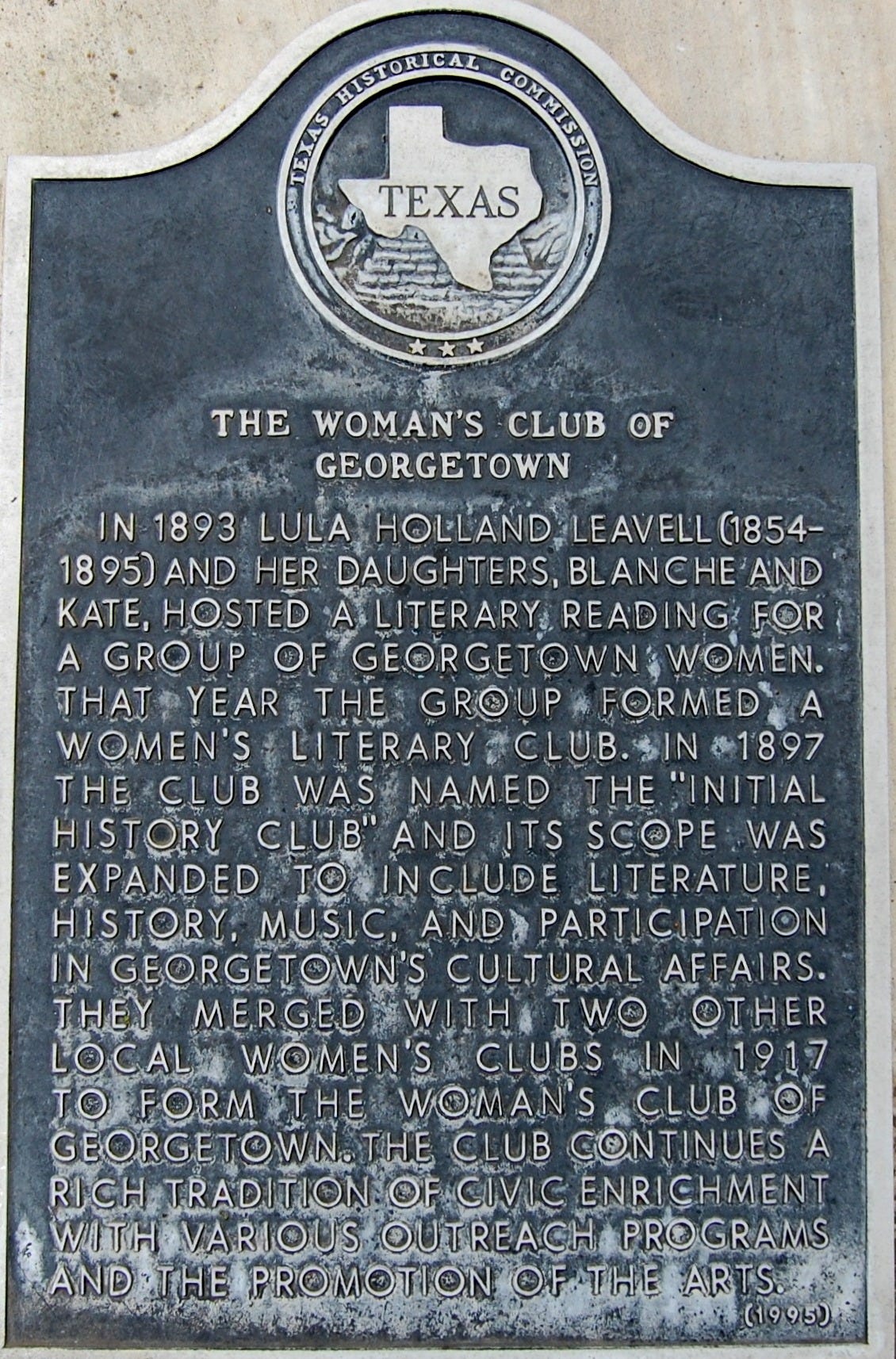
For fifteen years the house was the center of a large and rising family. As Helen Cordes wrote on her local history page, Hidden HerStories and MoreStories, in a post titled Women Making Georgetown Shine, Lula Leavell, with daughters Blanche and Kate, founded the Woman’s Club of Georgetown in the house on College.
It was there in the house, on March 28, 1895, that Kate Leavell married Alfred L. Sharpe, her father’s partner in business and twelve years her senior, before a few relatives and intimate friends. The Fort Worth Daily Gazette carried the wedding on its front page, calling Kate “the reigning belle of Williamson County” and Sharpe “one of Georgetown’s best citizens.” Within the year, the same parlor would hold a funeral.
Lula
A notice in the Austin American-Statesman on September 22, 1895, reported that “the condition of Mrs. John H. Leavell is considered critical” and that all of her children were at home. She was 41 years old.
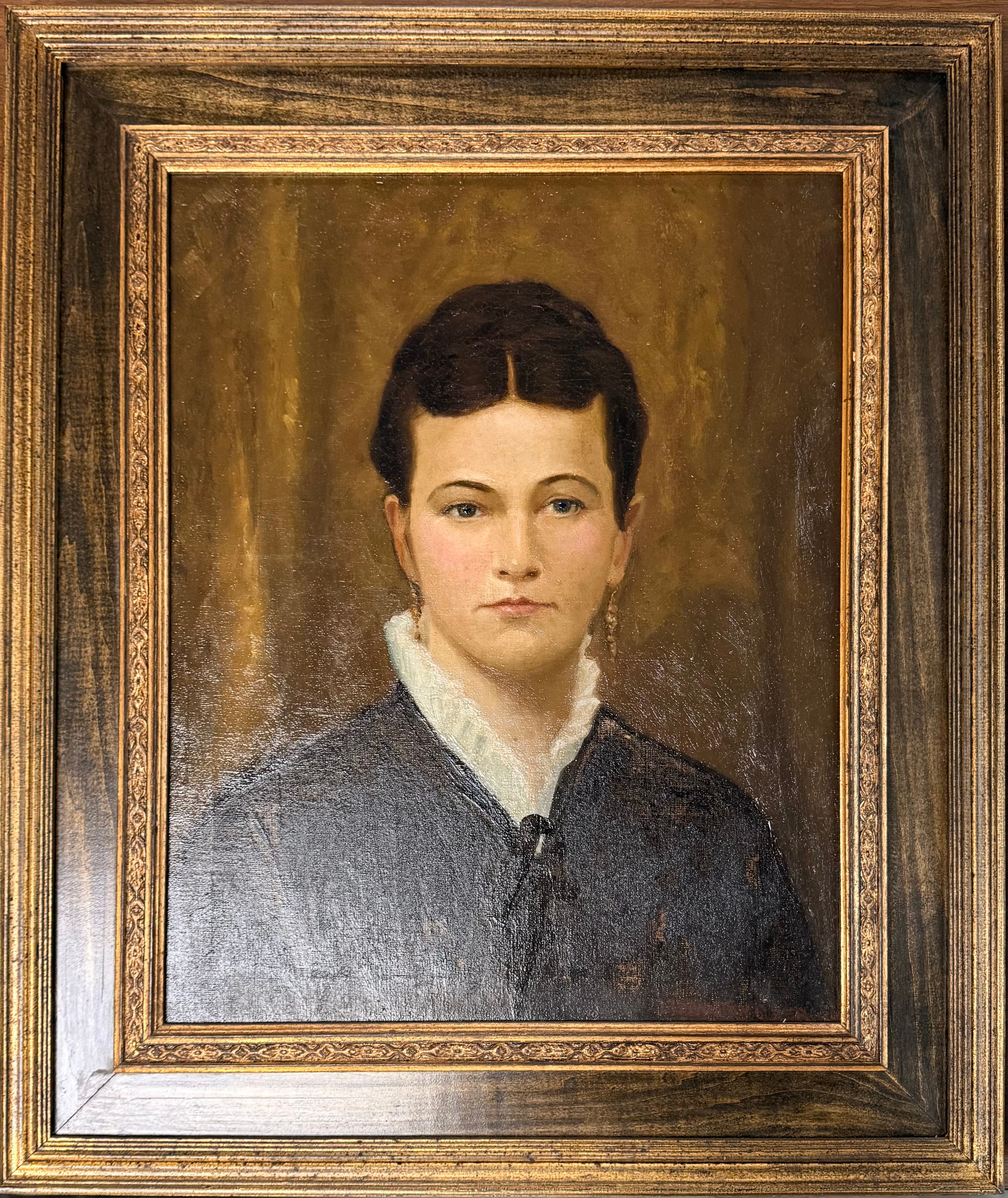
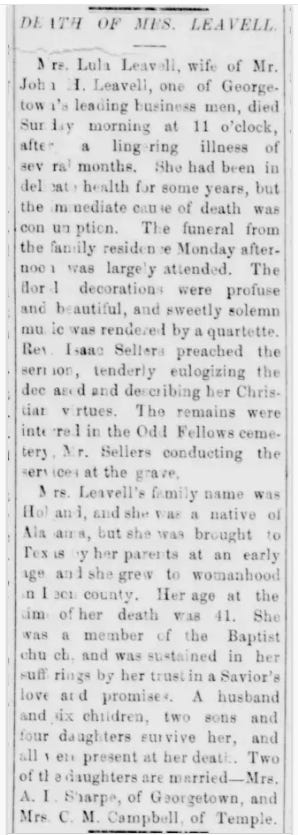
Lula Holland Leavell died on Sunday morning, November 17, 1895, after a lingering illness of several months. Her obituary in the Williamson County Sun the following Thursday gave the cause of death as consumption.
The funeral was held at the family residence on College Street. The floral decorations were described as profuse and beautiful, and a quartette played sweetly solemn music. All six children were present when she died. She was buried at the Odd Fellows’ Cemetery.
The Unraveling
There is a gap in the record after Lula’s death that the documents, taken together, help to fill.
Lula died in November 1895. Under normal circumstances, her will would have been filed promptly. The estate was entirely free of debt, a named executor was ready to serve, and the legal path was clear. Instead, the probate was not filed until December 1896, more than 13 months after her death. There’s no apparent reason for the delay.
John’s obituary, published three years later, offers a possible explanation. “Several years ago Mr. Leavell’s mind became unbalanced from business worries,” the Sun reported, “and it was found necessary to place him in a sanitarium for awhile.”
The timing aligns. The 1891 sale of his hardware stock, attributed to being “physically unable” to manage such an extensive operation, may have been an early sign. By 1895, with business pressure mounting and his wife gravely ill, maybe something broke.
The sequence, as the documents suggest, is this: Lula dies in November 1895. John’s mental health collapses. He’s placed in a sanitarium, possibly the Texas State Lunatic Asylum in Austin, the primary facility of the era. He remains institutionalized through 1896. Someone else is managing the stores and the children. Eventually he recovers, or recovers enough. He files Lula’s probate in December 1896. He returns to business.
After his release, the obituary continued, “he traveled extensively, and grew strong in mind and body, sufficiently so to resume his business.” Every summer he camped across Texas, and in the fall he went East to make his purchases. A September 1896 item in the San Antonio Express-News reported that “Mr. John H. Leavell has returned from an extended trip of several weeks through Northern and Eastern States.” He appeared, to his family and friends, fully restored. They likely anticipated a long and prosperous life.
It didn’t last.
The Last Days
In October 1898, a lightning bolt destroyed John Leavell’s barn. It was a minor loss for a man of his means, but for a mind already fragile, every blow must have landed differently. In the weeks that followed, those close to him noticed he was restless and depressed. He reportedly expressed fears of “again losing his reason.”
On Saturday, December 3, 1898, three days before his death, Leavell went to see his attorney, Robert A. John. He needed to update his will. Lula had been named executrix in the original document, drafted in 1891 when both of them were living. Now, three years after her death, that provision was meaningless. Attorney John drafted a codicil. Leavell copied it out in his own handwriting, formally revoking the bequests to his deceased wife and appointing three of his adult children as executors in her place: Charles, Kate, and Blanche. He signed it in the presence of three witnesses.
Was this prudent planning, or a man putting his affairs in final order? Both are possible. The codicil’s language is calm and precise, the work of a sound legal mind. John D. Hudson, one of the witnesses, testified under oath that Leavell was “of sound and disposing mind and memory” at the time of signing.
On the night of Monday, December 5, Leavell went to his daughter’s room. He was complaining of nervousness. He stayed until midnight, conversing with her and her husband. Then he retired to his own apartment. Nothing unusual was heard during the night.
Sometime before dawn on Tuesday, December 6, he rose, lit the lamp, and opened his desk. He took out a Bible and a Testament and marked passages with strips of paper on which he had penciled dates. He wrote a letter to his children and sons-in-law, sealed it, and marked it private. Then he stood before the bureau mirror in his undershirt and pantaloons, barefoot, with a Winchester rifle. The ball passed through the transom glass above the door. Death, the Sun would report two days later, was of course instantaneous.
Sometime around six o’clock that morning, the household heard what sounded like a stone thrown against the house. Nobody investigated. Leavell was often late to breakfast, and the family assumed he was sleeping in, knowing he had been restless. He did not appear at his place of business. Around a quarter to 11, his son-in-law and partner, A.L. Sharpe, grew uneasy and walked home to check on him. He went around to Leavell’s room, peered through the shutters, and discovered the body.
The news spread through Georgetown within minutes. Friends arrived at the house. The absent children were telegraphed. Blanche came from Temple. Charles came from the State University at Austin. The aged father came from Leon County.
The funeral was held the next afternoon, December 7, at the residence on College Street. Rev. G.W. McCall conducted the services. The interment was at the Odd Fellows’ Cemetery. It was largely attended.
What He Left Behind
The Sun described the deed as “undoubtedly committed in an insane moment.” That was the language of the era, a way of understanding what had happened, a way of granting mercy to the dead and to the family left behind.
Within weeks, the probate machinery began to move. The will and codicil were filed on January 2, 1899. Notice was posted at the courthouse, in Taylor, and in Round Rock. On March 24, the will was proved in open court and admitted to probate. Charles, Kate, and Blanche were confirmed as executors without bond.
When the appraisers finally tallied the estate, the figure was staggering: $167,720.56. The inventory included nearly $60,000 in real estate, interests in both mercantile firms, over $80,000 in promissory notes, two life insurance policies totaling $12,500, and $7,826 in cash. His personal property was modest by comparison: an office desk and safe valued at $125, a pony named Bessie worth $10, a cow named Jennie Bell worth $35, and a pony cart worth $15.
The house on College Street was set aside as the family homestead, not subject to partition while the two youngest children, Gray and John, remained minors. It would stay in the family’s joint ownership into the early 1900s.
Two of his daughters were at school in Washington, D.C. at the time of his death, a mark of just how far Leavell’s ambitions for his children had reached. His son Charles, who had been at the University of Texas, appears to have transferred to Southwestern University in Georgetown after the death, likely to stay closer to his responsibilities as guardian of young John. The guardian accounts paint a picture of life after the father: boarding fees, school supplies, a summer spent at Fort Davis in far west Texas, enrollment at San Antonio Academy, a $5 Christmas gift to the grandfather.
The late John H. Leavell carried $12,000 in life insurance, the Sun noted on December 15, 1898. Seven thousand in the New York Life, $5,000 in the Equitable. A man from Temple representing the former company had already been to Georgetown to make settlement.
The business of death moved quickly in 1898. The estate was settled, the homestead was set aside for the minor children, and the world moved on. The house on College Street, the one John Leavell had built of cypress in the year he arrived in Georgetown, remained.
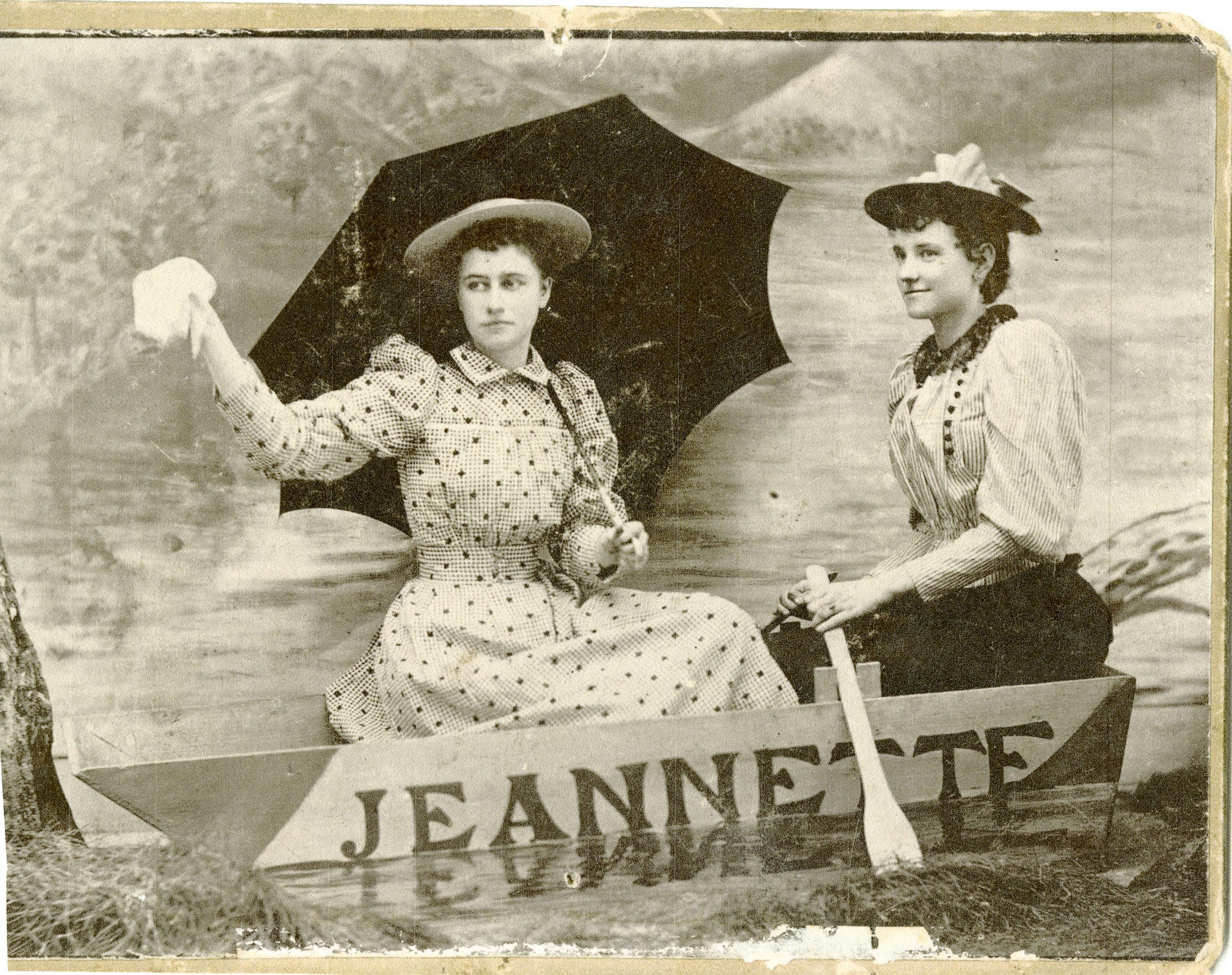
What happened to 803 S. College after the Leavell family is a story I am still untangling. The 2010 Williamson County Sun article on the Cox renovation mentioned, almost in passing, that the owners between the Leavells and the Coxes had not stayed long. That note has stayed with me. In Part 2, I’ll follow the deed and see what the records can tell us about the families who came after.
Sources
John H. Leavell — Death and Funeral
“John H. Leavell’s Death,” The Williamson County Sun (Georgetown, Texas), 8 December 1898, p. 1; digital image, Newspaper Archive (newspaperarchive.com : accessed 2 April 2026).
Lula Leavell — Death and Funeral
“Death of Mrs. Leavell,” The Williamson County Sun (Georgetown, Texas), 21 November 1895; digital image, Newspaper Archive (newspaperarchive.com : accessed 3 April 2026).
“Georgetown Gleanings,” Austin American-Statesman (Austin, Texas), 22 September 1895, p. 4; digital image, Newspapers.com (newspapers.com : accessed 3 April 2026).
Probate and Estate Records
Williamson County, Texas, Probate Minutes, Estate of Mrs. Lula Leavell, deceased, No. 929, 21 December 1896; “Williamson, Texas, United States records,” images, FamilySearch (familysearch.org : accessed 3 April 2026), Image Group Number 007573773.
Williamson County, Texas, Probate Minutes, Estate of John H. Leavell, deceased, No. 1047, 24 March 1899; “Williamson, Texas, United States records,” images, FamilySearch (familysearch.org : accessed 2 April 2026), Image Group Number 007573775.
Williamson County, Texas, District Court, Chas. H. Leavell, et al. v. Lulu Leavell, et al., Commissioners’ Report of Partition, 9 August 1899; “Williamson, Texas, United States records,” images, FamilySearch (familysearch.org : accessed 3 April 2026), Image Group Number 008340471.
Business and Civic Life
Jno. H. Leavell, advertisement, The Williamson County Sun (Georgetown, Texas), May 1880; “GET OFF THE SIDE WALK!!!,” advertisement, The Williamson County Sun, December 1880; digital images, Newspaper Archive (newspaperarchive.com : accessed 3 April 2026).
“Georgetown: The Principal Points and Surroundings About a Live Texas Town,” Austin Weekly Statesman (Austin, Texas), 18 April 1889, p. 1; digital image, Newspapers.com (newspapers.com : accessed 4 April 2026).
[National Cash Register notice], San Marcos Free Press (San Marcos, Texas), 1889.
“Georgetown Gleanings,” Austin American-Statesman (Austin, Texas), 30 August 1891, p. 1; digital image, Newspapers.com (newspapers.com : accessed 3 April 2026).
“Leavell & Sharpe” [buying trip notice], The Williamson County Sun (Georgetown, Texas), 14 April 1898; digital image, Newspaper Archive (newspaperarchive.com : accessed 3 April 2026).
[Council proceedings, metallic shed petition], The Williamson County Sun (Georgetown, Texas), 14 April 1898; digital image, Newspaper Archive (newspaperarchive.com : accessed 3 April 2026).
John H. Leavell, “Wants to buy land notes,” advertisement, The Williamson County Sun (Georgetown, Texas), November 1898; digital image, Newspaper Archive (newspaperarchive.com : accessed 3 April 2026).
The House — Property Records
Williamson County, Texas, Deed Records, C.A.D. Clamp to John H. Leavell, Lots 1 and 2, Clamp’s Addition, recorded 30 April 1880, vol. 23, p. 240; Williamson County Clerk’s Office, Georgetown.
Clara Scarbrough, “Data on Georgetown Buildings 1976 for National Register Survey: John H. Leavell Home, 803 College,” 1976; copy in project research files.
Marriage and Family
W. D. Wood, comp., A Short Biography of Daniel B. Wood and Family, William Horn and Family, Isaac F. Wood and Family, W. D. Wood, his Wife and Her Family (San Marcos, Texas: Democrat Print, [n.d.; received April 28, 1971]), p. 32.
1880 U.S. Census, Williamson County, Texas, population schedule, Georgetown, John H. Leavell household; digital image, FamilySearch (familysearch.org : accessed 3 April 2026) or Ancestry (ancestry.com : accessed 3 April 2026).
“Marriage at the Residence of the Bride’s Father” [Kate Leavell and Alfred L. Sharpe], Fort Worth Daily Gazette (Fort Worth, Texas), 29 March 1895, p. 1.
“Misses Lula and Grace Leavell...” [Fort Davis return], The Williamson County Sun (Georgetown, Texas), 7 September 1899; digital image, Newspaper Archive (newspaperarchive.com : accessed 3 April 2026).
Old Town Echoes is independently researched using primary historical sources. AI tools assist in drafting and editing; all content is reviewed, sourced, and verified by the author.
Fantastic story and wonderfully written! I love learning more about the history of my neighborhood all the time.
This is one of my favorite homes. Leavell had so much money and a beautiful family. I wonder what drove him to take his life. 🤔