


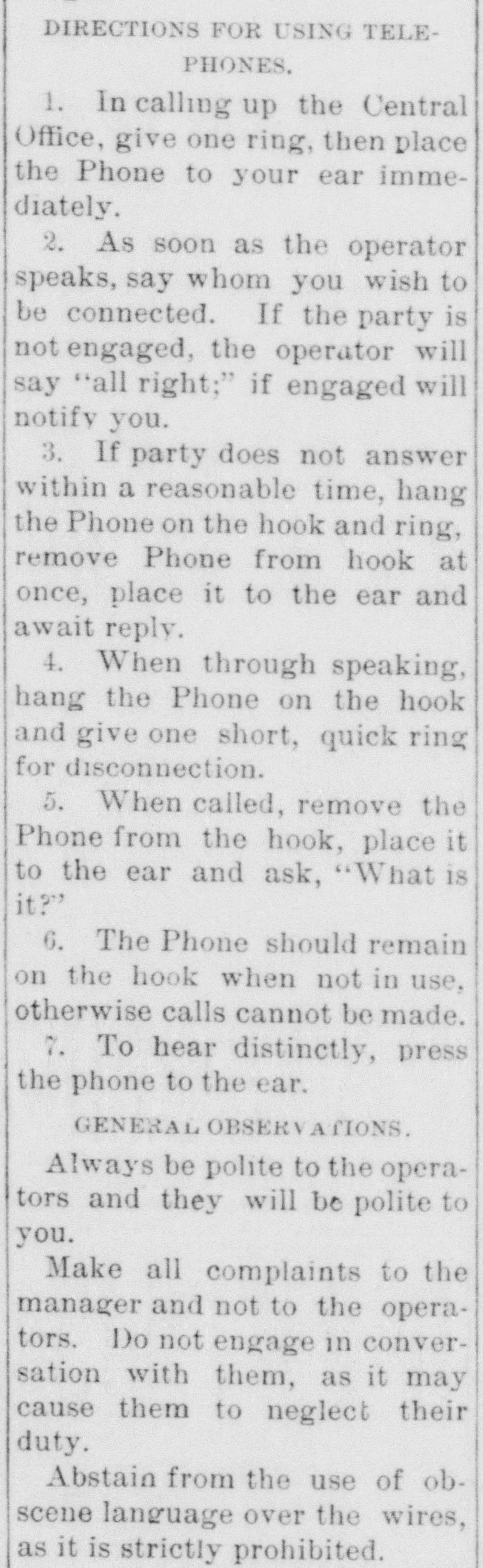
On the 28th of May, 1885, the Williamson County Sun introduced the town’s new telephone exchange, and then it gave a good bit of the front page to explaining how to actually use a telephone.
DIRECTIONS FOR USING TELEPHONES.
In calling up the Central Office, give one ring, then place the Phone to your ear immediately.
As soon as the operator speaks, say whom you wish to be connected. If the party is not engaged, the operator will say “all right;” if engaged will notify you.
If party does not answer within a reasonable time, hang the Phone on the hook and ring, remove Phone from hook at once, place it to the ear and await reply.
When through speaking, hang the Phone on the hook and give one short, quick ring for disconnection.
When called, remove the Phone from the hook, place it to the ear and ask, “What is it?”
The Phone should remain on the hook when not in use, otherwise calls cannot be made.
To hear distinctly, press the phone to the ear.
That last one is my favorite. Press the phone to the ear. Someone found it genuinely necessary to print that.
Then came the General Observations, such as:
“Always be polite to the operators and they will be polite to you.”
Georgetown had owned a telephone exchange for about three months when that ran. Getting one had taken a year and a half, one failed subscription drive, an anonymous letter that named names in print, and a great deal of nagging from the paper now doing the explaining.
Neither Will Be Established
The Sun had been at this since the summer before. In June 1884 it wrote that “the water works and the ice factory are soon to be in operation. Now let us have a telephone exchange and a cotton factory.” In July it tried again, in five words: “Georgetown must have a telephone exchange.” Two weeks later it called the exchange “the next convenience Georgetown must have.”
On a Thursday at the end of that July, a man from Austin set a telephone on a table in the office of the Slaton hotel, and Georgetown lined up to take turns talking into it. They talked to Round Rock. They talked to Austin, and Temple, and Belton. Archie Watson, who managed the Austin telephone exchange, had brought the instrument up himself and put it through over the Texas Telegraph-Telephone company’s wires, and the Sun reported, with some wonder, that “conversations were held by various persons here with persons in the other places named.”
Then Watson passed the hat. He wanted three hundred dollars toward running a line to town, and thirty people willing to rent an instrument if an exchange were ever built.
He got about a hundred and sixty dollars, and eleven potential subscribers.
The Sun printed the result on the 7th of August without any softening: “…the telephone company withdraws the proposition to establish a line and exchange on the terms named, and neither will be established.”
It seemed like a flat, final sentence. The Sun was disappointed in its town.
Nine More
By September the paper was back at it, and the situation had changed. Georgetown had telephone service. The Erie company had leased the frontier telegraph company’s lines, and there was a telephone office in town where you could go and make a call. What the town did not have was an exchange. The town could talk to Austin. It could not talk to itself.
The man who expected to run it, if it ever existed, was E. H. Bobo, and the Sun let him describe what he had in mind. The office would be centrally located, well furnished, attractive, “comfortably and conveniently arranged, so that ladies, gentlemen and children can all feel at home there, and enjoy visits to the office.”
On the 2nd of October the Sun gave the subject six words and a paragraph to itself: “Wake up on the telephone exchange.”
What finally moved it was a letter. On the 4th of December the paper ran a long unsigned piece headed “Will We Have a Telephone Exchange?” Whoever wrote it understood the problem:
“There are, however, some who think they will wait till their neighbors take a ‘phone before they will subscribe; that they do not need a ‘phone unless they are in use all over town... Now this is the very thing that keeps the company from establishing an exchange.”
Everybody wanted to be the second person in town with a telephone. Nobody wanted to be the first.
The letter did the arithmetic in public. The company had originally wanted 30 instruments; it would now settle for 25. Sixteen were spoken for. Nine more would do it. A business telephone cost $5 a month and a residence $4. It mentioned, in passing, that a telephone was “almost indispensable to the busy housewife,” who could order her groceries in five minutes instead of spending an hour sending for them. Then it got to the part I suspect actually worked, which was shame: “Our sister cities all have exchanges. Belton, Lampasas, Austin, and even Temple has over fifty ‘phones.”
Anyone wishing to subscribe could leave their name at Taylor’s Bank, or with H. R. Rives at the Slaton hotel.
Five weeks later, on the 8th of January 1885, the Sun printed one sentence: “The requisite number of subscriptions for a telephone exchange here have obtained.” By the end of the month the materials had arrived.
Up the Steps
On the 5th of February, this:
“The room next to Dr. Crawford’s office, over Booty’s store, has been leased as the office of the telephone exchange, which is soon to be in working order.”
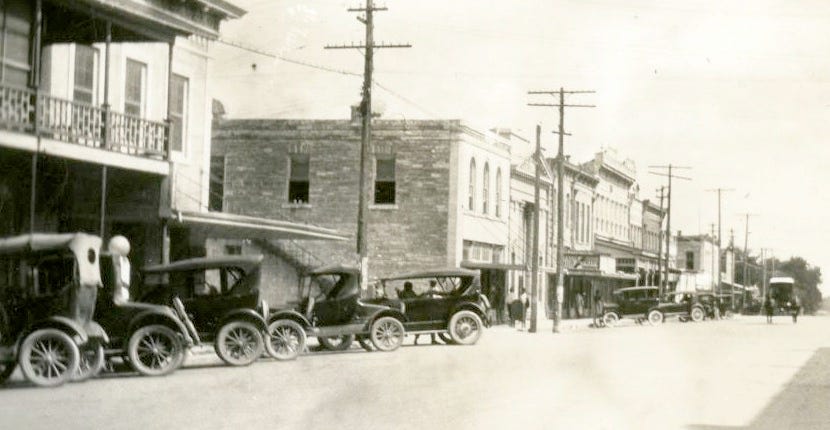
Booty Bros. kept a store at the corner of Oak and Brushy streets, now the northwest corner of Eighth Street and Austin Avenue, a corner you have almost certainly walked past. It was two stories of stone: dry goods, hats, boots and shoes and notions on the ground floor, and upstairs the Odd Fellows’ hall and a row of rooms rented out by the room.
You didn’t get up there through the store. You went around the side and climbed up.

At the top of the stairs was the dentist.
Dr. B. C. Crawford had been in Georgetown for years by then, and when the Sun wrote him up the following October it placed him precisely: “an elegantly fitted up office in the second story of the Booty building, just at the head of the stairs.” The town business census that April counted seven physicians and exactly one dentist, so there is no ambiguity about which man this was. The paper also assured readers, warmly, that “the Doctor extracts teeth without pain.”
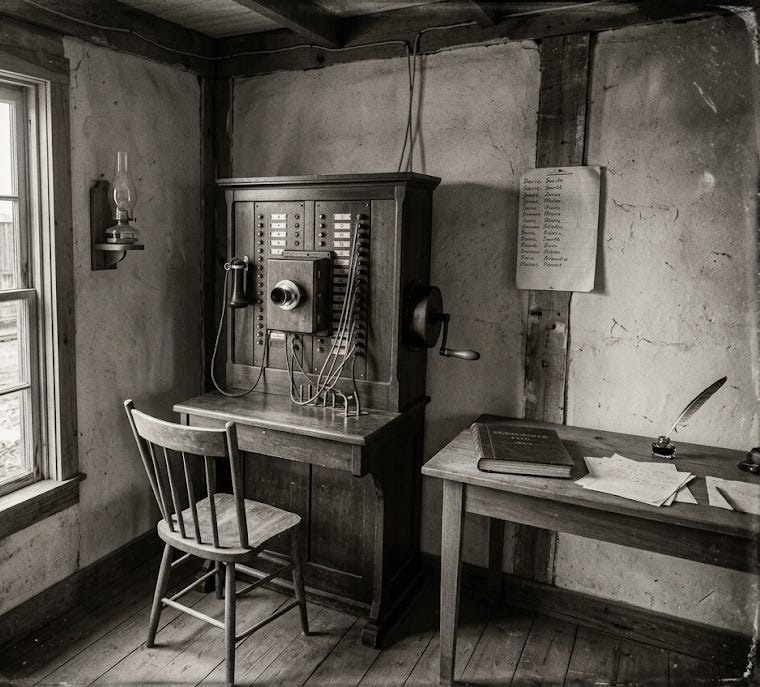
The telephone exchange was the next room along.
23 Names
On the 12th of March the Sun published the first Georgetown telephone directory. Here is the whole of it:
Dr. J. N. H. Huggins, residence
Slaton Hotel
Ellyson & Penn, livery stable
D. H. Snyder, residence
John Sparks, residence
W. L. Mann, drug store
Georgetown Ice Co.
T. S. Snyder, residence
Dr. J. E. Walker, residence
Sanders & Lesesne, drug store
Water Works office
L. R. Carpenter, depot
Rucker & Montgomery, store
Dr. W. P. Fleming, residence
J. T. Olive, court-house
Oliver Steele, store
Emzy Taylor, banker
Sun Office
Booty & McDougle, store
Pump house
S. T. Atkin, residence
Dr. H. N. Graves, residence
Rev. Jas. Mackey, residence
That is the entire network. Everyone in Georgetown who could be telephoned, in one column of newsprint.
Four doctors, both drug stores, the courthouse, the waterworks and its pump house, the ice company, the depot, the hotel, the livery stable, the banker, three stores, and the newspaper at number 18. The institutions of the town, its emergencies, and its money, and nine residences.
Do you see any familiar names?
That April the Sun counted the town’s businesses at a reader’s request, “for the information of friends in an older state.” Sixteen lawyers, three meat markets, a skating rink, a shooting gallery, two fire companies, and, tucked into the list, “telephone exchange and office, 1; telephone lines to other places, 3.” Three wires out of Georgetown, and one room they all came home to.
What It Cost to Talk
Back, then, to that front page of the 28th of May, because the directions weren’t the half of it.
The column priced the thing first. Five minutes to Temple was a quarter. Austin, Belton, Round Rock, Liberty Hill and Corn Hill were 35 cents. San Antonio was 60. Lockhart was 85, for reasons the column does not explain.
You could send telegrams from that room as well, over the Erie company’s lines, to some 50-odd places whose names are half the pleasure of the article: Babb’s Ranch, Copperas Cove, Gay Hill, Senterfeit, Yellow Prairie.
The General Observations ran on well past the line about politeness. Make your complaints to the manager, not the operators, and don’t chat with them, “as it may cause them to neglect their duty.” Abstain from the use of obscene language over the wires, “as it is strictly prohibited.”
Then this:
“Do not encourage non-subscribers, as they are not only a nuisance to the central office, but to all subscribers, as they consume the time of others.”
If the operator suspected a non-subscriber was using the telephone, they were authorized to demand his name, and if he refused to give it, he was refused the instrument.
Nine months earlier, that office was going to be somewhere ladies, gentlemen, and children could all feel at home and enjoy visiting. Now it had a doorman to keep out the riffraff.
Christmas Eve
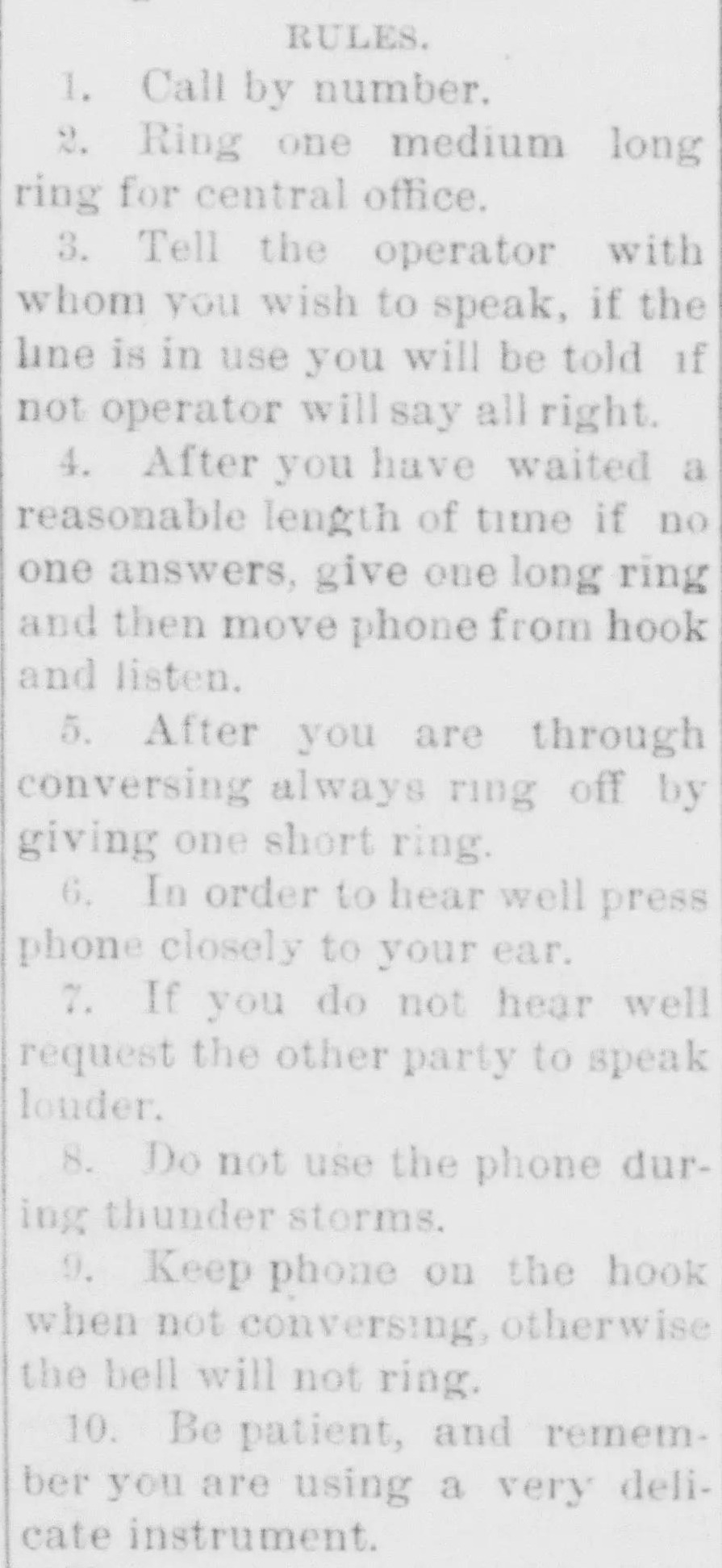
On the 24th of December 1885 the Sun printed the whole thing again, revised, under the heading “Telephones and Rules.”
The list had grown to 25 numbers, and it had gotten more personal. Where March gave you “Slaton Hotel,” December gives you E. H. Slaton; the ice factory is J. L. Tindale; the Sun office is J. E. Cooper. A meat market had joined, and a second grocery, and another doctor. Rev. Mackey had dropped off. Numbers 25 to 28 were being held back for something new called a territorial line, which is to say the country folks were starting to join.
Rule number one was now “Call by number.” In May you told the operator a name. By Christmas the town had been numbered.
The manners were gone. No politeness rule. Nothing about obscene language, nothing about non-subscribers. Ten months in, the paper printed operating instructions and stopped teaching etiquette.
You could now reach 23 towns without repeating, roughly double what you could reach in May, and, by repeating at Waco, numbers of towns and cities north of there.
Two new rules had arrived instead of the manners: #8 “Do not use the phone during thunder storms” and #10 “Be patient, and remember you are using a very delicate instrument.”
The exchange didn’t stay in that room over Booty’s store, but that’s a story for another day.
Here’s the part I wasn’t sure I would be able to tell you. The building is still there.
It is 718 S. Austin Avenue, on the northwest corner of 8th, and it’s spent most of the last century in disguise.
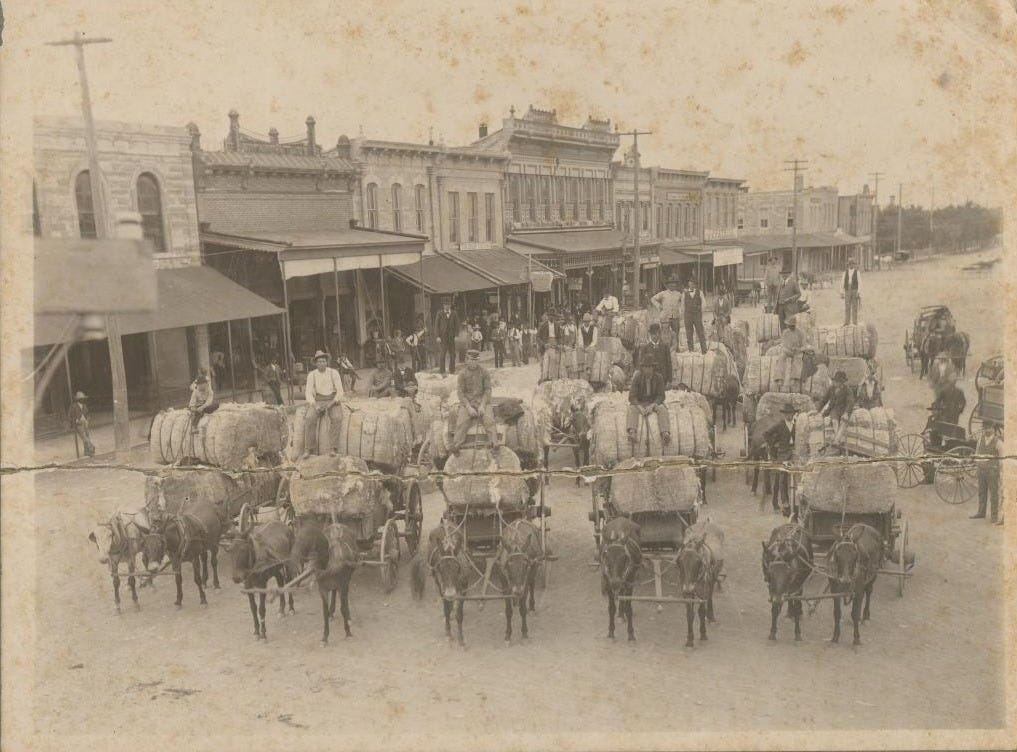
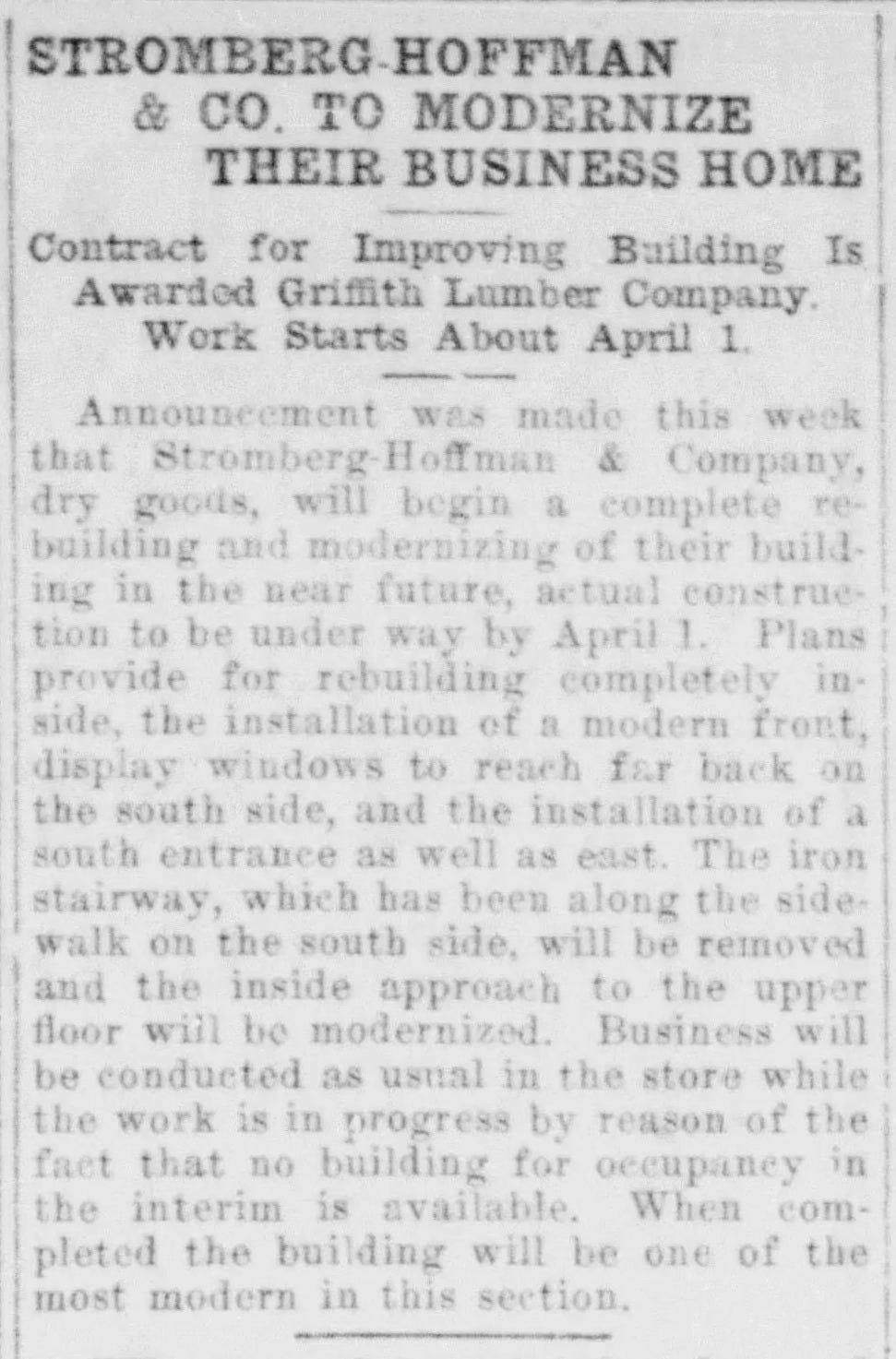
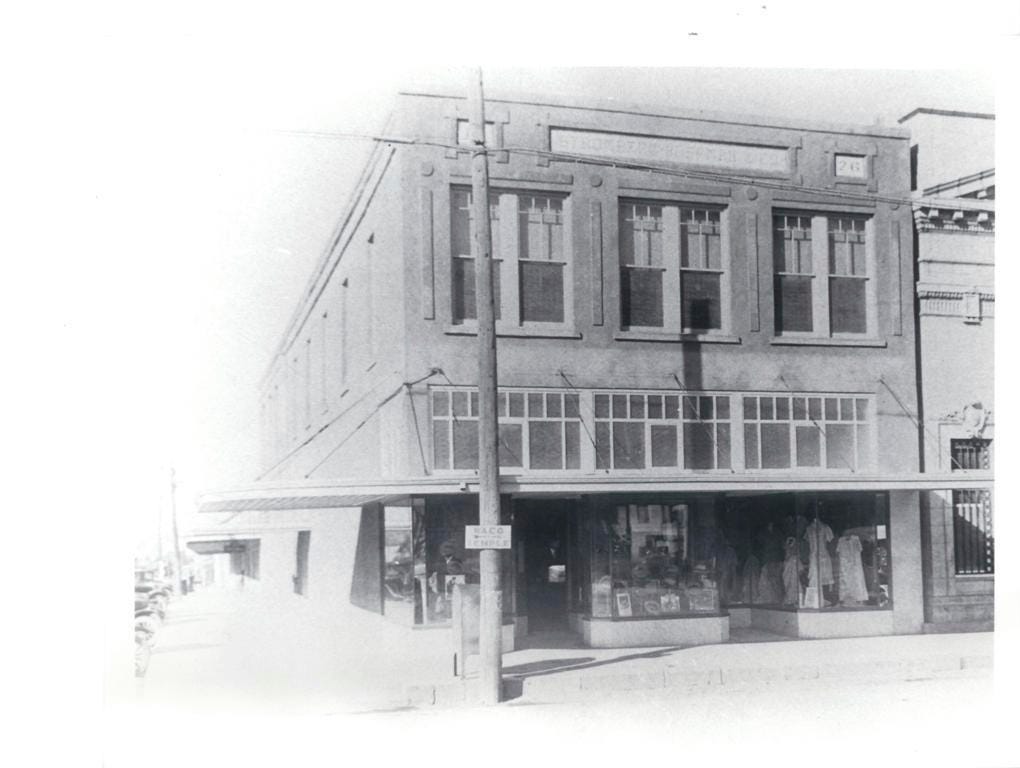
In the spring of 1926 the firm of Stromberg-Hoffman put a new front on it, gray stucco laid straight over the native limestone. We know it’s the same building because they wrote about it in the Sun. A March 1926 article described the remodel, noting that business would go on as usual in the store “by reason of the fact that no building for occupancy in the interim is available.” The 1926 we see on the building today marks a remodel date, not a build date.
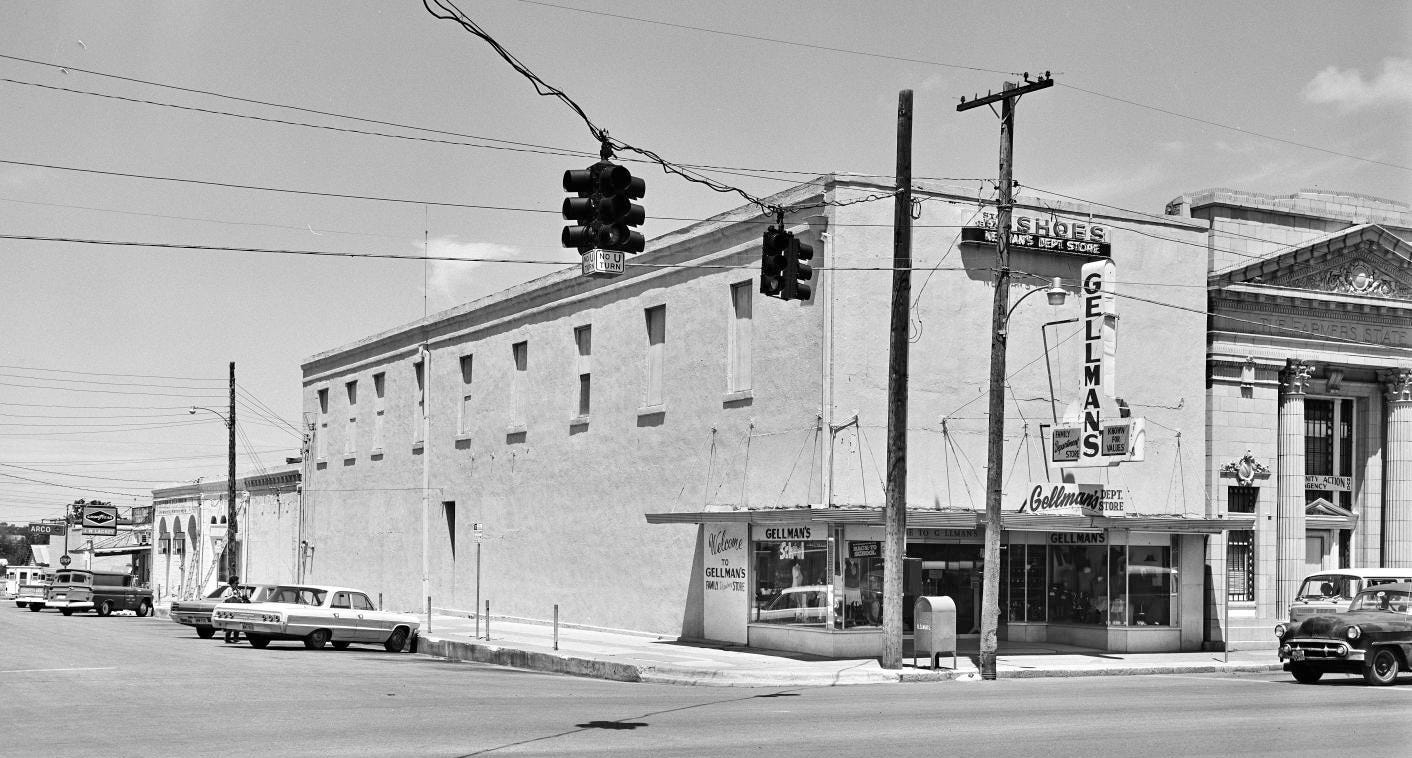
The windows along the Eighth Street side were filled in and plastered over sometime between the mid-1960s and 1976, and by 1984 the whole Austin Avenue front was a blank wall with a Gellman’s Department Store sign bolted to it.
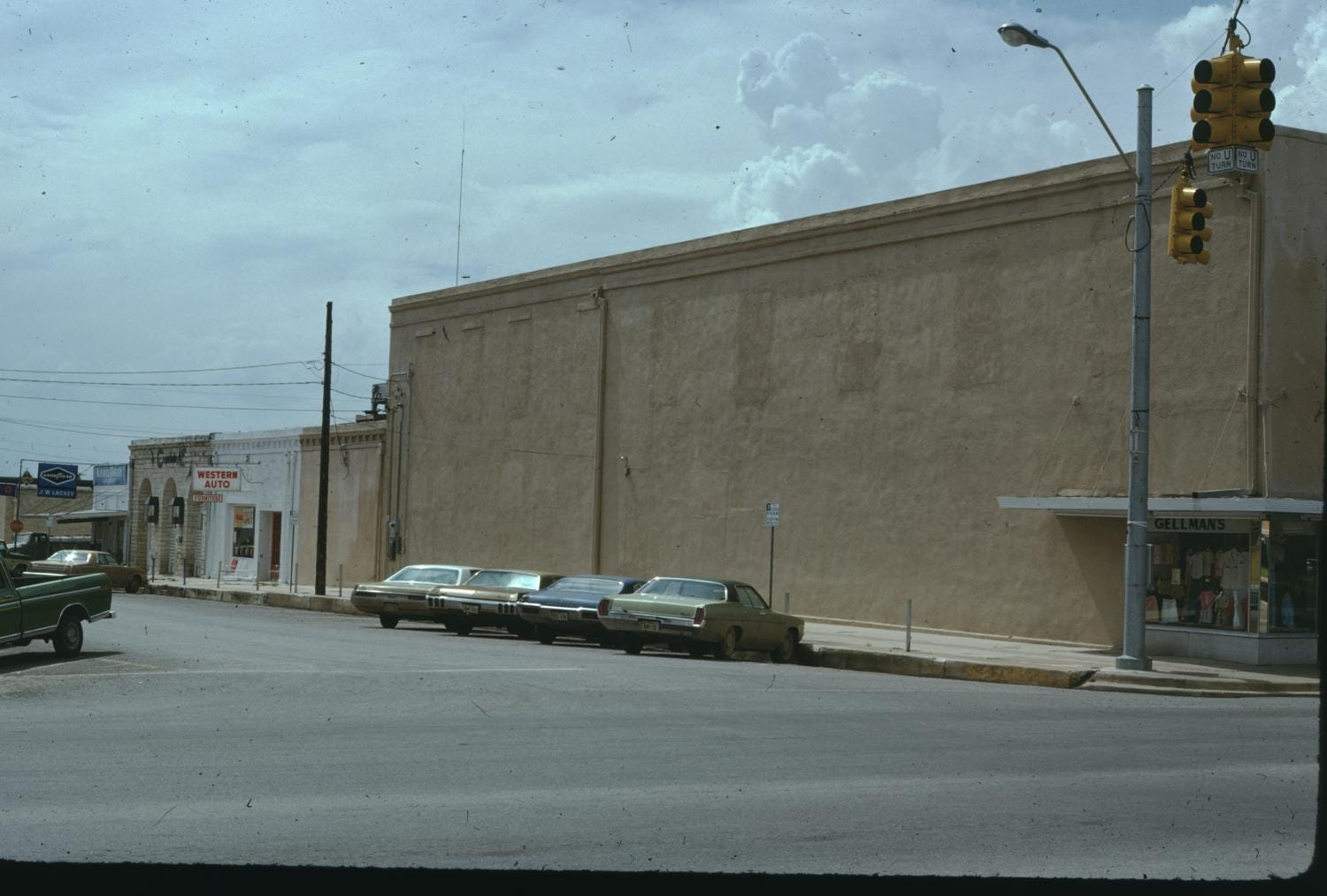
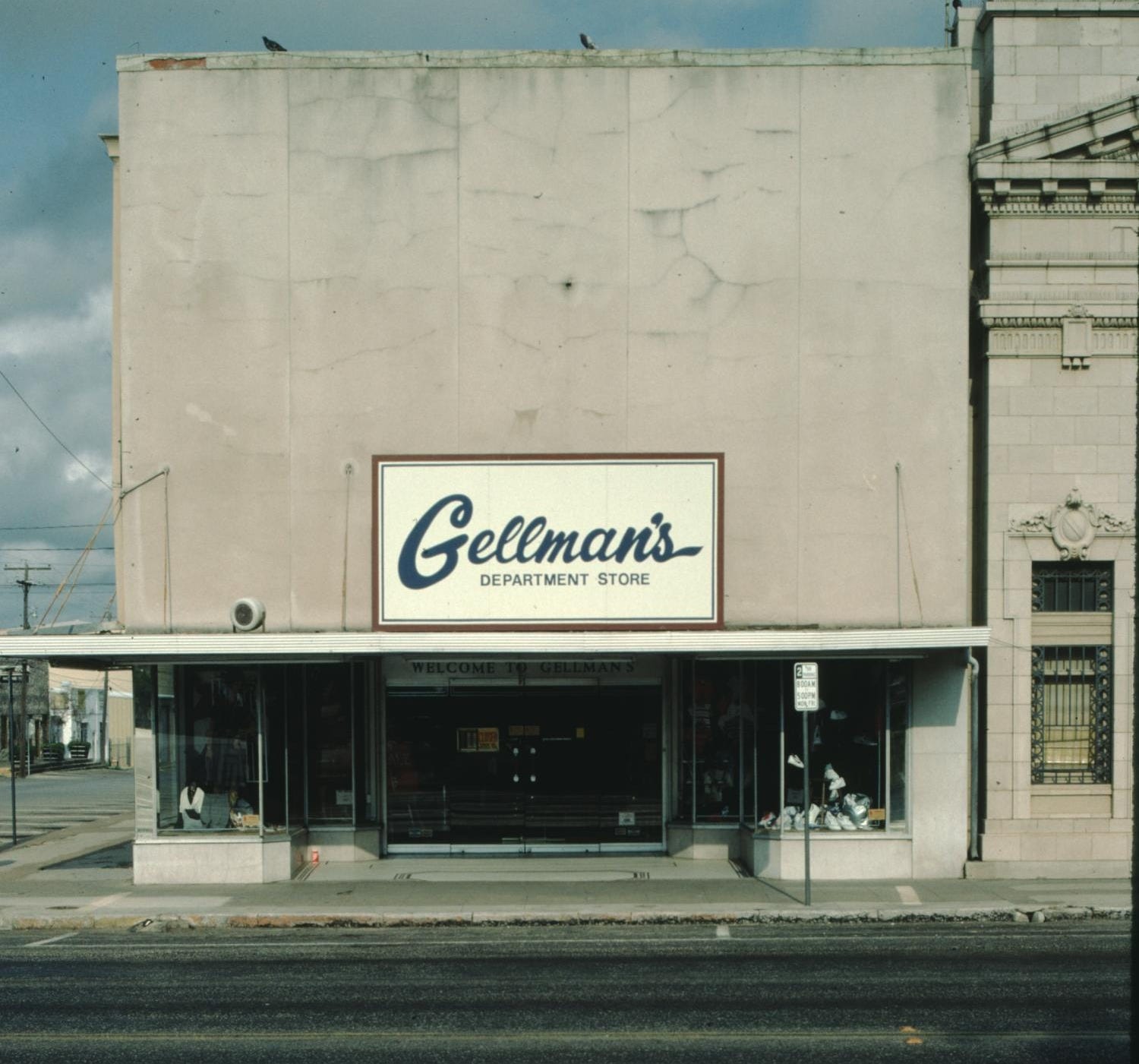
Go through the Sanborn fire insurance maps corner by corner, 1885-1925, and the footprint never changes. The building never came down. They just kept putting new faces on it.
The room is still up there, or the memory of it. Second story, northwest corner of 8th and Austin. The stairs are gone and the dentist with them, but the floor where the whole of Georgetown’s ability to talk to itself was once kept, 23 subscribers and a switchboard, next door to a man who pulled teeth without pain, is just above the retail space that currently houses Prima Dora.
Sources
Newspapers
All Sun items below are from The Williamson County Sun (Georgetown, Texas); digital images, Newspaper Archive (newspaperarchive.com : accessed August 2026). Untitled local items are described in brackets.
[Local item, “Now let us have a telephone exchange”], 26 June 1884, p. 3.
[Local item, “Georgetown must have a telephone exchange”], 10 July 1884, p. 3.
[Local item, “the next convenience Georgetown must have”], 24 July 1884, p. 3.
[Local item, Archie Watson’s telephone at the Slaton hotel and the failed subscription], 7 August 1884, p. 3.
“A Telephone Exchange,” 11 September 1884, p. 4.
[Local item, “Wake up on the telephone exchange”], 2 October 1884, p. 3.
“Will We Have a Telephone Exchange?” (Communicated), 4 December 1884, p. 4.
[Local item, “The requisite number of subscriptions… have obtained”], 8 January 1885, p. 3.
[Local item, materials for the exchange received], 29 January 1885, p. 3.
[Local item, the room next to Dr. Crawford’s office leased], 5 February 1885, p. 3.
“The Telephone Exchange” [Georgetown’s first directory], 12 March 1885, p. 2.
“Georgetown’s Industries” [the business census], 16 April 1885, p. 3.
“Our Telephone Exchange” [rates, directions and General Observations], 28 May 1885, p. 1.
[Local item, Dr. B. C. Crawford in the second story of the Booty building], 22 October 1885, p. 3.
“Telephones and Rules” [the revised directory and ten rules], 24 December 1885, p. 1.
“Stromberg-Hoffman & Co. to Modernize Their Business Home,” 19 March 1926, p. 3.
Other printed sources
“Work now under way remodelling home of Stromberg-Hoffman & Co.,” The Megaphone (Southwestern University, Georgetown, Texas), 6 April 1926, p. 1.
National Register of Historic Places inventory, Georgetown Commercial Historic District, 1977, item 33.
Maps
Sanborn Fire Insurance Maps, Georgetown, Williamson County, Texas, block 41. Georgetown, Tex., August 1885, sheet 1 (the whole town on one sheet); Georgetown, Tex., July 1889, sheet 1 of 2. Footprint compared across the 1885, 1889, 1894, 1900, 1905, 1910, 1916 and 1925 sheets. Originals at the Dolph Briscoe Center for American History, University of Texas at Austin.
Photographs
Wilcox photograph, Austin Avenue looking north, c. 1900–1907. Williamson Museum WILLM 2006-015-366; The Portal to Texas History, metapth426926.
Atlee photograph, Austin Avenue looking north at Eighth Street, c. 1915–1925. Williamson Museum WM2010.020.014; The Portal to Texas History, metapth402884.
“Stromberg-Hoffman Building,” undated. Photograph courtesy of the Georgetown Heritage Society; City of Georgetown records archive, doc 391674 (records.georgetowntexas.gov). Creative Commons, attribution.
Texas Historical Commission photograph, 718 S. Austin Avenue as Gellman’s Department Store, undated, 1960s. The Portal to Texas History, metapth677307.
Texas Historical Commission color slide, Eighth Street elevation, 1 July 1976. The Portal to Texas History, metapth960227.
Texas Historical Commission color slide, Austin Avenue front, 1 August 1984. The Portal to Texas History, metapth972098.
Illustration
Interior of an 1885 telephone exchange office, generated with Google Gemini, September 2026. Not a photograph, and not a depiction of Georgetown’s exchange.
Old Town Echoes is independently researched using primary historical sources. AI tools assist in drafting and editing; all content is reviewed, sourced, and verified by the author.
I love the history, this was a great read!