


“I was long ago converted to the theory of evolution and see no more reason why we should be ashamed to acknowledge our Simean ancestry than that of the dust from which the Biblical first man was manufactured.”
Those lines ran in The Williamson County Sun in the fall of 1927, two years after the Scopes trial. The woman who wrote it was 81 years old and living a few blocks off the Square. She signed her full name to it: Nanna Smithwick Donaldson.
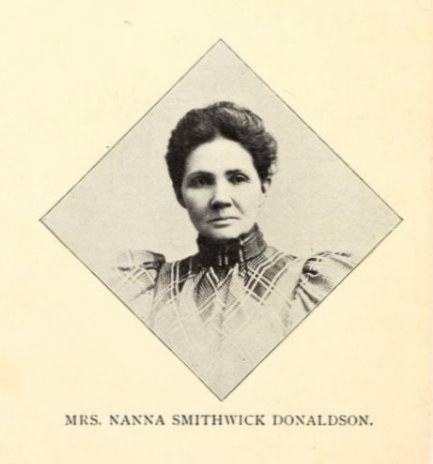
She’d been in Georgetown twenty-two years by then. Six years later, at 88, she was still firing letters at the Sun about the President of the United States.
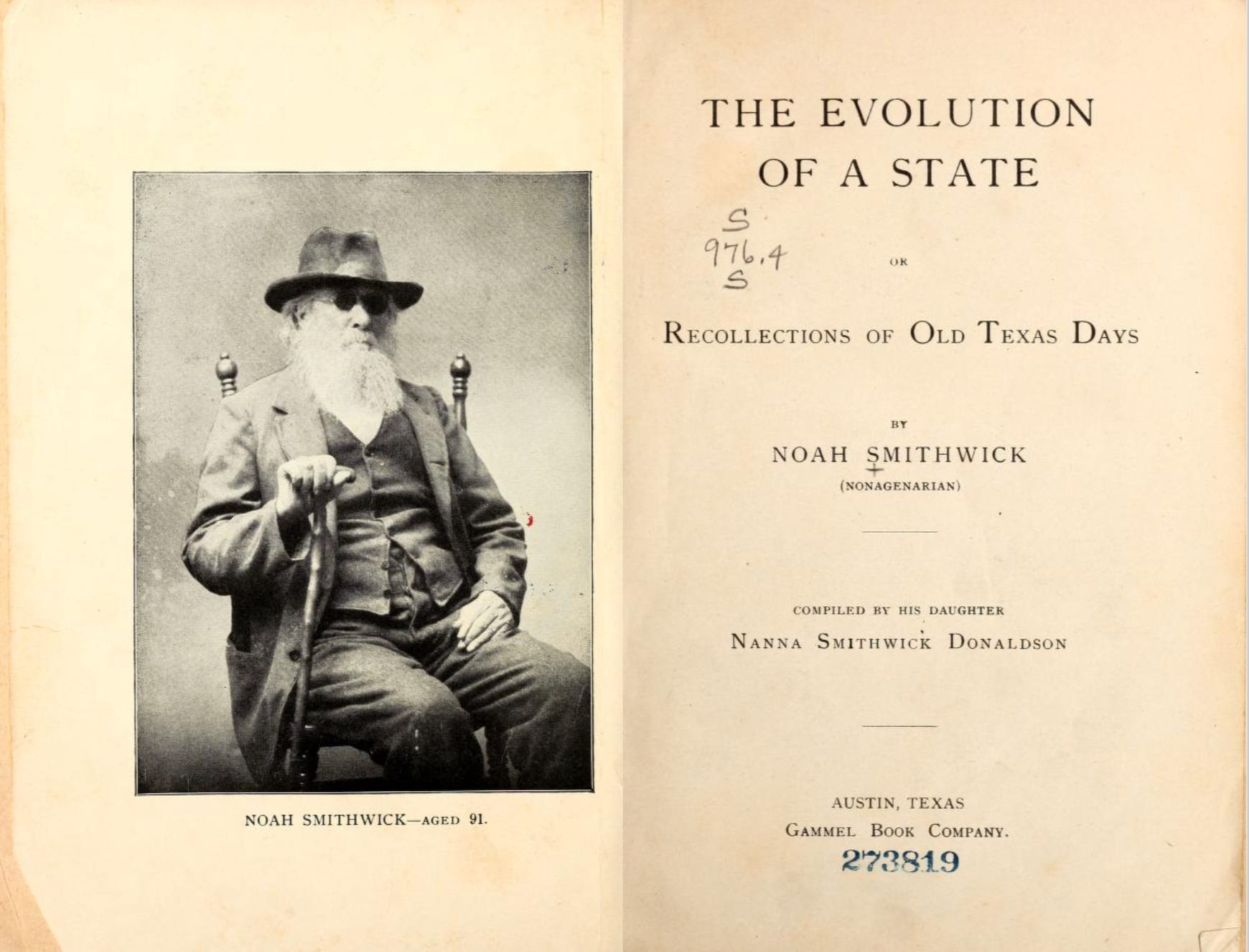
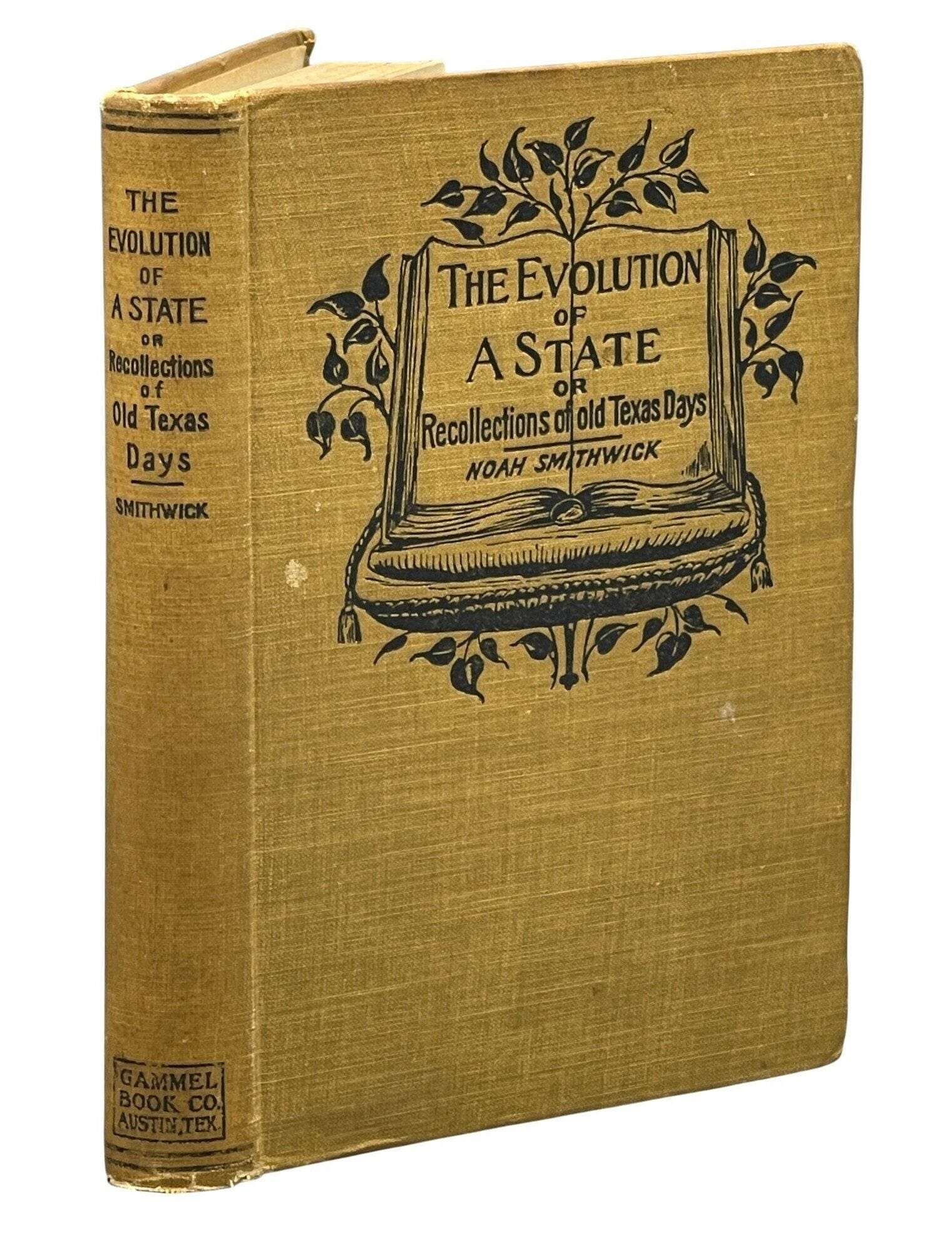
If you’ve read any early Texas history, you’ve probably come across her father. Noah Smithwick’s memoir, The Evolution of a State, or Recollections of Old Texas Days, has never really gone out of print. J. Frank Dobie ranked it “best of all books dealing with life in early Texas.” What you may not know about Noah Smithwick is that he was blind when that book was written. Every word of it passed through the pen of that same daughter.
I first encountered Nanna in the deed books. One of the first things I do with an old house is trace its chain of title, and once I know the owners, I turn to traditional genealogy to help tell their stories. Nanna’s ownership was relatively brief, and she might have stayed as a minor footnote in that chain, but then Old Town neighbor Tom Cavness told me a story, I went looking for her in the papers, and out came a run of remarkable articles: a woman who fired off letters to the editor that would get a healthy comment section going even today.
She signed all three of her names on nearly everything she ever wrote, though the custom of her day would have folded her into a plain Mrs. N. S. Donaldson, the way her cousin and housemate, born Martha Jane Anderson, was known in the papers as Mrs. M. J. Suttles. Three names, and the woman attached to them seems like she was far more interesting company than her father’s famous book let on.
Born a Texan
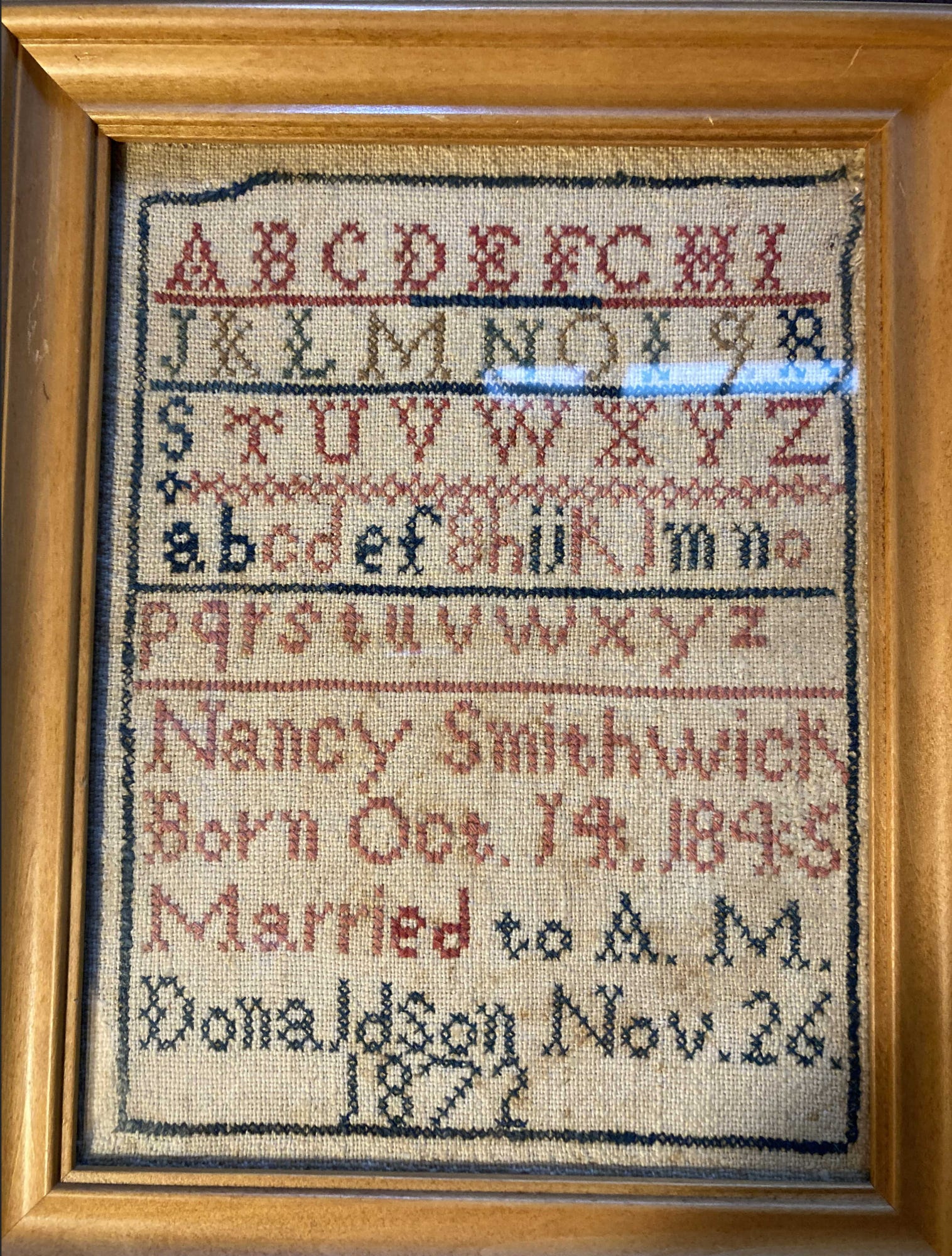
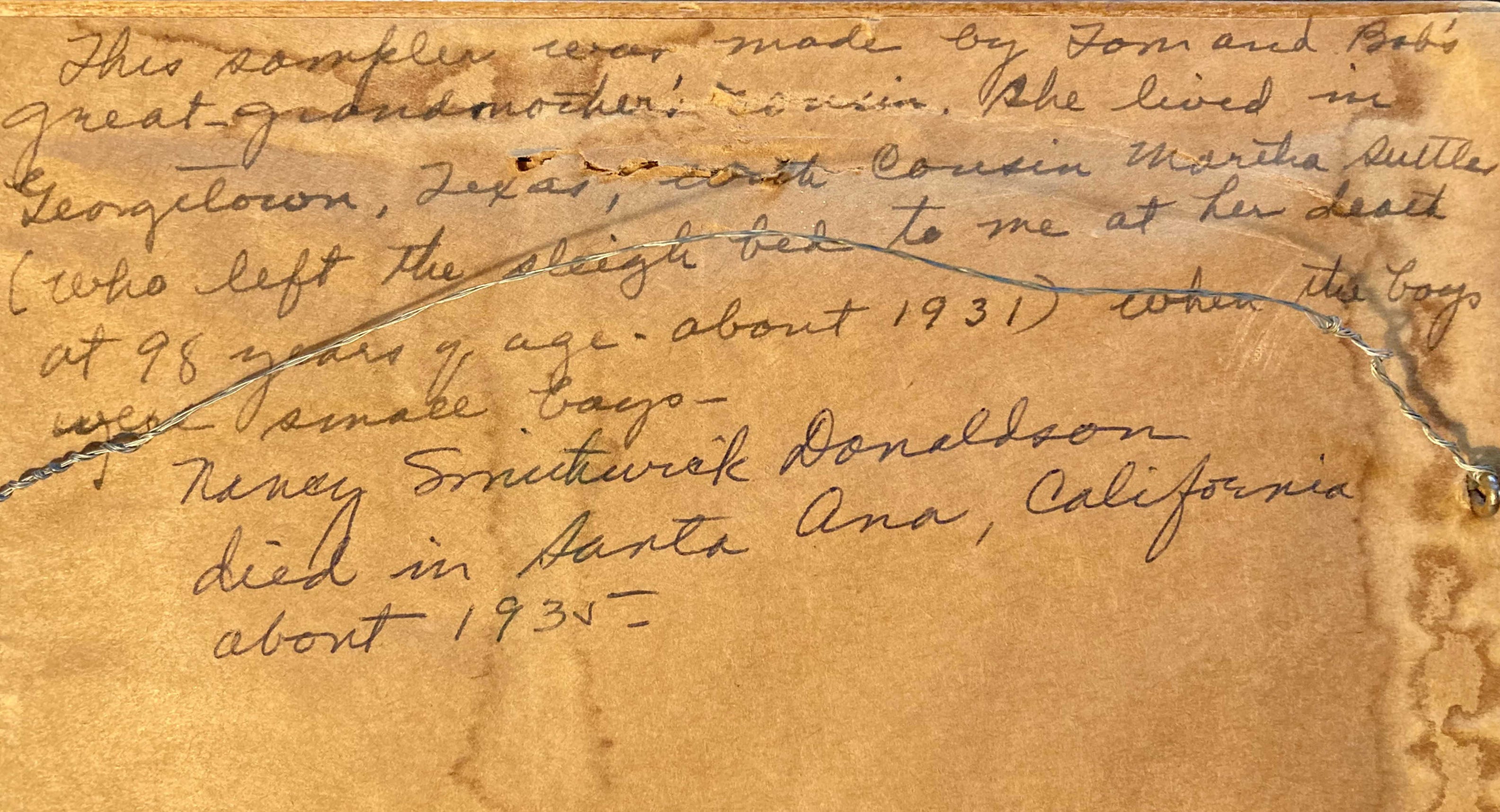
Nancy “Nanna” Smithwick was born October 14, 1845, ten weeks ahead of statehood: born a citizen of the Republic of Texas, a distinction she shared with a shrinking club for the rest of her long life. We know her birth date because she stitched it herself. A cross-stitch sampler survives in family hands, worked in red thread below two rows of alphabet practice: “Nancy Smithwick Born Oct. 14, 1845. Married to A. M. Donaldson Nov. 26, 1872.”
Both newspapers that announced that wedding say the 29th, though I’m not inclined to argue with the woman holding the needle.
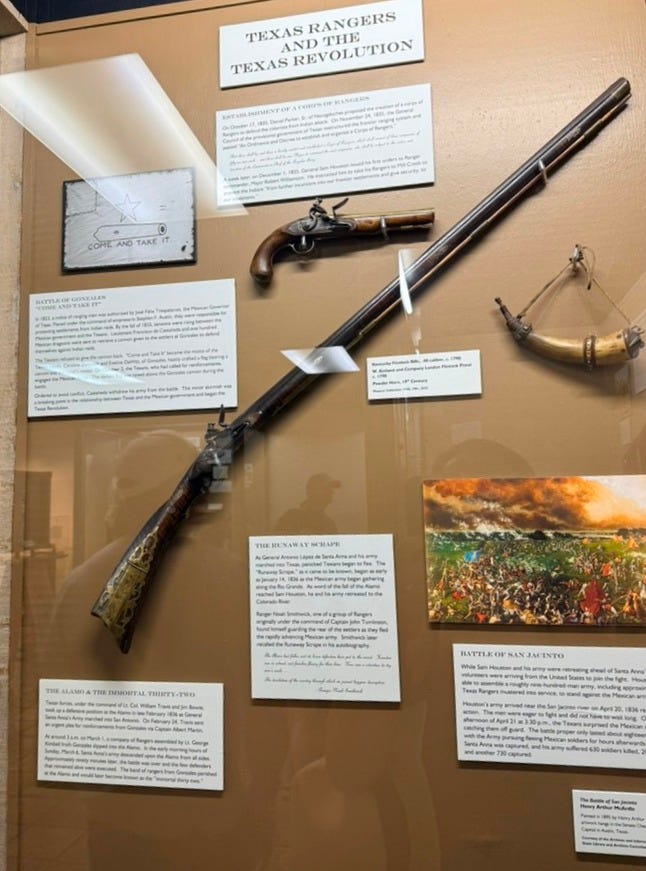
Her father was Noah Smithwick. He came to Texas in 1827, a nineteen-year-old blacksmith who then spent three decades standing wherever Texas history happened to be happening. He worked on the Gonzales cannon that fired the Revolution’s first shot. He rode as a Texas Ranger, first under Captain John Tumlinson and later out of Fort Colorado near Austin, and when the Alamo fell and panicked families fled east in the Runaway Scrape, he was in the rear guard, between the refugees and Santa Anna’s advancing army. He stayed until 1861, when his opposition to secession sent him west to California, done with Texas but never done remembering it.
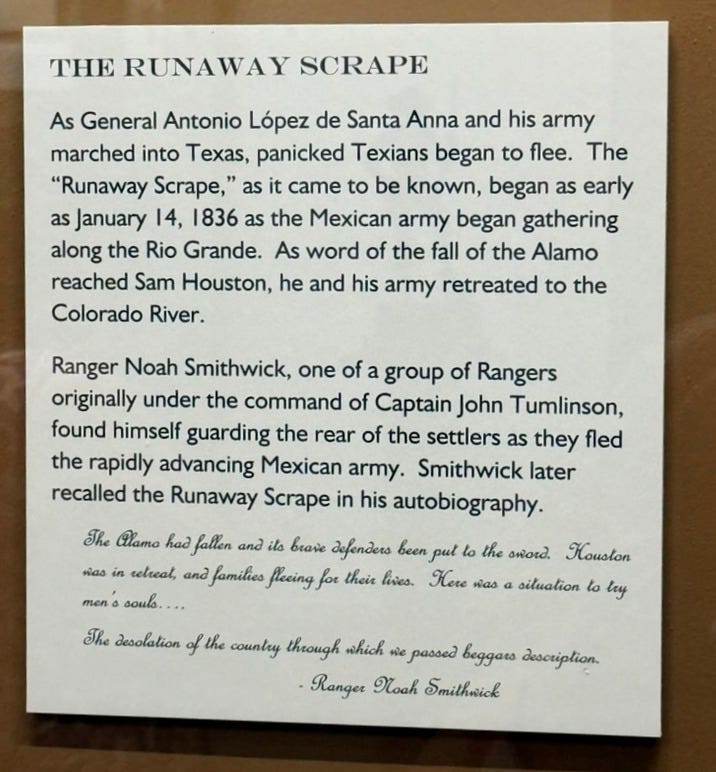
Last weekend I stood in front of an exhibit case at the Texas Ranger Hall of Fame and Museum in Waco, and there he was on the wall, quoted by name on the Runaway Scrape: “The Alamo had fallen and its brave defenders been put to the sword. Houston was in retreat, and families fleeing for their lives. Here was a situation to try men’s souls.”
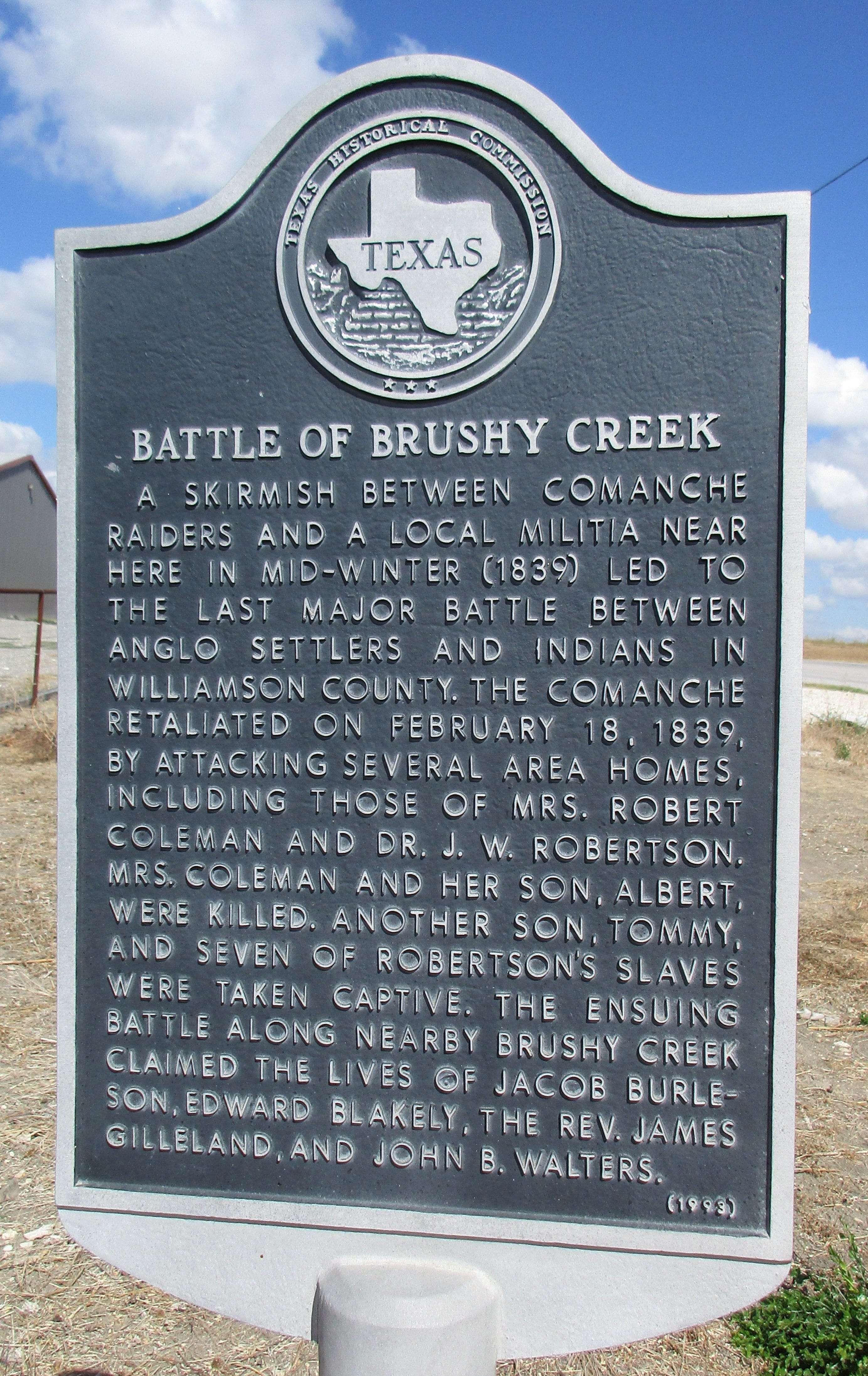
Nanna’s mother, Thurza Blakey Smithwick, was a pioneer Texan in her own right. Thurza lost a brother at San Jacinto, seventeen-year-old Lemuel, and a second brother, Edward, in the Brushy Creek Indian fight of 1839. Nanna had Texas blood on both sides, and one side of it was spilled right here in Williamson County.
Gone West
Nanna went west young, almost certainly with the family in 1861, when she was fifteen. A Sacramento newspaper’s marriage column proves she was there by her twenties: in November 1872 she married A. M. Donaldson at Linn’s Valley in Kern County, close by where her father had first settled after leaving Texas.
We don’t know much about Archibald M. Donaldson; he was born in Livingston County, New York, October 5, 1823. By 1880 he was farming in Kern County, where the census caught the two of them keeping house, a New York man and his Texas-born wife. He died near Bakersfield, September 4, 1881. His death notice was brief and gives us hardly any details of his life.

Whether she grieved her husband, the record declines to say, but she never once mentions him in any of the decades of letters that I’ve found.
What we do know is that Nanna Smithwick Donaldson was widowed at thirty-five, and she spent the next fifty-five years as her own woman.
Her letters drop breadcrumbs across the California map from there: a church bazaar in Bakersfield in the early 1880s, in the very years her married life was ending there, then Santa Ana, where her brother Edward lived on North Sycamore Street and where she made her own home from around 1889. Add it up and you get what she later called “half an ordinary lifetime in the Golden State.”
The Book
Santa Ana is where the family story turns literary. Noah had moved there in 1879 with his son Edward. There is an accident of spelling in that: the old Texas Ranger who once stood between fleeing Texans and Santa Anna’s army lived out his last twenty years in a town called Santa Ana, one n short of the general, named for the saint and not the soldier. He had gone blind in old age, but his memory of early Texas was intact and vivid, and somebody needed to get it down on paper. That somebody was Nanna. Noah talked; she wrote, shaped, and arranged, and The Galveston Daily News began printing his recollections with her hand on every line.
In October 1899, Noah Smithwick died at age 91, and the book did not exist yet.
The manuscript was a stack of paper in Santa Ana, its author was gone, and everything that happened next happened because his daughter made it happen. In November 1900 The Austin American-Statesman noted that Mrs. Donaldson had returned to Texas for good, manuscript in hand: “She will remain in Austin until the book issues from the press.” She did, and it did. The Evolution of a State came off Gammel’s press in 1900 with a line on the title page that most memoirs never grant: “Compiled by his daughter, Nanna Smithwick Donaldson.”
Compiled is the title page’s word. Her own word, in the preface she signed “Nanna Smithwick Donaldson, Austin, Texas,” was humbler still: an “amanuensis,” the hand that takes down another’s words. And then she wrote: “whatsoever of merit the work may possess, belongs of right to the author, while the amanuensis accepts whatever of blame that may attach to the defects the reader may discover.” She opened her father’s book by giving away every ounce of the credit and keeping the blame for herself.
The author had been dead a year when it was born. The book exists because she wrote it down, gave shape to his words, carried it across the country, and stood over the press until it was real, and it became one of the classic firsthand accounts of early Texas.
Pecan Spring
By 1903, Nanna was writing from Florence. Her first cousin, Martha, whose mother was sister to Nanna’s mother, had an old homeplace out that way, a spring-fed grove of patriarchal pecan trees Nanna said was known in the early days as Pecan Spring. Martha had just been widowed for the second time, and Nanna, family record-keeper by proven talent, went to her.
We know all this because Nanna wrote it up, of course. In April 1904 The Austin Statesman ran her long feature on the old house, under a byline its readers would have taken at face value: “Written for the Statesman by Nanna Smithwick Donaldson, author of ‘The Evolution of a State.’” Author. In print, in her lifetime, in the capital’s paper.
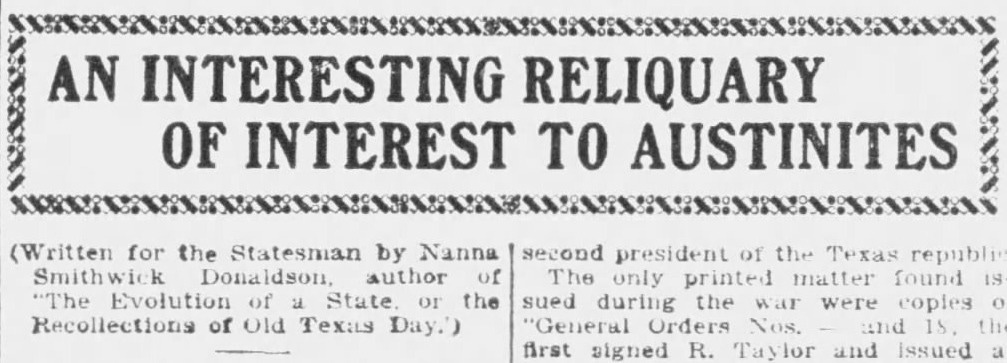
The piece itself is a delight, an inventory of a family attic by a woman with a historian’s eye: Republic of Texas treasury notes, Civil War orders, the dark blue silk dress Martha wore to Sam Houston’s inaugural ball in 1859, when she danced in the capitol itself. And one item in the inventory was an old sampler, stitched in Kentucky more than a hundred years before by the cousins’ shared grandmother, fine enough that Nanna judged it proof of the family line. Her grandmother kept the family record in thread. So did Nanna, in 1872. The women of the family had always been its historians.
That same month, April 1904, Nanna also published a signed note in the Quarterly of the Texas State Historical Association, weighing in on who really first said “Thermopylae had her messenger of defeat; the Alamo had none,” and correcting a general’s attribution on chronological grounds while she was at it.
In 1905 the cousins came in from the hills together. The Sun reported that September that Mrs. M. J. Suttles had bought “the Dick Morse place” in Georgetown, and the two women ran it as a household of two for a quarter century. The Sun’s locals column tracked them like the minor celebrities they were, and in April 1913 it settled any question of where Nanna belonged: “Mrs. Nana Smithwick Donaldson, who makes her home with Mrs. Martha Suttles, has gone to Idaho on a visit.”
Idaho. In 1913. At 67. When she summered in California in 1919, the Sun printed her travel letter from the Pacific. When she went again at 83, a Santa Ana paper marveled that “despite her eighty-three years,” she “travelled alone.” The woman moved through the world with ease, and the papers kept score.
Her Own Pen
Here’s the thing you learn reading thirty years of her clippings: Nanna never met a newspaper she wouldn’t write to, and she never needed her father’s book as an excuse.
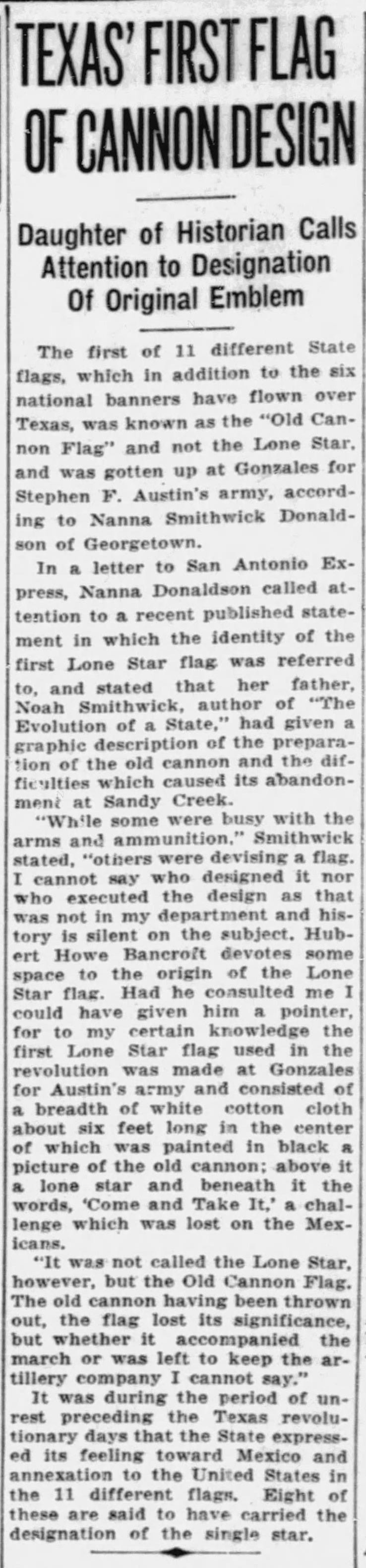
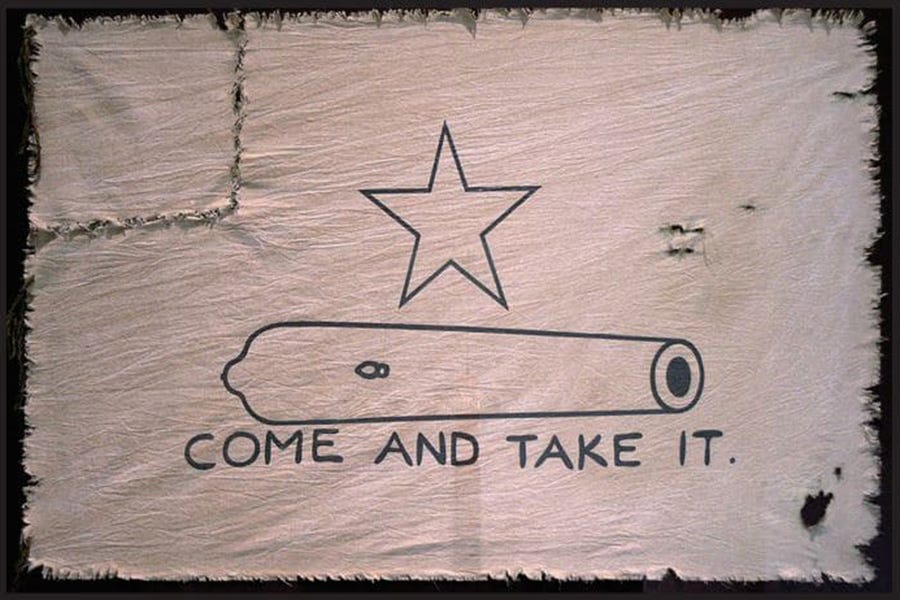
In 1903 she was writing to The Atlanta Constitution, of all papers, from Florence, Texas, of all places, hunting the name of a Georgia man who once ran a private gold mint. In 1931 she wrote The San Antonio Express to put the design of the Gonzales “Come and Take It” flag on record; she’s credited with sketching the cannon and flag she knew from her father’s account.
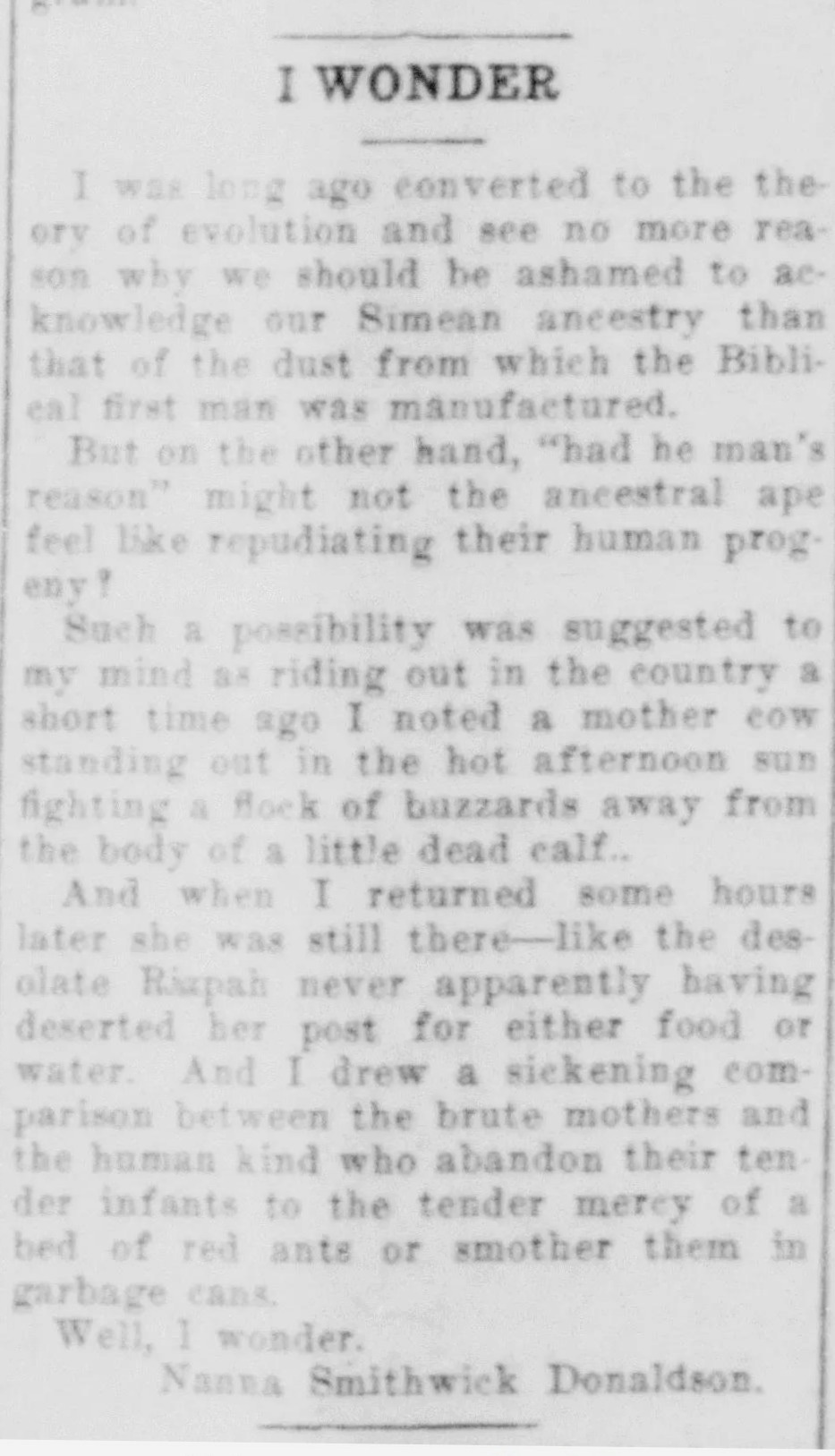
The Sun got her local material too. “I Wonder,” the evolution essay this piece opened with, ran there in 1927; two years later came “The Enchanted Well,” a bylined reverie about seeing pictures in the weathered wall of an old stone building, with a poem recited from memory out of a McGuffey’s Reader she’d carried in her head for half a century.
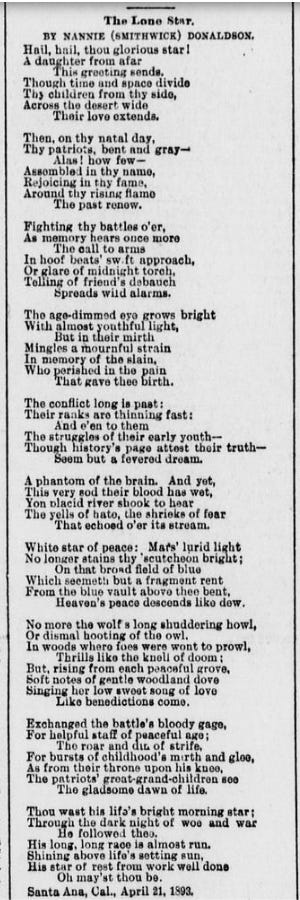
And she wrote poems, with receipts reaching back to the 1890s. The Galveston Daily News, the same paper that had carried her father’s recollections, ran her work from Santa Ana. On San Jacinto Day 1893 she penned a poem called “The Lone Star,” eleven stanzas addressed to the Texas star on behalf of the “patriots, bent and gray” of her father’s generation; its closing stanza, about an old man whose “long, long race is almost run,” was surely written with the blind 85-year-old in her own house in mind. She had Texas blood on both sides of that poem, and you’ve met the other side already: her mother’s brothers, dead at San Jacinto and at Brushy Creek. And on New Year’s Eve 1896 the News printed a second poem of hers, a farewell to a dying year called “Requiescat.”
Mrs. Donaldson Has Reaction
Martha Suttles died in the home she shared with Nanna in February 1931, a few weeks short of 98, and her will left the homeplace to her cousin. So at 85, Nanna Smithwick Donaldson became the owner of the house she’d already called home for decades.
If you’re picturing a quiet dotage, you haven’t been paying attention.
In 1933, the year she turned 88, Nanna sent the Sun at least four letters to the editor. The New Deal was remaking the country, and she was having none of it. In May she sized up the special session of Congress, then busy handing President Roosevelt his New Deal, and offered a suggestion: “I would suggest that as a matter of economy, they pass an act giving him blanket authority and retire to private life.”

In June she took “a parting shot at the Washington circus,” and that one had a story behind it.

Rummaging among old trinkets, she’d found a gold coin dated 1843 and took it to a bank, straight into the teeth of the new gold recall. The cashier refused it. “Having spent half an ordinary lifetime in the Golden State where gold coin was a common medium of exchange, I felt fairly stunned to be told that the stamp of the United States of America was not sufficient authority for its acceptance by any bank.” She took it personally, and she said why: “Every drop of blood in my veins came down to me through patriotic ancestors, and it boiled with indignation to think of the principles for which they fought being thus traduced.” The ancestors weren’t a figure of speech. Her father worked on the Gonzales cannon; her mother’s brothers died at San Jacinto and at Brushy Creek.
Then she turned on Congress: “But the ring-master cracked his whip and the animals obediently performed.” Agree with her politics or don’t; the Sun’s readers surely did both. What strikes me is the voice: confident, funny, literate, stuffed with allusion, coming from an 88-year-old woman writing at a desk in Georgetown. In an era when the paper’s society column recorded women mostly as hostesses and honorees, Nanna Smithwick Donaldson claimed the letters column, the essay page, and a historical quarterly, and nobody seems to have thought it strange. And if they did, she likely didn’t care.
A Footnote
Around 1934 she went back to Santa Ana for good, to North Sycamore Street, her brother Ed’s street, where the Smithwick clan gathered for Christmas reunions. In 1936 she sold the house in Georgetown to a family that would keep it for sixty years. She died at home in California late on Saturday, January 23, 1937, at 91, and was buried in Fairhaven Cemetery, survived by four nieces. No children. No grandchildren. No one whose job it would be to keep her name alive.
That same year, 1937, a Dallas literary column praised a new facsimile of the book and described how the blacksmith, by then too old to write it himself, “entrusted the task and his facts to an amanuensis, evidently his daughter, Mrs. Nanna Smithwick Donaldson.” The word was hers, remember, lifted from her own self-effacing preface. Texas took her at that word, though for now it still printed her whole name beside it. Then, in 1983, a Corpus Christi columnist gave the book a full, glowing column, “for any Texana nut, this book is a must,” and in the single clause he spared for the person who made it, he called her Norma.
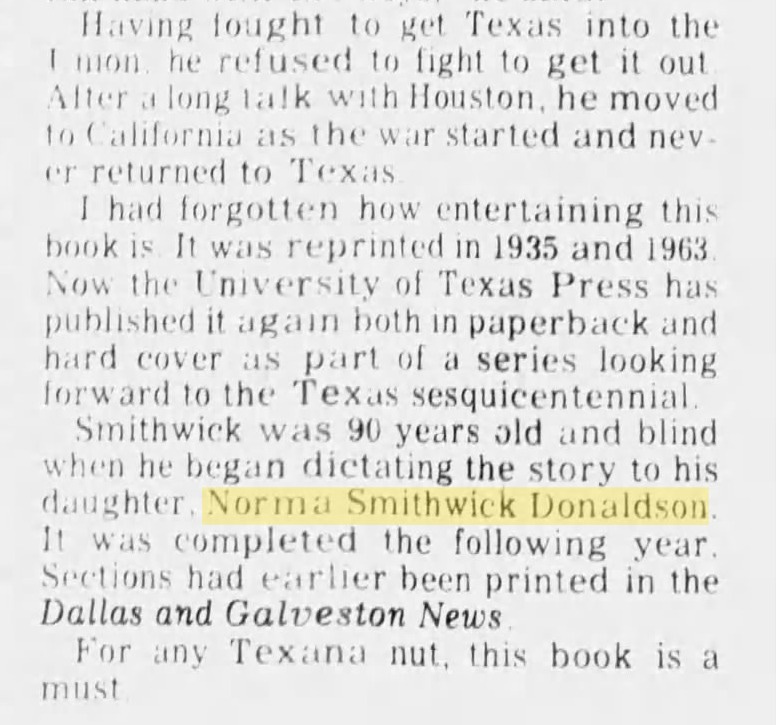
Norma. Four decades of bylines, and in the one place her name still turned up in print, somebody gave her a different one. The arc is easy to trace: author in 1904, an amanuensis in 1937 in the humbler word she’d picked out for herself, and by 1983 a stranger named Norma, and there was nobody left to write in and object.
The book was reprinted in 1935 and 1963, and the University of Texas Press keeps it in print to this day; you can still buy it, and her name is still inside, which means she was never really lost. Every Texas history buff who quotes Noah Smithwick has been quoting her all along.
Requiescat
She has no marker in Georgetown. But at Fairhaven, in Santa Ana, her family got the granite right: Nancy Smithwick Donaldson, 1845 to 1937, the whole name and the Republic birth year with it. The modern database that indexes her grave files her as plain “Nancy Donaldson.” Eighty-nine years on, the stone is still quietly correcting the record.

Her poems are still scattered through the old papers, waiting to be found. And Georgetown, to its credit, remembered her longer than the historians did. The Sun reprinted “Requiescat” for its readers around New Year’s 1930, while she was still living here, and when Fred Millholin needed a New Year’s piece for his Yesteryears history column in 1974, hers is the one he reached for, remembering her as “a well recognized and published Georgetown poetess.”

So let’s give her the last word, the one she wrote for a dying year:
Requiescat

Watched by the wan, cold moon, the dying year
Exhales his parting breath on midnight air.
The soft winds sigh, the sleeping forests stir
And rustle all their leaves in whispered prayer.

Though oft he broke for us the bitter bread
And mingled in our cup the drops of gall,
Our shrinking feet through thorny pathways led,
Yet the old year was something kind withal.

Then strew the sweet pale blossoms on his tomb,
Nor yet withhold the tribute of a tear;
E’en though the falling drop a smile illume,
Bearing a welcome on the bright new year.

–Nanna Smithwick Donaldson, Santa Ana, Cal.
Sources
Newspapers
“A Private Mint” [Mrs. N. Smithwick Donaldson letter via The Atlanta Constitution], The Williamson County Sun, 8 October 1903, p. 3.
Nanna Smithwick Donaldson, “An Interesting Reliquary of Interest to Austinites” [bylined “Written for the Statesman by Nanna Smithwick Donaldson, author of ‘The Evolution of a State, or the Recollections of Old Texas Day’”; the Suttles homeplace in northwest Williamson County; the grandmother’s sampler], The Austin Statesman, 10 April 1904, p. 9.
[Mrs. M. J. Suttles buys the Dick Morse place; Mrs. Nannie Smithwick Donaldson moving from Florence], The Williamson County Sun, 21 September 1905, p. 5.
Locals items on the Suttles-Donaldson household: The Williamson County Sun, 28 May 1908, p. 5 (Corpus Christi and Galveston); 22 September 1910, p. 5 (return from California); 24 April 1913, p. 5 (”makes her home with Mrs. Martha Suttles”; Idaho); 11 July 1919, p. 5 (to Los Angeles and Santa Ana to summer with her brother, E. Smithwick); “Mrs. Nanna S. Donaldson Writes from Pacific,” 8 August 1919, p. 8.
“Tribute to Mrs. Suttles” [80th birthday at her home], The Williamson County Sun, 13 March 1913, p. 6; “96 Years Old,” 8 March 1929, p. 1; “20 Years Ago” [reprinting the 20 February 1931 death notice of Mrs. Martha Jane Suttles], 22 February 1951, p. 7.
“An Appreciated Visit” [Suttles, Donaldson, and Knowles cousins; Donaldson biography], The Williamson County Sun, 3 June 1927, p. 3.
“I Wonder” [essay by Nanna Smithwick Donaldson], The Williamson County Sun, 23 September 1927, p. 4; “The Enchanted Well,” 28 June 1929, p. 2.
Letters of Nanna Smithwick Donaldson, The Williamson County Sun: “Mrs. Donaldson Has Reaction on ‘New Deal,’” 5 May 1933, p. 4; “Mrs. Donaldson Takes ‘A Parting Shot at the Washington Circus,’” 16 June 1933, p. 5; “Plans Remind Old Citizen of Church Grab Bag Era,” 11 August 1933, p. 6; “A Looker-On,” 27 October 1933, p. 4.
“Texas’ First Flag of Cannon Design” [Donaldson letter on the Come and Take It flag], San Antonio Express, 29 April 1931, p. 8.
[Mrs. Nanna Smithwick Donaldson returned from California; guest of Mrs. N. G. Shelley; the book in press], Austin American-Statesman, 17 November 1900, p. 2.
Nanna Smithwick Donaldson, “The Alamo Monument,” Notes and Fragments, The Quarterly of the Texas State Historical Association 7, no. 4 (April 1904): 328-329; quoted in The Waco Times Herald, 7 March 1909, p. 4.
“Marriages: At Linns Valley, November 29, A. M. McDonaldson [sic] to Nannie Smithwick,” The Sacramento Bee, 18 December 1872, p. 3.
“Married: At Linns Valley, Nov. 29th 1871 [sic; 1872], A. M. Donaldson to Miss Nannie Smithwick,” The Tulare County Times (Visalia, California), 14 December 1872, p. 2 (a second contemporary notice of the marriage, spelling the surname correctly; the printed year 1871 is an apparent misprint for 1872, and the day, November 29, agrees with the Bee against the sampler’s November 26).
“Noah Smithwick Dead,” The Tulare County Times (Visalia, California), 9 November 1899, p. 1: he “died at Santa Ana October 21st” “in his ninety-first year,” “belonged to the Texas Rangers, and was at one time a colonel of the militia,” and “was obliged to leave Texas by reason of his strong Union proclivities,” removing to Santa Ana in 1879 with his son Edward. The same notice gives the fullest word on his son-in-law: “A. H. [sic; A. M.] Donaldson, now deceased, at one time a supervisor of this county [Tulare], was married to Miss Nannie Smithwick, one of two daughters of deceased.” (The obituary’s California dates are garbled and are not relied on.)
“Mrs. Nanna Donaldson Is Complimented” [Christmas reunion, Santa Ana; “despite her eighty-three years, travelled alone”], The Register (Santa Ana, California), 27 December 1928, p. 10; “Nanna Donaldson Called by Death,” 25 January 1937, p. 3.
Nannie (Smithwick) Donaldson, “The Lone Star” [poem, dated Santa Ana, Cal., April 21, 1893], The Galveston Daily News, vol. 52, no. 73, 4 June 1893; and Nanna Smithwick Donaldson, “Requiescat” [poem, signed from Santa Ana, Cal.], The Galveston Daily News, vol. 55, no. 282, 31 December 1896; digital images, The Portal to Texas History.
“Fred Millholin’s Yesteryears: A New Year Is Drawing Near” [reprinting “Requiescat” in the “45 Years Ago” section, evidencing a Williamson County Sun reprint ca. New Year’s 1930, and identifying its author as a “well recognized and published Geogetown [sic] poetess” who resided with Mrs. Martha J. Suttles], The Williamson County Sun, 26 December 1974, p. 2.
“San Felipe as Young Blacksmith Knew It in 1828” [Hilton R. Greer on the Steck facsimile, crediting the amanuensis], The Dallas Journal, 14 July 1937, p. 10; “Descendents of Pioneer Texan,” Wichita Falls Times, 7 October 1936, p. 6; “Fort Colorado Replica About Finished,” The Austin American, 26 December 1966, p. 14; “Henry’s Journal: The Donkey Story,” Victoria Advocate, 13 March 1985, p. 2.
J. Frank Dobie, Guide to Life and Literature of the Southwest (Dallas: Southern Methodist University Press, 1943), “How the Early Settlers Lived”: “SMITHWICK, NOAH. The Evolution of a State, Austin, 1900. Reprinted by Steck, Austin, 1935. Best of all books dealing with life in early Texas. Bully reading.” (Text via Project Gutenberg ebook no. 314.)
Bill Walraven, “Texas in 1827: Land of Dried Venison and Mosquitoes” [full-column appreciation of The Evolution of a State; “his daughter, Norma Smithwick Donaldson”], Corpus Christi Caller-Times, 1 December 1983, p. 17.
Books, records, and other sources
Noah Smithwick, The Evolution of a State, or Recollections of Old Texas Days, compiled by his daughter Nanna Smithwick Donaldson (Austin: Gammel Book Co., 1900), including her signed preface (”Nanna Smithwick Donaldson, Austin, Texas”: the “amanuensis” passage; publication urged “for preservation”; Noah’s “death occurring before the final revision was completed”) and her portrait plate (”Mrs. Nanna Smithwick Donaldson”); reprinted Austin: Steck Co., 1935; Austin: University of Texas Press editions in print.
Cross-stitch sampler of Nancy Smithwick, 1872 (recto), with provenance note (verso); family-held, digital images via Ancestry member tree.
Will and probate of Martha Jane Suttles, Williamson County (1931 devise to Nanna Smithwick Donaldson); death certificate, Texas no. 10684 (parents Robert Anderson and Sarah Blakey); deed, Nanna Smithwick Donaldson to Fred Millholin, Williamson County Deed Records, vol. 293, p. 510 (1936).
Bernard Buckner Blakey, A Blakey Book (Little Falls, Minnesota, 1977), p. 45 (the Blakey sisters: Sarah A. Blakey m. Robert Anderson; Thursa N. Blakey m. Noah Smithwick).
Gravestone of Nancy Smithwick Donaldson (1845-1937), Fairhaven Memorial Park, Santa Ana, California; photograph via Find a Grave, memorial no. 68043433 (where the same stone is indexed as “Nancy Donaldson”).
Gravestone of Archibald M. Donaldson (”Sacred to the memory of... born in Livingston Co., N.Y., Oct. 5, 1823, died near Bakersfield, Kern Co., Cal., Sept. 4, 1881”); Union Cemetery, Bakersfield, Kern County, California; photograph via Find a Grave, memorial no. 116739883.
1880 U.S. Federal Census, 5th District, Kern County, California (Supervisor’s District 4, Enumeration District 20, page 42, lines 18-19; enumerated June 26, 1880, John Henry Peters, enumerator), A. M. Donaldson household, dwelling 448 / family 473: “A. M. Donaldson,” age 53, farmer, born New York (father born Scotland, mother New York), head of house; wife “Nancy,” age 34, keeping house, born Texas (father born North Carolina, matching Noah Smithwick); two-person household; digital image via Ancestry (member tree identifies him as Archibald Melville Donaldson). The census age (53, implying birth ca. 1827) does not match the gravestone’s October 5, 1823; the gravestone date is used in the text.
“A. M. Donaldson, an old pioneer of Tulare County, and at the time of his death a resident of Kern County, has just died,” The Tulare County Times (Visalia, California), 17 September 1881, p. 2 (his entire death notice).
L. W. Kemp, “Blakey, Lemuel Stockton” [typescript biographical sketch, c. 1934-36], Kemp Sketches, pp. 271-275, San Jacinto Museum of History (sanjacinto-museum.org/KempSketches/SJV75.pdf): Lemuel S. Blakey killed at San Jacinto in Capt. Jesse Billingsley’s company; his brother Edward J. Blakey killed in the Brushy Creek fight, 1839; their sister Thursa m. Noah Smithwick; “Nannie who married Archibald M. Donaldson.”
Old Town Echoes is independently researched using primary historical sources. AI tools assist in drafting and editing; all content is reviewed, sourced, and verified by the author.