


This week’s tea is a quick cup, but it’s a sweet one, and there are elephants.
On a Friday morning in October of 1903, at 11am, Georgetown put down what it was doing and turned up at the Square. The Gentry Brothers’ famous trained animal show had come to town, and the parade was a free spectacle.
Weeks of Anticipation
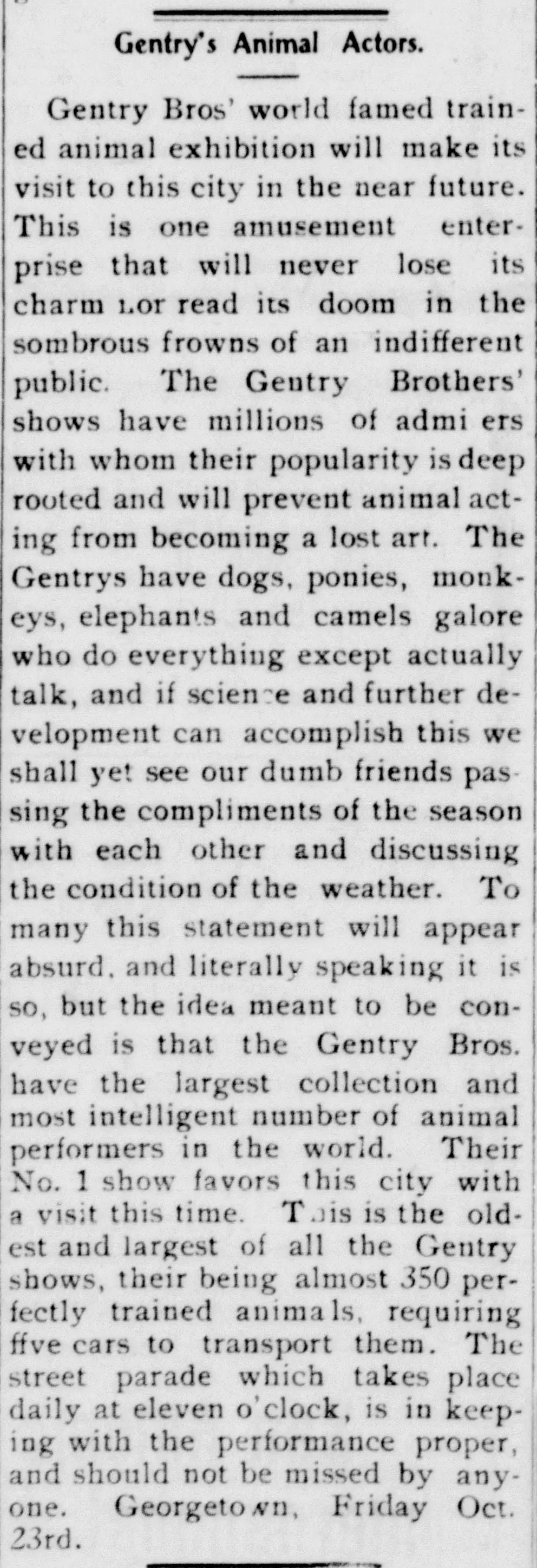
The town had plenty of warning. On October 15, the Williamson County Sun announced that Gentry Brothers’ No. 1 show was on its way, the oldest and largest of all the Gentry shows, almost 350 trained animals riding in five railroad cars. The Sun did not undersell it:
“This is one amusement enterprise that will never lose its charm nor read its doom in the sombrous frowns of an indifferent public.”
The Gentrys, the paper went on, had “dogs, ponies, monkeys, elephants and camels galore who do everything except actually talk.”
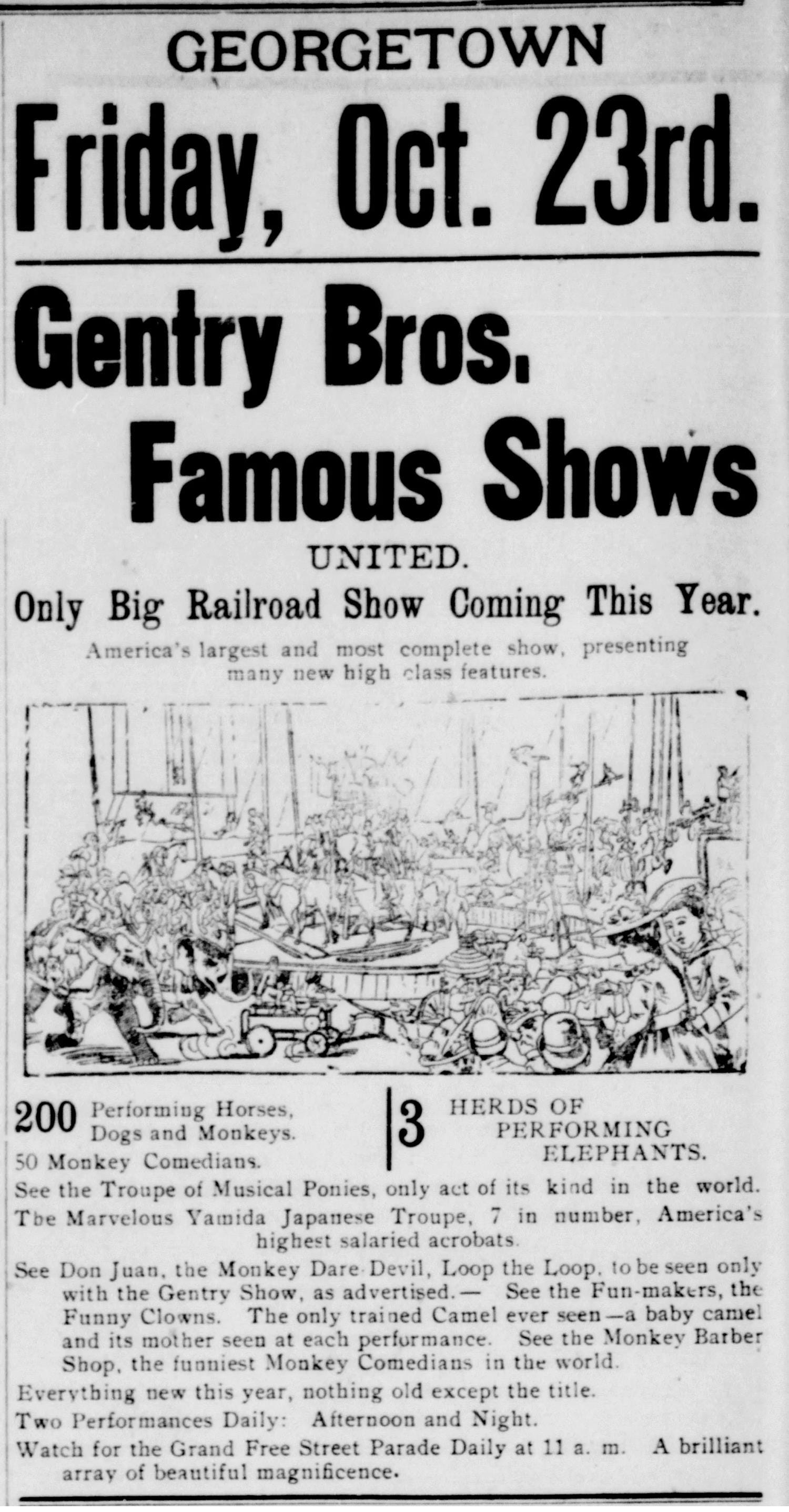
A week later the show’s own advertising took over a column of page 8: two hundred performing horses, dogs and monkeys. Fifty monkey comedians. Three herds of performing elephants. A troupe of musical ponies, “only act of its kind in the world.” The Marvelous Yamida Japanese Troupe, “America’s highest salaried acrobats.” Don Juan, the Monkey Dare-Devil, who looped the loop. A monkey barber shop.
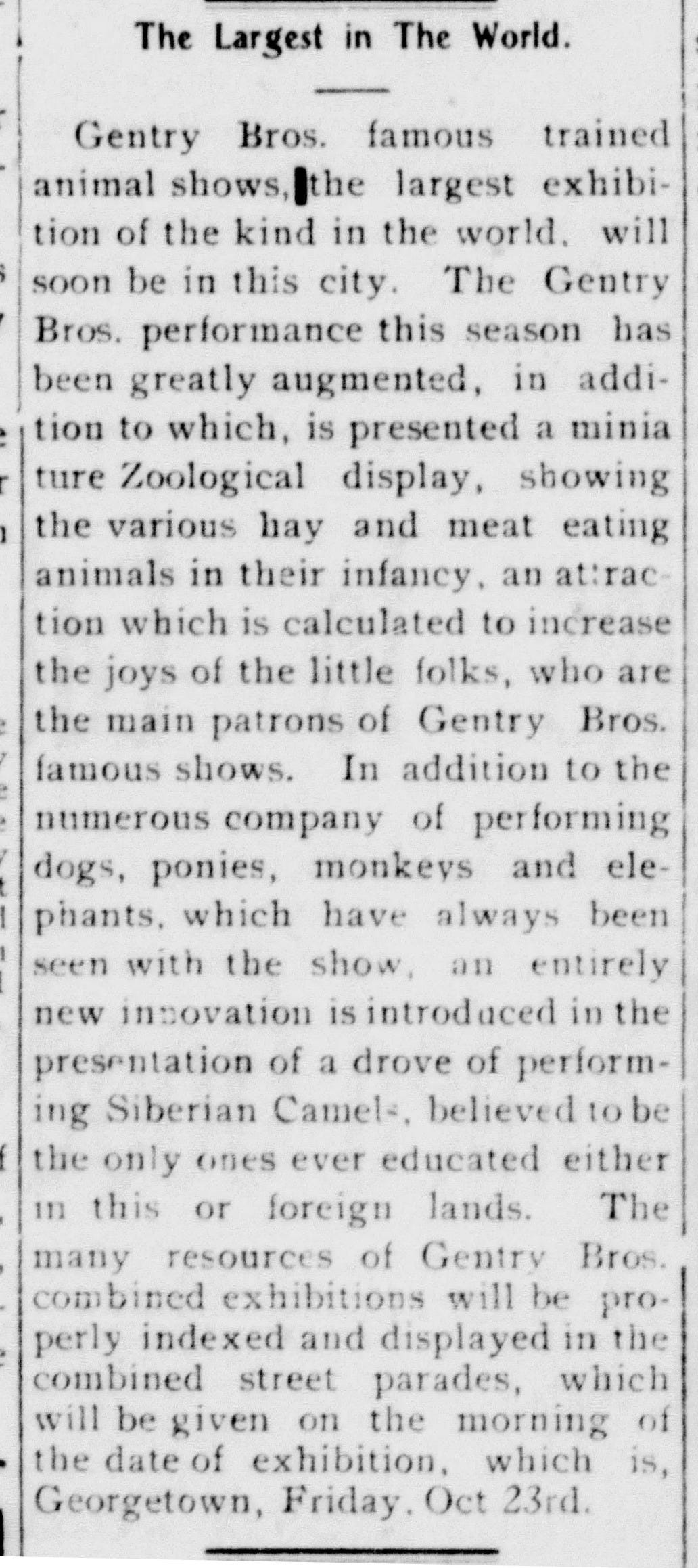
That same issue promised the little folks, “the main patrons of Gentry Bros. famous shows,” a miniature zoo of baby animals, plus an entirely new innovation: a drove of performing Siberian camels, “believed to be the only ones ever educated either in this or foreign lands.” The ad on the next page claimed the only trained camel ever seen was a baby camel and its mother. So was Georgetown getting two educated camels, or a whole drove of them? Depended on which page you read. Nobody seems to have minded.
What the Camera Caught
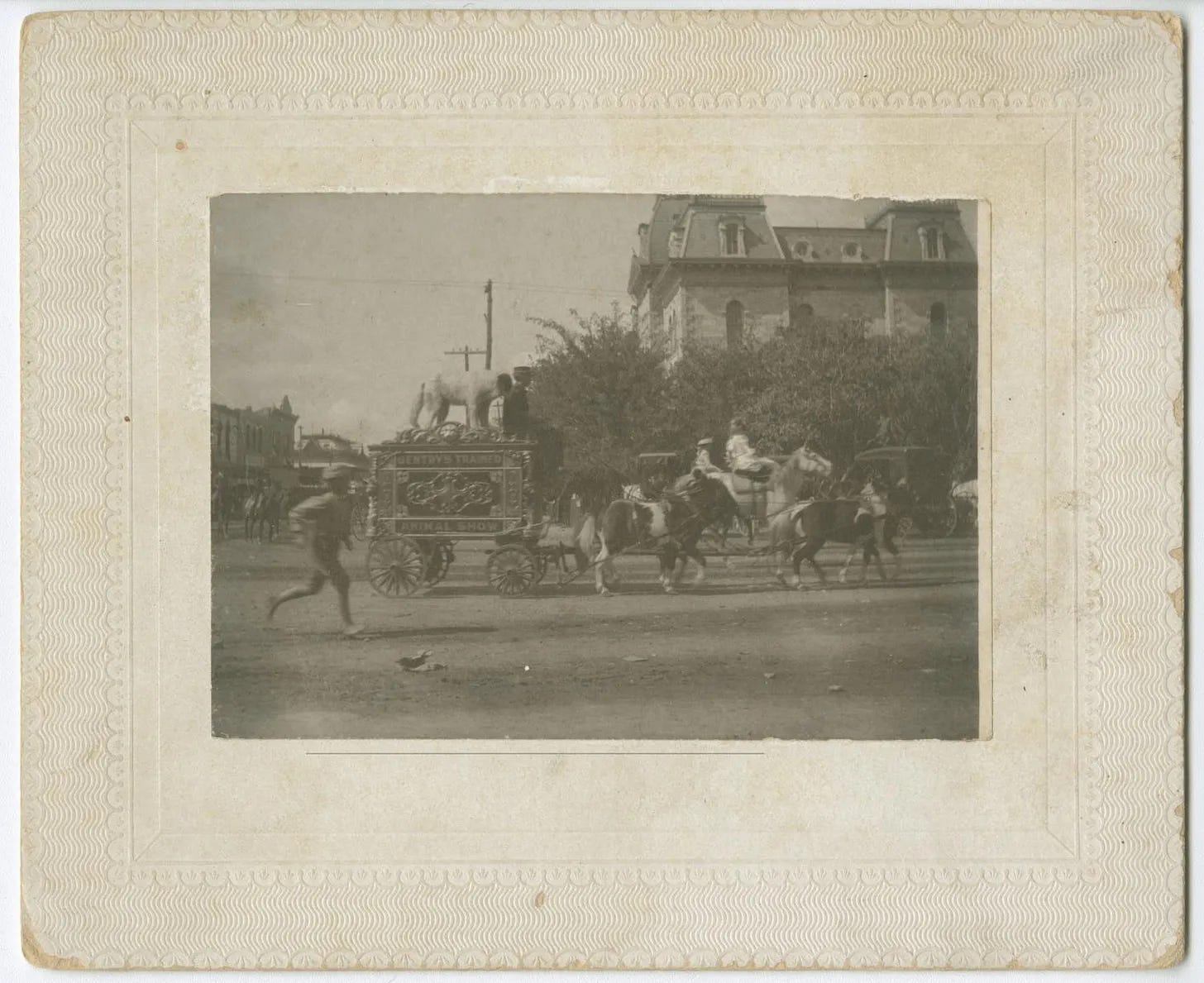
The parade rolled at eleven on the morning of the show, Friday, October 23, and the Sun advised that it “should not be missed by anyone.” We know what it looked like, because someone stood at the edge of the square with a camera. The gilded wagons came first, lettered GENTRY’S TRAINED ANIMAL SHOW and drawn by matched teams of little ponies.
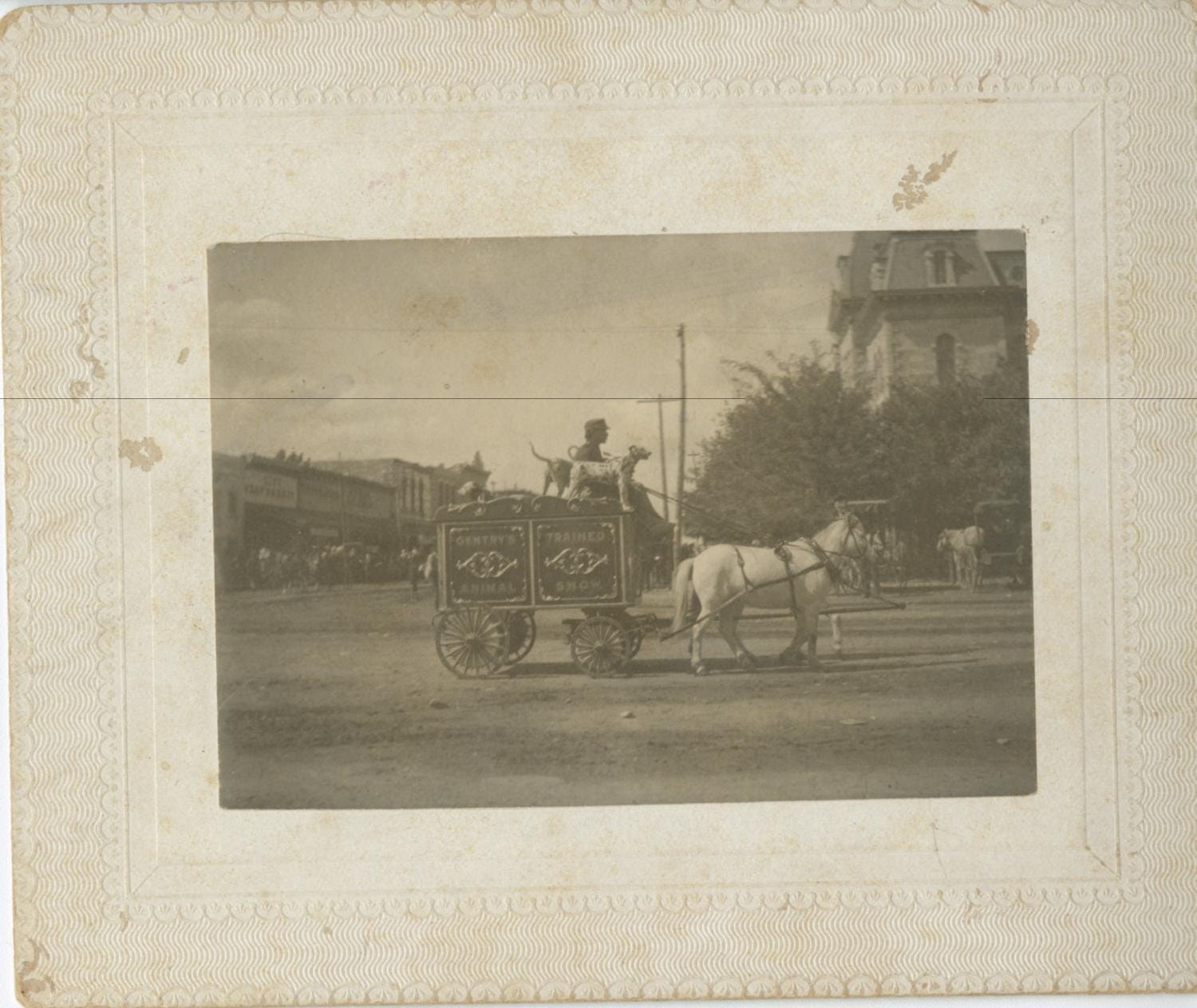
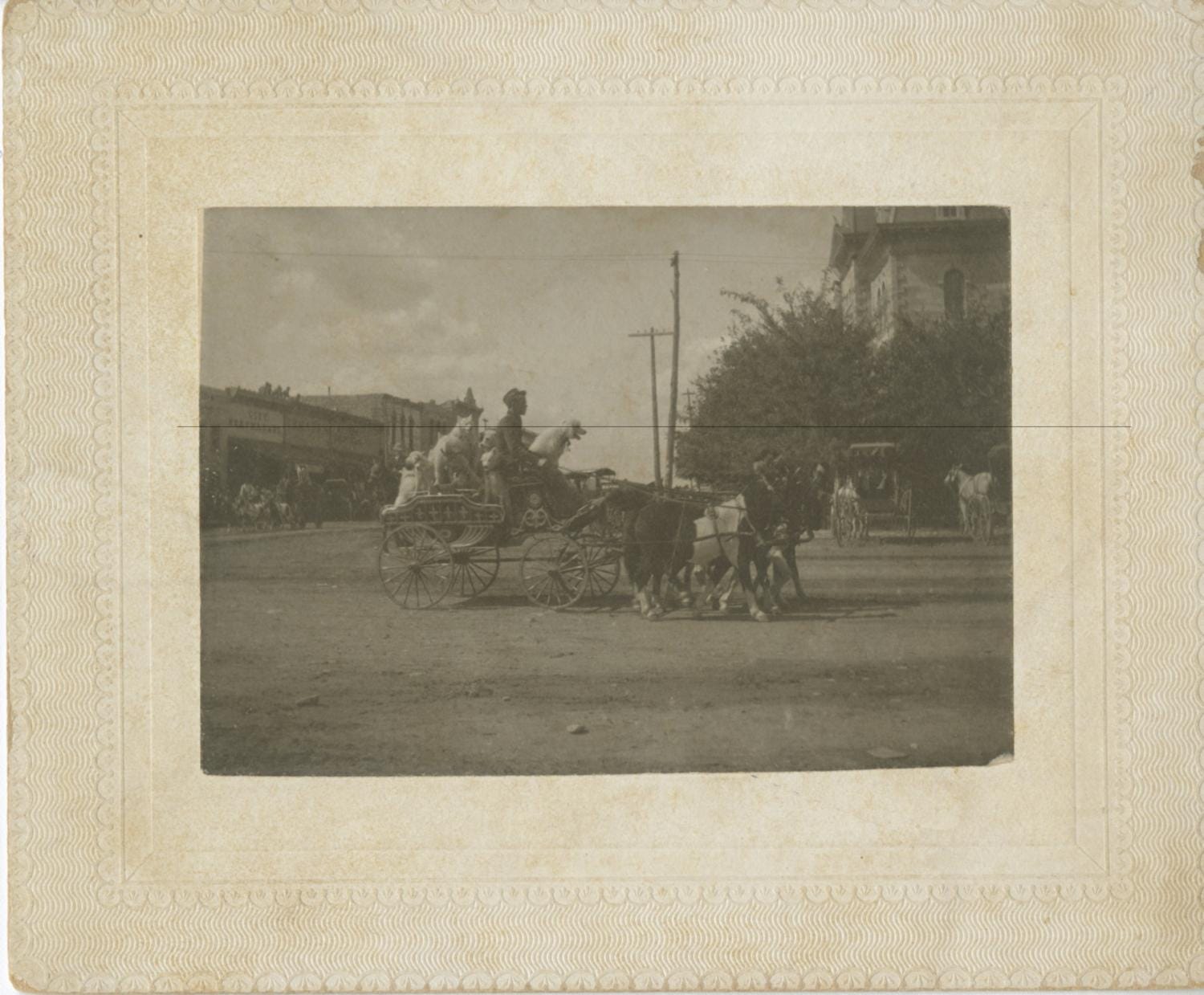
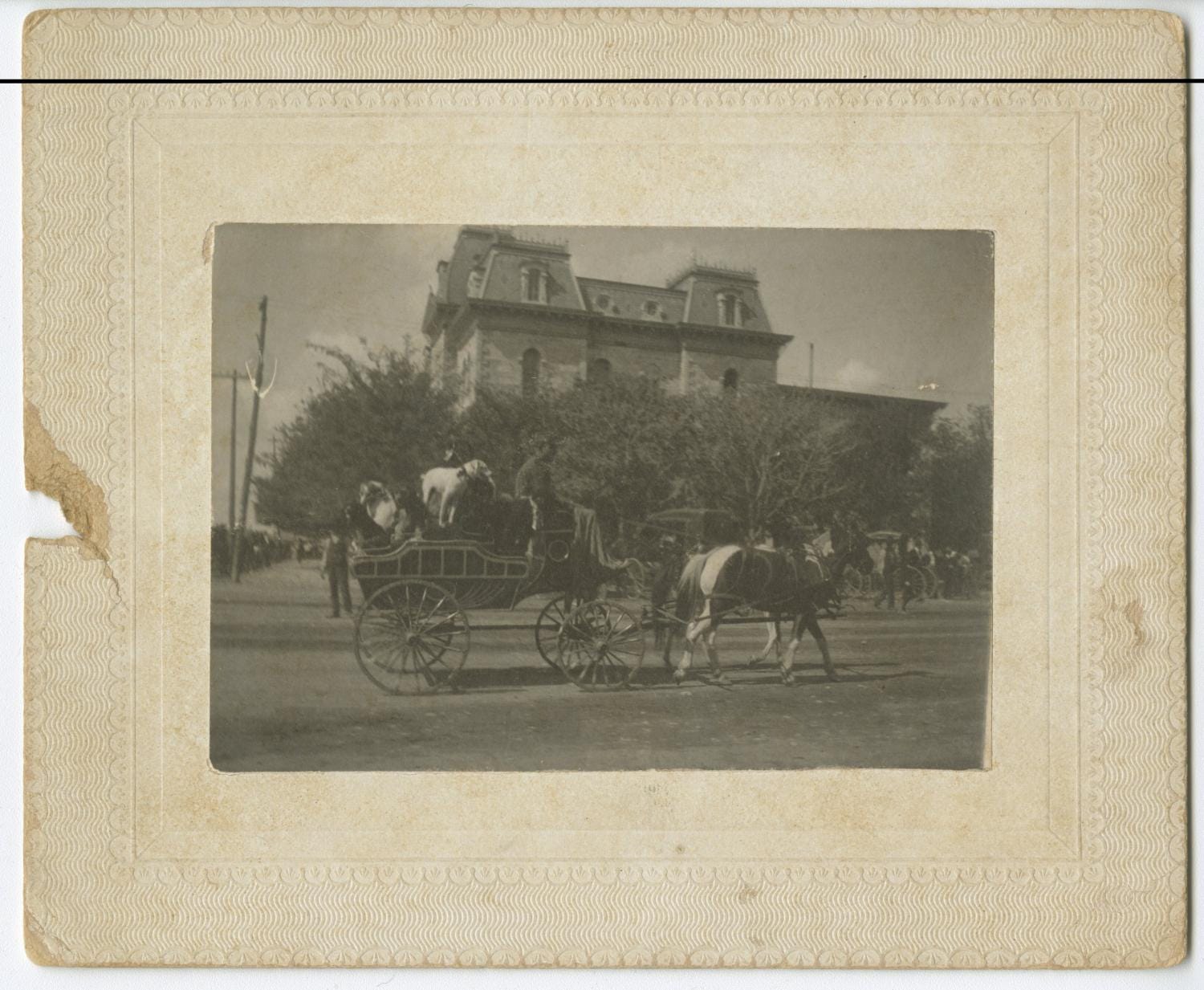
Behind them came an open carriage with trained dogs riding the rooftop like they owned the place, and the procession strung itself down the block, crowds lining the storefronts.
Then the elephants, two of them, in embroidered blankets with their names worked into the cloth: Pinto, the big one, and Little, who wasn’t so little.
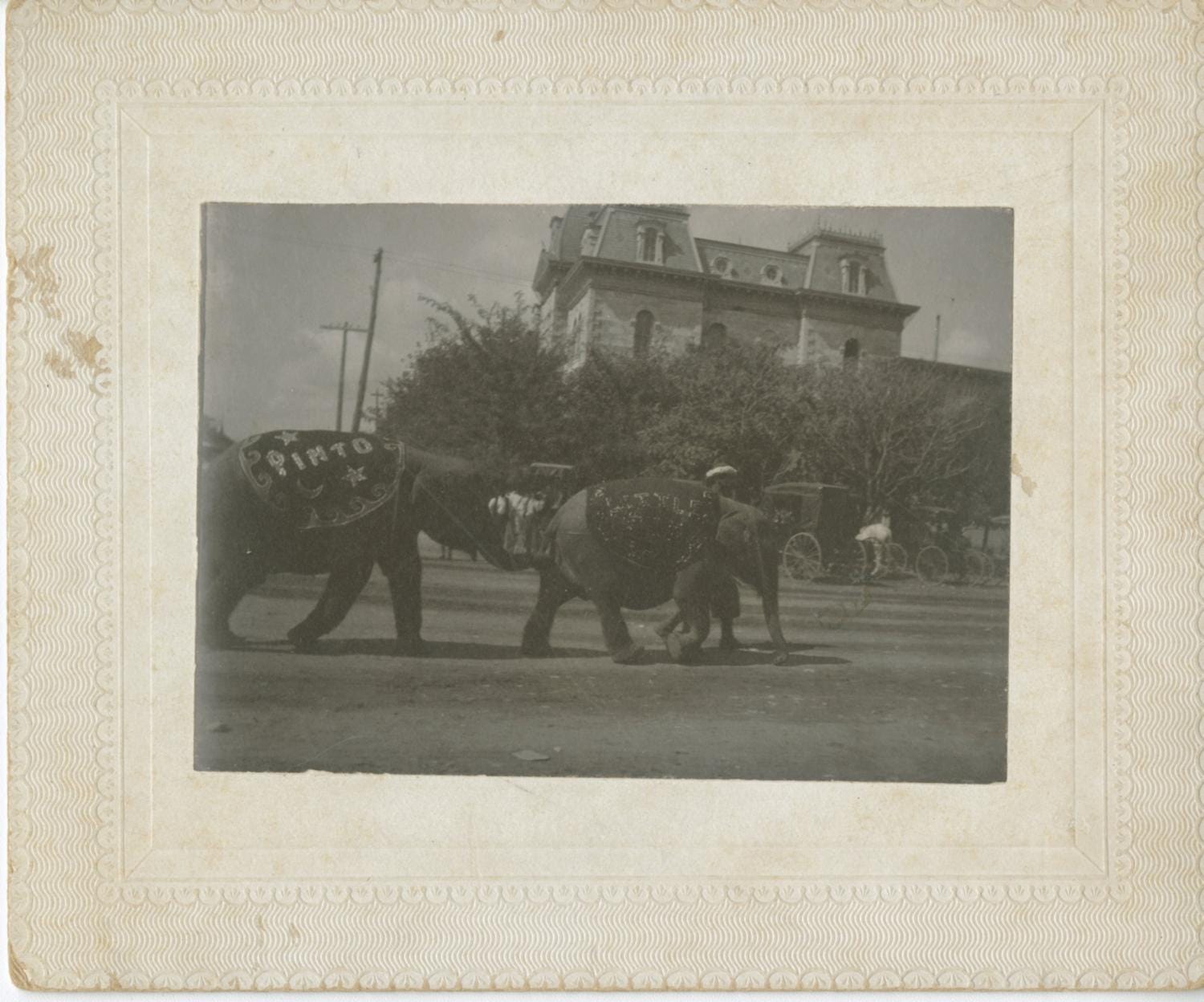
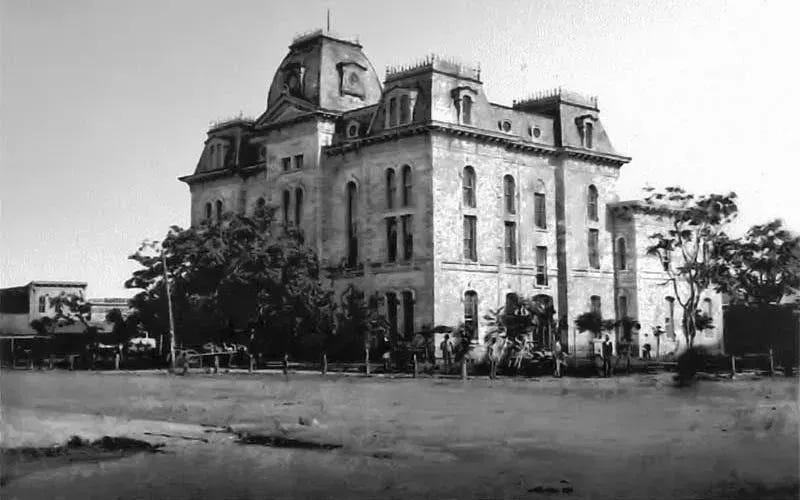
Look past the animals in these photographs. Rising behind the whole procession is the old fourth courthouse, with mansard roof and proud little tower, which the town would tear down within the decade. The photos hold two vanished things at once, a circus that passed in an afternoon and the building it passed in front of.
That someone with the camera was Annie Whittenberg, a young woman who had married a young Georgetown newspaperman named John Sharpe just that summer, a few months before the elephants came through. But theirs is a story for another day.
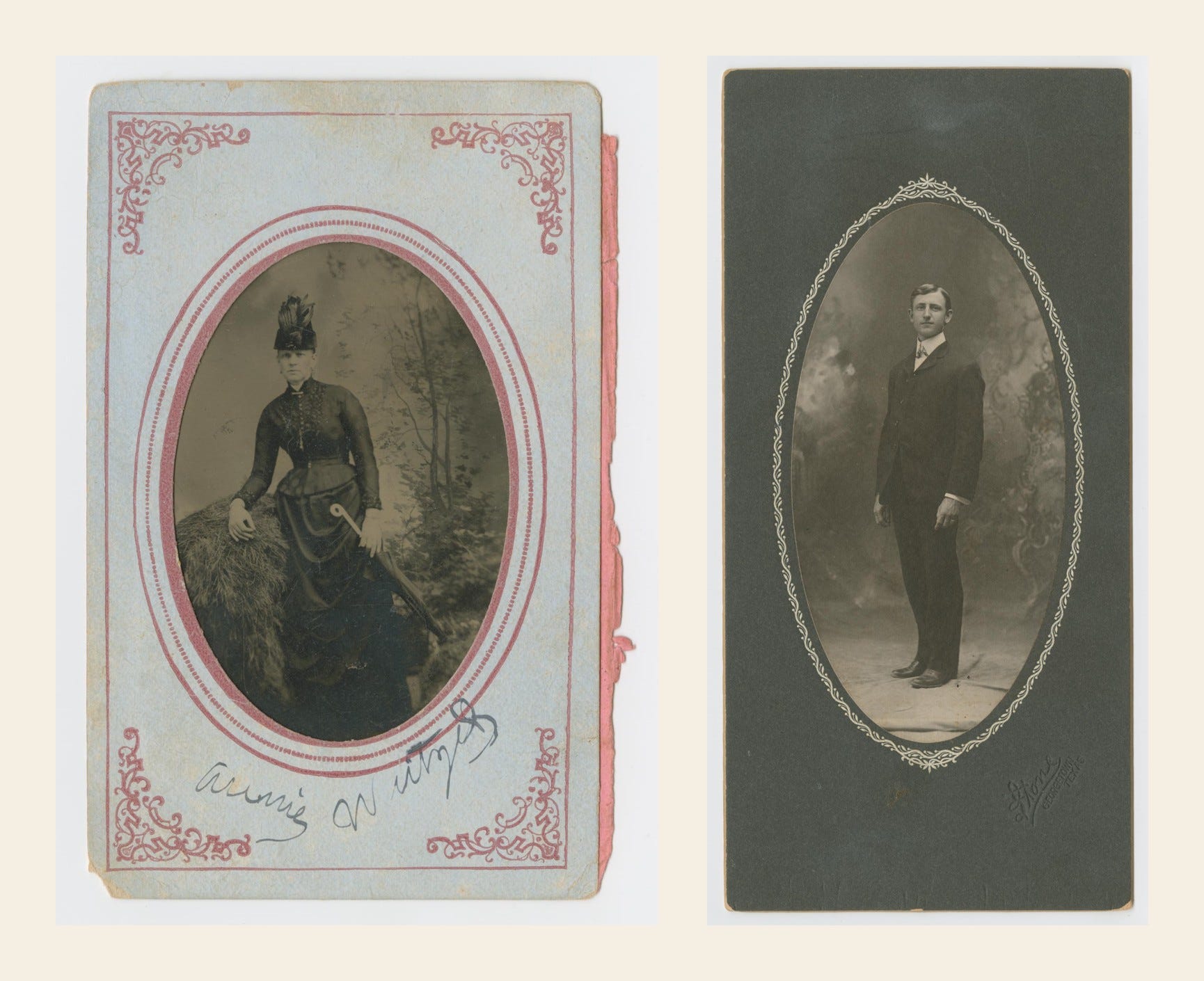
Who were Annie and John Sharpe? Do you know anything about the Sharpe family of Georgetown? Tell us about them in the comments!
Sources
The Gentry Brothers’ Show
“Gentry’s Animal Actors,” The Williamson County Sun (Georgetown, Texas), 15 October 1903, p. 7; digital image, Newspaper Archive (newspaperarchive.com : accessed 18 July 2026).
“The Largest in The World,” The Williamson County Sun (Georgetown, Texas), 22 October 1903, p. 7; digital image, Newspaper Archive (newspaperarchive.com : accessed 19 July 2026).
Gentry Bros. Famous Shows United, display advertisement, The Williamson County Sun (Georgetown, Texas), 22 October 1903, p. 8; digital image, Newspaper Archive (newspaperarchive.com : accessed 18 July 2026).
The Parade Photographs
Gentry’s Trained Animal Show parade photographs (five views: show wagons, dog carriage, procession, and elephants “Pinto” and “Little”), Georgetown, Texas, 23 October 1903; John Sharpe Collection, The Williamson Museum, Georgetown, Texas; digital images, The Portal to Texas History (texashistory.unt.edu), items metapth182564, metapth182565, metapth182566, metapth182567, and metapth182568 (accessed 18 July 2026).
Annie Whittenberg, manuscript note on reverse of the elephants photograph (metapth182567): “These are pictures I took of parade, Dog and Pony Show, Georgetown Texas, in about 1902 or 1903. Miss Annie Whittenberg.” The parade date is fixed to 23 October 1903 by the Sun notices above; a search of the 1902 Sun found no earlier Gentry visit.
The Fourth Courthouse
Photograph of the fourth Williamson County Courthouse (1878–1910), photographer unknown; print in project research files.
Photograph of the fourth Williamson County Courthouse with note of its condemnation and the $100,000 bond for its successor, The Williamson County Sun Booster Edition, 7 October 1909, p. 20; digital image in project research files.
Preservation Georgetown, “Historic Williamson County Courthouse,” Walk This Way walking tour, preservationgeorgetown.org (accessed 18 July 2026), for the 1878 construction (Ruffini & Preston, architects; John Didelot, builder) and 1910 demolition.
Annie Whittenberg and John Sharpe
Tintype portrait of Annie Whittenberg, ca. 1880s, signed “Annie Whittenberg” on the paper frame; John Sharpe Collection, The Williamson Museum (WILLM 2006-015-265); digital image, The Portal to Texas History (texashistory.unt.edu), item metapth426944 (accessed 18 July 2026).
Wedding portrait of John M. Sharpe, Sr., Stone Photography, Georgetown, Texas, 7 July 1903; John Sharpe Collection, The Williamson Museum (WILLM 2006-015-354); digital image, The Portal to Texas History (texashistory.unt.edu), item metapth426899 (accessed 18 July 2026). Typed notes on the reverse record his 7 July 1903 marriage to Annie Emily Whittenberg and his arrival in Georgetown, ca. 1898, to work in his uncle R. E. Gates’s newspaper and print shop.
Old Town Echoes is independently researched using primary historical sources. AI tools assist in drafting and editing; all content is reviewed, sourced, and verified by the author.