


In the third week of November 1923, anybody in downtown Georgetown after dark could look up and see a man standing on the rim of the city standpipe. He was “one hundred and ten feet above the street,” by the Williamson County Sun’s count, “with one foot hanging off,” and he had an electric light in his hand.
He was a dummy.
The Sun spelled it “dummie,” and it was dressed as Harold Lloyd, standing over a sign stretched around the rim of the big tank. Lloyd’s new comedy, Safety Last, is the one where he dangles from a clock face high above a city street. It was the feature picture that week at the Monarch Theatre, and the Monarch’s manager had found the best spot in town where the ad could do something like what the movie did.
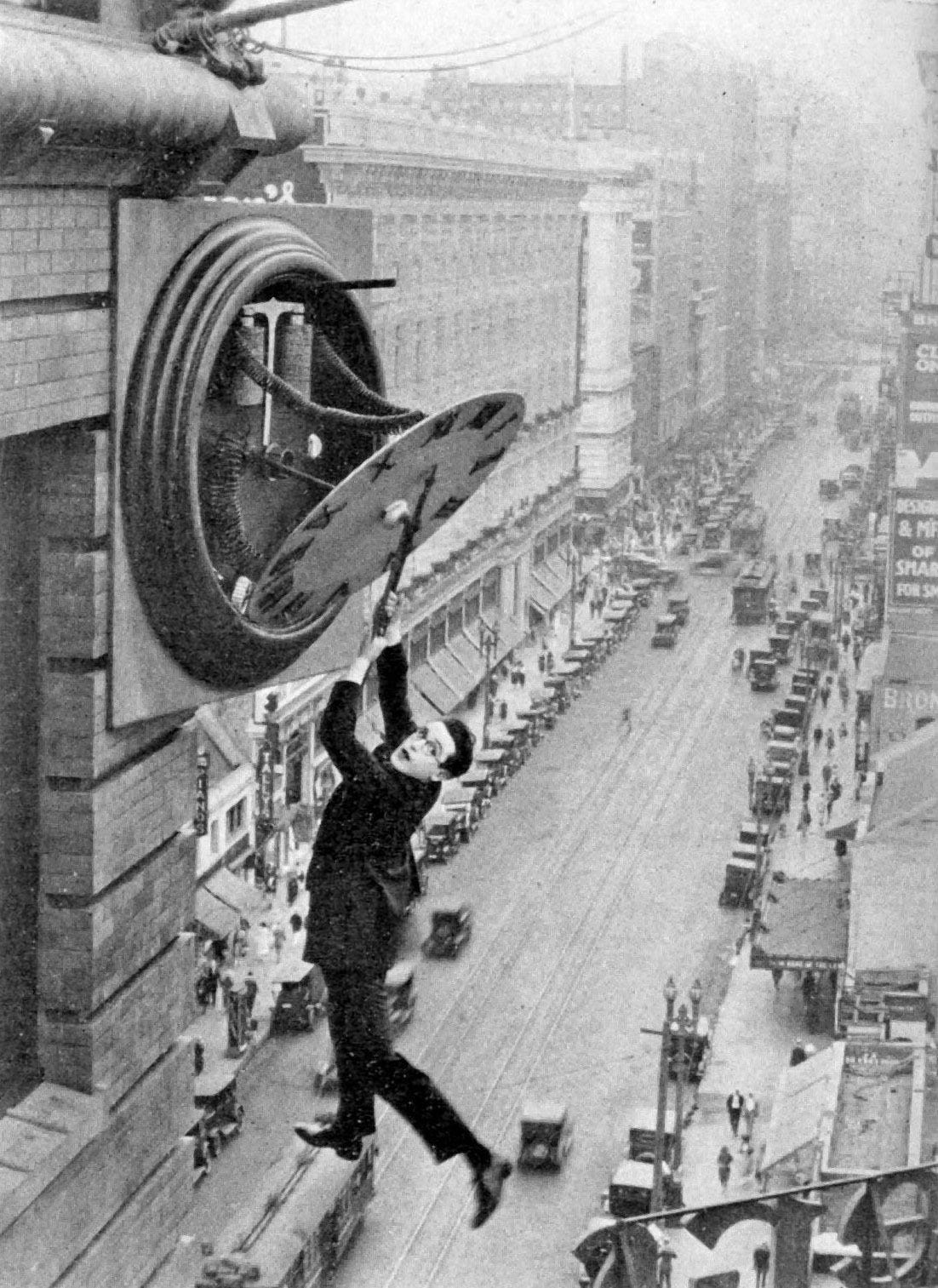
The paper gave the best line to a small boy looking up from the street: “The fellow who put that there has Harold Lloyd skinned when it comes to looking down from high things.” The Sun agreed with him. “We think so, too; he’s skinned at least 110 feet.”
The Monarch manager’s name was Sebe Goodlett.
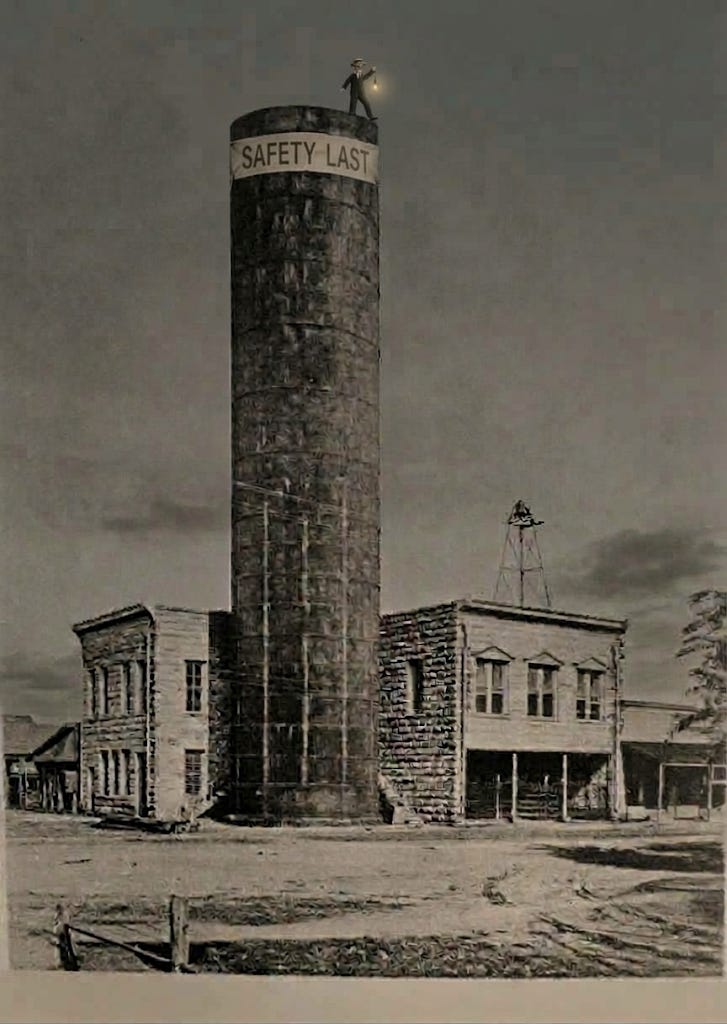
If you read The Theatre Without a Roof, you’ve met Sebe’s family. His father, Dave Goodlett, opened Georgetown’s first moving picture show in 1907 and ran it for years in a fenced lot on the Square called the Airdome. You’ve met the standpipe, too, if you went looking for the bonus points in the Main Street photo. (If you’ve never heard of the standpipe, see Liz Weaver’s post about it from earlier this year.) Sebe himself got two sentences in my earlier piece. He and his mother kept the Monarch running after Dave died, and in 1928 they sold it.
This week’s tea is the rest of Sebe’s story. He lost a foot to a train at 17, sold picture shows through a megaphone, and built at least part of a pleasure resort on the ground between the two forks of the San Gabriel. When I pulled the newspaper story that announced his park, there was more on the page than a park.
Born Into the Business
Sebe Scott Goodlett was born in Georgetown on April 6, 1895, the older of Dave and Alice Goodlett’s two sons. His brother Patsy arrived two years later. (Patsy isn’t Pat. Pat Goodlett, the fire chief from the Airdome story, was their uncle.)
By the 1910 census the whole household was in the picture business. Dave was a “Showman, Moving pictures.” Alice was listed as “Bookkeeper, Moving Picture show,” working on her own account, which is more than most census takers recorded for a wife. Sebe was 15.
(How do you pronounce Sebe? Sources vary. My best guess is SEE-bee, but I don’t know for sure. I do know it wasn’t a nickname; his birth certificate named him Sebe Scott.)
On the evening of March 13, 1913, Sebe and a friend were walking down the International & Great Northern track when the passenger train came through. They stepped off, one on either side, to let it pass. When it was gone, the friend found Sebe with his left foot “badly mangled.” He was driven to a sanitarium in Temple, and on April 10 the Sun reported that the amputation had been done the week before and that he “continues to do well and will soon be able to come home.”
He was 17. Four years later, when he registered for the draft, he gave his occupation as “Moving Picture Operator” and his employer as “Dave Goodlett.” The registrar added two words at the bottom of the card: “Lost foot.”
It didn’t keep him off a stage. In February 1918 the Southwestern YWCA put on a farce called “A Womanless Wedding,” with “many of our chief citizens” in gowns and hats, and the Sun’s review made a point of saying “the impersonations by Sebe Goodlett” were “fine.”
When the census taker came back in January 1920, Dave was still “Showman” and Alice was “Cashier, Picture Show.” Sebe, 24, was “Manager.” Two months later, on March 8, Dave collapsed in Hodges Bros. drug store. The Sun wrote that “his son, Sebe, was called, arriving at his side a few minutes before the end.”
Sebe was already managing the Monarch when his father died, and he went on managing it, with Alice and Patsy alongside him. He had his father’s habit of giving the show away. In April 1920 he hosted Southwestern’s baseball team after they beat the University of Texas, and the student paper noted he’d “been quite generous in giving free tickets to the college athletes.” The same week the dummy went up on the standpipe, he gave the football team and its coaches a turkey supper for 30. By 1924 the Megaphone said he had “always been a friend of the school.”
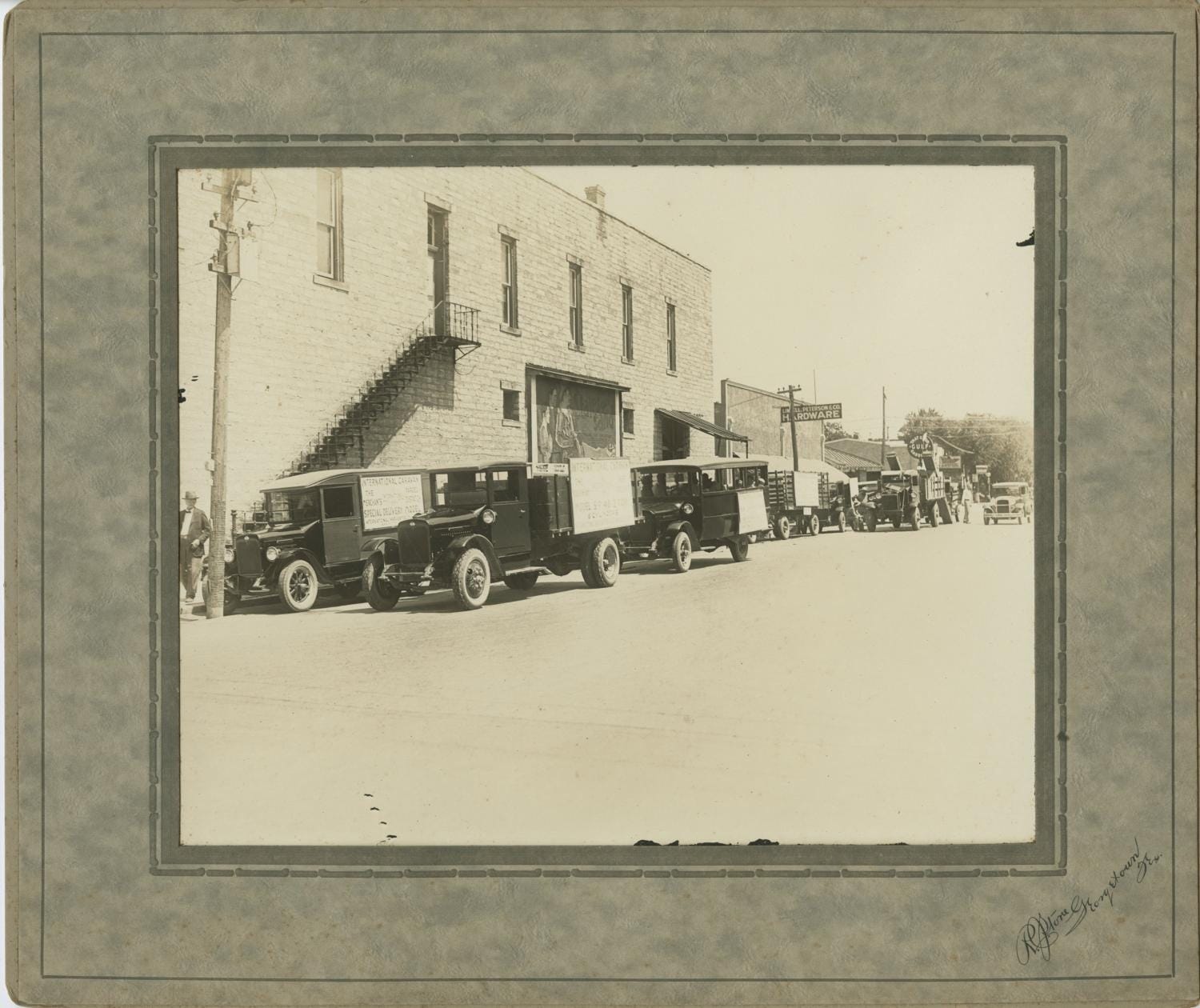
People who were children then remembered Sebe’s megaphone. Sixty years later Ruth Carlson told an interviewer that on Saturday nights “you could hear Mr. Goodlett standing up on the stairway outside the theater hollering, ‘Now showing . . .’ and he’d tell what was on with his big megaphone.” That stairway is still on the side of the building. It’s the one that climbs the wall at Kilwin’s.
On Sunday, November 27, 1921, at Jim Shaw’s house, Sebe married Frances Rachel Sharpe, a freshman at Southwestern. It was her 19th birthday. Frances was born in Liberty Hill, and after her mother died in 1914 she and her younger sister Inez came to Georgetown to live with their uncle and aunt, John and Annie Sharpe. If you read The Elephants on the Square, you met Annie briefly. She was the young woman with the camera. (These aren’t the Sharpes of The Farm Southeast of Town. As far as I know, the two families weren’t related.)
The minister was Horace W. Busby of the Church of Christ.
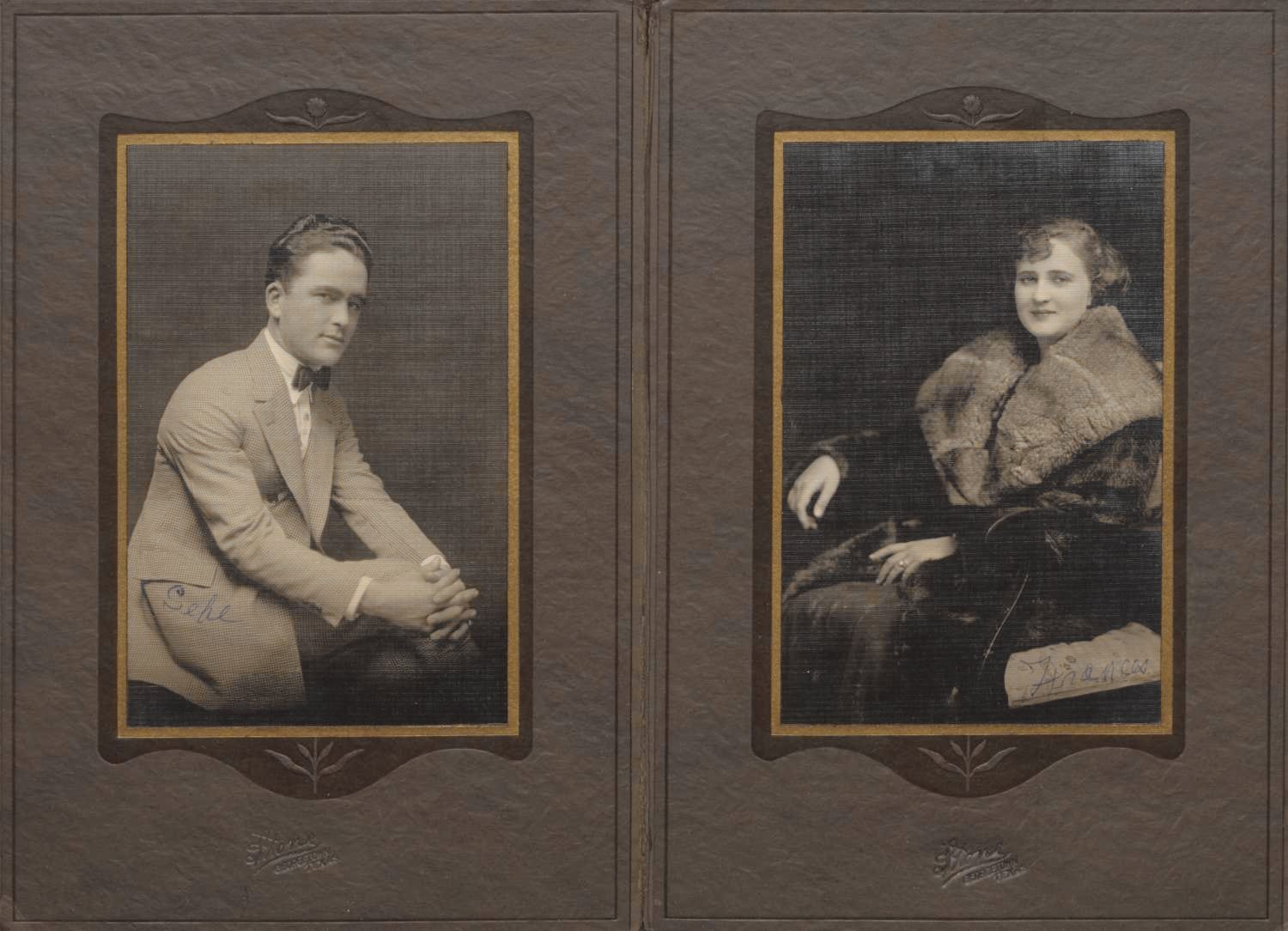
Six days after the wedding, the Austin Statesman reported that Sebe was “arranging details for the erection of a $10,000 residence on South Main street.”
That’s who had a dummy on the standpipe in November 1923: a 28-year-old theater manager, two years married, who liked a crowd and knew how to get one. Less than seven weeks later he made the Austin paper.
The Equal of Any in Texas
The Austin American, January 8, 1924, page 3:
Tourist Park and Pleasure Resort For Georgetown
“Georgetown is to have a tourist park and general pleasure resort which, according to plans now being worked out, will be the equal of any in Texas, in the matters of convenience and attractiveness. The enterprise is being inaugurated by a private individual, Sebe Goodlett, whose plans have the hearty endorsement of the chamber of commerce.”
He’d bought 25 acres a mile from the courthouse, “lying between the north and south branches of the San Gabriel river” and fronting the highway. He planned small cottages, a cafe, a filling station, a dam across the river to make a lake for bathing and boating, and a scenic driveway along both forks. The article ends with the whole town in his corner: “The chamber of commerce, Lions club and all Georgetown are behind him in the enterprise with every possible help, but the financing of the scheme Mr. Goodlett claims as his exclusive privilege.”
Under the main headline there’s a second, smaller one. It says INDIAN SITE TO BE USED.
The explanation comes in the fourth paragraph:
“The property to be used for the park is the old Lesueuer property lying between the two bridges, and includes the hillside where numerous Indian skulls, bones and arrow heads were recently unearthed when workmen were excavating for soil to build approaches to the new bridge over the North San Gabriel.”
The next paragraph, under the subhead “Former Indian Village,” says the location “was formerly the site of an Indian village” and passes along a legend of gold and altar jewels buried nearby. Then the article goes back to the tourist park.

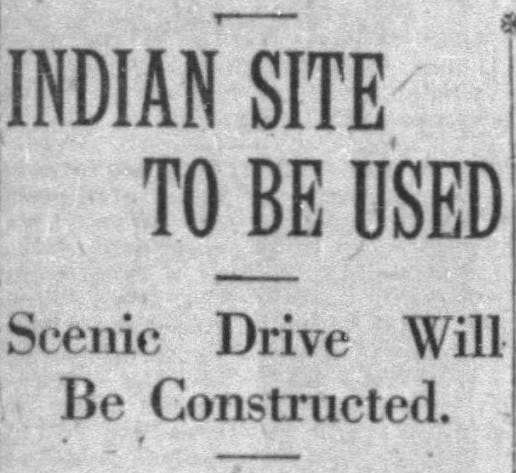
That’s all it says. Workmen digging fill for a bridge approach had turned up human remains. The hillside they came out of was part of the ground Sebe had just bought. The paper mentioned it between the bathing beach and the buried treasure and kept going.
I’ll come back to the hillside. The paper didn’t, and neither did the town, for a long time.
Work started right away. By February 1 the Sun reported “a large number of men at work on the grounds.” Driveways were going in, “boulders are being broken up and rocks are being hauled filling ravines,” trees were trimmed and the underbrush cut, and tables and camp stoves were being set out for picnickers. A pump was being installed on a platform over the river to lift spring water to the top of the bluff. That same week Sebe bought the neighboring Will Williams place, “thus completing occupancy of the whole tract.”
In April the Megaphone laid out everything he had in mind. Besides the driveway and the swimming pool, the park would have “a skating rink, an aviation landing field, huts for the use of tourists, and a nine-hole golf links.” He proposed to dam the South San Gabriel into a lake running from the Blue Hole to the west bridge and put motor boats on it. The pool, the paper said, would probably open the following Saturday, April 12. It would all “furnish clean amusement for the people of Georgetown and the University students.”
Pure Spring Water
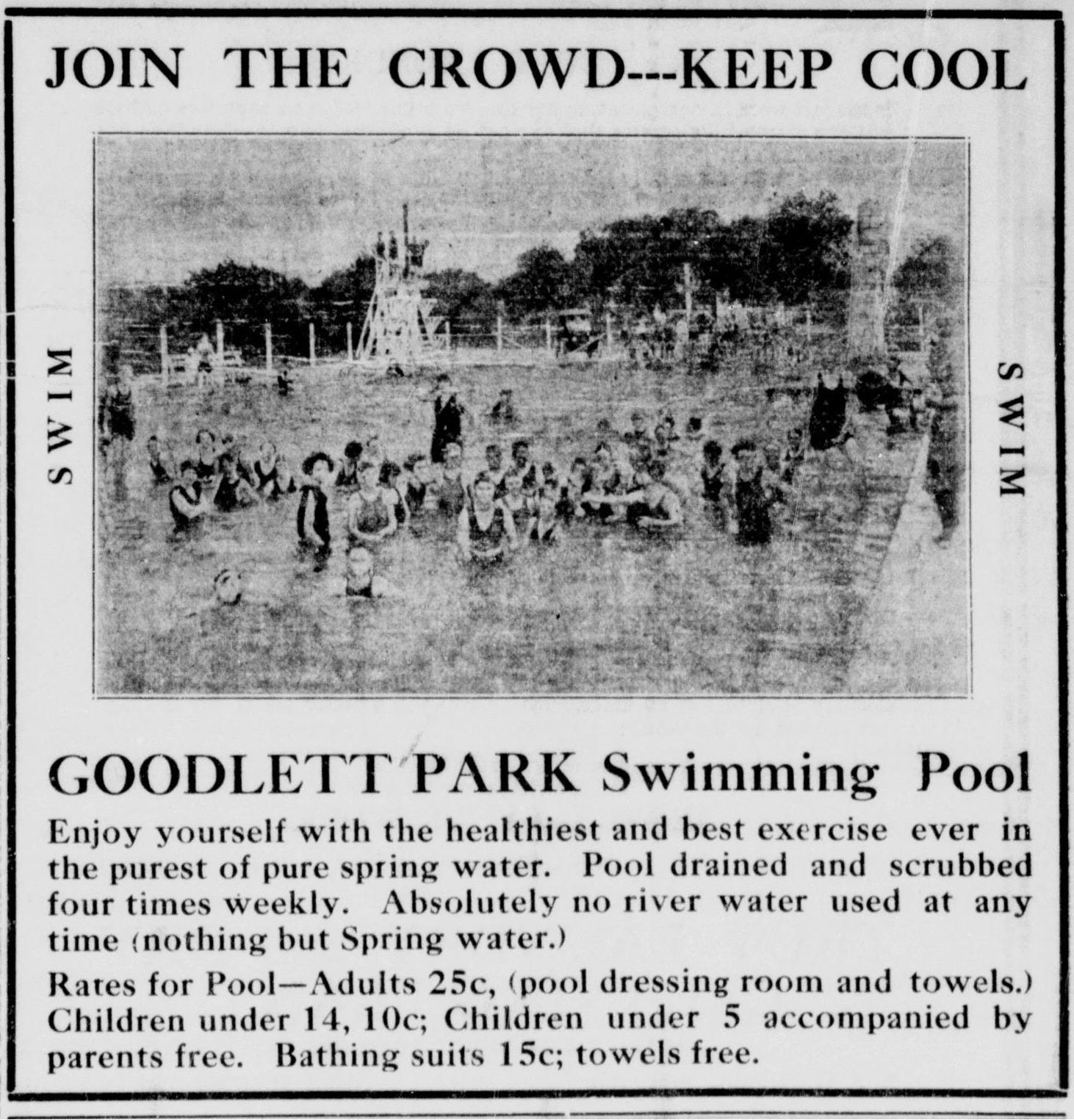
The pool is the part we know got built. On August 22, 1924, the Sun ran a front-page ad with a photograph of it, crowded with swimmers, a diving tower at one end:
“JOIN THE CROWD—KEEP COOL. GOODLETT PARK Swimming Pool. Enjoy yourself with the healthiest and best exercise ever in the purest of pure spring water. Pool drained and scrubbed four times weekly. Absolutely no river water used at any time (nothing but Spring water.)”
Adults swam for a quarter, children under 14 for a dime, and a bathing suit rented for 15 cents. As far as I know, that ad is the only photograph of the pool that survives.
In the same issue, a grocer named C. M. Harris announced that he’d moved his store and filling station “from North Town to Goodlett Park between the rivers,” and signed himself “The Park Grocer.” When the Sanborn insurance mappers drew the park in October of 1925, they lettered a “CONC SWIMMING POOL,” a bath house beside it, and an auto repair shop out on the highway frontage. I haven’t found the golf links or the motor boats anywhere but in the plans.
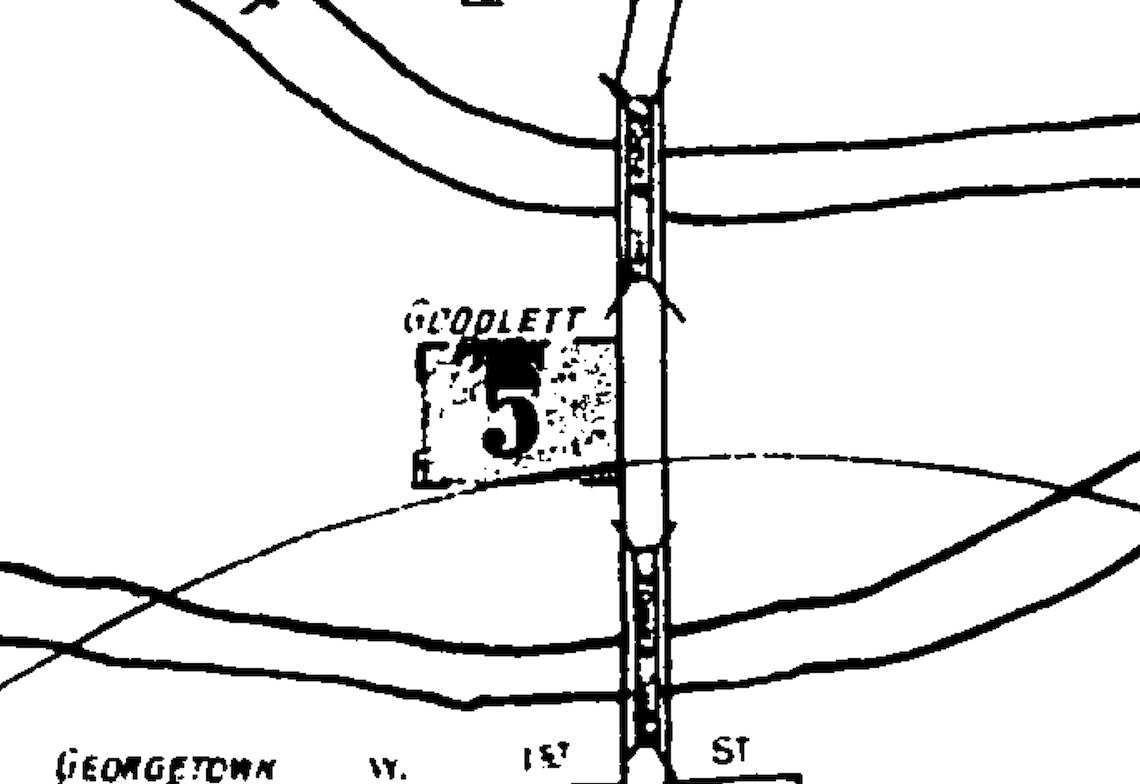
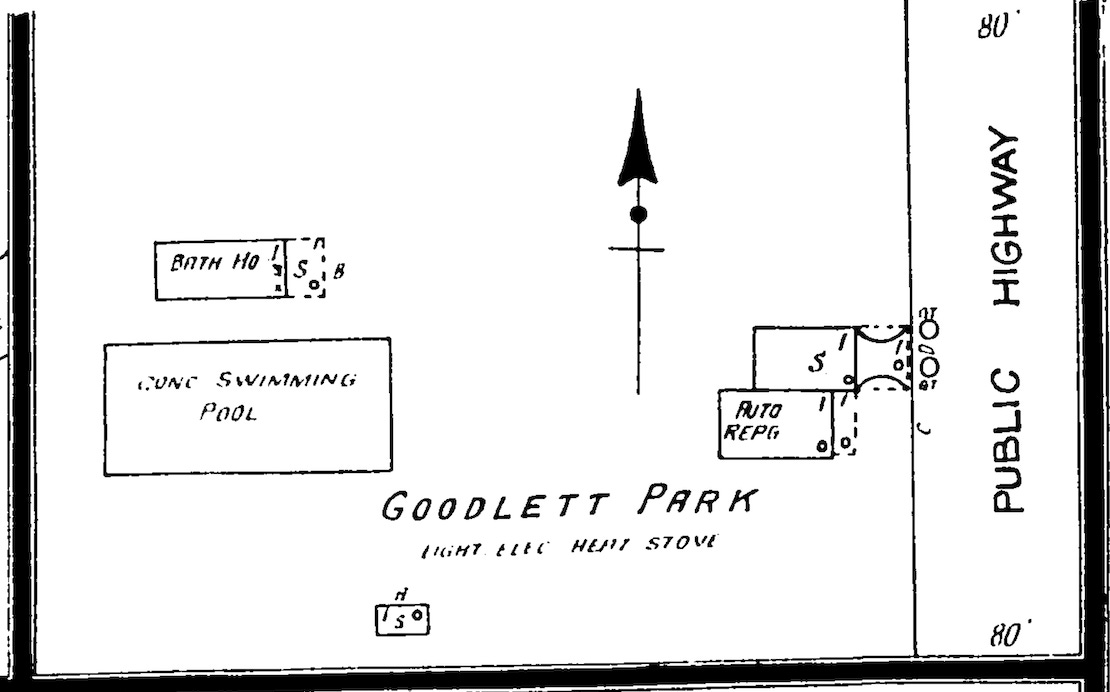
You’ve driven past the spot. A later Sun article places the pool “between the North and the South San Gabriel Rivers just west of the bridges on Highway 81.” Highway 81 is Austin Avenue now. The park was on your left as you head north out of downtown, after the first bridge and before the second. Hat Creek Burger Company sits on the site today.
The Chief Point of Interest
On Monday, December 1, 1924, the history classes of Taylor High School set out with their teacher, Miss Martha Emmons, on a 115-mile tour of historic places in Williamson County. The Sun printed their write-up in January. Here’s their stop in Georgetown:
“From Liberty Hill the hilarious group drove to Georgetown. The chief point of interest here was the site of an ancient Indian village, now the swimming pool. It was not known definitely where this village had stood until the summer of 1924, when excavations were made for the pool, and Indian relics were unearthed.”
The students had the season a little off, since the pool was dug that winter and spring. The rest is the first I’d seen of it. The January article only mentioned the bridge crew. This one says digging the pool turned things up too.
Earlier that same day, at the site of Kenney’s Fort near Round Rock, the class had been “allowed to bring away bits of China and pottery, and some arrowheads, as souvenirs of this interesting place.”
The following May, Miss Emmons read a paper to the Texas Folk-Lore Society in Austin about buried-treasure stories in Williamson County. “Just out from Georgetown near the site of the old Indian village,” she told them, “is another fabled source of wealth.”
In 16 months the hillside had turned up in a real estate announcement, a school field trip and a folklore paper. None of them mentions what became of the people who were buried there.
The Cottage Between the Rivers
The winter after the pool opened was a hard one for the Goodletts. On December 30, 1924, Frances gave birth to a stillborn daughter in an Austin hospital. The baby was buried in Georgetown the same day. Nine days later the Sun reported that Frances had been “seriously ill for several days” in Austin, that her condition was grave, “and little if any hope is held out for her recovery.”
She did recover. At the end of May the paper had a happier line: “Mr. and Mrs. Sebe Goodlett have moved to the Goodlett Park cottage between the rivers.”
Two months after that, the water quit. The Bartlett Tribune of July 24, 1925, under a Georgetown dateline: “The big swimming pool in the Goodlet park has been closed to the public on account of the lack of water.” It was a drought summer. “The San Gabriel river bed is perfectly dry except for occasional water holes and they are also fast disappearing.”
The park was still good for a crowd that fall. In September, Universal planned an all-day party at the Monarch for 50 Central Texas picture exhibitors, and the program called for “a chicken barbecue” at noon at Goodlett Park. After 1925, though, I lose the park in the Sun. I haven’t found a closing notice or a sale. It just stops being mentioned.
The World’s Best Salesman
In June 1928, Sebe and Alice sold the Monarch to O. A. Engelbrecht, who ran the Palace. Patsy had worked in the theater with his brother right up to the sale.
The 1930 census found Sebe and Frances boarding in a house on Rieger Avenue in Dallas. He was a motion picture salesman and she was a stenographer. By 1935 they were in Denver, where the 1940 census has him as a traveling salesman for a film distributing company. His 1942 draft card names the company: National Screen Service.
Those were years of losses. In June 1940 Patsy died of a heart attack in Edwards Market in Georgetown. He was 43, and he went the way their father had 20 years earlier, suddenly, in a Georgetown store.
In December 1941, Frances was taken ill in the car on the way home to Georgetown for Christmas. She spent a couple of days in the hospital here, “but by sheer will-power got up a day or two before Christmas.” After the holidays there was a specialist in St. Louis and months in a Denver hospital. When her doctor was drafted that summer, she was moved to a hospital in Raton, New Mexico, and she died there on September 2, 1942. She was 39. Alice had been at her side “for four months or more.” They brought her home to Georgetown to bury her.
Sebe was back in Georgetown, spending Christmas of 1945 with his mother, when word came from New York that he’d taken first prize in every department of National Screen Service’s sales organization. His 50 co-workers in the Denver office wired their congratulations to “the world’s best salesman.”
National Screen Service was the company that supplied theaters with their trailers and posters. Dave Goodlett brought Georgetown its first picture show. His son spent the last part of his life selling theaters their coming attractions.
Sebe died in Denver at midnight on Thursday, October 14, 1948. He was 53. The funeral was at the Church of Christ in Georgetown the next Wednesday, with the building “filled to overflowing.” Horace Busby, who’d married Sebe and Frances 27 years before, came from Fort Worth to preach it. He told the congregation how often, holding meetings in Dallas or Fort Worth or Denver, he’d been cheered when Sebe walked into the church or turned up at his hotel room.
They buried him in the Odd Fellows Cemetery “by the side of his wife, two little babies, his father, and his brother.” I’ve found the record of one of those babies. I’m still looking for the other.
The Same Spring
Not quite nine months after the funeral, on July 7, 1949, the Sun announced that Georgetown would have a swimming pool again. Two local men had nearly finished putting the Riverside pool in shape:
“This is the pool, located between the North and the South San Gabriel Rivers just west of the bridges on Highway 81, that was built by Sebe Goodlett in 1925, and used only a few seasons.”
(It was 1924, but the paper was close.) The pool held 293,000 gallons and was “in remarkably good shape with only a few cracks in the walls.” Pipes had been laid “to the same spring used before.”
The concrete Sebe poured in 1924 was still there, and so was the spring.
The Hillside
That leaves the part of the story the 1924 paper spent one paragraph on.
Who were the people on that hillside, what was done with them, and did anybody record anything? Here’s what I’ve found so far.
The first writer I’ve found who took it seriously is Clara Scarbrough, in her 1973 county history, Land of Good Water. The title is a translation. It’s the English for Takachue Pouetsu, which Scarbrough gives as the Tonkawa name for this country. In her chapter on the county’s Native people she lists the known burial sites in Williamson County, and one of them is “the area between North and South San Gabriel rivers west of Highway 81 at Georgetown, where excavation for a swimming pool revealed the site.” She adds another, “possibly a continuation of the one near the pool, at the site of the Highway 81 bridge—also uncovered during construction.”
A footnote further on is blunter. “A large Indian burial ground was found at Georgetown between the North and South San Gabriels in the 1920s and 1930s during excavation for a swimming pool and for a bridge.” She had found “no judgment by reputable scientists as to the identity of the tribe,” and she declined to guess. I’m following her lead on that. Her last word on it: “That a burial ground was discovered is certain.”
She also explains, in general terms, why so little is known about places like this one. Burial grounds in the county were usually uncovered by construction crews, who had work to finish. Others were picked over by relic hunters. “Information has been lost in this way.” In the same footnote she describes a “pseudo-scientist” who “gathered enormous amounts of Indian artifacts from the county, departed the state with them and sold them as souvenirs.” She doesn’t name him, and she doesn’t say he took anything from this hillside.
After Scarbrough, the record goes mostly quiet again. When the Sun published a timeline for the county’s 175th anniversary in 2023, it opened with the Tonkawa, “whose ancestors camped by the river for approximately 10,000 years.” Its entries for the mid-1920s don’t mention the park, the pool, or what was found there.
Scarbrough tried once more. In 1975, when a hike and bike trail was being planned along the South San Gabriel, she gave the planners a list of historic sites that might be labeled along the way. The first one on her list was the “Old Indian Village and burial site just west of Old Highway 81.”
I haven’t found any record of what became of the remains the bridge workers dug up in the winter of 1923, or of whatever the pool excavation uncovered a few months later. If your family has a story about Goodlett Park, the pool, or what came out of that ground, I’d like to hear it. Leave a comment or send me a note.
Helen Cordes hasn’t let it stay quiet. The history walk on her site starts at the Blue Hole and has you look across the river at this spot, and she tells her readers what Scarbrough found. In 2023 and 2024 she led walks along the San Gabriel with Ben and Lisa Nava, Lipan Apache residents of Georgetown. “The problem is, people think they have all died out, but that’s not correct,” she told the Sunday Sun. “They’re here and are proud to share their history and culture.”
The people whose ancestors lived along this river aren’t only in the past tense, and their story is a much longer one than Sebe Goodlett’s. Helen has written it up in Georgetown’s First Peoples. I’ll let her tell it.
There’s one chapter she doesn’t get into. In 1976 the county was asked to name its new lake for the Tonkawa. You know that same lake as Lake Georgetown, but that’s a story for another day.
Sources
The Williamson County Sun
[Local item, Sebe Goodlett’s amputation at the Temple sanitarium], 10 April 1913, p. 3.
“A Screaming Farce,” 7 February 1918, p. 1.
“David J. Goodlett,” 12 March 1920, p. 5.
“Banquet for Football Team,” 23 November 1923, p. 4.
“Safety Last,” 23 November 1923, p. 7.
“Park Getting Rapidly in Shape,” 1 February 1924, p. 3.
Goodlett Park Swimming Pool, “Join the Crowd, Keep Cool” [advertisement with photograph], 22 August 1924, p. 1.
C. M. Harris, “To the Public” [advertisement], 22 August 1924, p. 8.
[Local item, Mrs. Sebe Goodlett seriously ill at a hospital in Austin], 9 January 1925, p. 8.
“Writing a History of Williamson County,” 23 January 1925, p. 3.
[Local item, “Mr. and Mrs. Sebe Goodlett have moved to the Goodlett Park cottage”], 29 May 1925, p. 3.
“Folk-Lore in Williamson County,” 24 July 1925, p. 5.
“Universal Plans Party for Exhibitors,” 18 September 1925, p. 5.
“Englebrecht Buys Monarch Picture Theatre,” 8 June 1928, p. 1.
“Patsy Goodlett Is Victim of Heart Attack,” 7 June 1940, p. 1.
“Mrs. Sebe Goodlett Passes Away at Raton, N.M., Wednesday,” 4 September 1942, p. 8.
“Funeral Services for Mrs. Sebe Goodlett,” 11 September 1942, p. 5.
“Sebe Goodlett Wins Award of His Organization,” 1 February 1946, p. 1.
“Final Funeral Rites Held For Sebe Goodlett At Church of Christ,” 22 October 1948, p. 7.
“Georgetown To Have Swimming Pool Soon,” 7 July 1949, p. 1.
Beulah Gilbreath, “Park to preserve beauty,” 29 May 1975, p. 11.
“A Georgetown and Williamson County timeline,” 8 March 2023, pp. 1, 9 and 11.
Katherine Anthony, “Local Native American history explored during March 24 walk,” The Sunday Sun, 17 March 2024, p. 5.
Other newspapers
“Foot Is Crushed by Train,” Austin American-Statesman, March 1913, p. 6 (Georgetown dateline of 14 March).
“Monarch Theatre stands treat to baseball boys,” SU Megaphone (Southwestern University, Georgetown), 27 April 1920, p. 2.
“Goodlett-Sharpe,” SU Megaphone, 29 November 1921, p. 2.
“Much Building Activity at Georgetown,” Austin American-Statesman, 3 December 1921, p. 2.
“Tourist Park and Pleasure Resort For Georgetown,” The Austin American, 8 January 1924, p. 3.
“Stag,” “New Park Nearing Completion,” SU Megaphone, 8 April 1924, p. 1.
“Seniors Matinee at the Monarch Theatre,” SU Megaphone, 3 June 1924, p. 1.
“Goodlet Park Swimming Pool Closed,” The Bartlett Tribune (Bartlett, Texas), 24 July 1925.
County and state records
Delayed certificate of birth, Sebe Scott Goodlett, born 6 April 1895, filed 15 April 1942. Williamson County Court.
Marriage license no. 323, Sebe Goodlett and Frances Rachel Sharpe, issued 26 November 1921, solemnized 27 November 1921 by Horace W. Busby. Williamson County Clerk.
Standard certificate of death no. 40549, Infant Goodlett, Travis County, 30 December 1924. Texas State Board of Health, Bureau of Vital Statistics.
Census and draft records
1910 U.S. census, Williamson County, Texas, Georgetown, enumeration district 117, sheet 17A, David J. Goodlett household.
1920 U.S. census, Williamson County, Texas, Georgetown, enumeration district 152, sheet 2A, Dave J. Goodlett household.
1930 U.S. census, Dallas County, Texas, Dallas, enumeration district 57-43, sheet 12B, Sebe S. and Frances R. Goodlett.
1940 U.S. census, Denver County, Colorado, Denver, enumeration district 16-201A, sheet 6B, Sebe and Frances Goodlett.
World War I draft registration card, Sebe Scott Goodlett, Williamson County, Texas, 5 June 1917.
World War II draft registration card (fourth registration), Sebe Scott Goodlett, Denver, Colorado, 1942.
Books
Clara Stearns Scarbrough, Land of Good Water: Takachue Pouetsu, A Williamson County, Texas, History (Georgetown, Texas: Williamson County Sun Publishers, 1973), pp. 25 and 46.
Martha Mitten Allen, ed., Georgetown’s Yesteryears: A Special Place (Georgetown, Texas: The Georgetown Heritage Society, 1987), p. 31 (Ruth S. Carlson).
Online
Liz Weaver, post on the Georgetown standpipe, Facebook group, 2026, https://www.facebook.com/groups/3222582281327505/posts/4155759928009731/.
Helen Cordes, “Georgetown’s First Peoples,” Hidden HerStories and MoreStories, https://www.hiddenherstories.com/blog/first-peoples. Consulted 2 October 2026.
Maps
Sanborn Map Company, Insurance Maps of Georgetown, Williamson County, Texas, October 1925, sheets 1 (index map) and 5. Digital image, Sanborn map collection, Dolph Briscoe Center for American History, University of Texas at Austin.
Photographs
Safety Last! (Hal Roach Studios, 1923), still of Harold Lloyd on the clock, Wikimedia Commons.
Stone studio portraits of Sebe and Frances Goodlett, undated, The Portal to Texas History (texashistory.unt.edu, metapth426898), crediting The Williamson Museum, accession 2006-015-325.
“Cars on street in Georgetown,” photograph by R. Stone, 1927, The Portal to Texas History, crediting The Williamson Museum.
“Stand Pipe and Fire Department,” Georgetown, Texas, undated printed view, photographer and publisher unknown. The banner and figure were added with Google Gemini in October 2026 from the description in the Williamson County Sun of 23 November 1923. It is not a photograph of the stunt.
Old Town Echoes is independently researched using primary historical sources. AI tools assist in drafting and editing; all content is reviewed, sourced, and verified by the author.