


Content note: this piece describes a shooting and, in three places, deaths by suicide. If that’s not for you today, come back another time.
In The Afterlife of 803 College, I gave Holland Sharpe one sentence.
She was John Leavell’s granddaughter. Her father shot her twice in the back in 1916 and then killed himself, and she lived. That was the whole of it, one line in a long list of the family’s dead, and then I moved on to the house’s story. But this story turns out to be more than a house. It’s a family story, about a family that shaped our town.
I wanted to know more about the Leavell granddaughter who survived, so here she is. I found so much more than I was expecting.
This story leaves town: El Paso, New York, San Antonio... But it starts here and it comes back home, and part of it is still standing a couple of miles southeast of town.
Grab a glass of something. This one will take a minute.
The Railroad Agent
Alfred Lansing Sharpe came to Georgetown from Ravenna, Ohio, where he was born in November 1858, and by the middle of the 1880s he was the joint agent here for the International & Great Northern Railroad and the Wells Fargo Company. The Sun liked him. When he married in the fall of 1886 the paper called him “our very popular railroad station agent.”
The woman he married was Lucy R. Oakley. She came to Texas in 1885 at 20 years old and took a position teaching vocal music at Southwestern University. They married in San Antonio and came home to Georgetown that same evening. The Light ran it under “Welcomed Home,” and said she was highly esteemed “in the city where her lot is now cast,” and that it was at the University “that the happy ones met and loved.”
On November 11, 1889, in a rented room in Mrs. Emma Seery’s house on Brushy Street, Lucy had a son. They named him John Oakley Sharpe.
She bore another child who didn’t live. And then, on a Friday morning in February 1893, after a week or two of being dangerously ill and one day of seeming better, Lucy Sharpe died. She was 28. They buried her in the Odd Fellows Cemetery, and the Sun asked the town’s sympathy “to the bereaved husband and motherless little one.”
A Parlor Wedding
Two years later, in 1895, Alfred Sharpe married again, this time into the biggest fortune in Williamson County.
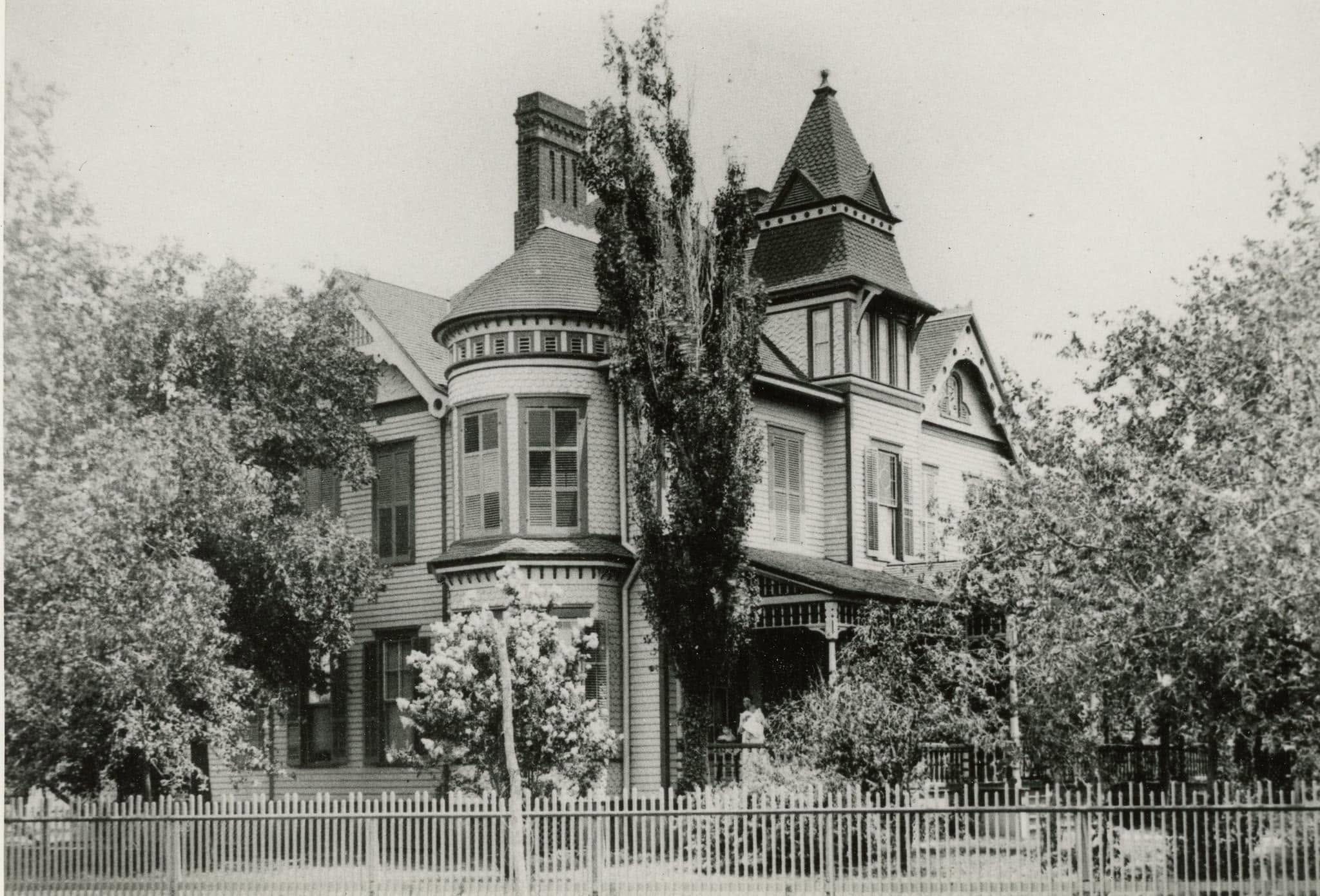
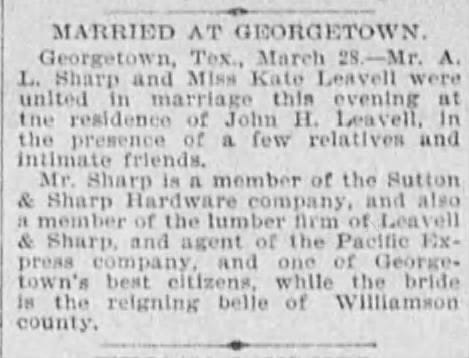
Kate Leavell was John H. Leavell’s daughter, and Sharpe by then was Leavell’s business partner; the store on the square carried both their names. They were married in the front room of the big house at the foot of Eighth Street, in front of a few relatives and intimate friends.
In September 1897 Kate had a daughter and named her Holland, which had been her own mother’s maiden name.
The Discovery
You know what happened next, if you’ve been reading along. On the morning of December 6, 1898, John Leavell went into his room before dawn and never came out.
I told you last time who found him. When Leavell hadn’t appeared at the store by a quarter to eleven, it was his son-in-law who got uneasy and walked home, went around the side of the house, and looked through the shutters of Leavell’s room.
Alfred Sharpe was 40 years old. Little Holland was 14 months old and living in that house.
The Farm
Here’s where the inheritance enters, and it’s not just money, it’s a place, and you can drive to it today.
In 1883 and 1884, John Leavell bought a combined 366 acres from F. M. Taylor and J. T. Chamberlain. It was referred to in family documents as the Taylor and Chamberlain farm. When his estate was partitioned in 1899, that land was set aside for his daughter Kate.
The Sharpes left Georgetown for El Paso around 1901. Alfred did well out there for a while; he kept a store, he ranched, and in November 1904 the El Paso Republicans, hunting for a candidate the young Democrats could live with, found him. He went to Austin and found himself the lone Republican in the Texas Legislature. The El Paso law and order league asked him to introduce their bill against gambling; he introduced it and it became law, and it was considered the death knell of open gambling in Texas. That record got Theodore Roosevelt’s attention, and in 1906 Roosevelt appointed Sharpe collector of customs at the port of El Paso, succeeding Pat Garrett, the sheriff who shot Billy the Kid.
Kate died in El Paso in 1908, of tuberculosis, the same thing that had killed her mother a dozen years earlier. She was 36, and the family had been in El Paso seven years. She had made her will the previous October.
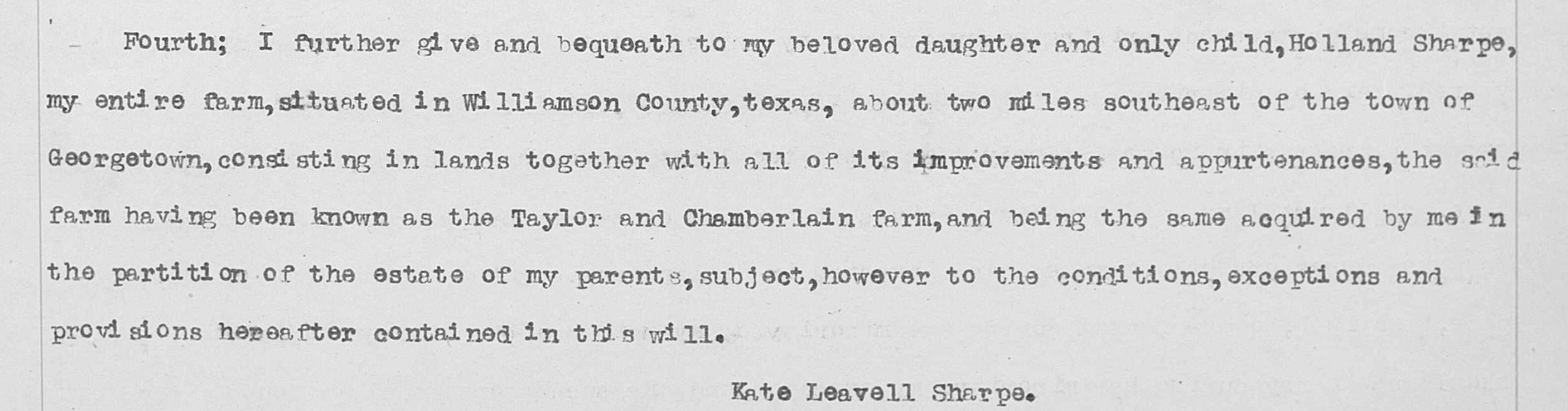
To her daughter, “my beloved daughter and only child, Holland Sharpe, who is at this date about ten years of age,” she left the furniture and the silver and the jewelry and her books, and then the farm: “my entire farm, situated in Williamson County, Texas, about two miles southeast of the town of Georgetown.” The executor was to hold it intact and sell no part of it. Holland was not to come into possession until she was 21.
To her stepson, Oakley, she left two sets of books her husband had given her, and something much larger: one half of the net income of her entire estate, set aside until he turned 22, for the completion of his education. That money sent Oakley Sharpe to Phillips Exeter, where he graduated with honors, and then to Yale.
And then, in the twelfth clause, Kate wrote out an instruction to her husband, as executor. The property was to be sold only as necessary, and never the farm, “my desire being to have the property prudently and securely managed, rather than hazarded in what may promise great gains.”
What He Lost
Alfred Sharpe was reappointed collector by Taft, resigned when Wilson came in, and then went east to Binghamton, New York, to work as building superintendent for his cousin.
The financial trouble had started years before, while he was still collector. By 1916 it had come to a head.
On February 8, 1916, Sharpe’s cousin, Willis Sharpe Kilmer, filed suit in El Paso to foreclose on the Sharpe house. The cousin who had given him work was also the man he owed.
I feel like there’s a lot more to that story, but the record remains silent on it for now. The papers that reported the suit didn’t say what the debt was for.
On February 27, Sharpe came down to El Paso to straighten out his affairs, and while he was there he went into federal district court and filed for bankruptcy. On March 23 he started home, and on the way to the railroad station he lost his pocketbook with his money and his ticket in it, and his friends made up a purse so he could get on the train. The pocketbook turned up the next day, and the money was sent on to him at Georgetown where he meant to stay a few days.
He was here. The former collector of the port of El Paso, freshly bankrupt, traveling on money his friends had scraped together, came home to Georgetown in March of 1916 to look after his interests, which is to say his dead wife’s farm.
A neighbor who saw him told the San Antonio Express afterward that he “seemed to be in good spirits.” Seven weeks later he shot his daughter.
Binghamton
Holland was 18, and she wanted out.
Under her mother’s will she couldn’t touch the farm or the money until she turned 21, and she wanted her father to resign the trusteeship and hand her mother’s property over to lawyers she had chosen in San Antonio. The Associated Press reported: “Miss Sharpe did not think her father liberal enough in his guardianship of her fortune.” They had been fighting about it for a while.
On the evening of Wednesday, April 19, 1916, it started again in the parlor. The Brooklyn Daily Times had the fullest account:
A quarrel in the parlor of the Sharpe home preceded the shooting. She urged her father to resign his trusteeship of the money Mrs. Sharpe had left her, so that a young San Antonio attorney could be appointed. Sharpe refused, and drove her from the room at the point of a revolver. She dashed upstairs. Just before reaching the top, a bullet struck her. It penetrated her left lung. The second penetrated her chest. The girl fell, and two more shots thudded into the wall over her prostrate body.
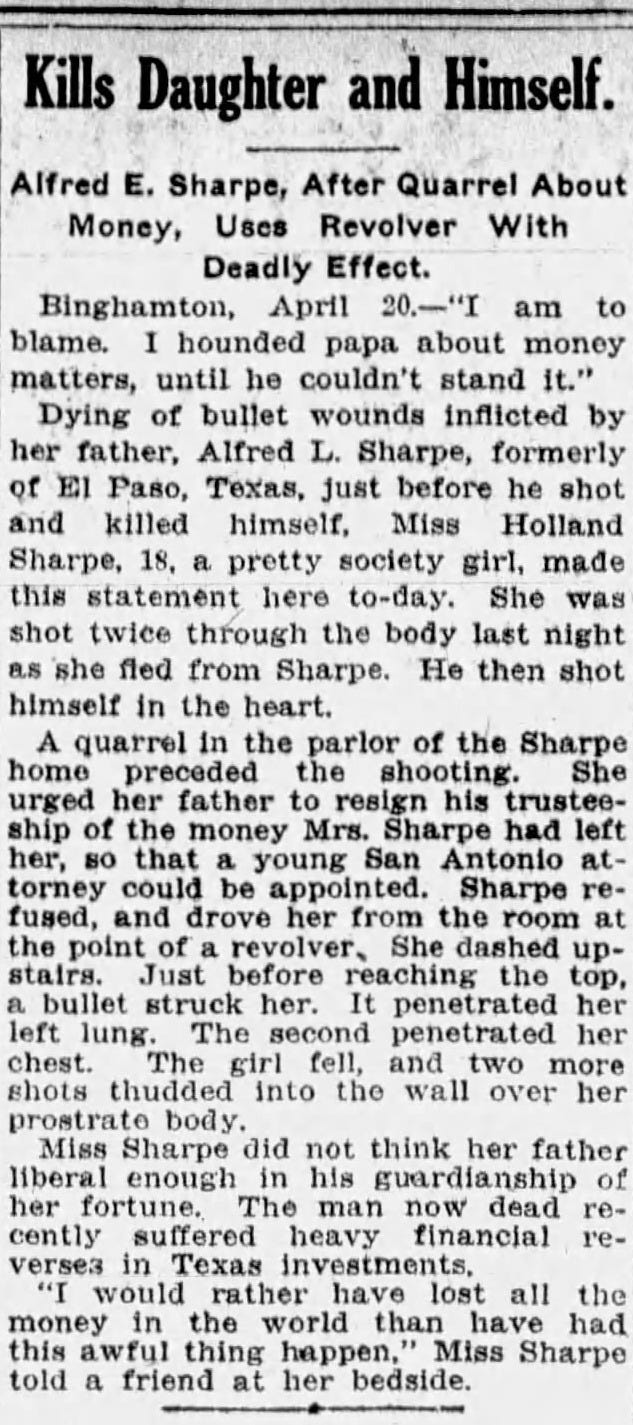
He was firing at her back while she ran, and when she went down he put two more into the wall above her. Then he went to another part of the house and shot himself through the heart. He was 57.
She was not expected to live. And from her hospital bed, that first day, she said two things:
“I am to blame. I hounded papa about money matters, until he couldn’t stand it.”
“I would rather have lost all the money in the world than have had this awful thing happen.”
She was 18 years old, with two bullet holes through her chest, and her first instinct was to take the blame.
In Los Angeles, her half-brother Oakley started across the continent for her bedside. Asked what was behind the quarrel, he told a reporter that he knew absolutely nothing about it.
That December, seven months after the funeral, the El Paso house was sold at the courthouse door to satisfy Kilmer’s judgment of $5,540.74. The defendants were Kate’s estate, both of Alfred Sharpe’s children, and his trustee in bankruptcy.
What Georgetown Read
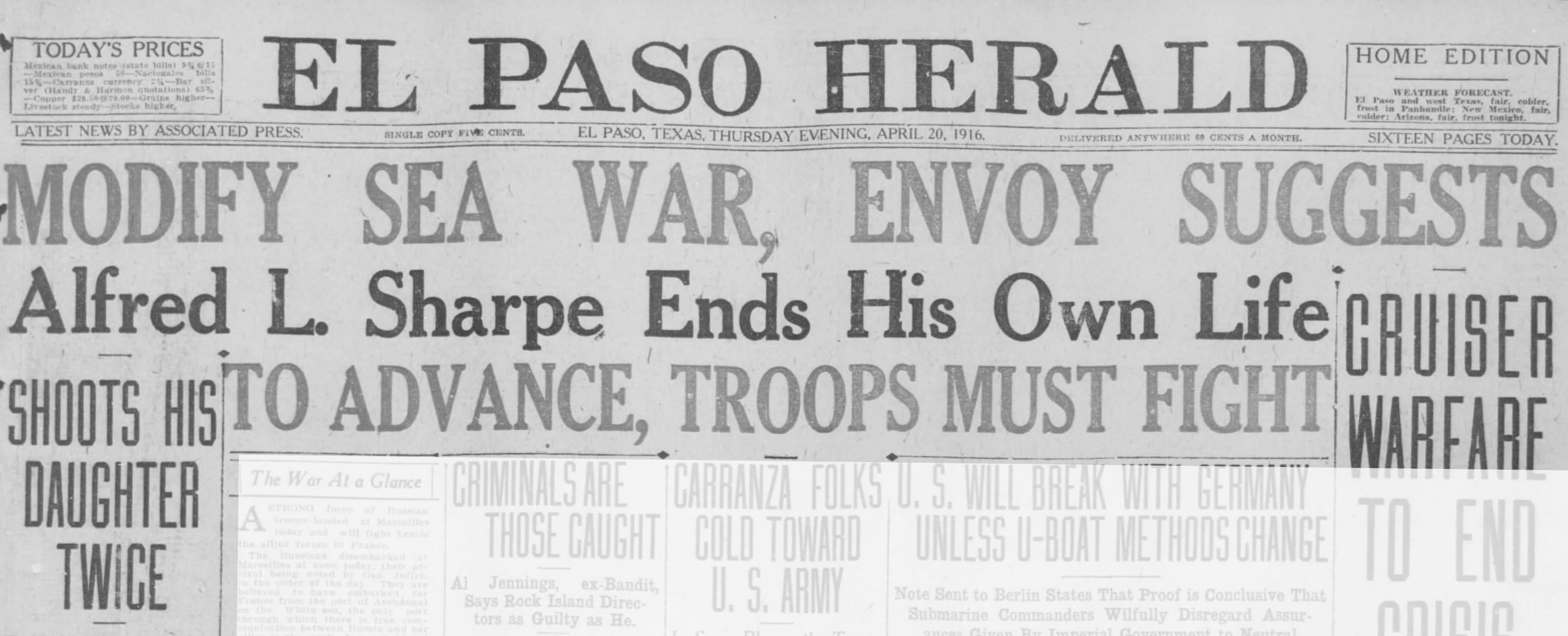
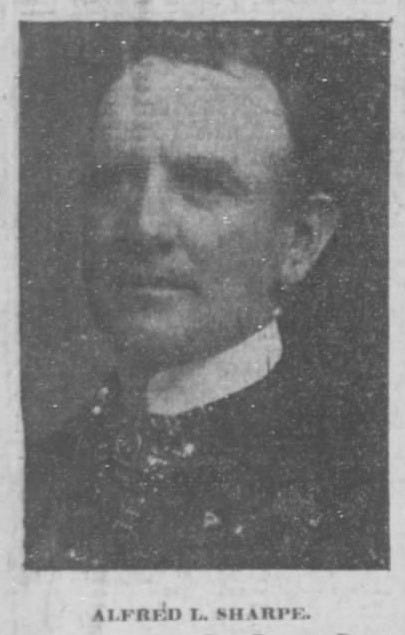
The story ran everywhere. Middletown and Trenton and Altoona, Hutchinson and Fort Wayne, Santa Fe and Bakersfield and Reno and Des Moines. The El Paso papers put his photograph on the front page.
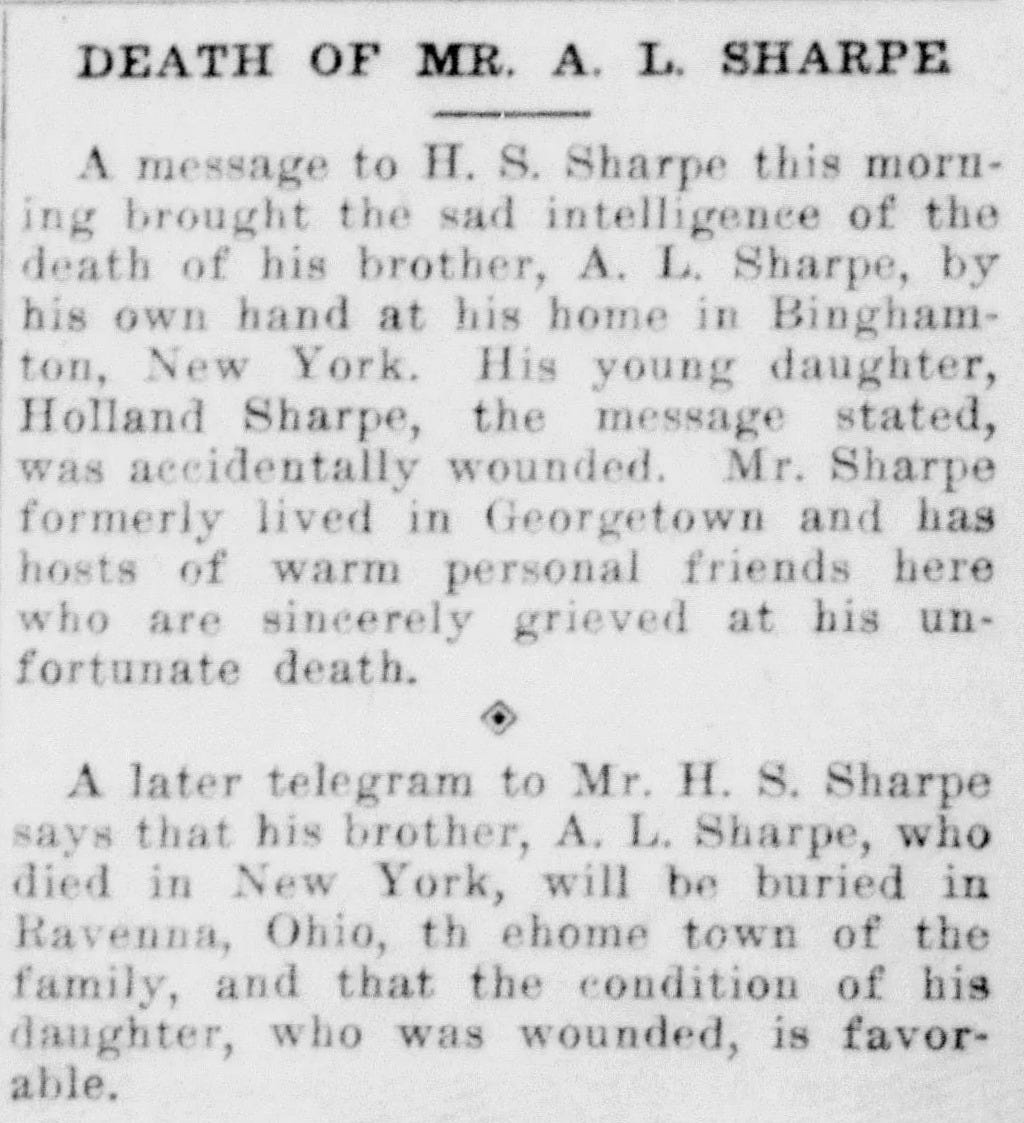
Here’s what the Williamson County Sun printed, on the front page, on Thursday, April 20:
A message to H. S. Sharpe this morning brought the sad intelligence of the death of his brother, A. L. Sharpe, by his own hand at his home in Binghamton, New York. His young daughter, Holland Sharpe, the message stated, was accidentally wounded. Mr. Sharpe formerly lived in Georgetown and has hosts of warm personal friends here who are sincerely grieved at his unfortunate death.
A week later, the Sun ran:
Friends of the family will be pleased to learn that late information from New York indicates that Miss Holland Sharpe, who is ill at Binghamton, is improving and physicians are very hopeful of her recovery.
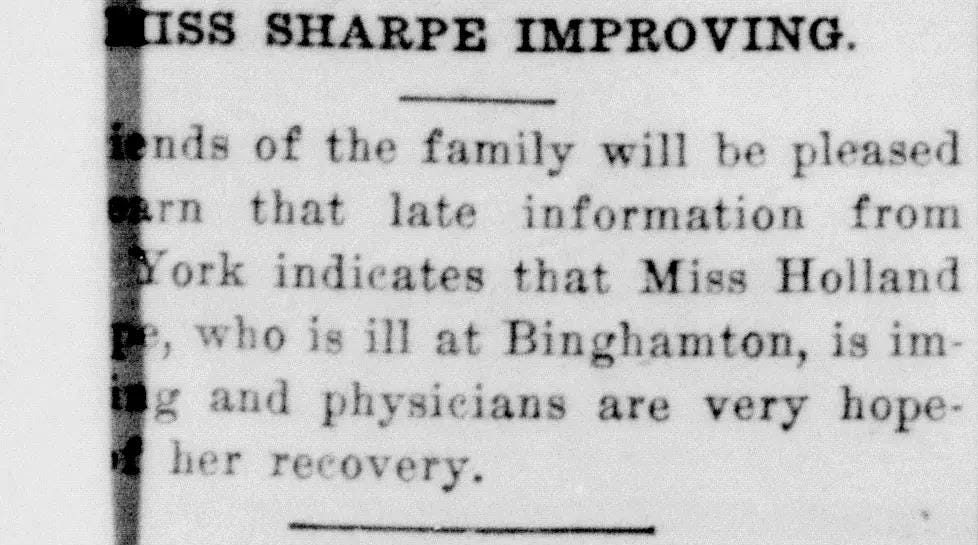
Accidentally. Ill at Binghamton.
The day after the first item, a correspondent with a Georgetown dateline wired the San Antonio Express a fuller account. It ran under the headline “Former Texas Man Wounds Daughter; Then Shoots Self.”
Miss Holland Sharpe
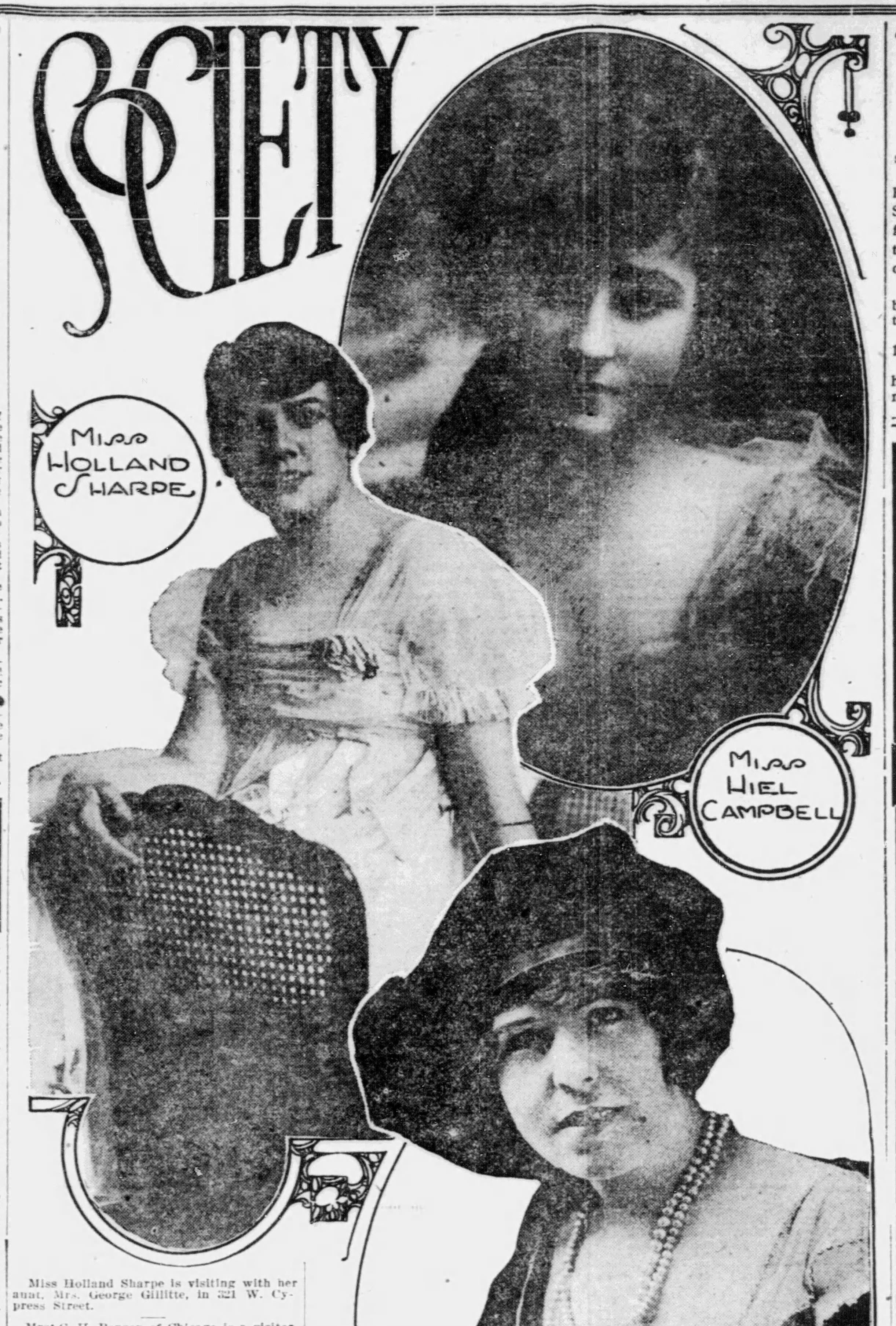
On September 14 1918, the society page of the San Antonio Evening News ran a photograph. Holland was visiting her aunt. Then another in 1919.
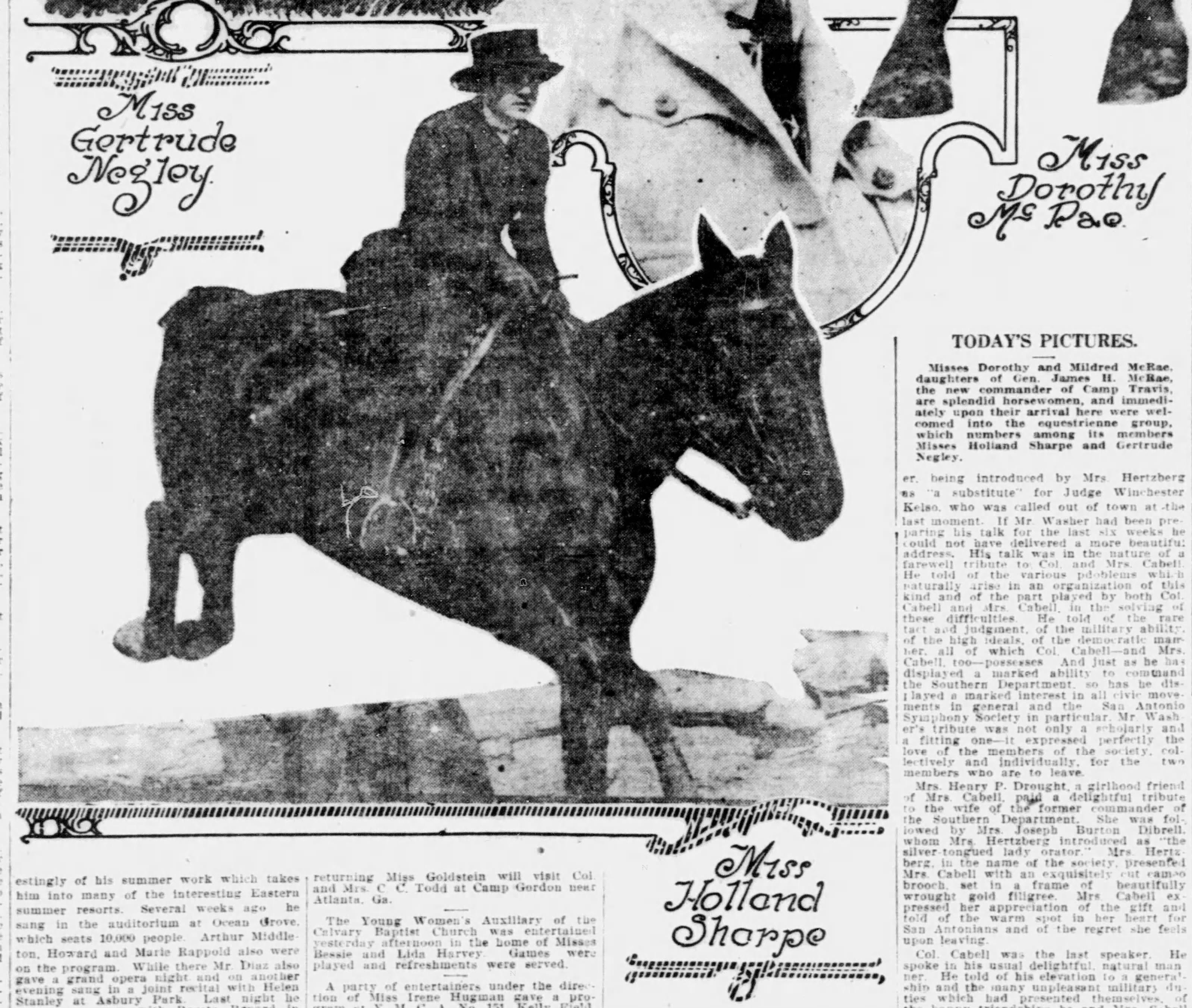
A young woman in a riding habit and hat, sitting a horse at the top of a jump. The caption underneath, in that flowing hand-lettering those pages used, reads Miss Holland Sharpe. The column beside it says the general’s daughters, newly arrived at Camp Travis, had been welcomed into the equestrienne group, “which numbers among its members Misses Holland Sharpe and Gertrude Negley.”
She had gone to San Antonio to live with her aunt and uncle, Lula Leavell Gillette and George Gillette, the city attorney. By the summer of 1919, with two healed bullet tracks through her left lung and chest, she was taking horses over fences for the newspaper photographers.
The San Antonio society pages ran her portrait over and over in those years.
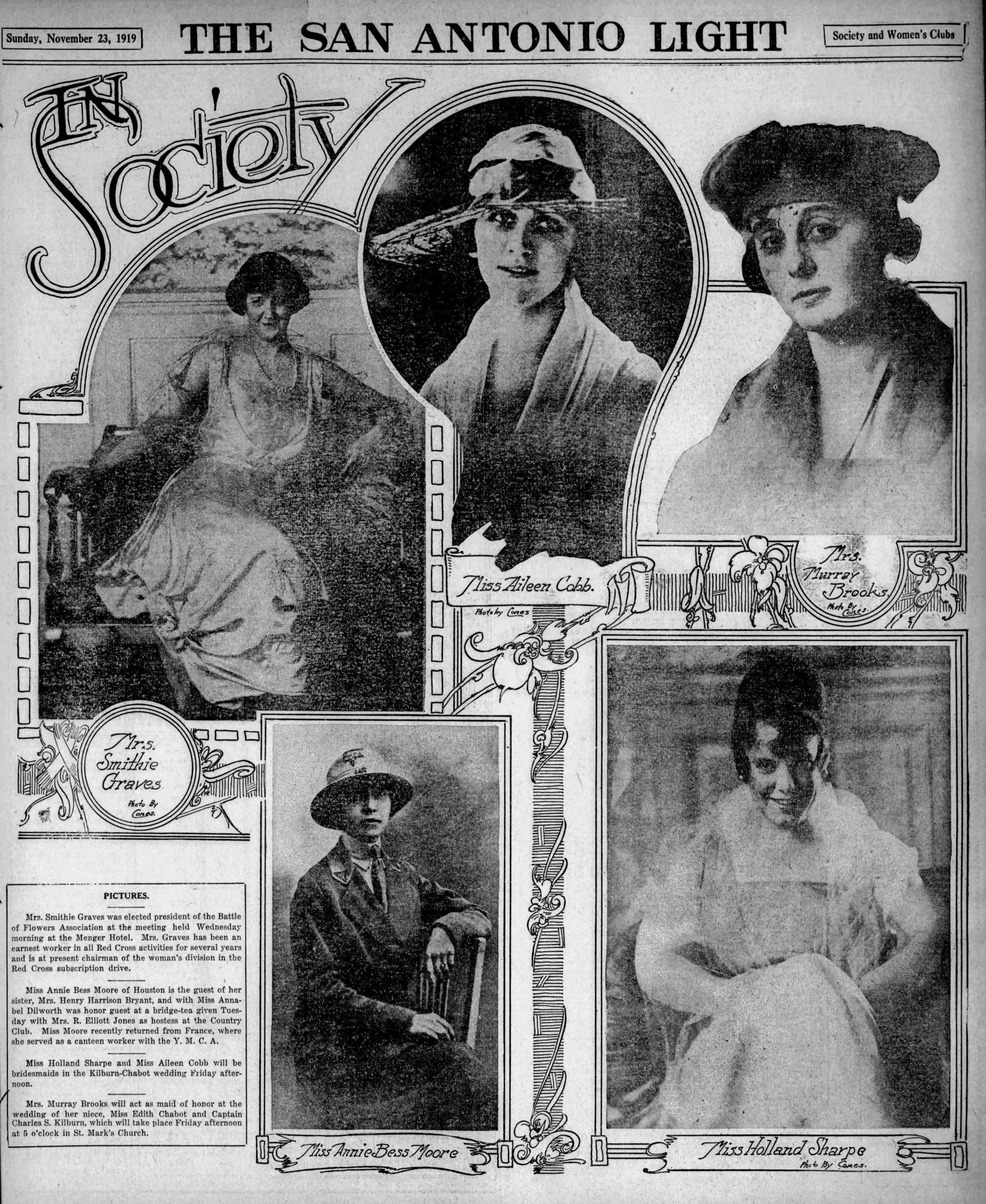
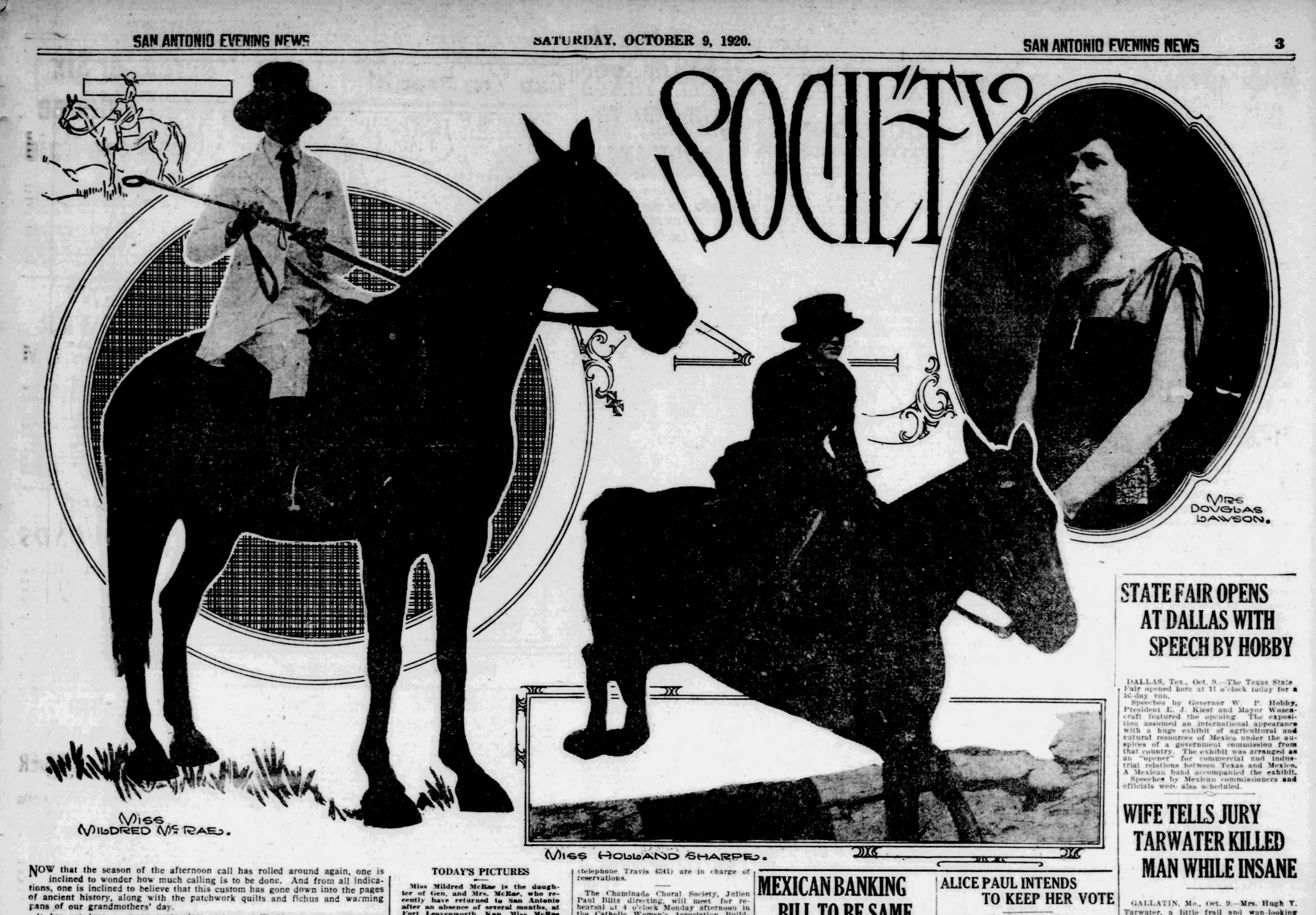
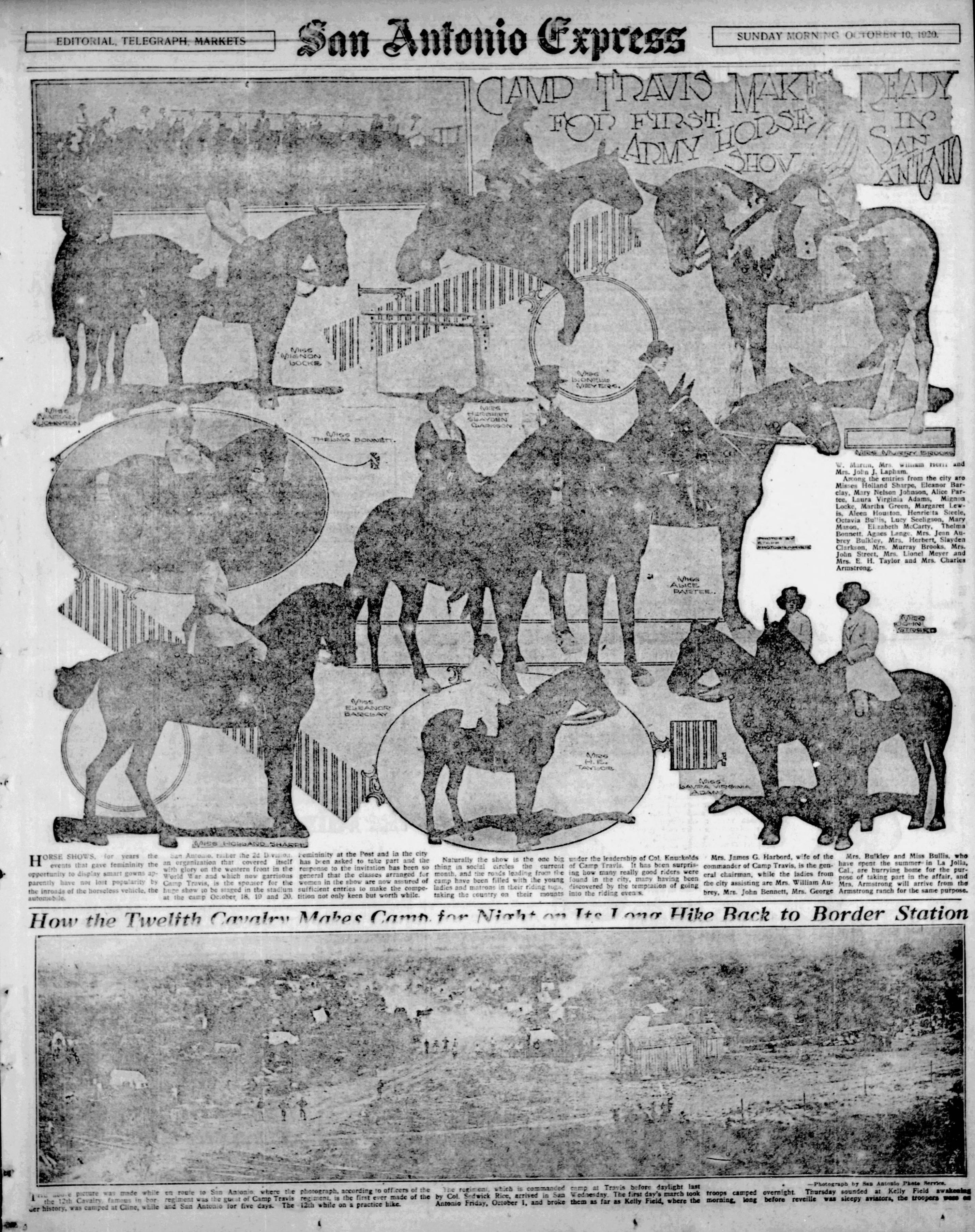
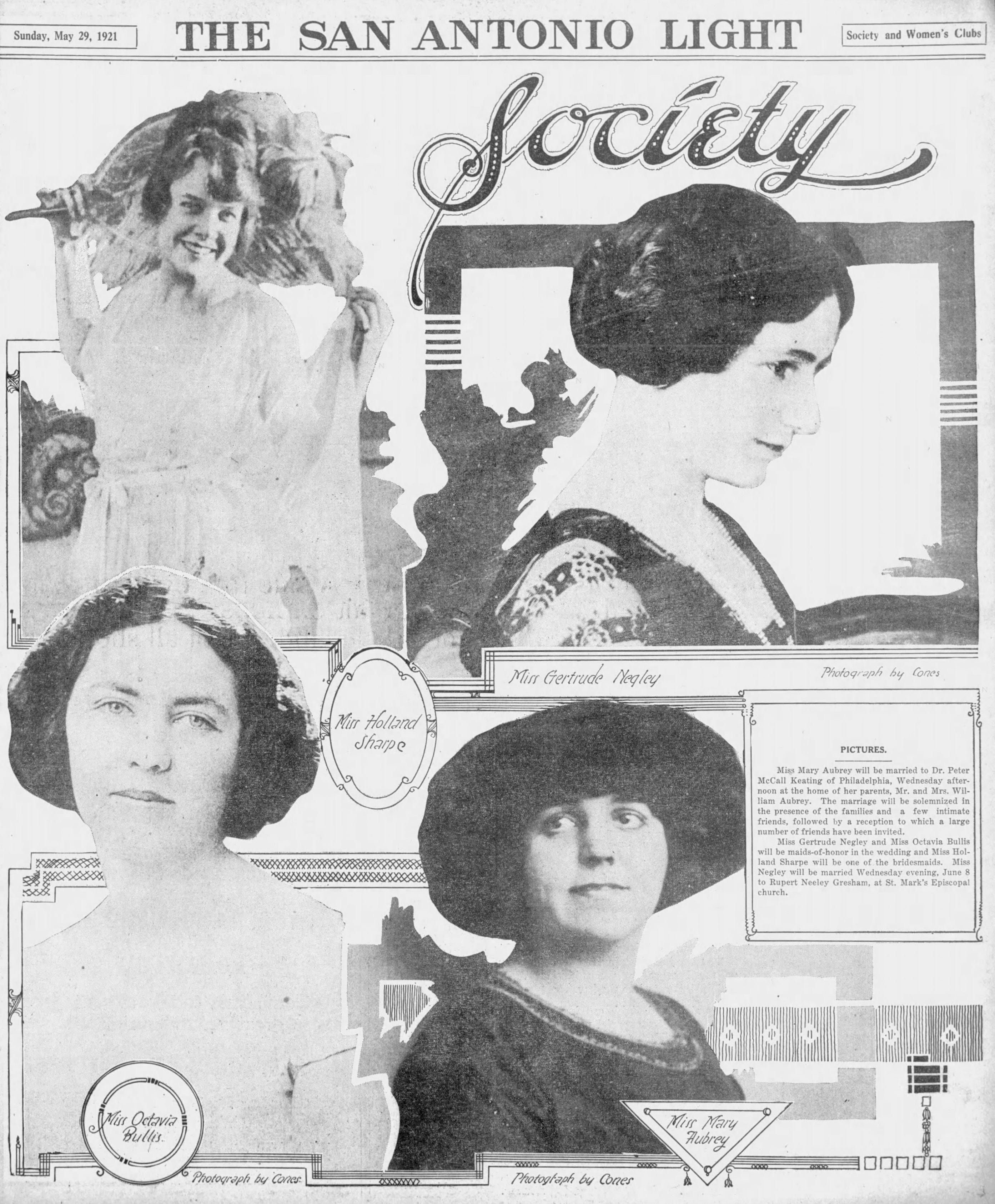
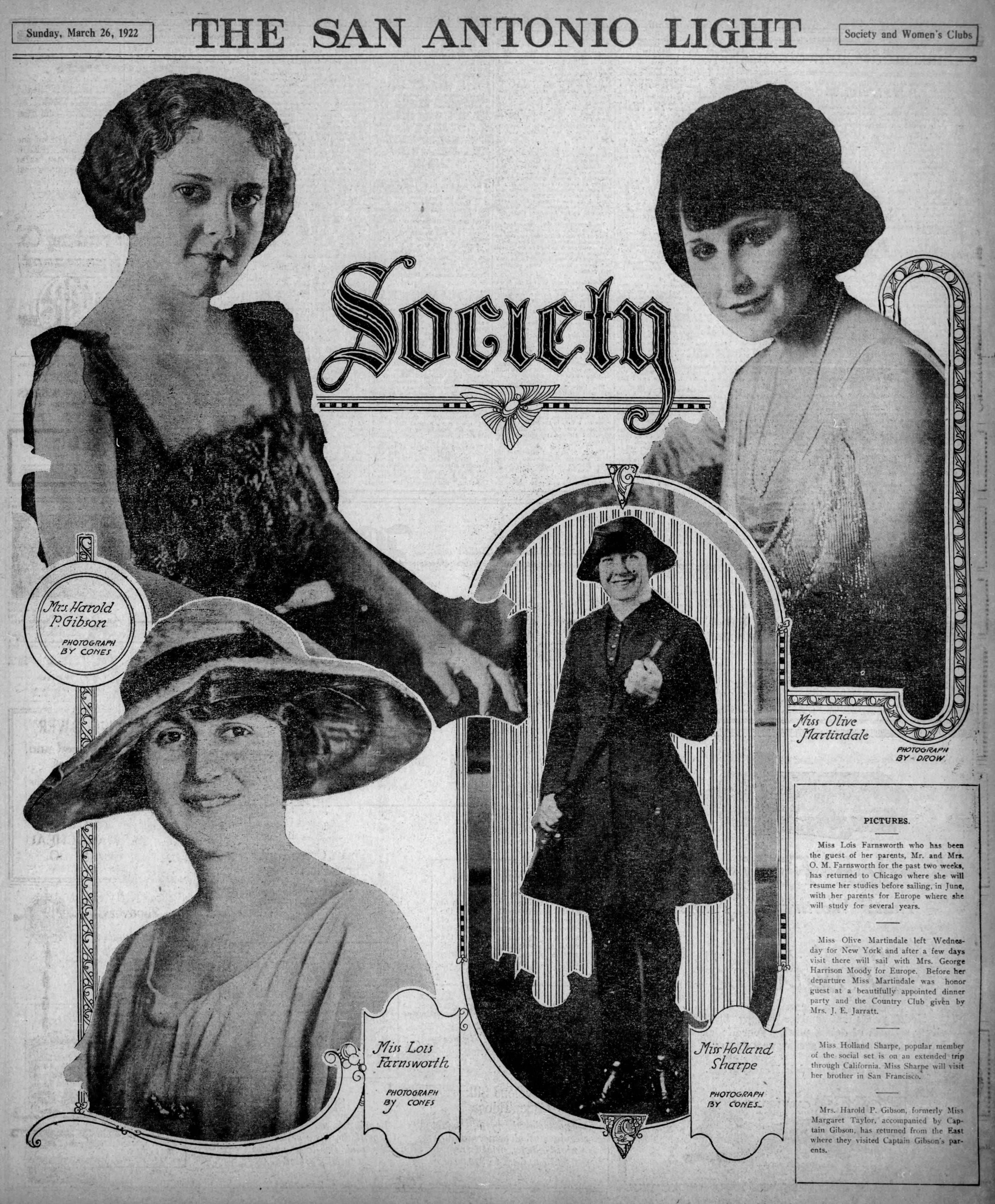
She rode in the first Army horse show at Camp Travis in October 1920. She was a bridesmaid in 1919 and 1921. In a 1922 photo, the description reads, “Miss Holland Sharpe is on an extended trip through California. Miss Sharpe will visit her brother in San Francisco.”
Six years after Oakley crossed the country to be at her side in Binghamton, she got on a train and went to see him.
Stealing Away
She turned 21 in 1918, the farm became hers outright, and she kept it.
In March 1925 she married Frost Woodhull, a San Antonio lawyer, University of Texas football captain, and grandson of the man who founded Frost Bank.
The Gillettes were giving the wedding, and by the middle of that month everything was arranged. Five o’clock Thursday afternoon, at their house, immediate family only. The announcement cards were engraved. Her uncle Charles Campbell and her cousin Hiel had come down from Temple for it. Her cousin Gray Gillette was on her way from Austin, where she was at the University, to serve as maid of honor.
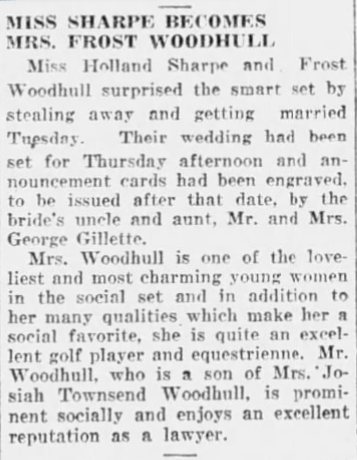
They eloped on the Tuesday.
“Miss Holland Sharpe and Frost Woodhull,” the San Antonio Evening News reported, “surprised the smart set by stealing away and getting married Tuesday.” The paper described the bride as “quite an excellent golf player and equestrienne.”
At 18 she had asked to be given charge of her own money, and her father shot her in the back for it. At 27 she wasn’t asking anyone for permission.
Howard Street
I’m going to be brief here, because there isn’t a kind way to tell this part.
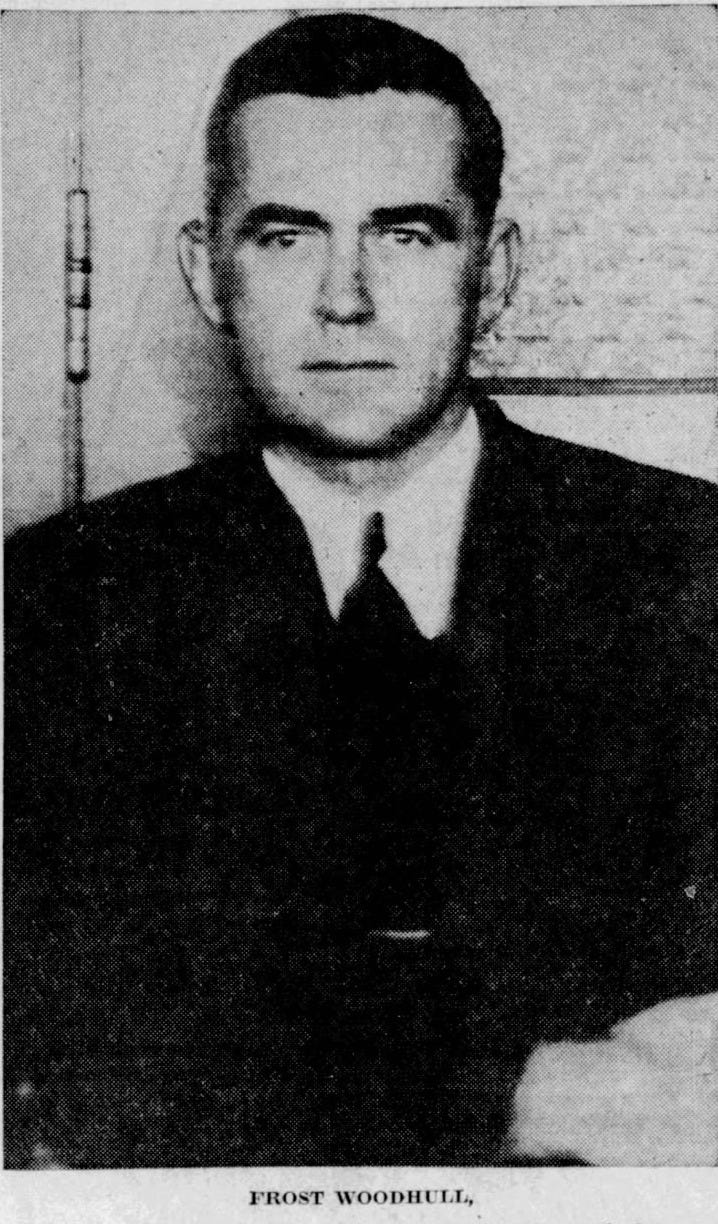
Frost Woodhull was County Judge of Bexar County for two terms. He’d been elected on a reform ticket, ran unopposed the second time, and refused a third because he had pledged to serve only two. He started the county’s bookmobile service. The project he was proudest of was the restoration of San Jose Mission, which he pushed through with federal money he went and got for the county himself. He taught flying at Kelly Field during the war. He was blind in one eye from a horse running him into a tree and was still a crack shot. He collected Texas folklore and wrote for the Texas Folklore Society’s quarterly, and he counted J. Frank Dobie a friend. He fished, he said, in nearly every trout stream in the United States.
On the morning of Tuesday, March 7, 1939, he shot himself in the bathroom of their house at 1510 Howard Street.
Holland found him. She had gotten up early and gone out to the grocery store.
Her photo was in the paper again.
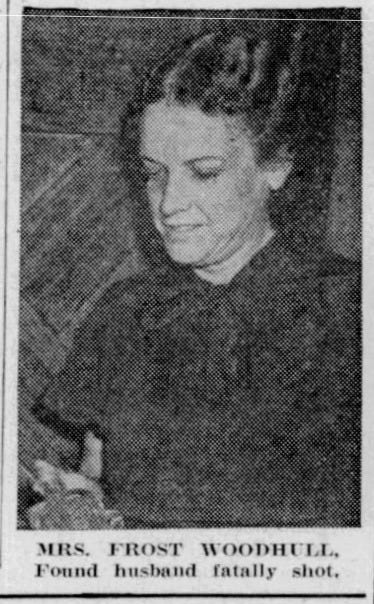
She was 41. Their son John was three days short of nine years old.
The Williamson County Sun told Georgetown about it on March 10, in the social column, in a single sentence about which local couple had gone down to the funeral. It said only that former County Judge Frost Woodhull “died Tuesday morning.”
Fitting the Baby
What happened next surprised me. Heiress and wealthy widow that she was, Holland went to work.
She had been on the board of the Texas Children’s Home-Finding Society since at least 1936, three years before her husband died, back when the work was something a well-married woman did with her afternoons. The society’s office was in Room 202 of the Frost National Bank Building, which is to say her husband’s family’s building, and its president was a Frost.
After 1939 it stopped being an afternoon. She took a position in the city health nursing office. And in March 1941 the San Antonio Social Workers’ Bulletin carried this:
Mrs. Holland S. Woodhull, formerly in the city health nursing office, has been appointed superintendent of the Texas Children’s Home-Finding Society.
She was appointed to a vacancy, replacing a woman who had married and moved to North Dakota, and her name ran in a column alongside WPA field supervisors and juvenile probation officers and settlement house directors. In 1942 the papers call her the society’s executive-secretary. By the time she died they call her its president.
The society had been incorporated in 1923. It worked mostly across Southwest Texas, took in children committed by the district courts or surrendered by their parents, placed 75 children in a good year, and checked on every one of them for months afterward.
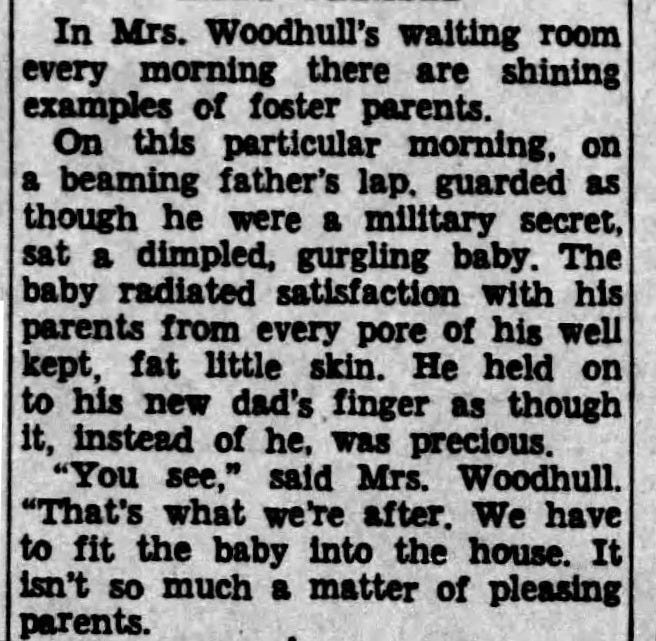
In August 1943 a reporter from the San Antonio Light spent a morning in Holland’s waiting room. There was a baby on a beaming father’s lap.
“You see,” said Mrs. Woodhull. “That’s what we’re after. We have to fit the baby into the house. It isn’t so much a matter of pleasing parents.”
That’s the only time, in a hundred and thirty years of records, that I’ve found Holland Sharpe’s voice.
This was a woman who had been the child forced to fit into a house, in El Paso, first with a stepmother who wasn't her mother when her father remarried, and a father who eventually tried to kill her over her inheritance. Later, she was the stepmother herself, fitting into Frost Woodhull's house alongside his daughter from his first wife. She knew what it meant to be on both sides of that equation. And when she finally had the power to make the rules, her professional philosophy was simple: the child comes first.
San Pedro Avenue
Here’s another thing I wish I didn’t have to write.
Holland Sharpe Woodhull died on Sunday, June 9, 1946, at her home on San Pedro Avenue, by her own hand. She was 48. Her cousin George Griswold Gillette couldn’t reach her by telephone, went over to the house, and broke a window to get in.
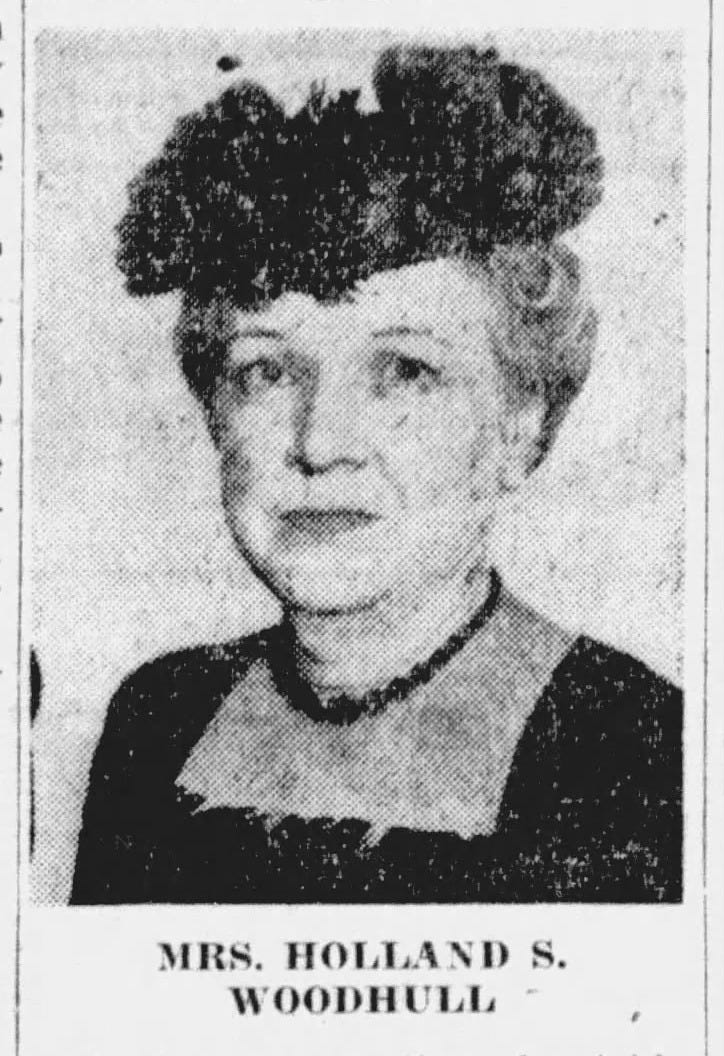
Her son John was 16.
Her obituary names two survivors. A son, John Woodhull. And a brother, Jack Oakley, of Oakland, California.
She had gone out to see him in 1922. He had come across the country for her in 1916. Sometime in the five years between those two journeys, John Oakley Sharpe stopped being a Sharpe. He spent the rest of his life in California as Jack Oakley, which is to say under his own dead mother’s name. He put down his father entirely, but 30 years on, he was still Holland’s brother.
What Was Left
So what did local merchant John Leavell leave?
He left a house that his children sold inside of five years, and it spent roughly the next century as somebody’s rental. I’ve told that story.
He left money to Kate that went into trust for Holland, and the trust was the thing that put a bankrupt man with a gun on a staircase in New York behind his own daughter.
And he left Kate the farm.
Holland kept the Taylor and Chamberlain place from 1918 until she died and never sold an acre of it. In 1940, she signed the easement that brought electric light out to the tenant house on it. It passed to her son, and John Frost Woodhull kept it another 47 years. He grew up to be an aviator and a Texas historian, exactly like the father he lost at eight; a newspaperman who went to Coahuila with him in 1961 wrote that John “has his father’s vast storehouse of Texana, which he is carefully indexing.” He flew his own plane over the border country looking for the ruts Santa Anna’s ox-carts left.
In 1973 he leased half an acre of Kate’s farm and the water underneath it to the Jonah Water Supply Corporation. In 1984 he sold seven acres to the family that had been farming it. In 1993 he put the rest into a partnership with his daughters, one of whom he had named for his mother.
And he came home. John Frost Woodhull moved to Georgetown, raised his children here, sold life insurance, and though life would take him out of Georgetown again, when he died in San Antonio in 2001 he was buried in Georgetown, in the Odd Fellows Cemetery, in the same ground as John and Lula Leavell and as Lucy Oakley Sharpe.
In January 2015 the family conveyed the farm into a development company, and it stopped being a farm. It’s the Saddle Creek subdivision now, out by Rockride Lane. You’ve probably passed by it dozens of times. When the surveyors drew the first plat in 2017, they marked three pecan trees, the biggest thirty inches through, and wrote beside them: trees to remain. Thirty-inch pecans are old. Those three were standing when Holland owned that field; they might have even been there when Leavell left the farm for Kate.


What I’ve Kept
There’s a shape here that wants to be a ghost story, or the story of a family curse. A story that started out to be one of resilience kept trying to become something else. So many of the members of this family died tragically, many by their own hand (and I didn’t even tell you about all of them). Make of that what you will. I can’t make sense of it.
What John Leavell left, as far as I can tell, was money that came to have strings attached and land that came with roots. The land is still out there growing pecans.
And Holland is the one who kept getting back up. Until she didn’t.
She was shot in the back at 18 and said it was her own fault. She rode jumpers again at 22. She eloped two days before her own wedding at 27 because she had decided she was done asking permission. She found her husband dead by his own hand at 41. And then she went and got a job placing other people’s children into other people’s houses, until she died by her own hand at 48.
The vital records and the newspapers will tell you what happened, but rarely do they help you sort out the why of it all.
If you or someone you know is struggling, the 988 Suicide and Crisis Lifeline is available 24/7. Call or text 988.
Sources
The Georgetown years
“Married” [A. L. Sharpe and Lucy R. Oakley], The Williamson County Sun (Georgetown, Texas), 11 November 1886, p. 3; and the “54 Years Ago” reprint, 8 November 1940, p. 10.
“Welcomed Home” [Fred L. Sharpe and Miss Lucy Oakley], San Antonio Light, 11 November 1886, p. 1.
“Death of Mrs. A. L. Sharp,” The Democratic Press, 22 February 1893, p. 3, reprinting The Williamson County Sun, 16 February 1893.
Delayed Certificate of Birth, John Oakley Sharpe, born 11 November 1889, Georgetown; Williamson County, filed 6 February 1940; Texas Department of Health, Bureau of Vital Statistics.
“Married at Georgetown” [A. L. Sharp and Miss Kate Leavell], Fort Worth Daily Gazette, 29 March 1895, p. 1.
“Death of Mrs. Leavell,” The Williamson County Sun, 21 November 1895; “John H. Leavell’s Death,” 8 December 1898, p. 1.
[Mrs. Kate Sharpe to make El Paso her home], The Williamson County Sun, 5 September 1901, p. 6.
“Texas Student Wins Prize,” The Williamson County Sun, 31 December 1908, p. 7; and “Collector Sharpe’s Son Makes Hit at Exeter,” El Paso Herald, 5 July 1911, p. 16.
The estate and the land
Williamson County, Texas, Deed Records: F. M. Taylor to John H. Leavell, 20 February 1883, vol. 28, p. 459 (256.67 acres, William Addison league, A-21); J. T. Chamberlain et ux to John H. Leavell, 31 July 1884, vol. 35, p. 59 (110 acres, W. Stubblefield league).
Commissioners’ Report of Partition, estate of John H. Leavell, District Court Civil Minutes, vol. 11, p. 200, Williamson County, 1899.
Certificate of Death no. 22717, Kate L. Sharpe, City of El Paso, 28 March 1908.
Last Will and Testament and Codicil of Kate Leavell Sharpe, 12 October 1907 and 26 March 1908; probated El Paso County, cause no. 1135, 5 May 1908, Probate Minutes book 14, pp. 40, 45, 50; certified copies recorded Wharton County, 2 August 1909, and Williamson County, 2 July 1927.
Sheriff’s Sale notice, Willis S. Kilmer vs. Charles H. Leavell, administrator, Holland Sharpe and John Oakley Sharpe, and Charles B. Stevens, trustee in bankruptcy of the estate of Alfred L. Sharpe, bankrupt, 41st Judicial District Court, El Paso County; El Paso Times, 21 November 1916, p. 11.
Easement, Holland Sharpe Woodhull to Texas Power & Light Company, 25 June 1940, Williamson County Deed Records.
Oil, Gas and Mineral Lease, John F. and Louise M. Woodhull to H. H. Dent, Jr., 27 January 1967, Williamson County Deed Records, vol. 495, p. 214 (366.67 acres in two tracts).
Lease Agreement, John F. Woodhull to Jonah Water Supply Corporation, 29 January 1973, Williamson County Deed Records, vol. 584, p. 35.
Warranty deeds, John F. Woodhull to Timothy B. and Kimberly Ann Telander (4.00 acres) and to Bertil F. and Mary Louise Telander (3.00 acres), 20 November 1984, as recited in Exhibit A of the 1993 deed below.
Warranty Deed, John F. Woodhull to Woodhull Family Partners, 28 December 1993, Williamson County Official Records, vol. 2442, p. 243.
Conveyance, Woodhull Family Partners to Woodhull Ventures 2015 LP, 16 January 2015, Williamson County Official Public Records, doc. 2015003698.
Final Plat, Saddlecreek Phase 1A, 24 May 2017, doc. 2017046488, Williamson County Clerk’s Office, Georgetown (”trees to remain”).
Alfred Sharpe
Legislative Reference Library of Texas, member profile, Alfred Lansing Sharpe, House District 100 (El Paso County), 29th Legislature, 10 January to 22 December 1905.
“Former Collector Sharpe Here on Way to Ranch,” El Paso Herald, 1 March 1916, p. 6.
“In the ‘Good Old Days’ of Local Politics,” by J. D. Ponder, El Paso Herald, 17 May 1917, p. 6.
April 1916
“Alfred L. Sharpe Ends His Own Life” / “Wounds Daughter, Ends His Own Life,” El Paso Herald, 20 April 1916, pp. 1 and 13.
“Former Collector Sharpe Self Slain,” El Paso Times, 21 April 1916, p. 5.
“Kills Daughter and Himself,” The Brooklyn Daily Times, 20 April 1916, p. 4.
“Shoots Daughter and Kills Self” (Associated Press), Lexington Herald-Leader, 20 April 1916, p. 6.
“Former Texas Man Wounds Daughter; Then Shoots Self” (Georgetown, Los Angeles and Associated Press dispatches), San Antonio Express, 21 April 1916, p. 7.
“Father of L. A. Man Shoots Daughter,” Morning Tribune (Los Angeles), 21 April 1916, p. 13.
“Death of Mr. A. L. Sharpe,” The Williamson County Sun, 20 April 1916, p. 1.
“Miss Sharpe Improving,” The Williamson County Sun, 27 April 1916, p. 1.
Holland
“Today’s Pictures” [photograph captioned “Miss Holland Sharpe”], The News (San Antonio), 2 August 1919, p. 6.
Society portraits and horse-show items: The News (San Antonio), 14 September 1918, p. 6; San Antonio Light, 23 November 1919, p. 41; San Antonio Evening News, 9 October 1920, p. 3, and San Antonio Express, 10 October 1920, p. 15; San Antonio Light, 29 May 1921, p. 13; and “Miss Holland Sharpe” [California trip], San Antonio Light, 26 March 1922, p. 37.
[Wedding arrangements], San Antonio Light, 16 March 1925, p. 6; and “Miss Sharpe Becomes Mrs. Frost Woodhull,” The News (San Antonio), 19 March 1925, p. 8.
“75 Children Find New Homes Here,” San Antonio Express, 9 May 1936, p. 16.
[San Antonio Social Workers’ Bulletin items], The News (San Antonio), 4 March 1941, p. 22.
“Foundlings Quickly Find S. A. Parents,” San Antonio Light, 28 June 1942, p. 23.
“Many Seek Adoption Of Babies,” San Antonio Light, 22 August 1943, part two, p. 8.
“Widow of Ex-Judge Kills Self,” The News (San Antonio), 11 June 1946, p. 2; “Woman Found Shot to Death In Her Home,” San Antonio Express, 11 June 1946, p. 12; “Woodhull Funeral Set,” San Antonio Light, 11 June 1946, p. 18.
Last Will and Testament of Holland Sharpe Woodhull, 3 August 1943, and order of probate, Bexar County no. 59278, 23 July 1946; recorded Williamson County, vol. 868, pp. 741–748.
Frost and John Woodhull
“Frost Woodhull Takes Own Life,” San Antonio Light, 7 March 1939, pp. 1 and 4-A; “Frost Woodhull Kills Himself at His Home,” San Antonio Evening News, 7 March 1939, p. 1; “Woodhull Rites Set For Today,” San Antonio Express, 8 March 1939, p. 5.
[Frost Woodhull funeral note], The Williamson County Sun, 10 March 1939, p. 4.
“Woolford’s Tales: A Life in Records Only” and “A Town Limns Our Past,” by Sam Woolford, San Antonio Light, 12 November 1961, p. 74, and 19 November 1961, p. 80.
New York Life Insurance Company advertisement, John F. Woodhull, agent, The Williamson County Sun, 22 December 1977, p. 14.
John Frost Woodhull obituary, San Antonio Express-News, 20 April 2001.
Old Town Echoes is independently researched using primary historical sources. AI tools assist in drafting and editing; all content is reviewed, sourced, and verified by the author.