


Here I am again, taking 3 weeks to bring you my “weekly” piece. The big house has a long history, but I’m back with tea to spill. Last time, I said I would follow the deed and see what the records could tell us about the families who came after the Leavells. I did. I’ve read every deed this property has generated since 1880, about twenty-five of them, plus the liens, releases, affidavits, and one foreclosure file. This cup steeped a while, but it came out strong. Pour yourself something cold; we have a hundred and twenty years to cover.
Content note: This story discusses suicide in a historical context.
Following the Deed
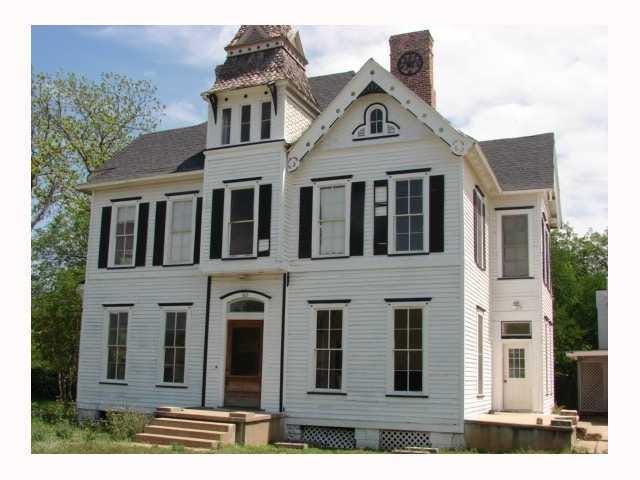
In August 2010, the Williamson County Sun ran a feature on the house at the corner of College and Eighth, the first in a series on notable historic renovations. The new owners, Todd and Kathy Cox, had bought the place out of foreclosure and were deep into restoring it. The article told the Leavell story in brief, and then came the line that started me down this whole road:
“Perhaps the memory of their father’s suicide was too painful, but for whatever reason, Mr. Leavell’s children sold the house and it has seen many owners since, though most didn’t stay for long.”
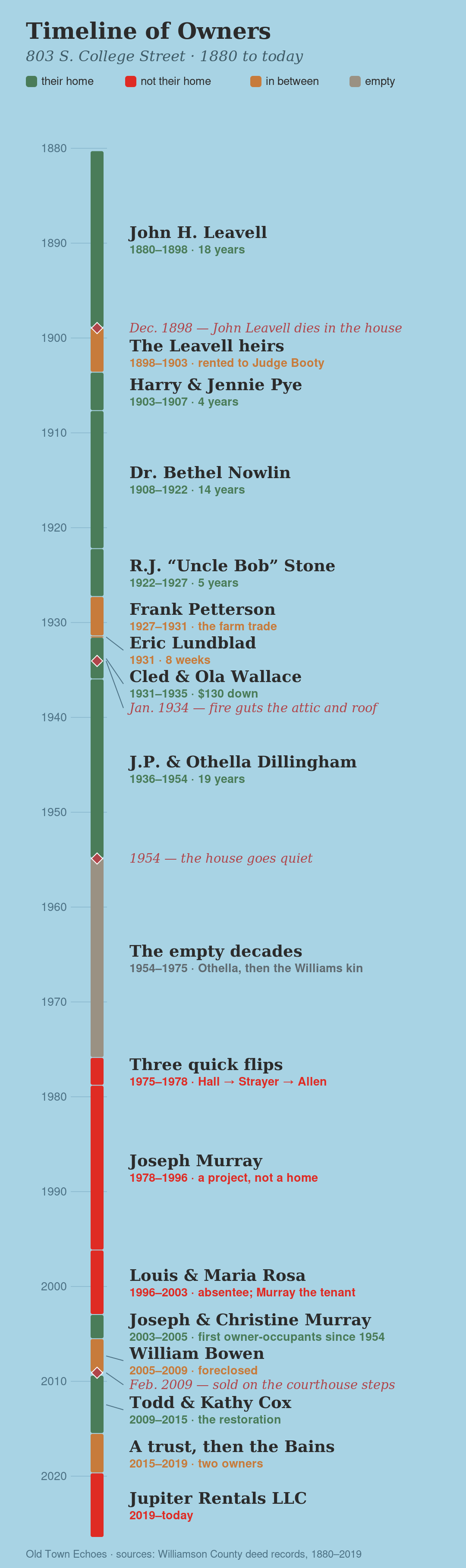
Most didn’t stay for long. Is that true? It’s the kind of claim that gets repeated until it hardens into fact, and the only way to test it is to follow the deed, owner by owner, from the Leavell estate to the present day. If you read enough deeds in sequence, with the newspapers filling in the faces, a shape starts to emerge. The shape of this house’s story surprised me. By the end of the trail I was keeping two lists: one of owners, and another one I didn’t expect to be keeping.
The Family Lets Go
When John H. Leavell died in December 1898, the house stayed with the family. The court set it aside as the family homestead, exempt from partition while the two youngest children, Gray and John Jr., were still minors. For a few years the block at the foot of Eighth Street remained in the family’s joint hands.
Between 1901 and 1902, Charles bought out his five siblings deed by deed, and the addresses on those deeds map the family’s scattering: Kate still in Williamson County, Lula in San Antonio, Blanche in Temple, Gray and Charles himself in El Paso. The consolidation turned out to have one purpose, and in September 1903 it happened: Charles and his wife Emma sold the homestead to H.E. Pye for $5,150. The property left the family after 23 years of Leavell ownership.
The house had not stood empty in the meantime. When Pye moved in, the Sun noted that Judge A.J. Booty had just vacated it. The grand house’s first stint as a rental had already begun within five years of its builder’s death.

A Railroad Agent and a Country Doctor
Harry E. Pye was the Katy Railroad’s new station agent, arrived from Temple in May 1903 with his wife Jennie, a childless couple who had married in a secret wedding in Cameron four years earlier. Four months after stepping off the train, Pye bought the finest house in the neighborhood. Four years after that, he sold it.
Pye sold the mansion to Dr. Bethel Nowlin in September 1907 for $5,500, and that December he bought a cottage from Dr. R.S. Hyer, the president of Southwestern University, for $2,000. The Pyes didn’t leave town; they downsized and stayed in Georgetown another twenty years. Selling the house may have just been a childless couple deciding they didn’t need eleven rooms.
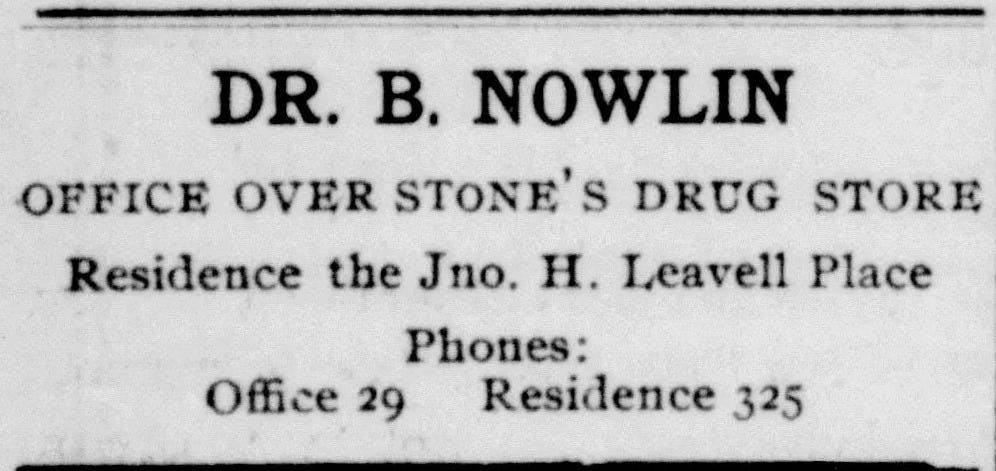
Dr. Nowlin, a country physician from Jonah who had practiced in Williamson County since the 1880s, moved his family into the house and stayed fourteen years, the longest hold the house had seen since the Leavells themselves. His professional card in the Sun, running from February 1908, gave his office as “over Stone’s Drug Store” and his residence as “the Jno. H. Leavell Place.” The house was still Leavell’s as far as the town was concerned, even a decade after his death.
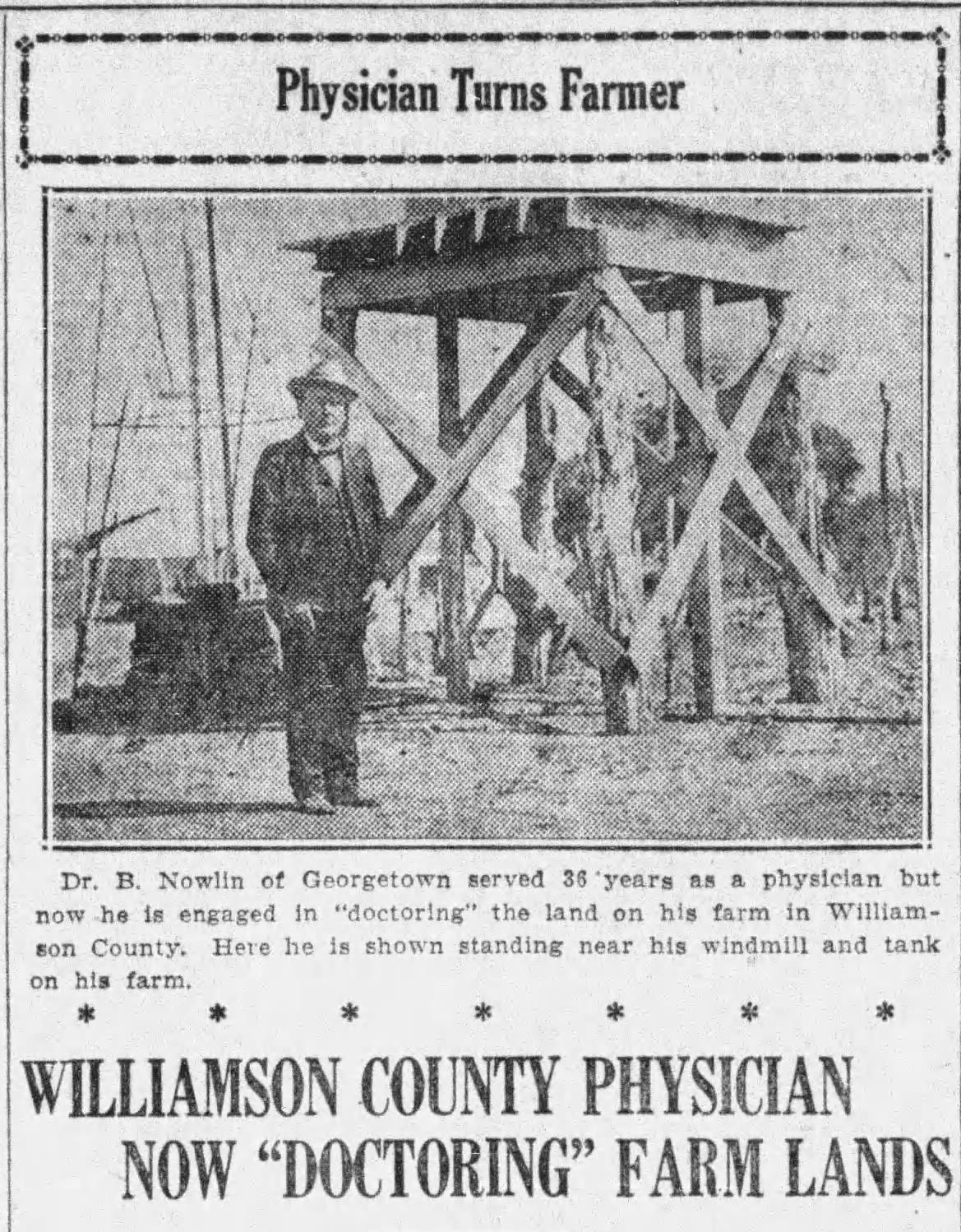
Nowlin raised four children there, and in 1922 he retired from medicine and did what retiring country doctors did: he sold the house in town and moved to his farm near Mankins Crossing. He sold to R.J. Stone for $5,500, the same price he had paid in 1907.
The fire-insurance maps add one more wrinkle: the 1916 Sanborn labels the house not “D” for dwelling but “Boarding,” as does the 1925 sheet. Even in its steadiest decades, under the doctor and then the photographer, the big house seems to have been taking in lodgers.


The Photographer’s House
Robert James “Bob” Stone was Southwestern University’s school photographer, “Uncle Bob” to decades of students, and the brother of T.B. Stone, the druggist whose store Dr. Nowlin had kept his office above. He bought the house in March 1922 and immediately began spending money on it. That October was when the city paved College Street. In July 1923, Stone and his wife Tula Lee signed a $3,000 mechanic’s lien to the Griffith Lumber Company “for certain improvements placed upon” the house. Three thousand dollars was more than half what he had paid for the whole property.
What did $3,000 build? The lien record names the debt but not the work, and the underlying contract is currently out of reach while the county’s mechanic’s lien volumes are being refurbished. Here’s what I keep turning over, though: the house in the 1886 photographs has no third-floor tower. The 1890 remodel is documented in the Sun, porches and a bay window and three rooms over the rear, no tower mentioned.
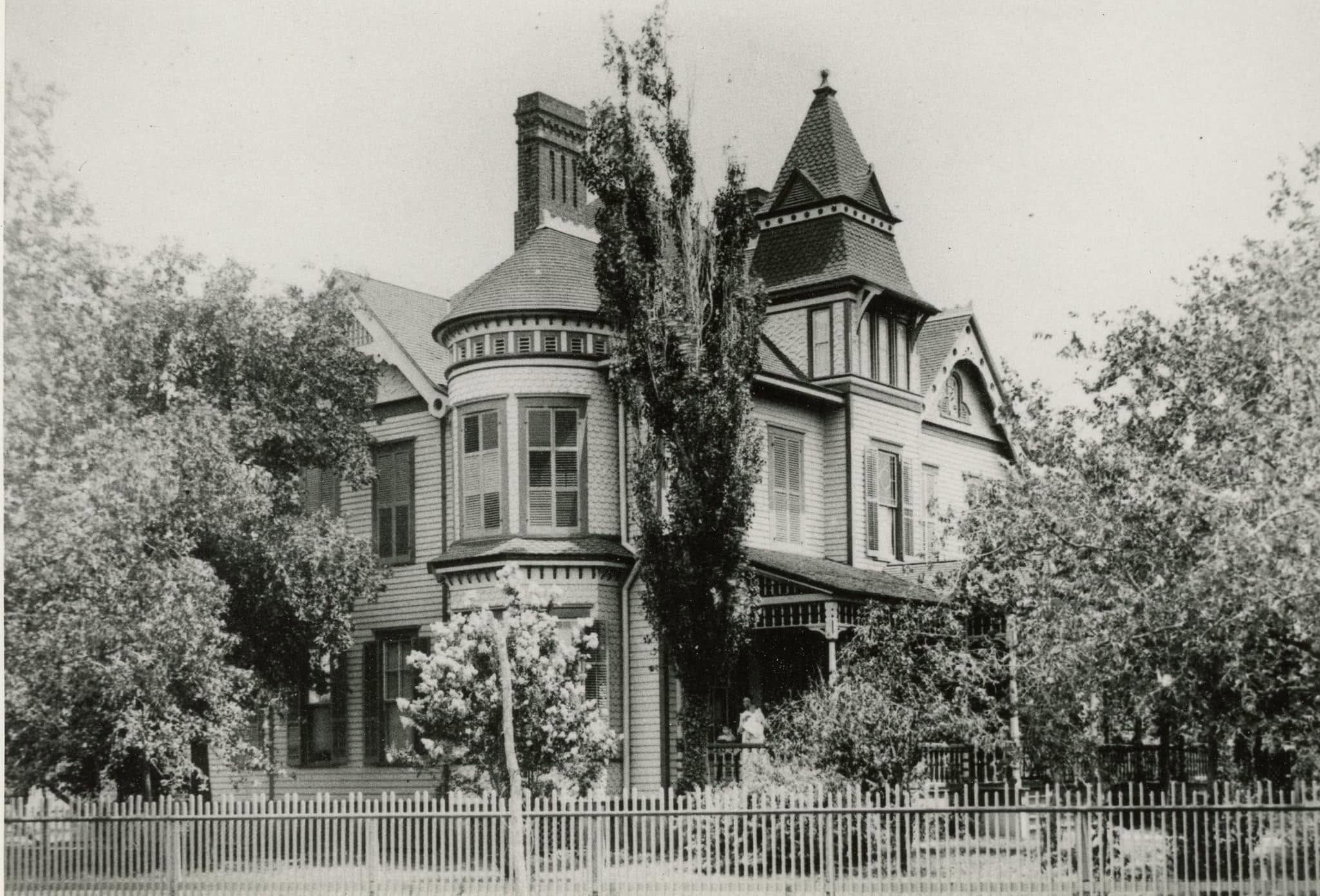
However… An undated photograph handed down in the Leavell family (said to be from 1882, though the 1886 views rule that out) shows the tower standing over a wrap-around porch behind a picket fence. While the 1886 photo shows a recently planted yard with what appear to be saplings and no tall foliage, the undated photo shows significant growth, indicating that about 15-25 years lapsed between the two photos. If you look closely, you can see a woman on the porch with children. Based on the fact that the photo was passed down through the Leavell family, who sold the house in 1903, my best guess on the date of the photo below is somewhere around 1900-1903. So, the tower was added sometime after 1886, most plausibly with the 1890 work or soon after it.
What Stone’s $3,000 built in 1923 is still an open question, but based on the photo below, the tower was likely already there when Leavell sold the house in 1903.
The Stones’ five years in the house were also marked by the kind of sorrow that this house seems to gather. Their youngest child, Robert James Jr., known as Sonny to the town, was a frail, bright boy the whole town seems to have loved. He died in October 1925 at age eleven after a long decline. The Sun‘s obituary says he died at home, and that the funeral was held at the home. The Stones had owned the Leavell house for three years by then. Among his pallbearers was a man named Eric Lundblad, whose name will reappear in this story shortly.
In 1926, Stone did something no owner had done before: he sold a piece of the block, a 65-by-85-foot corner, for $300. The full block John Leavell had assembled was beginning its long shrinkage down to the third of an acre the house sits on today. Then in April 1927, Stone sold the house itself; Frank A. Petterson traded him a farm of roughly ninety-nine acres for it, the exchange valued at $7,677.50.
Hard Times
Petterson had swapped his farm for the grandest house in town at what turned out to be the top of the market. Four years later the Depression had done its work. In June 1931 he sold the house to Eric Lundblad, the same Eric Lundblad who had carried Sonny Stone’s casket, for $2,175. Read that against the 1927 valuation: the house had lost nearly three-quarters of its value in four years.
Lundblad held it for eight weeks. In August 1931 he sold to Cled E. Wallace, a Church of Christ evangelist “widely known throughout the South and West,” for $2,000, taking a small loss for his trouble. Wallace put $130 down. The rest was financed at eight percent.
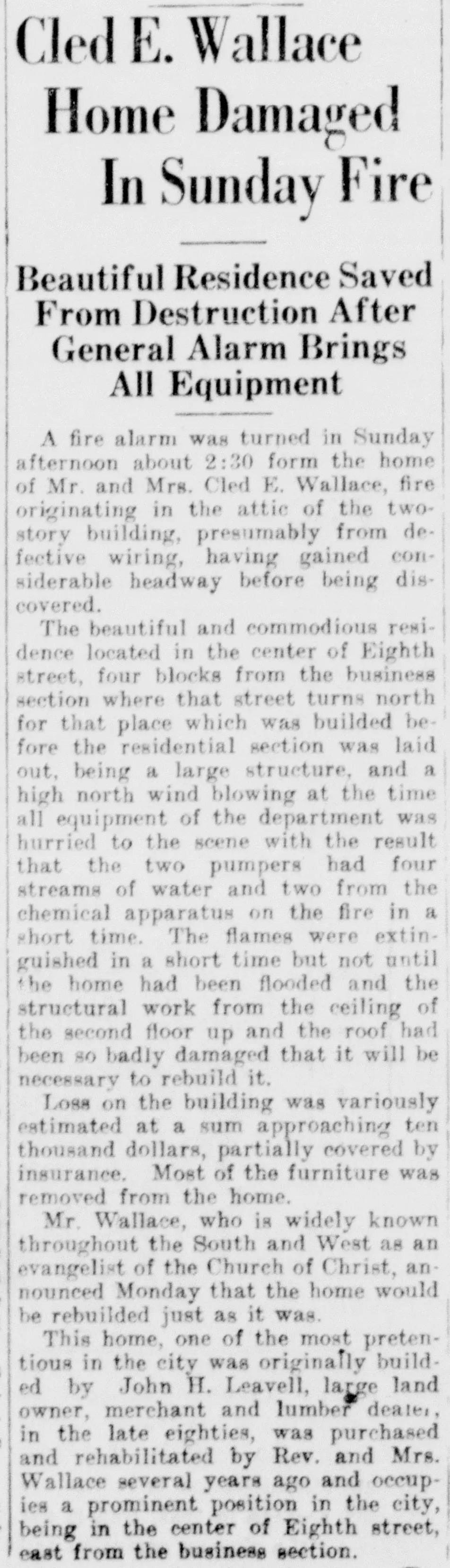
Wallace was betting on the house, and he backed the bet with work. Within days of buying it he hired a contractor, Hugh Bunton, to “remodel, repair, paint and paper the residence and build a two-story garage,” $1,981.33 worth, nearly as much as the house had cost him. Then came the hardest stretch. His note came due on New Year’s Day 1933 and he could not pay it; it was renewed rather than foreclosed. Then, on a cold, windy Sunday in January 1934, fire broke out in the attic, defective wiring the suspected cause, and gutted the house from the second-floor ceiling up through the roof. The damage was estimated at ten thousand dollars, only partly insured. The Sun reported that the furniture was mostly saved and that Wallace would rebuild it “just as it was.”
And then, against all odds of the decade, Wallace won. He paid off the remodel loan in March 1934 and paid his lender in full, and in December 1935 he sold the house for $6,500 cash, no foreclosure and no bank anywhere in sight, and moved to Oklahoma. The evangelist had bought the Leavell House at the bottom of the Depression with a $130 downpayment, navigated a remodel and a fire, and walked away four years later with a profit.
The Dillingham Place
The cash buyer was J.P. Dillingham, who came up from Travis County with his wife Othella and gave the house its longest family chapter since the Leavells themselves, nineteen years, outlasting even the Nowlins. By September 1936 they were advertising “furnished apartments, also furnished rooms” at the Dillingham place. A 1946 for-sale ad spells out what the mansion had become: an eleven-room house divided into three apartments, plus a small apartment over the two-story garage that Wallace had built in 1931. Four rental units, a new roof, fresh paint, offered at $20,000. It did not sell, and the Dillinghams stayed. Renters came and went around them, a roomer in the main house here, a railroad man there. This house has been somebody’s rental for far more of its life than the town tends to remember.
The Dillinghams’ adopted daughter, Beulah, was reported by the Sun in 1940 to be failing after an operation and “being cared for at the home of Mr. and Mrs. J. P. Dillingham, 803 College Street.” She died there that December, age 42, and was buried in the Odd Fellows Cemetery. A death in the house, forty-two years almost to the week after John Leavell’s.
The Sun caught a gentle scene at the house in the fall of 1948: J.P.'s eighty-second birthday, "spent quietly at home" on College Street, a chicken dinner and a birthday cake Othella baked for the occasion. Six years later, in November 1954, he died in the house, 88 years old, after a long illness, the last man to own this house and live out his life in it. With his death the house began the strangest chapter of its story, which is the chapter where almost nothing happens at all.
The Empty Decades
Othella didn’t leave immediately; she was still advertising furnished bedrooms in the fall of 1955. But at some point in the years that followed, the widow moved away, eventually to Round Rock, and the big house at the foot of Eighth Street went quiet. In 1970 she deeded it to her kin, Rudie and Bennie Williams, for one dollar and “love and affection,” reserving a life estate; she died in 1975 at 95. The Williams brothers never intended to keep it. They had already signed an option, back in 1969, to sell it for $7,500 the moment they could.
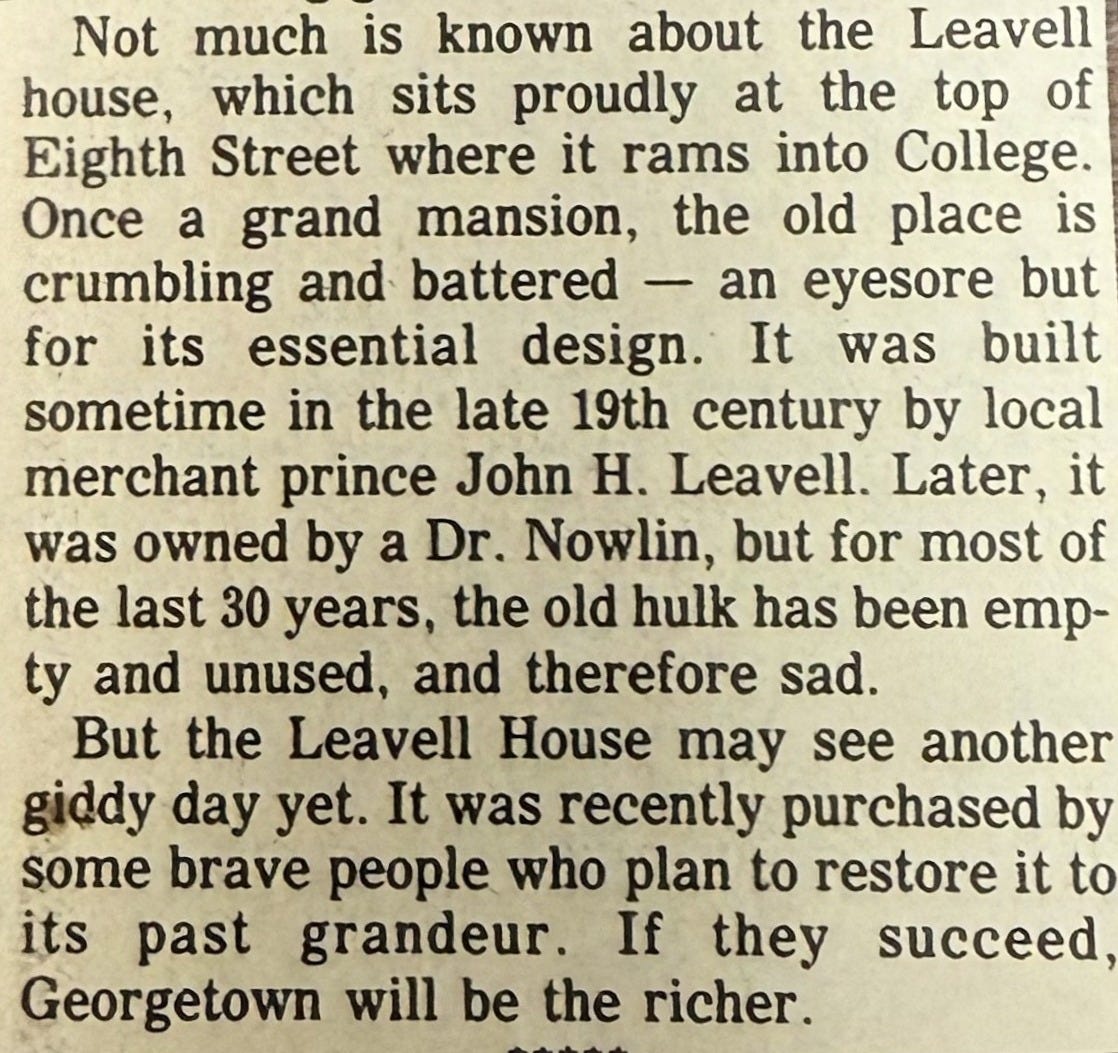
An undated Sun column by Linda Scarbrough, written most likely in the late 70s, looks back at this stretch: “For most of the last 30 years, the old hulk has been empty and unused.” Empty, crumbling, an eyesore, she wrote, the words of a town watching its grandest Victorian rot at the end of one of its best streets. Thirty years is a columnist’s round number, and classified ads suggest the address was at least partly occupied into the mid-fifties and again by the mid-seventies. But the heart of it holds: for something like two decades, the grandest Victorian in Georgetown could not find anyone to want it.
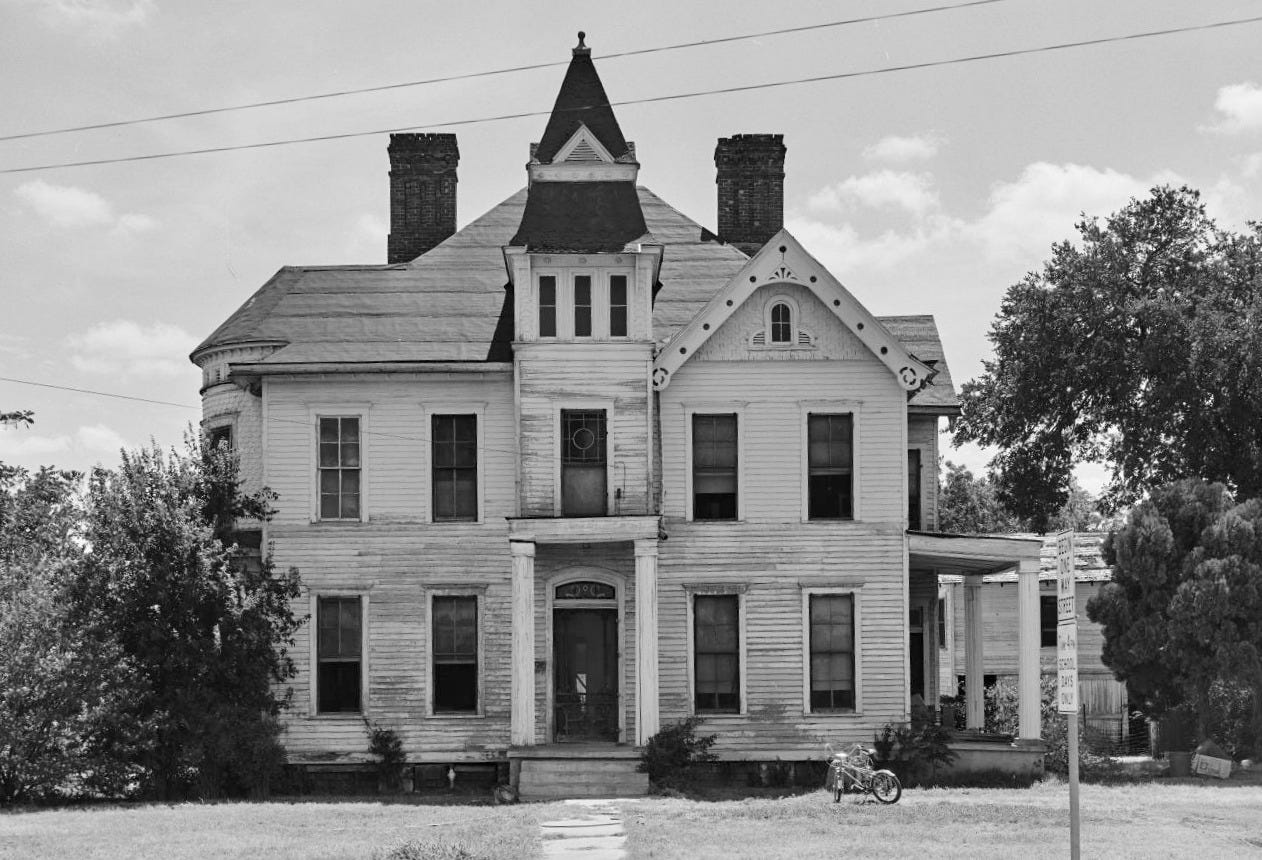
I keep thinking about what those years mean for the 2010 article’s claim. “Most didn’t stay for long” is true, as far as it goes. But the deeds say something stranger and sadder. After J.P. Dillingham’s death, the record shows a widow holding on to a memory, kinfolk holding an option, speculators holding a position, a contractor holding a project, and a Navy family holding an investment. Not until 2003 would an owner again swear in the county records that this house was their family home. The problem wasn’t just that owners left, it was that for half a century, almost nobody seems to have claimed it as home.
The Speculators and the Contractor
What happened next happened fast, and the prices tell the story by themselves. December 1975: Bert and Linda Hall exercise that old option and buy the derelict house for $7,500. March 1976, three months later: the Halls sell to Ed Strayer for $21,250, financing him personally. Strayer puts on a roof, composition shingles and shiplap from the Wickes lumber yard, and in May 1977 sells to a Houston couple, the Allens, for $27,000. The old hulk had more than tripled in price in eighteen months without anyone doing much more than keeping the rain out. The preservation era had reached Georgetown, and speculators were paying attention.
The Allens held on for eighteen months and then, in the last days of 1978, sold to Joseph C. Murray, a building contractor then living in California, who would be connected to this house for the next twenty-seven years. Murray is likely the reason the house survived. He moved to Georgetown, and deed by deed you can watch his life braid into the place: a divorce in 1981, after which he kept the house; years of restoration work done with his own contractor’s hands; and then, in 1996, a sale that was not really a goodbye. He sold to Louis and Maria Rosa, a Navy family from Rockport, for a financed $116,800. The Rosas never lived there, and a 1998 affidavit in the county records names their tenant plainly: Mr. Joseph Murray. He had sold the house and stayed in it.
In 2003 Murray bought it back, this time with his second wife, Christine, and filed a homestead designation. When Joseph and Christine Murray swore in January 2003 that 803 College was their family home, they became the first owners since the Dillinghams to make that claim.
They stayed two more years, and in 2005 they sold at the top of another boom, and the house sailed straight into another American financial disaster.
The Crash and the Secret Library
The 2005 buyer paid around $265,500, nearly all of it borrowed from First Magnus Financial, one of the subprime lenders that would not survive 2007. By the summer of 2008 the foreclosure machinery was turning, and in February 2009 the house was sold on the courthouse steps to Fannie Mae for a credit bid of $300,696.79. The house John Leavell built, whose builder's unraveling began in the years of the Panic of 1893, whose price collapsed by three-quarters in the Depression, had now been foreclosed in the crash of 2008. The three great financial catastrophes of the house’s lifetime each left a mark on its deed trail. That could be attributed to the house’s peculiar bad luck or it could just be what it looks like when any house stands long enough.
Fannie Mae resold the foreclosure that May for roughly $212,000 to a company called Hometown Renovations, which turned out to be Todd Cox. He and his wife Kathy moved from Round Rock into a smaller house next door while they planned the work. What followed is the renovation Georgetown still talks about, and the source of the article that started this piece.
The Coxes restored the staircase, all six stone fireplaces, the wraparound porches, ninety percent of the original wood floors, seventy percent of the old glass. They also converted the third-floor attic into a secret library that opens when you push the right spot on a wall of bookshelves.
“You could write a book on this place,” Cox told the Sun in 2010. And then, the line that reads differently once you’ve walked the whole deed trail: “We may live in it for the rest of our lives.”
They listed it for sale the following year. The listing sat on the market for 671 days at $1,285,000 and expired. Listing records show the house had already failed to sell in 2004, and it would fail again in 2013. Even restored to glory, the house was hard to keep and hard to sell, too big, too grand, too much... Or was it something else? At this point in the story, one has to begin to wonder. The Coxes finally sold in 2015, to a trust. The trust sold in 2017 to a Pflugerville couple, who financed nearly $800,000 of it. The couple sold two years later.
A Company With Rentals in the Name
John Leavell built this house in 1880 as a family home, and for eighteen years it was exactly that. In the 128 years since his death it has been a rental under his own heirs (Judge Booty was their tenant), a boarding house under the Nowlins and the Stones, an apartment house under the Dillinghams, a room-by-room rental under the widow Othella, a rental under the Rosas, and today it belongs to a company with the word Rentals on its letterhead.
The current deed is dated September 2019. The buyer, and the owner of the Leavell House as I write this, is a company called Jupiter Rentals LLC.
The house isn’t sitting idle. Its occupant today is Alta Loma, a licensed Georgetown mental-health treatment program headquartered a block west on 8th Street, which operates the old mansion as a supportive-living residence it calls Casa Sana, “healthy house.” Residents live there under round-the-clock care, take their meals together seven days a week, and walk to the square for work and school. After everything you’ve just read, there’s something fitting in that: the house that kept boarders for half its life is boarding again, this time in the service of healing. The people who live and work in the house today deserve their privacy, and the owner is entitled to the same public-record-only treatment I have given every living person in this series.
The 2010 article said most owners didn’t stay for long. The deed trail says something more precise: in nearly a century and a half, the number of families who owned this house and simply lived in it as their home for more than a handful of years is three. The Leavells, the Nowlins, the Dillinghams. Even Joseph Murray, tied to the house longer than any of them, seems to have owned it for eighteen years without living in it, and lived in it as its owner for barely two. Everyone else, including the residents today, was only passing through.
What I Can’t Help Wondering
Faithful readers know I’m not above a good ghost story. I’m pretty sure I live with a ghost in my current residence. The story of the Leavell House isn’t a ghost story in the traditional sense, though; every fact in this piece has a deed, a newspaper, or a court record behind it. The “ghost story” here is only a suggestion in the spaces in between those records. Before I let the house go, I want to gather in one place something the records kept handing me, one clipping at a time: the deaths of the people who lived here.
Lula Leavell died of consumption in the house in 1895, at 41. John Leavell died in the house by his own hand in 1898, at 52; a seventh Leavell child had not survived childhood. Baby Blanche Leavell, Charles and Emma’s second daughter, born in all likelihood in the house in its last Leavell winter and carried west with the family at seven months old, died in El Paso in June 1903, at seventeen months; her mother had been called home by telegram from Temple to find her dying. Emma Place Leavell herself, who came to the house as Charles’s bride in 1899, was dead in El Paso by 1905, at 27, leaving two small daughters, and was buried beside her baby. Kate Leavell Sharpe, married in the parlor in 1895, died in El Paso in 1908, reportedly on her wedding anniversary, at the very hour of the ceremony. Her husband Alfred Sharpe, who was living in the house in 1898 and was the one who found John Leavell’s body, shot their daughter Holland over her Leavell inheritance in a Binghamton, New York house in 1916, then killed himself; Holland, mercifully, survived. Blanche Leavell Campbell, who grew up in the house and left it as a bride in 1895, died suddenly in Temple in 1920, at 46, after an emergency operation. Sonny Stone, the photographer’s boy, died at home in 1925, at 11, in the middle of his family’s ownership. Gray Leavell, who grew up in the house and stood as maid of honor at her sister’s parlor wedding, drank poison and stepped off a steamer into Galveston Bay in 1930, at 45, leaving a note that said it seemed best because of the economic depression, thirty-two years after her father reached the same conclusion at his desk. Roy Nowlin, raised in the house from the age of three, was found dead with his own gun in Baytown in 1932, at 26; the paper allowed that it might have been an accident. Beulah Dillingham, the adopted daughter, died in the house in 1940, at 42.
Four of those deaths happened under 803’s roof. The others belong to people who had lived within it and died young, or violently, or both, somewhere else.
And those are just the ones I found.
I’m a genealogist; I know that any family followed across ninety years accumulates its dead and that a big house passing through many hands collects more stories than most. That is the sober reading, and it could be the right one.
And still.
Add the rest of the ledger: a fire that ate the roof, a Depression that ate three-quarters of the house’s value, fifty years in which no owner would make it a real home, the town calling its finest Victorian an eyesore, a restorer’s marriage ending mid-restoration, a boom-time buyer lost to the bank, restorers who vowed to stay for life listing it within a year and finding no buyer in 671 days, and at the end of the trail a deed made out to a rental company.
So, what is it? I can’t help but wonder if the house holds something that wants it empty; something that finds whatever trouble an owner carries in: a note coming due, a marriage fraying, a mortgage sinking, and leans on it so heavily that leaving feels like the only option. A restless something, quietly convincing a century of owners that they’d really rather live somewhere else.
Or… Maybe the explanation is the ordinary one: big houses are expensive, and every generation has to decide whether a landmark is worth the upkeep.
Either way, the house is still there at the foot of Eighth Street, closing the view from the Square the way it has since 1880. It has outlasted everyone who ever tried to keep it, and it will outlast us too. Walk past it some evening around dusk, when the tower catches the last of the light, and decide for yourself.
If you or someone you know is struggling, the 988 Suicide and Crisis Lifeline is available 24/7. Call or text 988.
Sources
The Chain of Title — Deed and Lien Records
Williamson County, Texas, Deed Records: heirs of John H. Leavell to Charles H. Leavell, 1901–1902; Charles H. Leavell to H.E. Pye, 1 September 1903; H.E. Pye to Bethel Nowlin, 9 September 1907 (with 1908 release of vendor’s lien); Bethel Nowlin to R.J. Stone, 27 March 1922; R.J. Stone to Clifford Hausenfluck, 27 February 1926, vol. 227, p. 311; R.J. Stone to Frank A. Petterson, 16 April 1927, vol. 231, p. 623; Frank A. Petterson to Eric W. Lundblad, 13 June 1931; Eric W. Lundblad to Cled E. Wallace, 6 August 1931; Cled E. Wallace to J.P. Dillingham, 28 December 1935; Othella Dillingham to Rudie B. and Bennie L. Williams, 31 July 1970; Williams heirs to Bert and Linda Hall, 24 October 1975, vol. 623, p. 195; Hall to Ed Strayer, 5 March 1976, vol. 630, p. 121; Strayer to Randall C. and Grace Elizabeth Allen, 6 May 1977, vol. 669, p. 286; Allen to Joseph C. and Patricia S. Murray, 31 October 1978, vol. 742, p. 503; Patricia S. Murray to Joseph C. Murray, 18 December 1981, vol. 863, p. 431; Murray to Louis and Maria Victoria Rosa, 8 March 1996, doc. 9612104; Rosa to Joseph C. and Christine Murray, 17 December 2002, doc. 2003000597; Murray to William A. Bowen, 28 July 2005, doc. 2005064084; Substitute Trustee’s Deed to Federal National Mortgage Association, 3 February 2009, doc. 2009008367; Fannie Mae to Hometown Renovations, LLC, 29 May 2009, doc. 2009040764; Hometown Renovations, LLC to Todd S. and Kathy O. Cox, 2010, doc. 2010063223; Cox to Kelly Gerry 2012 Irrevocable Trust, 17 July 2015, doc. 2015061528; Gerry Trust to Anthony Don and Connie Deanne Bain, 27 February 2017, doc. 2017017691; Bain to Jupiter Rentals LLC, 12 September 2019, doc. 2019087609; Williamson County Clerk’s Office, Georgetown.
Williamson County, Texas, Mechanic’s Lien Records: R.J. Stone and Tula Lee Stone to Griffith Lumber Company, $3,000, 11 July 1923 (released May 1924); Cled E. and Ola Wallace to Hugh Bunton, remodeling contract, 7 August 1931; Ed Strayer, Wickes Lumber materials lien, vol. 35, p. 759 (released April 1977); Rosa to J.C. Murray d/b/a Cam Jones Construction, 8 March 1996, doc. 9612105.
Rosa non-homestead and lease affidavit, 1998, doc. 9834132; Murray Voluntary Designation of Homestead, 2003, doc. 2003000600; Williamson County Clerk’s Office, Georgetown.
Newspapers
Andrew McLemore, “New owners make their mark on College Street monument” (”Building on the Past”), The Sun (Georgetown, Texas), 22 August 2010, sec. B; copy in project research files.
[Improvements on Mr. John H. Leavell’s residence], The Williamson County Sun, 4 September 1890, p. 11.
“Katy railroad Agent H. E. Pye has bought Chas. A. Leavell’s residence property,” The Williamson County Sun (Georgetown, Texas), 3 September 1903, p. 5; and moving-in item naming Judge A.J. Booty, 10 September 1903, p. 1; digital images, Newspaper Archive (newspaperarchive.com).
“Mr. Harry E. Pye of Temple arrived this week...” [Pye’s arrival as Katy agent], Austin American-Statesman, 3 May 1903, p. 12; [Pye–Carothers marriage], Houston Post, 26 November 1899, p. 3.
“Mr. H. E. Pye sold his handsome residence property (the old John H. Leavell place)...to Dr. B. Nowlin,” The Williamson County Sun, 12 September 1907, p. 5; and Hyer cottage purchase, 5 December 1907, p. 10.
Dr. B. Nowlin professional card (”Residence the Jno. H. Leavell Place”), The Williamson County Sun, 6 February 1908, p. 5.
“Dr. B. Nowlin, Physician and Pioneer, Passes,” The Williamson County Sun, 30 August 1929, p. 8; “Mrs. Nowlin Died Saturday,” 2 July 1948, p. 7; “Mr. H. E. Pye Dead,” 1 November 1929, p. 2.
“Williamson County Physician Now ‘Doctoring’ Farm Lands,” The Austin American, 9 May 1926, p. 18.
“Funeral Held Thursday For R. J. Stone,” The Williamson County Sun, 6 August 1953, p. 1; Robert James “Sonny” Stone obituary, 16 October 1925, p. 5; “Mrs. R. J. Stone, Longtime Resident, Dies in Houston,” 15 February 1968, p. 4.
“Cled E. Wallace Home Damaged In Sunday Fire,” The Williamson County Sun, 12 January 1934, p. 1.
“Yesteryears” (reprinting the 1931 Lundblad purchase item), The Williamson County Sun, 28 July 1977, p. 2.
Dillingham-era rental and for-sale classifieds, The Williamson County Sun: 20 March and 11 September 1936; 18 September 1942; 4 July 1947; 6 September and 4 October 1946 (”11-room old style home, made into 3 apartments”); 6 October 1955.
Beulah Dillingham items, The Williamson County Sun, 29 November 1940, p. 3, and obituary, 13 December 1940, p. 5.
“J. P. Dillingham’s 82nd Birthday,” The Williamson County Sun, 1 October 1948, p. 6; “J. P. Dillingham Dies Here Early Monday,” 18 November 1954, p. 6; “Mrs. Dillingham dies in R. Rock” [Othella Dillingham obituary], 19 June 1975, p. 9.
Linda Scarbrough, “Pulling Hair,” The Williamson County Sun (Whirligig), undated, ca. 1976–1979; clipping courtesy of the Williamson Museum.
The Family Deaths
“Death of Mrs. Leavell,” The Williamson County Sun, 21 November 1895; “John H. Leavell’s Death,” 8 December 1898, p. 1 (see Part 1 for full citations).
“Mrs. Emma Leavell” [death notice], El Paso Times, 1 December 1905, p. 5.
[Kate (Leavell) Sharpe death coverage], The Williamson County Sun, 30 March and 2 April 1908.
“Wife of Temple Banker Dies After Operation” [Blanche Leavell Campbell], Austin American-Statesman, 9 April 1920, p. 6.
“Blanche Leavell” [infant death notice], El Paso Herald, 25 June 1903, p. 2; “Little Blanch Leavell,” The Williamson County Sun, 2 July 1903, p. 1.
“Kills Daughter and Himself,” The Brooklyn Daily Times, 20 April 1916, p. 4; “Shoots Daughter and Kills Self” (Associated Press), Lexington Herald-Leader, 20 April 1916, p. 6; “Shot His Daughter Then Killed Himself Did Alfred Sharpe,” The Victoria Advocate, 28 April 1916, p. 2; “Death of Mr. A. L. Sharpe,” The Williamson County Sun, 20 April 1916, p. 1. See also Dwight A. Sharpe, “Register Report for Alfred Lansing Sharpe” (family genealogy, 2013), dasharpe.com.
“A Pretty Wedding” [Gillette–Leavell marriage at the Leavell home], San Antonio Express, 24 December 1899, p. 12.
“El Pasoan Learns of Sister’s Death,” El Paso Evening Post, 7 November 1930, p. 1; “Woman Kills Self,” El Paso Evening Post, 8 November 1930, p. 1; “Woman Who Drowned May Be From S.A.,” The News, 7 November 1930, pp. 1, 6; “Former Charity Worker Drowns,” San Antonio Express, 8 November 1930, p. 22; “Georgetown Is Scene of Sea Death Funeral,” San Antonio Express, 10 November 1930, p. 3.
“Roy Nowlin Is Victim Of His Own Gun,” The Williamson County Sun, 2 September 1932, p. 1.
Robert James “Sonny” Stone obituary, The Williamson County Sun, 16 October 1925, p. 5; Beulah Dillingham obituary, 13 December 1940, p. 5 (also cited above).
Survey, Listing, and Property Records
Texas Historical Commission, Historic Sites Inventory Form, John Leavell House, Site No. 663 (1984), and survey photographs, ca. 1970s–1984; Georgetown Heritage Society house file, 803 College; National Register of Historic Places, Georgetown Multiple Resource Area (1986), ref. 86000979.
Photographs of Georgetown, 1886: view from the preparatory school, Southwestern University Distinctive Collections; bird’s-eye panorama, UNT Portal to Texas History.
Sanborn Map Company, fire insurance maps of Georgetown, Texas: 1916 sheet 6 and 1925 sheet 5 (803 S. College, “Boarding”).
Leavell family photograph of the house (undated, ca. 1900–1903), shared by a Leavell descendant; copy in project research files.
Williamson County property and MLS listing records, 803 S. College Street (listing 5504677 and prior listings, 2004–2019).
Alta Loma Transformational Services, “The Villa” program page, altaloma.com (accessed 3 July 2026); Williamson County and Cities Health District “Restaurant Report” (”Casa Sana,” 803 S. College), The Sunday Sun, 18 May 2025, p. 7.
Old Town Echoes is independently researched using primary historical sources. AI tools assist in drafting and editing; all content is reviewed, sourced, and verified by the author.
fascinating work! Really love how you laid out the timeline
I assume HARC wasn't around at the time?