


If you’ve been around for red poppy season, you probably know Edwards Park even if you’ve never noticed its name. It’s the green block at 704 Ash Street, between 7th and 8th, with the swings and the wood chips and, in a good spring, a field of red poppies in bloom. A neighbor on East 7th wrote to the Sun in 2023 that the park had been “a neighborhood legend to local portrait studios.” When the Sunday Sun wants to tell Georgetown that poppy season has started, it runs photos from this park.
Have you ever noticed the round stone on display at the corner?
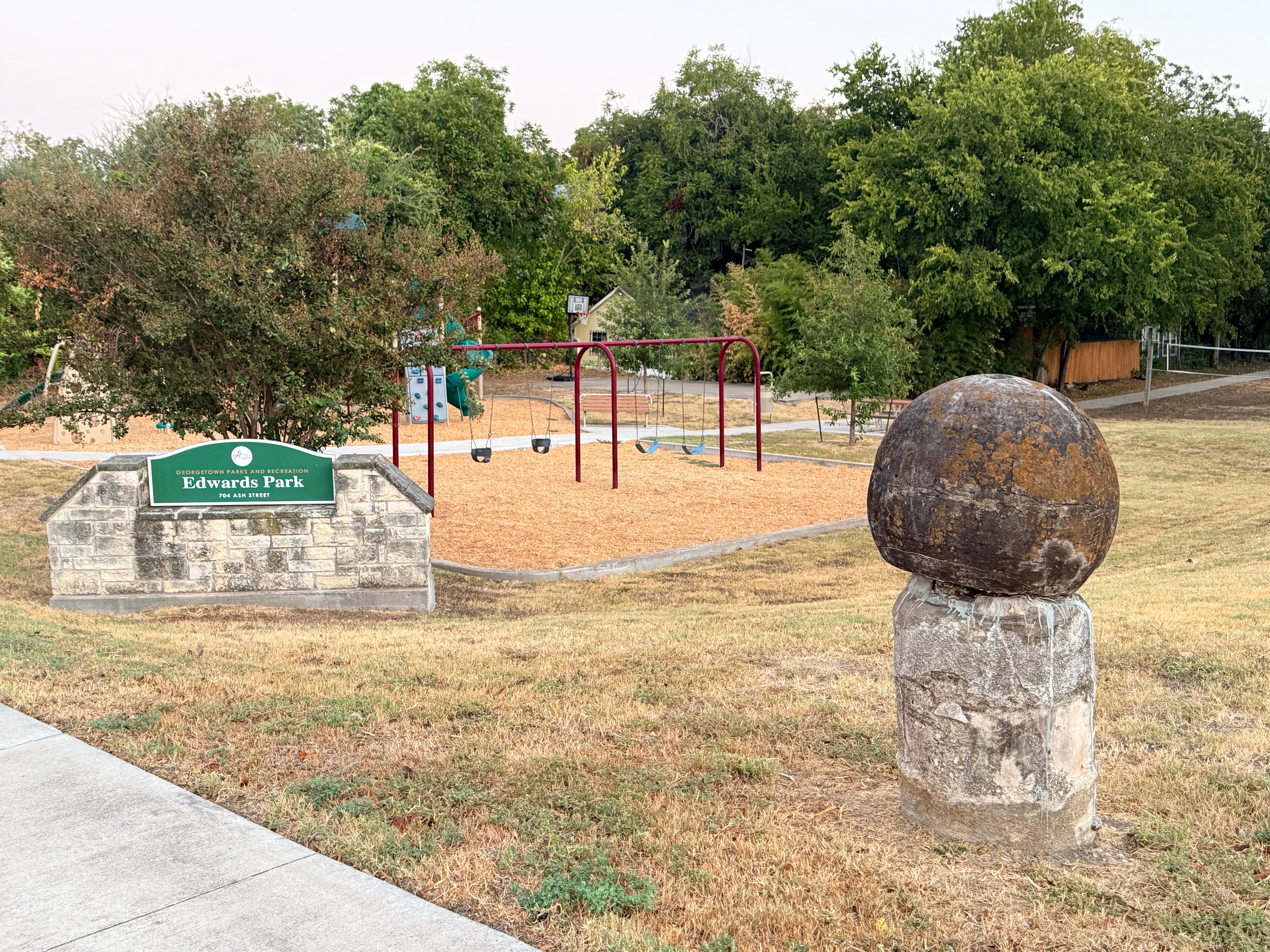
It stands near the Ash Street corner on a squat masonry pedestal, a dark gray sphere about two and a half feet across, gone orange in patches with lichen. There’s no sign on it, no plaque nearby, nothing to say what it is or why it’s there.
I photographed it in February this year, on a walk with my dogs, with no idea what I was looking at. It seemed like the sort of thing that should have an explanation attached. I thought I might look into it one day, then I forgot all about it.
The cave rock
Earlier this week, I noticed the stone in Donna Scarbrough Josey’s Images of America: Georgetown, on page 119, in a photograph by Sarah Raach.
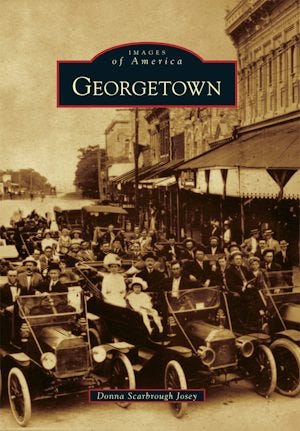
The caption calls it “the 30-inch, spherical rock displayed at the corner of Eighth and Elm,” says it’s been “a Georgetown curiosity since 1930,” that it came out of a Rockdale coal mine 100 feet down, that W. W. Edwards bought it and had L. P. Imhoff drill into it, and that it broke. “Cemented back together, there is still no consensus about its origin.” The caption adds that some people call it the “cave rock.”
(The corner is 8th and Ash, not 8th and Elm. Elm is the far side of the block.)
A curiosity since 1930, with no agreement about where it came from, with a name I’d never heard anywhere? That was enough to send me to the newspapers.
The gift
On May 6, 1930, W. W. Edwards signed a deed conveying to the City of Georgetown the east half of Lots 1 through 4 in Block 29 of Glasscock’s Addition. The consideration was $10 and Edwards had conditions: the City had to call it Edwards Park, and the land was to be used exclusively as a public park. If it ever stopped being one, the land would go back to Edwards and his heirs. The council named it Edwards Park on May 12.
Edwards was a grocer who’d come to Georgetown in 1907, put up buildings that became known as the Edwards Block on West 8th in 1924, and retired in 1930. He was 59, though the Sun would later remember him as “a rather elderly Georgetown man.” He was born in Milam County.
He also gave the town a large spherical rock.
Is it cement, or is it not?
The Sun ran the story on May 16, 1930, and Southwestern’s student paper reprinted it four days later, which is lucky, because the 1930 Sun is missing from the digital archive.
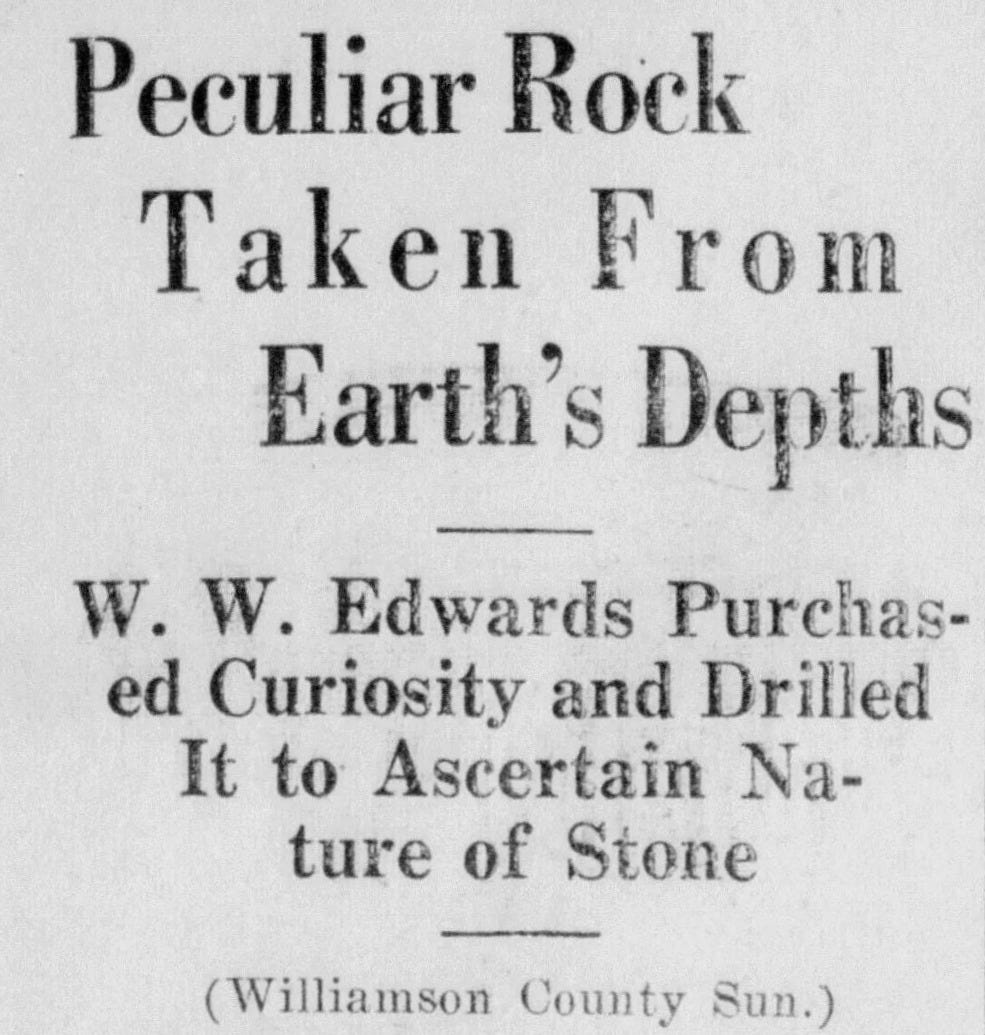
The stone had been found in one of the coal mines at Rockdale, in Milam County, resting on top of a vein of coal, 100 feet down under rock and dirt. It was round “as any baseball,” stood 30 inches high and weighed about 2,500 pounds. Edwards heard about it, bought it, and had it trucked to Georgetown.
Wanting to know what it was, he had a hole drilled into it at L. P. Imhoff’s machine shop at the foot of Jail Hill. The stone turned out to be as hard as marble, and partway through the drilling it broke into three pieces.
That’s when the speculation started.
The inside was dark gray and looked, in the Sun’s words, like “a very fine cement.” People whose opinion was “presumed to be good in such matters” examined it and said it was natural, not made by man. The doubters had one stubborn piece of evidence:
“However, a few laymen are interested to know, if it was not made, why were pieces of wood found inside?”
There was wood in it. Imhoff kept one of the fragments and took a piece of wood out of it himself, a splinter with a hole running through, the hole filled with the same material as the stone. The Austin American, which sent its own report to Austin that same day, measured the piece at roughly three quarters of an inch wide and six inches long, and had the workmen concluding from it that the stone had been formed from something pliable.
The Austin paper’s story disagrees with the Sun on several details. It puts the stone 90 feet down instead of 100, says Edwards had it drilled at his home rather than at Imhoff’s shop, calls it hard as granite instead of marble, and has “geologists” declaring it a natural stone “worn round by its meanderings over the earth.” Two reporters worked the same rock story in the same week and came away with different notes, which is how we can tell the Austin story isn’t a reprint of the Sun’s.
Nobody resolved it. The Sun let the speculation run all the way to the Temple of Solomon, wondering whether some ancient builder without access to brass or good clay might have cast his ornamental spheres out of cement instead, and then gave up honestly:
“And so it goes the whole gamut of speculation, yet the question remains, ‘What is it?’”
The three pieces were cemented back together. The City poured a foundation, and a receptacle for a flagstaff was set into the top of the stone, so that the thing could serve, as the paper put it, “as a curiosity and a bearer of the Stars and Stripes on this playground dedicated to the childhood of this community.”
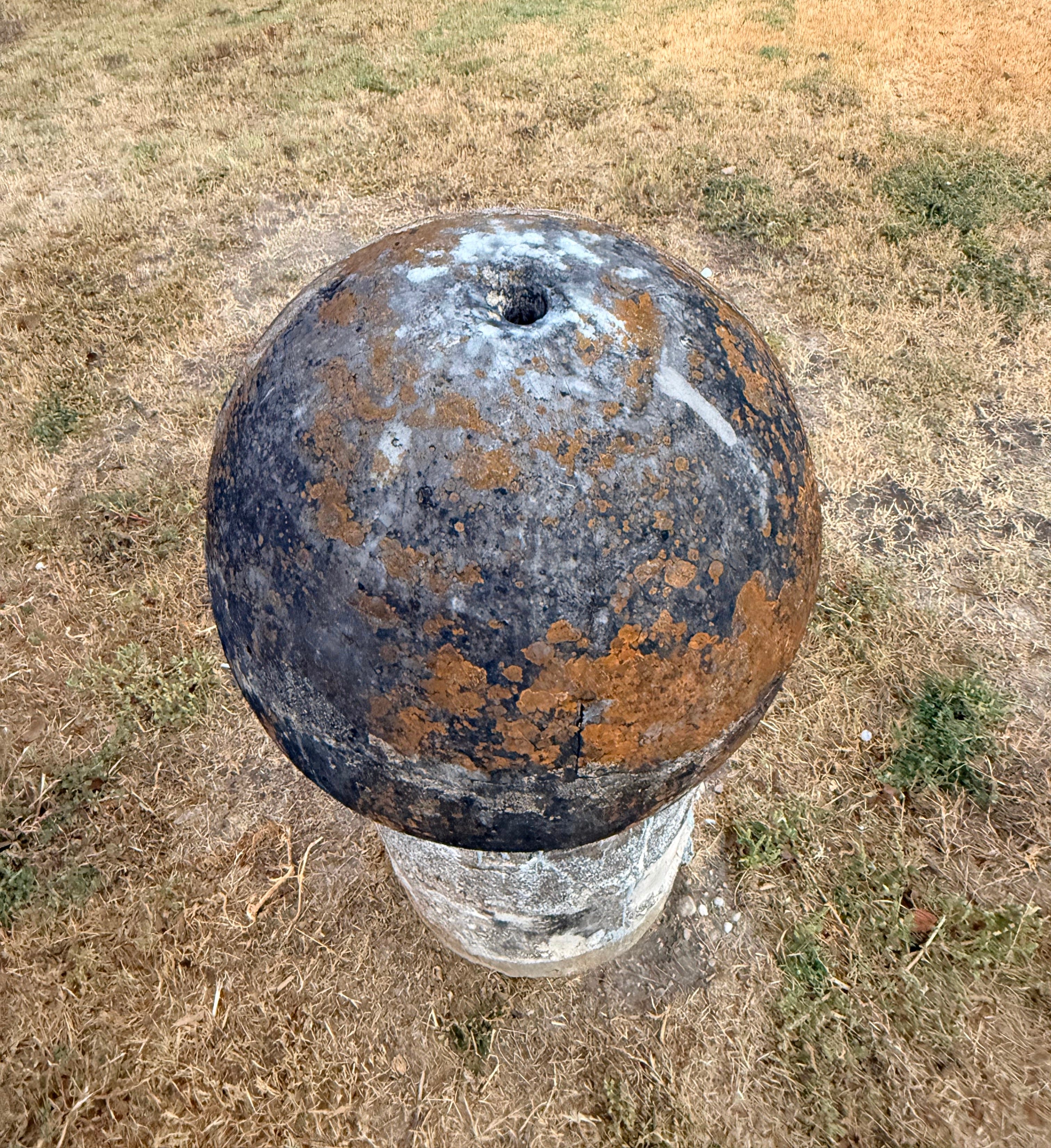
The hole is still there in the top of the stone. I stood over it yesterday and looked down into it, almost 100 years later.


The seams are still there too, a line running around the sphere below its middle with another dropping into it from the crown. You can see exactly where it came apart.
Whattizit
Georgetown kept talking about it. The Sun, looking back at that spring, called it “the mysterious rock,” and said the story of it “stirred the minds of a number of people.” Their own stories started coming in at the paper’s office. Mrs. O. T. Cate of North Georgetown, then in her 74th year, remembered a round rock dug out of a well at Hopewell near Liberty Hill more than 50 years earlier, broken open to reveal a live black snake the size of a pencil. A Round Rock man had found a live green frog in solid rock while digging bridge footings. Another man had found one at a bridge over the San Saba.
The city was working on the park that same summer. City Marshal C. J. Brady finished a set of new walks, noticed the possibilities of the little stream running through the ground, and put his men to work on a sunken garden.
Forty-five years later, something taken for a meteor crossed the sky over this part of Texas in a blinding light, and Mrs. Sam Harris thought of the rock in Edwards Park. She was Charles Brady’s daughter. The Sun sent Fred Millholin back to the 1930 clipping, and on May 29, 1975, the paper ran his retelling on the front page under the headline “Fred Millholin explains Georgetown’s ‘Whattizit’.” The photograph on page 14 is captioned METEORITE at EDWARDS PARK, which is not what the article says. Millholin wrote that many believed it a meteor and that “its origin has never been determined.”

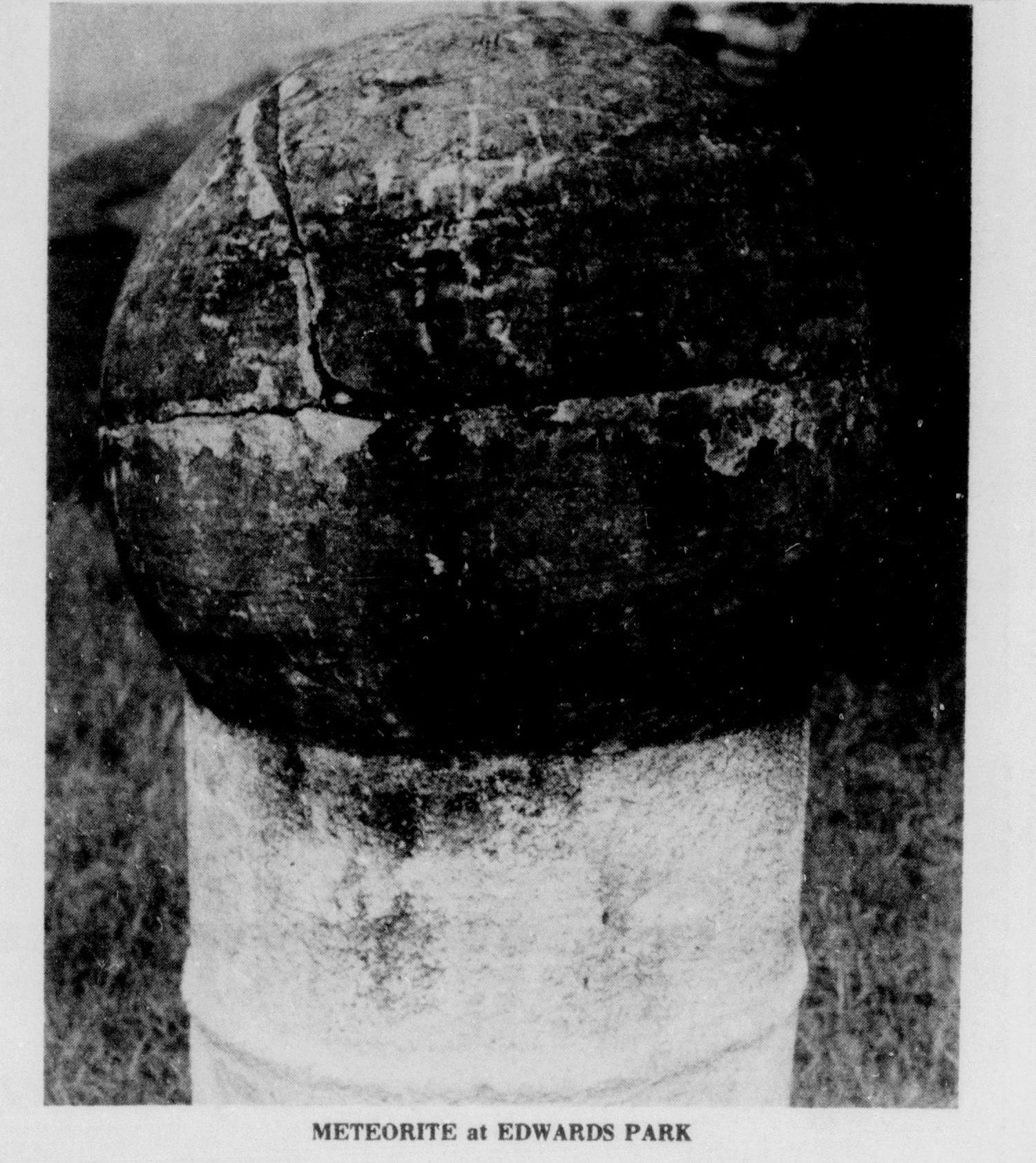
A stone out of a coal mine had become a meteorite, at least in a caption. The article called the thing the Whattizit, and that name at least came from the town. The “cave rock” turns up once, in Josey’s book 35 years later, but not in anything else I’ve found in print.
What came later
The park got on with being a park. Marvin Edwards, one of W. W.’s sons, was building a new house in October 1931 on East 7th at the northwest corner of what the paper called the Edwards Park plat, so the family kept its corner of the block after handing the park half to the town. Children played baseball and football there until San Gabriel Park came along with real stadiums.
In 1944 the City bought the west half of two of the lots from Edwards’s daughter, Lela Mae Ischy, and leased that ground to the American Legion’s Abe Harrison Post 174 for 99 years. The Legion put up a hall, in use by the spring of 1946, and the Boy Scouts who met there used the park. In 1964 a neighbor asked to fence part of the park, W. C. “Wiggie” Shell objected at the council meeting, and the council answered by ordering a fence around the whole park instead. The Sun, reporting the dispute, reached back to the reverter clause in the 1930 deed. The Sun ran a feature a week later headlined “Edwards Park Is Oldest in Town,” which noted, in passing, that somebody had recently suggested putting up a sign with the park’s name on it.

By January 1972 the hall had sat empty four or five years. Kennie Wilcox came to the council on the Legion’s behalf and asked how the city would feel about simply being given the building. There was a $300 note outstanding on a new roof. It seemed a shame, he said, to let such a nice building deteriorate. The mayor said the city had been looking for somewhere to put a day care center, and that this building, on its grassy wooded lot near the center of population, would be ideal.
It became the Mary Bailey Child Development Center, named for the Georgetown teacher who ran the West Side Kindergarten. By 1977 the town was calling it the Head Start Building and planning picnic benches for the park around it. Mary Bailey is a story all on her own, and she’ll get her own piece here one day.
Still no sign for the relic
The park is still a park. The City’s sign reads: GEORGETOWN PARKS AND RECREATION, Edwards Park, 704 Ash Street. The condition in the deed is still being met almost a century later, and the name Edwards still sits on the corner where he wanted it.
The rock is still there too, with lichen on it and a hole in its top, and there’s still nothing anywhere on that block to tell you what you’re looking at. The 1964 suggestion was for a sign carrying the park's name, and that one did eventually get installed in limestone, across the grass from the stone that still carries no explanation.
It may be that nobody could ever agree on what a sign should say. The men called in to look at it in 1930 pronounced it natural, while the doubters kept pointing at the wood inside. A caption writer in 1975 settled the matter by calling it a meteorite, while the article accompanying it made no such claim. Josey’s book, 80 years after the drilling, still allows that there’s “no consensus about its origin.”
Rock? Meteorite? Ancient ornamental sphere? Whatever it is, Georgetown has kept it around for generations without anyone in charge feeling the need to explain it.
Sources
The Williamson County Sun
“Peculiar Rock Taken From Earth’s Depths: W. W. Edwards Purchased Curiosity and Drilled It to Ascertain Nature of Stone,” 16 May 1930. Read here in the Megaphone reprint below; 1930 is missing from the digital archive of the Sun.
“Georgetown Flower Show April 16th” [the American Legion Memorial Hall on East Eighth Street in use], 5 April 1946, p. 1.
“Retired Businessman Died Sunday: Rites for W. W. Edwards Were Held Tuesday at Family Residence,” 13 August 1948, p. 5.
[Council report, Wiggie Shell’s objection to fencing the children’s park next to the Legion Hall], 15 October 1964, p. 2.
“Did You Know? Edwards Park Is Oldest in Town,” 22 October 1964, p. 7, with photograph “Edwards Park -- Gift to the City.”
[Council report, Kennie Wilcox and the American Legion’s offer of its building], 13 January 1972, p. 9.
“Mrs. Mary Bailey, 84, prominent educator, buried here Tuesday,” 15 February 1973, p. 19.
Fred Millholin, “Fred Millholin explains Georgetown’s ‘Whattizit’,” 29 May 1975, p. 1, continued p. 14 with photograph captioned “METEORITE at EDWARDS PARK.”
Fred Millholin’s Yesteryears, “45 Years Ago” [the volunteer firemen’s barbecue at the new Edwards Park, and the rock stories coming in at the Sun office], 29 May 1975, p. 2.
Fred Millholin’s Yesteryears, “I Love Cool Shade and Lemonade,” 45 Years Ago [City Marshal C. J. Brady’s new walks and sunken garden], 19 June 1975, p. 2.
“City completed broad improvements during Mayor Crawford’s terms,” Georgetown Sunday Sun, 4 January 1976, pp. 1 and 12.
Yesteryears by Doris Clifford, “46 Years Ago” [Marvin Edwards building at the northwest corner of the Edwards Park plat, from the Sun of 9 October 1931], 6 October 1977, pp. 2 and 3.
“PEP talk” [Georgetown Beautification Project; landscaping for Edwards Park and the Head Start Building], 15 December 1977, p. 6.
Trent Jacobs, “Requiem for the Red Poppies in Edwards Park” [letter], 15 March 2023, p. 4.
Brigid Cooley, “Old Town walk explores red poppy history,” 26 April 2023, pp. 1 and 9.
“Poppy season begins,” photographs by Andy Sharp, The Sunday Sun, 23 March 2025, p. 1.
Other printed sources
“Peculiar Rock Taken From Earth’s Depths,” reprinted from the Williamson County Sun of 16 May 1930 in The Megaphone (Southwestern University, Georgetown, Texas), 20 May 1930, p. 3.
“Georgetown Business Man Donates Unusual Stone to City for Mounting in Municipal Park,” The Austin American, 17 May 1930, p. 9, datelined Georgetown, 16 May.
“Centex Kindergarten Grows” [Mrs. Mary Bailey’s West Side Kindergarten], The Austin American, 25 March 1965, p. C15.
Donna Scarbrough Josey, Georgetown, Images of America series (Arcadia Publishing, 2010), p. 119; photograph by Sarah Raach, Williamson County Sun.
County and city records
Deed, W. W. Edwards to the City of Georgetown, 6 May 1930, recorded 9 May 1930. Williamson County Deed Records, instrument 1930-01170.
Deed, W. W. Edwards and wife Lucy to their daughter Lela May Ischy, 8 August 1934. Williamson County Deed Records, vol. 270, pp. 516-517.
Deed, Lela Mae Ischy and Philip Ischy to the City of Georgetown, 16 September 1944. Williamson County Deed Records, vol. 323, p. 507.
Resolution and 99-year lease, City of Georgetown to Abe Harrison Post No. 174, American Legion, 15 December 1944, vol. 324; replaced by resolution and corrected lease, 14 January 1946, vol. 332, pp. 283-284.
Georgetown City Council minutes, 12 October 1964, minute book pp. 396-397.
Maps
Sanborn Fire Insurance Map, Georgetown, Williamson County, Texas, surveyed October 1925, sheet 5, block 29.
Williamson County Appraisal District parcel map, block 29, consulted September 2026.
Photographs
Amanda Durdin, the rock at Edwards Park, 13 February 2026 and 18 September 2026.
Old Town Echoes is independently researched using primary historical sources. AI tools assist in drafting and editing; all content is reviewed, sourced, and verified by the author.