


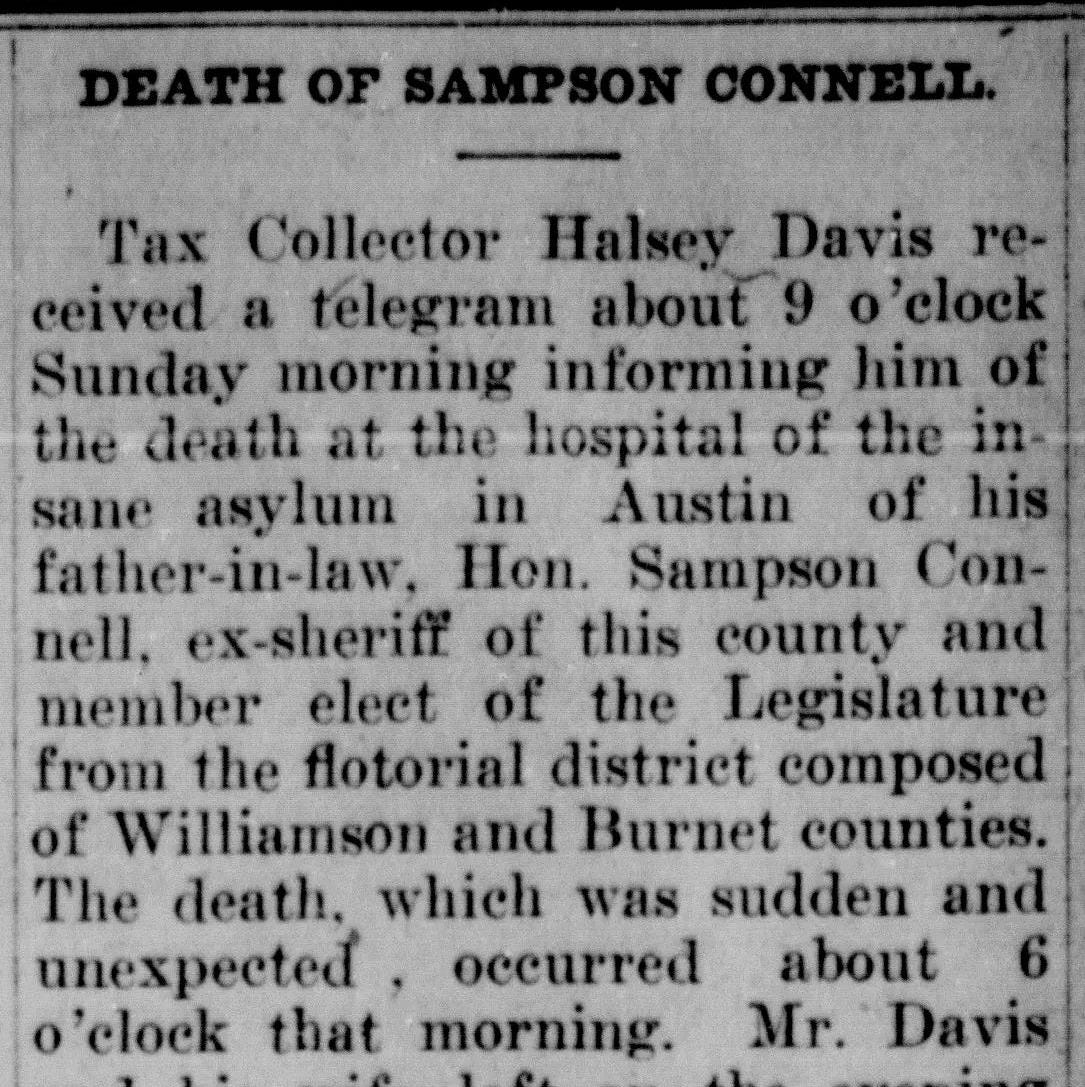
Sampson Connell died on January 10, 1915. He was 57 years old, a member-elect of the Texas Legislature, a former eight-term sheriff, and one of the most beloved men Williamson County had ever produced. His son-in-law, Tax Collector Halsey Davis, received a telegram around 9:00 that morning with the news.
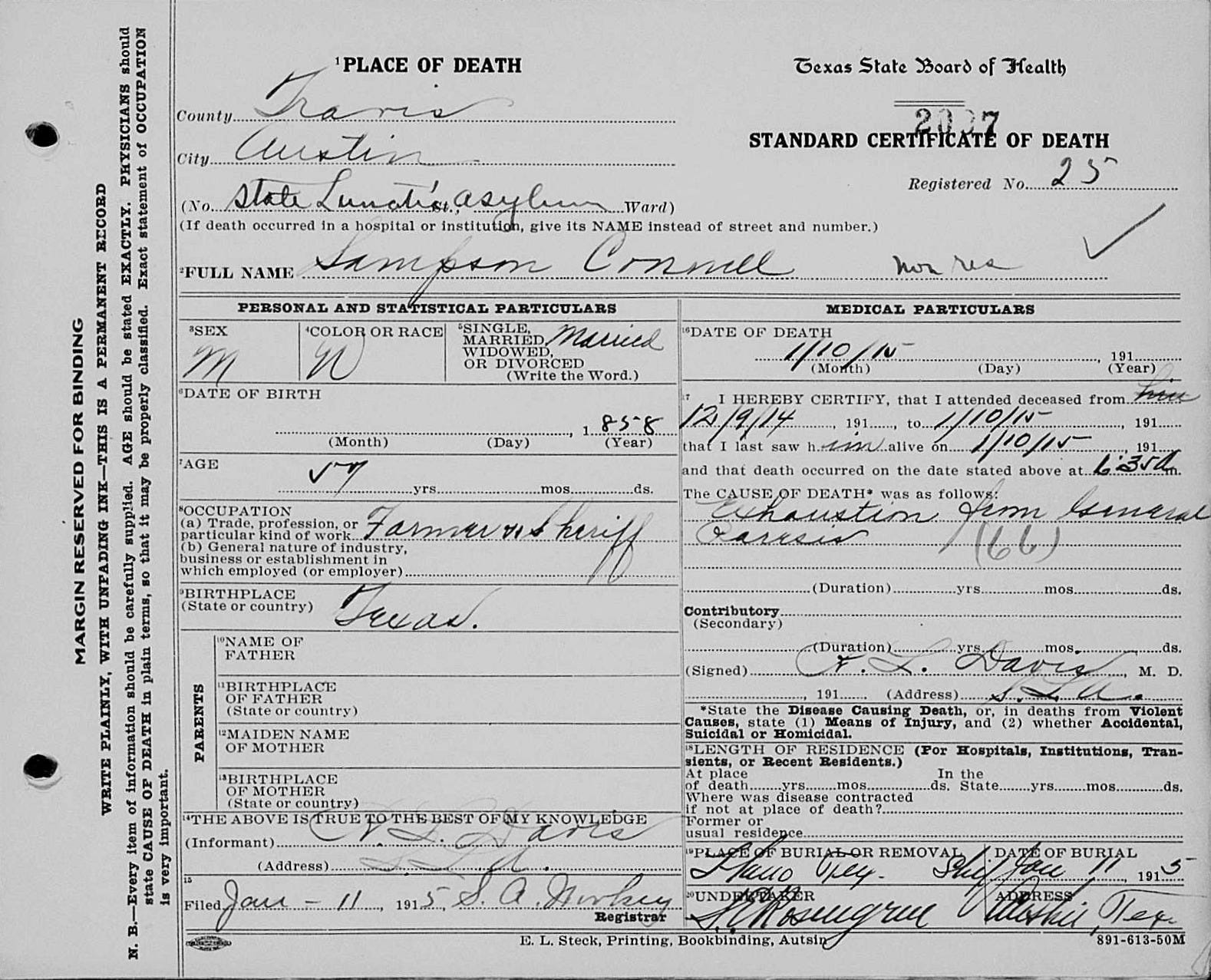
The telegram came from the insane asylum in Austin, where Connell had been a patient since at least early December. The death certificate, filed the next day, lists the cause of death as “Exhaustion from General Paresis.”
If you’re not familiar with that term, neither was I. We’ll get there. First, though, I want to describe how I got here, because this is not a story I set out to write.
The story behind the story
When I started researching Sam Connell, I was writing about small-town politics. The 1906 perjury scandal was juicy, absurd, and perfectly preserved in the pages of the Williamson County Sun. A sheriff accused of padding $4.00 in mileage, a reluctant city marshal pressured into filing charges, a grand jury that barely returned an indictment, and an election that made the whole thing backfire spectacularly on the accusers. It was local drama at its best, the kind of story that practically writes itself.
When I looked for what happened next, I found something I wasn’t expecting. Sam Connell’s obituary on the front page of the January 14, 1915, Sun opened with the telegram and the asylum and then, with the careful discretion of a small-town paper that knew everyone involved, pivoted to the man’s biography.
The Austin American, reporting from the city where Connell died, ran the following headline, only saying “he had been under treatment for several weeks.”

The papers were clearly leaving something out. They were silent on his cause of death, so I went looking for the document that would tell me how and why Sam Connell died in an insane asylum at the age of 57. Death certificates are confidential in Texas for 25 years from the date of death, but after that they’re public record.
When I found it, I understood. The papers were protecting Sam and his family.
So… the political story became a family story, and the family story became a medical story, and Sampson Connell’s story ended in a way that nobody in 1915 wanted to talk about.
At home in the county jail
Connell was first elected sheriff in 1888. He moved his wife and young children from Liberty Hill into the residence attached to the new county jail in Georgetown when it was completed in 1889.
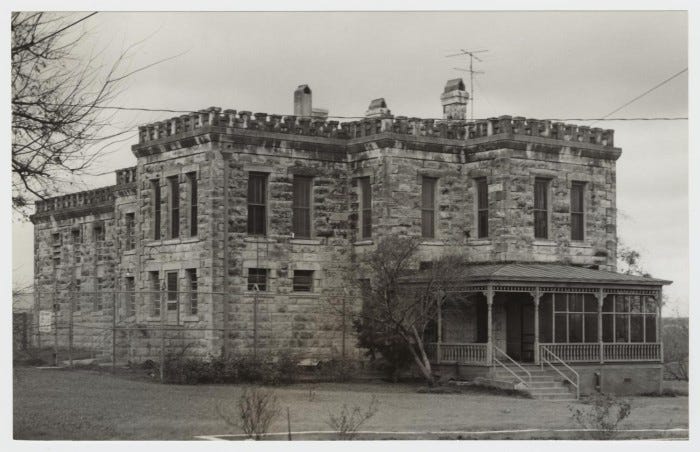
Still standing today, the jail is a substantial stone structure. A Sun reporter who toured it in January 1889 described a building that was part fortress and part home: the lower cells struck him as “dark and gloomy dungeons, with poor ventilation,” while the upper story included cells “designed for the insane, and for women.” The jailer’s residence, by contrast, was described as one of the best houses in town.
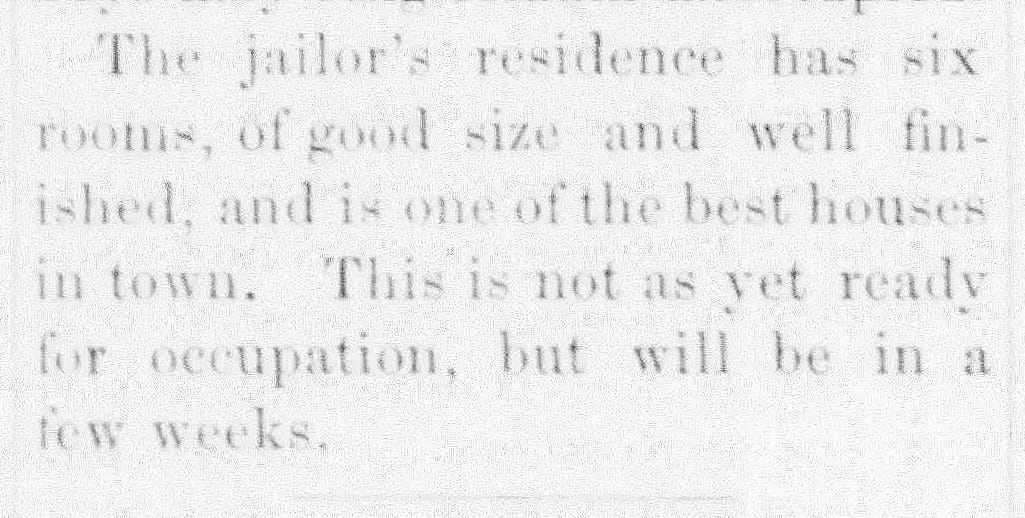
By February, the Sheriff and his family had moved in.

This was standard practice at the time. Sam’s granddaughter, Billie Connell Jordan described Sam’s wife Lillie’s role at the jail:
Lillie was a brave and gracious woman. The Sheriff's residence was in the county jail and she raised her large family there. Sheriff Connell would be gone for many days at a time and she always carried out her duties in overseeing the cooking for the prisoners and made sure they had their meals on time.
Local historian Liz Weaver did a wonderful series of posts on the jail last year on her Historic Georgetown Texas Facebook page, including videos of the interior of the residence. If you want to see the rooms where Lillie raised their family, her research is the place to start.
Sam and Lillie had married on January 3, 1883, at Liberty Hill. She was Lillie Ann Bainbridge, born in Alabama. During their courtship, Sam had been away on cattle drives, writing letters home about rain and cold and loneliness on the trail. By the time the couple moved to Georgetown, they had four young children: Effie Myrtle, born 1883; Beulah Virginia, born 1885; Ivy Evie, born 1886; and Lillie Maud, born 1888.
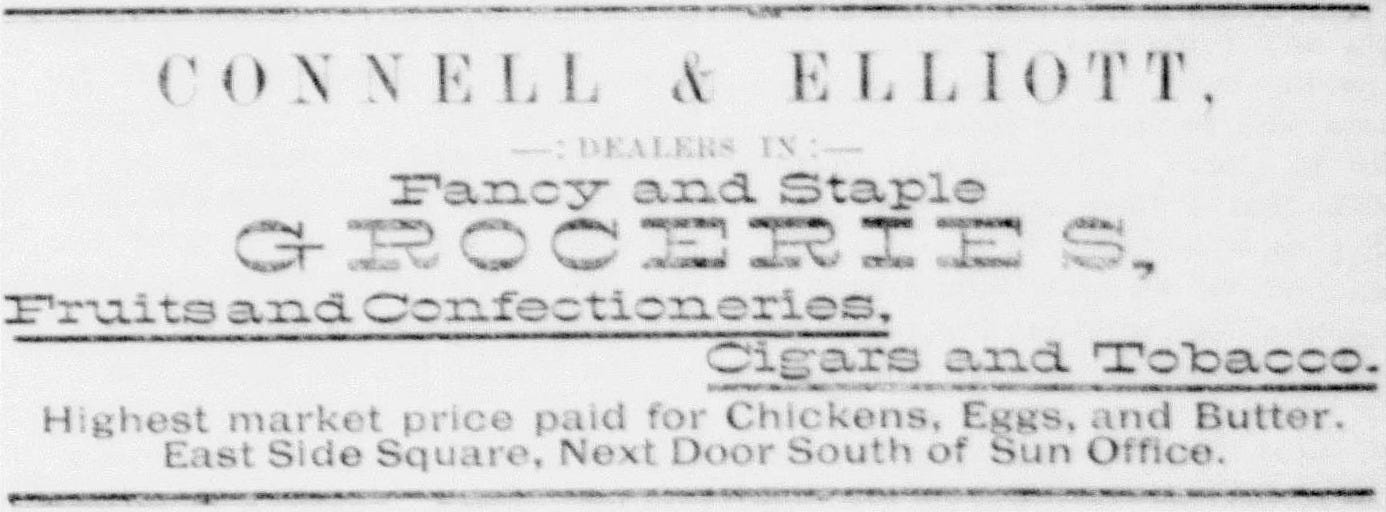
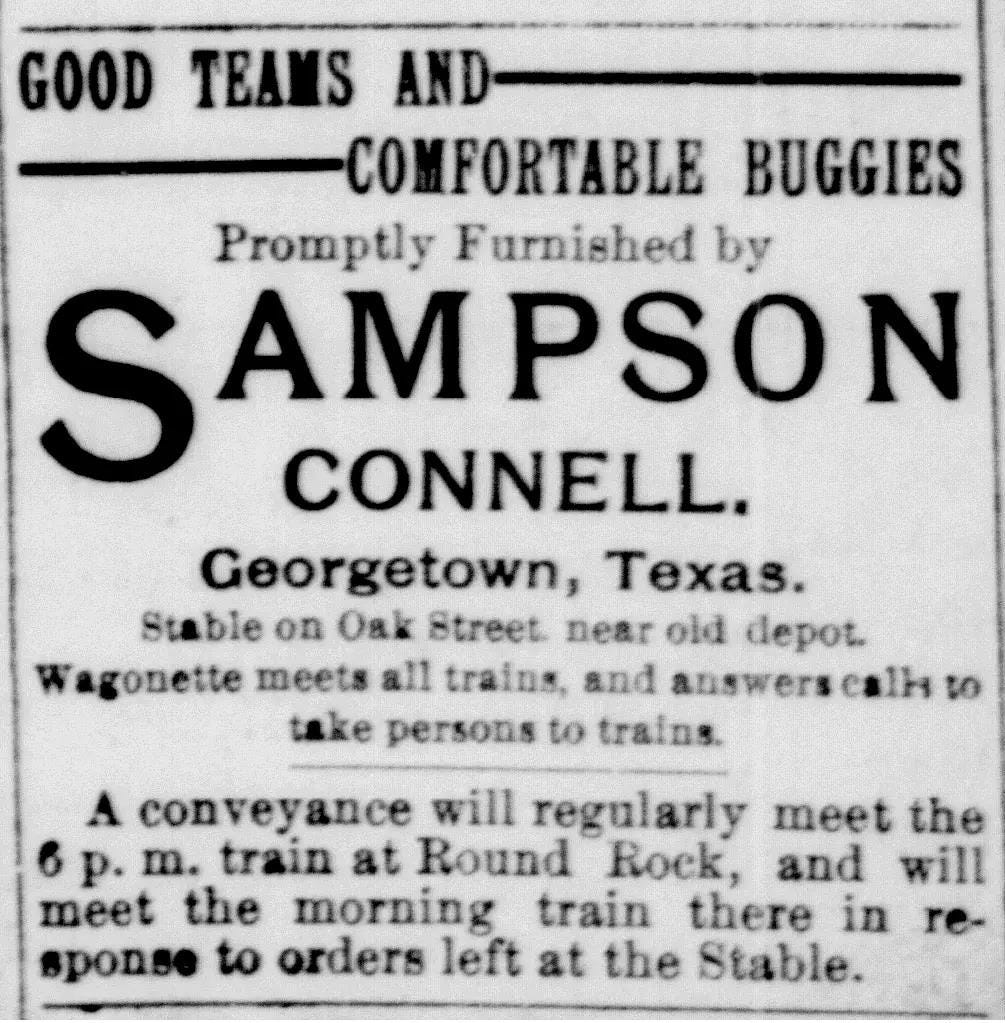
Connell served one term and then lost the office in 1890. What followed were eight of the hardest years of the family’s life. Sam tried everything. The newspaper trail shows a meat market partnership, a grocery business with two successive partners, a livery stable on Oak Street, and a stint reviving and running the Georgetown Hotel. He broke 300 acres of sod for J. H. Booty south of town at $3.00 an acre with four yoke of oxen. He bought land between Georgetown and Hutto, sold the family’s Liberty Hill home, moved Lillie and the children to a home on Block 17 of the Glasscock Addition, three blocks east of the courthouse, and eventually traded the two-story residence on that block for the Dever livery business. The civil docket tells the rest: he was on the city’s delinquent tax list for Block 17 in 1891, and he had at least one foreclosure judgment against him in 1895. A second foreclosure suit was eventually dismissed.
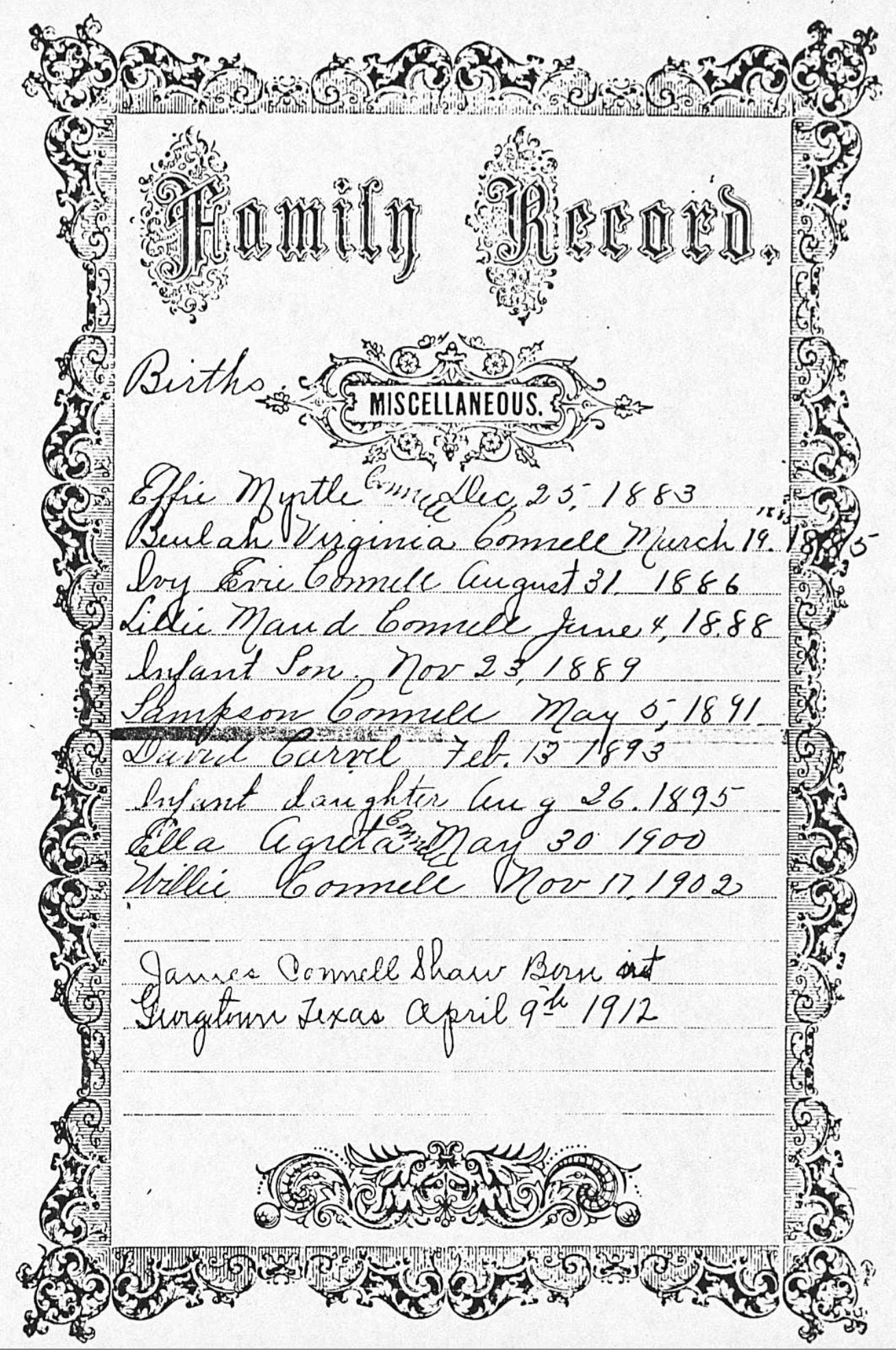
The Connell family Bible tells what was happening at home during these same years, and it’s a poignant record. The first four children, the girls born between 1883 and 1888, all survived to adulthood. But starting in November 1889, while the family was still living in the jail residence, something shifted.
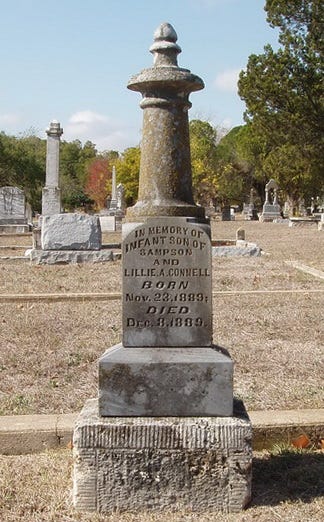
An infant son arrived on November 23, 1889. The Sun reported his death on December 12; he had died the previous Sunday evening and was buried Monday in the Odd Fellows’ Cemetery. He was only two weeks old. His is the only grave I’ve found of the children that were lost by the Connells.
Their first son to survive, Sampson, was born May 5, 1891. Another son, David, was born in February 1893. David only lived for three days. An infant daughter arrived in August 1895, unnamed in the Bible. No death date was given, but she didn’t survive to be listed on the 1900 census. Of the six children born after 1888, four died in infancy. The pattern is stark in the Bible’s careful handwriting: four healthy daughters in five years, then over a decade of mostly loss.
By January 1898, papers around the county were noting that Sam Connell was being urged to run for sheriff again.
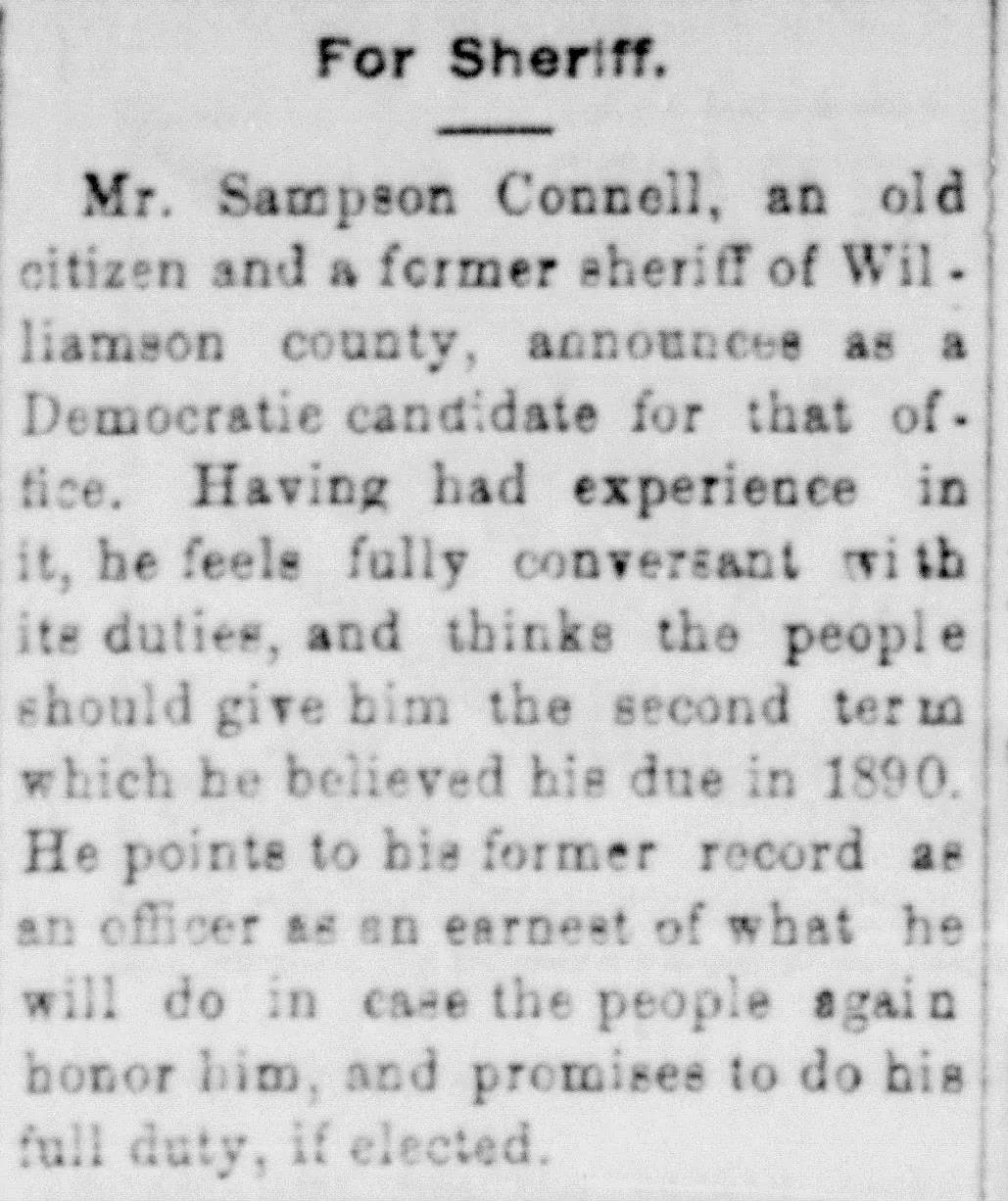
He won. He moved the family back into the jail residence, and this time he would stay for seven consecutive terms, fourteen consecutive years. Whatever that return to office meant for Sam’s public career, for Lillie it must have meant a roof that was paid for, a position that carried a salary, and an end to the years of instability.
But Lillie was suffering, too. In January 1899, the Sun reported that Mrs. Sampson Connell had been quite sick for several days. In May 1900, she was reported quite ill, and a week later, extremely ill at her home. Through all of this, she was pregnant again, or had just delivered. Ella Agreta was born May 30, 1900, in the middle of Lillie’s worst documented illness. Ella died the following day. By August, Lillie had been sent to Mineral Wells, the health resort town west of Fort Worth known for its mineral springs, where she was reported improving. She was still recovering in October.
In the 1900 census, Lillie reported eight children born and five living. A daughter named Willie arrived in November 1902, and by 1910, Lillie’s count had risen to 10 born and six living; four children lost across a span of 11 years.
Big-hearted Sam
The man the community saw was the public sheriff, and by all accounts he was exceptional at the job. J. L. Lane, who encountered Connell as a twelve-year-old boy at a First Monday trade day in Georgetown, remembered him this way decades later: a large man riding a fine sorrel horse through the crowds, smiling and waving to everyone, wearing a big Stetson hat, boots and spurs. Lane recalled that Connell was “a man all people honored and loved” and that “the rougher element of the section honored and feared him.” He noted that unlike later sheriffs who sat in their offices and dispatched deputies, Connell saddled up and said “Come on, boys.” He was a leader who rode hundreds of miles monthly, day and night, and landed horse thieves and outlaws in the very jail where his children were growing up.
He wasn’t just a lawman. Connell was also the kind of man who took in other people’s children. In 1902, Roseanna McLaughlin Carr, wife of Robert Carr of Granger, died of appendicitis, leaving behind four young children. That same year, according to a contemporary county history published in 1911, Sam and Lillie adopted the youngest, a boy named Wilmer Carr.
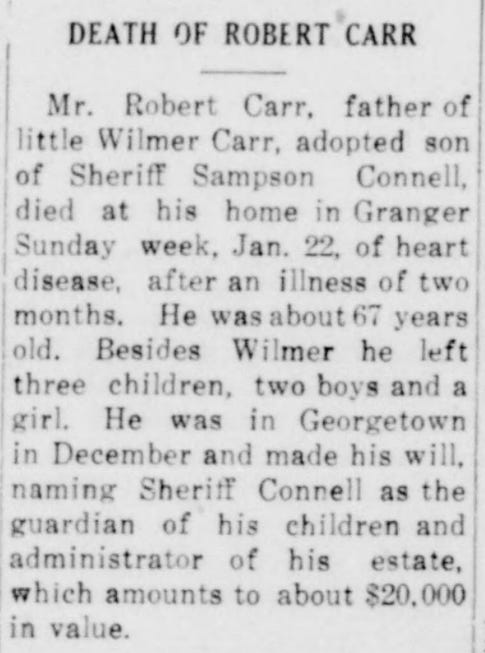
Connell’s 1915 obituary summed it up as: Connell “had raised several children besides his own, among them an adopted son to whom he was a real father and who was as devoted to him as any of his children.” Billie Connell Jordan’s narrative about the family confirms that Sam and Lillie also “raised” the other three Carr children, though it may be more accurate to say that they fostered them; Willie was 17, Mabel was 15, and Maud was 14 when Robert Carr died and Connell was named guardian of the older children. The Carr heirs are a story unto their own, though, so I’ll have to leave that for another day.
The quiet way
After leaving the sheriff’s office, Connell went back to farming near Liberty Hill. He wasn’t done with public life, though. In the summer of 1914, he ran for Flotorial Representative in the Texas Legislature from the 92nd District, composed of Williamson and Burnet counties.
A Leander correspondent for the Sun, writing on June 11, 1914, captured the campaign in a single line: “Ex-Sheriff Connell was with us Saturday interviewing the voters in his usual quiet way,” adding that any man who beat him would know he’d been in a real race.
He won the Democratic primary in July and the general election in November. The Thirty-Fourth Legislature was scheduled to convene on January 13, 1915. Sam Connell would not live long enough to take his seat.
October
The collapse, when it came, was fast.
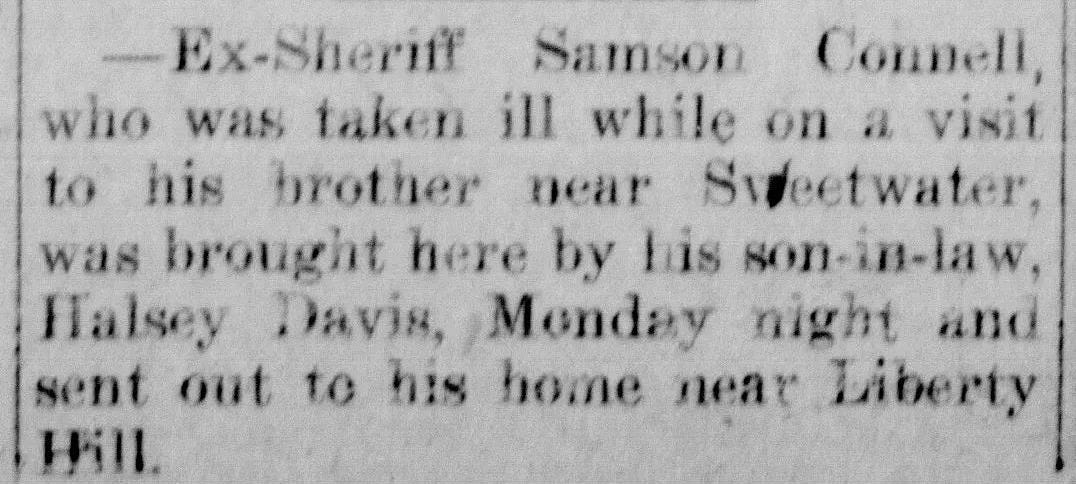
A week later, on October 15, another brief item:
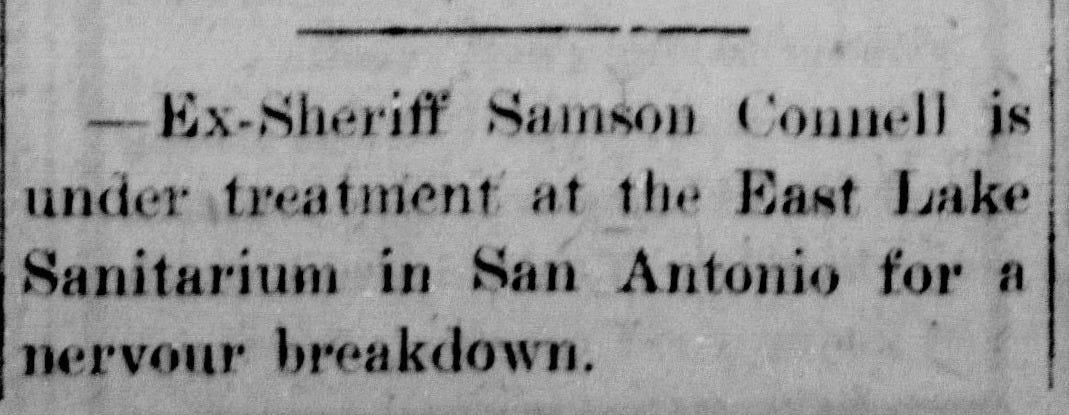
At some point between October and December, Connell was transferred to the Austin Hospital for the Insane, which the death certificate identified by its older name, the State Lunatic Asylum. The attending physician first saw him there on December 9, 1914. He lived just one more month.
What the death certificate said
Connell’s cause of death, written in a physician’s hand: “Exhaustion from General Paresis.”
General paresis of the insane, or GPI, was one of the most feared diagnoses of the nineteenth and early twentieth centuries. First identified in Paris in the 1820s, it was a progressive, invariably fatal disease that attacked the brain. Patients experienced tremors, unsteady gait, slurred speech, personality changes, delusions, memory loss, seizures, and eventually complete paralysis. Death typically followed within two or three years of the first symptoms. There was no treatment and no cure.
By 1913, researchers at the Rockefeller Institute had confirmed what many physicians had long suspected: GPI was caused by Treponema pallidum, the spirochete responsible for syphilis, invading the brain tissue years or even decades after the initial infection. In medical circles, the connection was settled science by the time Connell fell ill in 1914.
What the Connell family actually understood is a different question. By 1915, syphilis was widely understood by the general public to be a sexually transmitted disease, and a GPI diagnosis carried with it a certain implication about the patient’s past.
Country doctors, family physicians, and especially the families of respectable men had long preferred gentler explanations. Overwork. Nervous strain. The toll of a hard life.
When Lord Randolph Churchill, Winston’s father, died of GPI in 1895, even the Lancet described his condition as the result of “an over-full life in every direction.” If a British medical journal could find a way to avoid naming the underlying cause for an aristocrat, it is easy to imagine that a Texas family in 1914 may have received a similar kind of framing, or may have preferred not to ask too many questions.
We can’t know from the death certificate alone what Lillie and the family were told. All we can say is that the newspapers apparently knew enough to not print it.
Sam Connell had been carrying a disease that would explain both the pattern of infant deaths and Lillie’s chronic illness. We know this because of how Sam died. General paresis of the insane develops only after the bacterium has lived in the body for years, sometimes decades. By the time the neurological symptoms appeared in 1914, Sam had been infected for a long time.
Did Lillie know?
Syphilis in a marriage does not stay with the husband. It passes to the wife, and it devastates pregnancies. The medical literature of the era documented the pattern clearly: miscarriages, stillbirths, infants who survived days or weeks before dying, and eventually, in some cases, children who were born apparently healthy but carried the effects of the disease into their own lives. The sequence in the Connell family Bible, four healthy children followed by repeated infant deaths, is consistent with an infection acquired sometime in the late 1880s. Lillie’s years of illness, her trips to Mineral Wells, and the babies she buried, these weren’t separate misfortunes; they were likely part of the same disease that would kill Sam in an asylum twenty-five years later.
We can’t know what Lillie was told. Doctors of the era routinely concealed venereal diagnoses from wives, sometimes at the husband’s request. A woman would know she was ill, but she wouldn’t necessarily know why. Whether Lillie ever understood what was happening to her body and her children is an unanswered question.
What the papers said
The legislative escort at Connell’s funeral was significant. Members of the Legislature went to Acting Texas Governor Q. U. Watson and requested a committee to accompany Sam Connell’s remains to Liberty Hill. Watson appointed Representatives Bland, W. G. Blackburn, Myron Blalock, B. C. Dubbs, V. C. Dove, E. E. Dewitt, and J. R. Harrison. The funeral was held Monday afternoon at Liberty Hill followed by Masonic rites. A large number of friends and relatives were present, and the Sun noted that the crowd would have been much larger but for the bad condition of the roads.
The funeral drew county officials, judges, the entire Commissioners’ Court, and citizens from Georgetown, Taylor, Granger, and Milam County. Family came from Milam County, Lometa, and Hereford.
This wasn’t the funeral of a man whose community had abandoned him.
The thing nobody said
The newspapers handled Sampson Connell’s obituary carefully and with respect for his family. Just the bare fact of the asylum, stated once.
Georgetown in 1915 likely understood enough about general paresis to draw their own conclusions and seem to have made a collective decision that this was not the thing that defined Sam Connell. The man who rode through the crowds on a sorrel horse, who took in orphaned children, who bought twelve newspaper columns to answer his accusers and then won re-election by 570 votes, that was the man they buried.
In 1920, Lillie was living in Georgetown with her daughter Evie and son-in-law Wayne Magill, along with her youngest daughter Willie and Wilmer Carr, the adopted son to whom the sheriff had been “a real father.” By 1930, she had moved to the household of her daughter Willie and son-in-law Albert Lunsford, near Liberty Hill, back in the country where she and Sam had started. Sam’s biographical sketch, published while he was still in office, said that when the sheriff’s office was done with him, “he expects to go to his farm and make an honest living by the sweat of his brow.”
He didn’t get the chance to do that for very long, but Lillie kept the family together for another sixteen years in the place where it had all begun.
Sampson and Lillie Connell are buried at Liberty Hill Cemetery. Lillie outlived him by exactly sixteen years, dying on January 10, 1931, the anniversary of his death.
Lillie’s death certificate, filed in Travis County, lists her cause of death as lymphatic leukemia, with a duration of three years. She was 68 years old. The diagnosis was confirmed by blood count. Her son, Sampson, was the informant.
The word “leukemia” would not have meant much to most readers of the 1931 Georgetown papers. But it appears again, and again, in the records of this family.
Young Sampson, the boy who survived infancy when his brothers born on either side of him did not, died on June 27, 1958, at Seton Hospital in Austin. He was 67 years old, a retired fire inspector. His cause of death: chronic lymphatic leukemia.
Willie, the youngest, died on January 20, 1967, at Allen Hospital in Burnet. She was 64. Her cause of death: lymphatic leukemia.
Chronic infections are known to increase the risk of blood cancers by keeping the immune system in a state of sustained overactivity, and syphilis, which can persist in the body for decades, is documented to disrupt immune function and chronically stimulate the lymphatic system. In infants, congenital syphilis produces blood abnormalities so similar to leukemia that the two are routinely mistaken for each other.
A mother and two of her children, all carried off by the same diagnosis, all in their sixties. The two children who died of it were the two surviving children born during the years of documented infant loss and illness, the two who survived infancy when four of their siblings did not. The shadow of Sam Connell’s illness likely didn’t end with his death in 1915 or Lillie’s in 1931; it may have followed the family for more than fifty years.
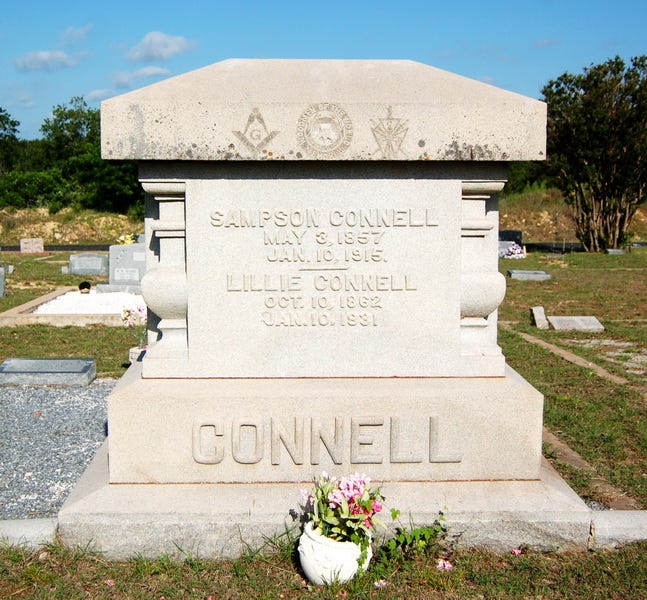
One more thing
Most of my research for Old Town Echoes starts with a house. As the Historian for Preservation Georgetown, house histories are the threads that I pull. This story wasn’t any different; I came across Sam Connell’s 1906 perjury scandal while I was researching a property that has nothing to do with him. One thread led to another, and here we are.
But that’s how this work goes… because buried in the records of the Connell family’s hardest decade, I found something else: a house. Don’t think I didn’t notice, since the houses are usually center stage in my research. It’s the one on Block 17 of the Glasscock Addition — the two-story residence Sam traded away for a livery business when the money ran out.
I found it. I know where it stood. Is it still there? We’ll talk about that next time.
Thanks for reading Old Town Echoes! Subscribe for free to get new posts and support my work.
Sources & Research Notes
Sampson Connell’s Background & Family
“Death of Sampson Connell,” The Williamson County Sun (Georgetown, Texas), 14 January 1915, p. 1; digital image, Newspaper Archive (newspaperarchive.com : accessed 16 April 2026).
“Connell, Member of Legislature, Dies at Local Hospital,” The Austin American (Austin, Texas), 11 January 1915, p. 8; digital image, Newspapers.com (newspapers.com : accessed 17 April 2026).
Texas State Board of Health, standard certificate of death no. 2307, Sampson Connell, 10 January 1915, Travis County; digital image, “Texas, U.S., Death Certificates, 1903–1982,” Ancestry (ancestry.com : accessed 17 April 2026).
Connell Family Bible, births page; images, “Holt, Hutchinson, Texas, United States records,” FamilySearch (familysearch.org : accessed 20 April 2026), image 231 of 1273; Sons of the Republic of Texas application attachment.
Connell Family Bible, births page (second copy); images, “Texas, United States records,” FamilySearch (familysearch.org : accessed 20 April 2026), image 1100 of 1793.
1900 United States Federal Census, Williamson County, Texas, Georgetown, District 0123, sheet 25, dwelling 177, family 486, Sampson Connell; digital image, Ancestry (ancestry.com : accessed 17 April 2026).
1910 United States Federal Census, Williamson County, Texas, Georgetown, District 0117, sheet 4b, Sampson Connel [sic]; digital image, Ancestry (ancestry.com : accessed 17 April 2026).
1930 United States Federal Census, Williamson County, Texas, Precinct 3, District 0012, dwelling 186, family 194, Lillie Connell in household of Albert Lunsford; digital image, Ancestry (ancestry.com : accessed 20 April 2026).
Billie Connell Jordan (1924–2024), granddaughter of Sheriff Sampson Connell, 'Historical Narrative by Billie Connell Jordan,' in 'Sheriff Sampson (Sam) Connell 1888–1890 and 1898–1912,' Williamson County Texas History (https://williamsoncountytexashistory.org/sheriff-sampson-sam-connell/ : accessed 24 April 2026).
“Sampson Connell,” in History of Central and Western Texas (Chicago: Lewis Publishing Co., c. 1911), pp. 706–707; digital image, FamilySearch (familysearch.org : accessed 20 April 2026). Notes “six children and one foster son” and states “Wilmer Carr, an orphan boy, was adopted by Mr. Connell in 1902.”
Sam Connell’s Career & Public Life
J. L. Lane, “Memories of a Williamson County Pioneer,” published in Williamson County Texas History (williamsoncountytexashistory.org : accessed 17 April 2026).
"A Texas Sheriff: Sampson Connell," The Houston Post (Houston, Texas), 18 June 1911, [3]; digital image, Newspapers.com (newspapers.com: accessed 17 April 2026).
“Sheriff Connell is occupying the residence in connection with the new jail,” The Williamson County Sun (Georgetown, Texas), 7 February 1889, p. 4; digital image, Newspaper Archive (newspaperarchive.com : accessed 17 April 2026).
The Williamson County Jail
“Our New Jail,” The Williamson County Sun (Georgetown, Texas), 17 January 1889, p. 3; digital image, Newspaper Archive (newspaperarchive.com : accessed 20 April 2026).
“Jail to Get Historical Marker” and “County Jail to Get Marker,” The Williamson County Sun (Georgetown, Texas), 14 January 1965, p. 3; digital image, Newspaper Archive (newspaperarchive.com : accessed 20 April 2026). Construction cost of $20,906 per county records cited in the 1965 article.
Evans Studio. [Williamson County Jail Photographs #1], photograph, Date Unknown; (https://texashistory.unt.edu/ark:/67531/metapth497012/m1/1/?q=Williamson%20County%20jail : accessed April 23, 2026), University of North Texas Libraries, The Portal to Texas History, https://texashistory.unt.edu; crediting Texas Historical Commission.
Liz Weaver, series of posts on the Williamson County Jail, Historic Georgetown Texas (Facebook page), 2025. Includes video of the interior of the jailer’s residence.
The Connell Infant Deaths
“The infant son of Sheriff Sampson Connell died last Sunday evening and was buried Monday in the Odd Fellows’ cemetery. It was only a few weeks old. The Sun joins a large number of friends in extending sympathy to Mr. and Mrs. Connell,” The Williamson County Sun (Georgetown, Texas), 12 December 1889, p. 3; digital image, Newspaper Archive (newspaperarchive.com : accessed 23 April 2026).
Connell Family Bible, deaths page; entries for infant son (died Dec 8, 1889), David Carvell Connell (died Feb 16, 1893), and Ella Agreta Connell (died May 31, 1900).
Lillie Connell’s Illness
“Mrs. Sampson Connell is quite sick with dengue fever,” The Williamson County Sun (Georgetown, Texas), 7 October 1897, p. 5; digital image, Newspaper Archive (newspaperarchive.com : accessed 23 April 2026).
“Mrs. Sampson Connell, wife of the sheriff, has been quite sick for several days, but is now improving,” The Williamson County Sun (Georgetown, Texas), 12 January 1899, p. 5; digital image, Newspaper Archive (newspaperarchive.com : accessed 23 April 2026).
“Mrs. Sampson Connell is reported quite ill this week,” The Williamson County Sun (Georgetown, Texas), 24 May 1900, p. 5; digital image, Newspaper Archive (newspaperarchive.com : accessed 23 April 2026).
“Mrs. Sampson Connell is extremely ill at her home in this city,” The Williamson County Sun (Georgetown, Texas), 31 May 1900, p. 5; digital image, Newspaper Archive (newspaperarchive.com : accessed 23 April 2026).
“Mrs. Sampson Connell is reported improving at Mineral Wells,” The Williamson County Sun (Georgetown, Texas), 23 August 1900, p. 3; digital image, Newspaper Archive (newspaperarchive.com : accessed 23 April 2026).
“Mrs. Sampson Connell and Mrs. Harry Journeay are both reported improving,” The Williamson County Sun (Georgetown, Texas), 4 October 1900, p. 5; digital image, Newspaper Archive (newspaperarchive.com : accessed 23 April 2026).
The Carr Children
“Little Wilmer Carr, adopted son of Sheriff and Mrs. Connell, was reported quite ill last evening,” The Williamson County Sun (Georgetown, Texas), 10 December 1908, p. 4; digital image, Newspaper Archive (newspaperarchive.com : accessed 19 April 2026).
Will of Robert Carr, dated 21 December 1910, Williamson County, Texas, probate records; digital image, accessed 19 April 2026.
“Death of Robert Carr” [identifying Wilmer Carr as adopted son of Sheriff Connell], The Williamson County Sun (Georgetown, Texas), 9 February 1911, p. 9; digital image, Newspaper Archive (newspaperarchive.com : accessed 19 April 2026).
“Deaths at Granger” [Mrs. Rosa Carr death notice], The Waco Times-Herald (Waco, Texas), 15 June 1902, p. 6; digital image, Newspapers.com (newspapers.com : accessed 20 April 2026).
The 1914 Campaign & Collapse
“Ex-Sheriff Connell was with us Saturday interviewing the voters in his usual quiet way...,” The Williamson County Sun (Georgetown, Texas), 11 June 1914, p. 8; digital image, Newspaper Archive (newspaperarchive.com : accessed 17 April 2026).
“Ex-Sheriff Samson Connell, who was taken ill while on a visit to his brother near Sweetwater...,” The Williamson County Sun (Georgetown, Texas), 8 October 1914, p. 4; digital image, Newspaper Archive (newspaperarchive.com : accessed 17 April 2026).
“Ex-Sheriff Samson Connell is under treatment at the East Lake Sanitarium in San Antonio for a nervous breakdown,” The Williamson County Sun (Georgetown, Texas), 15 October 1914, p. 4; digital image, Newspaper Archive (newspaperarchive.com : accessed 17 April 2026).
Lillie Connell After 1915
1920 United States Federal Census, Williamson County, Texas, Georgetown, Wayne Magill household, including Lillian Connell (mother-in-law), Willie (sister-in-law), and Wilmer Carr (brother-in-law); digital image, Ancestry (ancestry.com : accessed 19 April 2026).
Death Certificates of the Connell Family
Texas State Department of Health, Bureau of Vital Statistics, standard certificate of death, Mrs. L. A. Connell [Lillie Ann Bainbridge Connell], 10 January 1931, Travis County; digital image, “Texas, U.S., Death Certificates, 1903–1982,” Ancestry (ancestry.com : accessed 23 April 2026). Cause of death: lymphatic leukemia, duration 3 years.
Texas State Department of Health, Bureau of Vital Statistics, certificate of death no. 10176, Maud Connell Southern, 1 February 1955, Washington County; digital image, “Texas, U.S., Death Certificates, 1903–1982,” Ancestry (ancestry.com : accessed 23 April 2026). Cause of death: carcinoma of uterus.
Texas State Department of Health, Bureau of Vital Statistics, certificate of death no. 36149, Sampson Connell [V], 27 June 1958, Travis County; digital image, “Texas, U.S., Death Certificates, 1903–1982,” Ancestry (ancestry.com : accessed 23 April 2026). Cause of death: chronic lymphatic leukemia, duration 5 years.
Texas Department of Health, Bureau of Vital Statistics, certificate of death no. 00710, Evie Magiel [Magill], 30 January 1963, Bexar County; digital image, “Texas, U.S., Death Certificates, 1903–1982,” Ancestry (ancestry.com : accessed 23 April 2026). Cause of death: carcinomatosis, due to carcinoma of colon.
Texas Department of Health, certificate of death no. 13223, Effie Myrtle Shaw, 12 February 1967, Williamson County; digital image, “Texas, U.S., Death Certificates, 1903–1982,” Ancestry (ancestry.com : accessed 23 April 2026). Cause of death: cancer and pneumonia, due to cancer of stomach.
Texas Department of Health, Bureau of Vital Statistics, certificate of death no. 00876, Willie Connell Lunsford, 20 January 1967, Burnet County; digital image, “Texas, U.S., Death Certificates, 1903–1982,” Ancestry (ancestry.com : accessed 23 April 2026). Cause of death: lymphatic leukemia, duration 8 years.
General Paresis of the Insane
Jesper Vaczy Kragh, “Neurosyphilis: Historical Perspectives on General Paresis of the Insane,” JSM Schizophrenia 2, no. 2 (2017): 1013.
“General Paralysis of the Insane – Part One,” Staffordshire’s Asylums: A Case for the Ordinary (staffordshireasylumrecords.wordpress.com : posted 7 April 2021, accessed 17 April 2026).
Juliet D. Hurn, “The History of General Paralysis of the Insane in Britain, 1830–1950” (Ph.D. thesis, University of London, 1998).
Research Notes
The Connell Family Bible records two copies of the births page, both listing the same ten children. The four infant deaths are consistent with Billie Connell Jordan’s count of “four died in infancy.” The deaths page of the Bible records three of the four: an infant son (died December 8, 1889), David Carvell Connell (died February 16, 1893), and Ella Agreta Connell (died May 31, 1900). The fourth death, an infant daughter born August 26, 1895, is not recorded on the deaths page but is inferred from her absence on the 1900 and 1910 censuses.
Lord Randolph Churchill’s death from GPI in 1895 and the Lancet’s framing of it are drawn from Hurn (1998) and the Lancet notice of 26 January 1895, pp. 239–240. The Noguchi et al. confirmation of T. pallidum in GPI brain tissue (1913) is from Kragh (2017).
After Sam Connell’s death, I located the death certificates for Lillie and five of their six surviving children. The three family members born during or after the period of suspected infection — Lillie, Sampson, and Willie — all died of lymphatic leukemia. Three of the children born before that period died of other cancers. Chronic infections, including syphilis, are known to disrupt immune function and chronically stimulate the lymphatic system, and the clustering of lymphatic leukemia in three members of one family is medically striking, though the historical record cannot establish a definitive causal link.
A note on living descendants: Sampson and Lillie Connell have descendants living in Central Texas today, and some may encounter this piece. The medical conclusions presented here — particularly the connection between Sam's diagnosis, Lillie's illness, the infant deaths, and the later leukemia cases — are the author's interpretation of the historical and medical record, not established family history. The death certificate is a fact. The chain of consequences drawn from it is inferential. If you are a member of this family and have documents, photographs, or family knowledge that would add to or correct this account, I would genuinely welcome hearing from you.
Old Town Echoes is independently researched using primary historical sources. AI tools assist in drafting and editing; all content is reviewed, sourced, and verified by the author.