


At the end of my last story, I left you with a bit of a teaser... Buried in the records of the Connell family’s hardest decade, I had found a house; it was the one on Block 17 of the Glasscock Addition where Sam and Lillie lived during the years between Connell’s terms as sheriff, the years of infant loss and financial ruin. It’s still there. And like most Georgetown historic homes, the story took an unexpected turn.
A house in a file
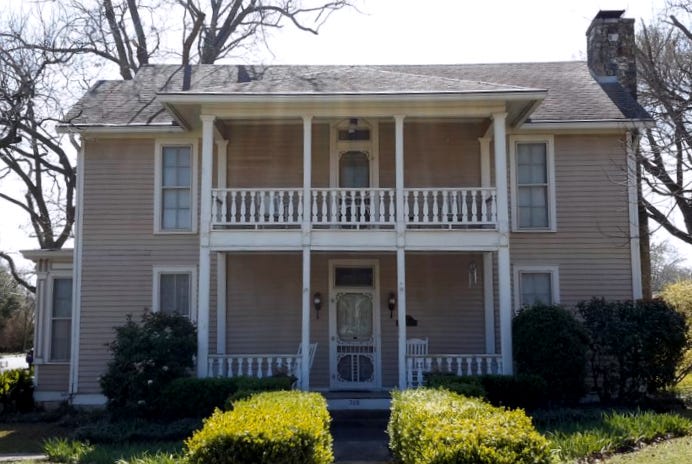
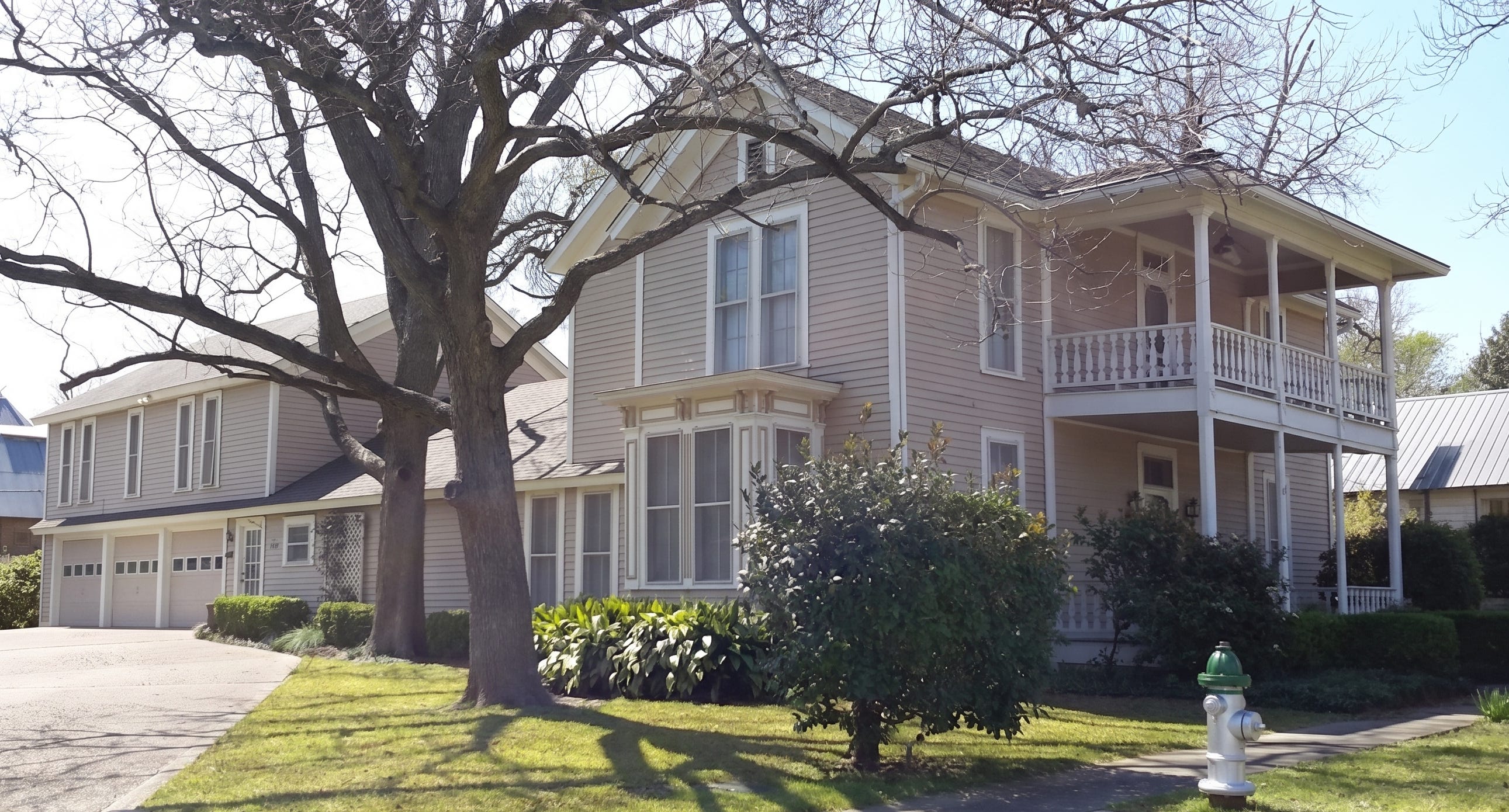
The house at 316 East 7th Street, on lots 1 & 2 of Block 17, sits three blocks east of the courthouse, a two-story wood-frame dwelling with weatherboard siding, a gabled roof, and a two-tiered porch facing north. The Texas Historical Commission’s 1984 inventory form describes it as a vernacular house with a Georgian plan, an exterior stone chimney, and a jig-sawn balustrade along the second-floor porch. The surveyor estimated the construction date as 1880.
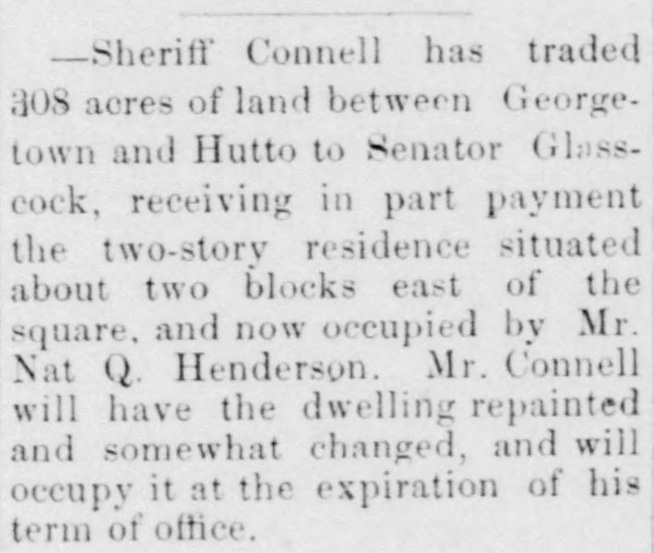
I first encountered this house as a line item in the Connell deed records. When Sam Connell lost the sheriff’s office in 1890, he traded 308 acres of land between Georgetown and Hutto to Senator G.W. Glasscock, receiving in partial payment what the Sun described as “the two-story residence situated about two blocks east of the square, and now occupied by Mr. Nat Q. Henderson.” The paper noted that Connell would have the dwelling “repainted and somewhat changed” and would occupy it at the expiration of his term of office. By November 1890, another brief item confirmed it: “Mr. Sampson Connell has moved to his place a short distance east from the square.”
That’s how I connected the Connells to 316 East 7th. I was out for a walk with the dogs one day, and I decided to swing past the address to see it in person. It was then I noticed the plaque on the front porch naming the home the Dever-Estes House, c. 1880. Dever-Estes? If the house was sold from Glasscock to Connell in its earliest days, why was it the Dever-Estes House? Did I have the wrong place?
Still not intending to write about the house, only hoping to satisfy my own curiosity, I went looking for the research file. Southwestern’s Distinctive Collections holds the archive of old Preservation Georgetown paper files on Georgetown’s historic homes. Once I had my hands on the digitized file, I found, among other things, a data sheet from 1983 listing the property as Lots 1 and 2, Block 17, Glasscock Addition, with the ownership chain running from Glasscock to Connell, Dever, Wilcox, McInnes, Dolan, Estes, and Kucler. The Texas Historical Commission inventory form, filed the following year, gave the architectural description but acknowledged something that caught my attention: no one could pin down when the house was built. The best anyone had managed was “circa 1880,” but nowhere did it say where that estimate originated.
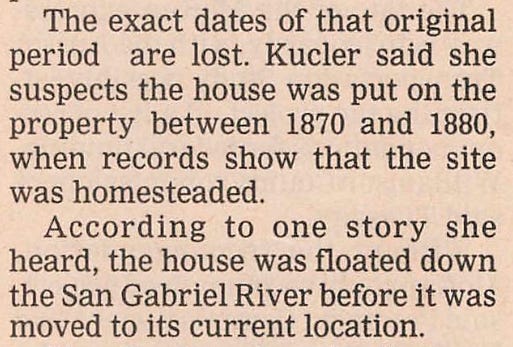
And there was another interesting tidbit in those files; a home tour article featuring the home in 1994 had the following quote from the owner:
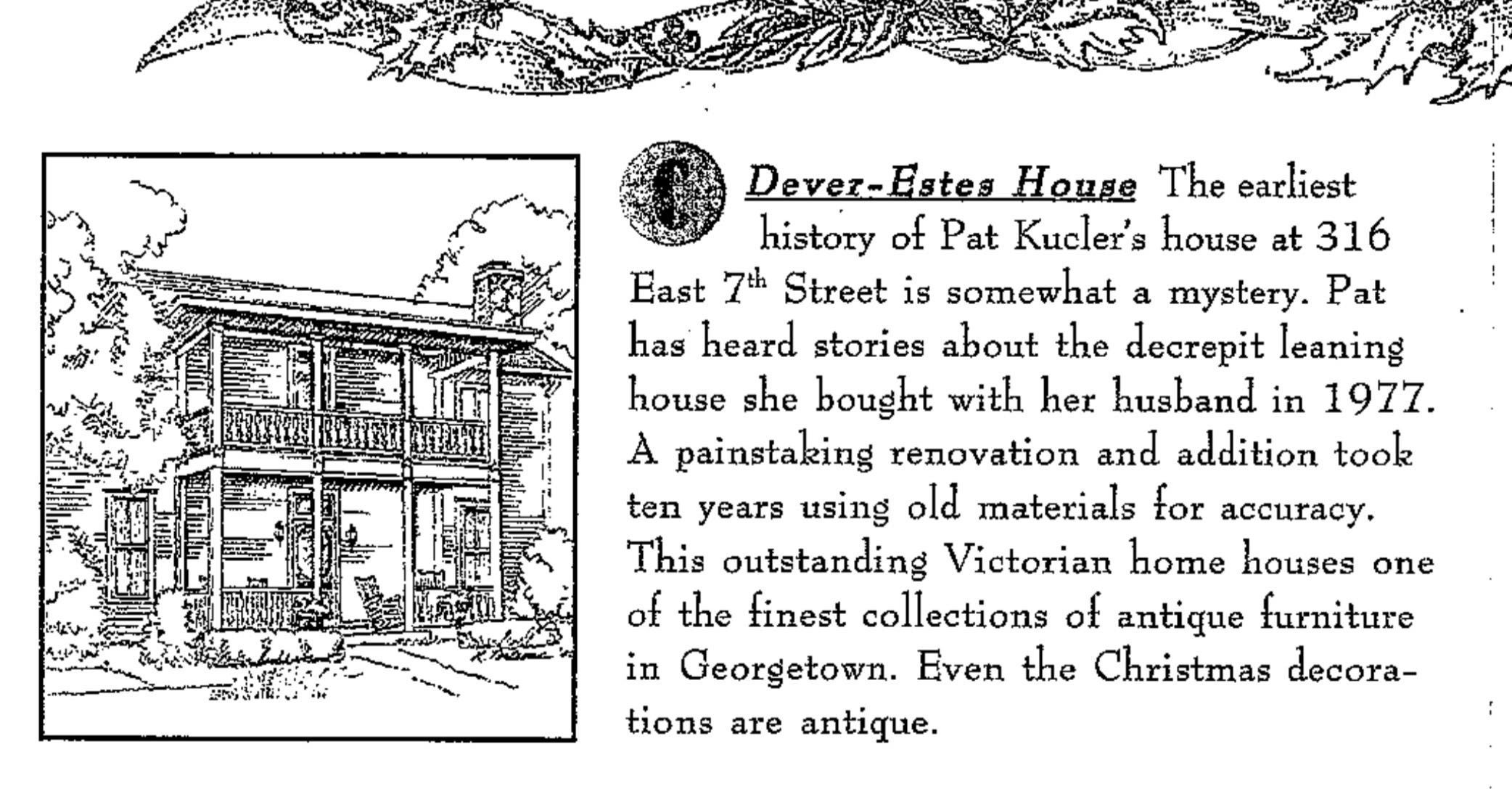
When the house was featured in Georgetown’s 2005 Home Tour, the brochure’s description of the home admitted they still hadn’t solved it. Next to a pen-and-ink sketch of the two-story facade, the entry for the Dever-Estes House opened with a confession: “The earliest history of Pat Kucler’s house at 316 East 7th Street is somewhat a mystery.” I read that line and thought: well, let’s see about that.
The clippings
Before I had time to dive into the deeds and chain of title, I ran into Liz Weaver. I asked her what she knew about the Dever-Estes House on 7th. She immediately said, “It was moved.” Of course, she already had a file on it, and she sent me a set of newspaper clippings that she had collected from the Sun, among them one that settled the move date quite clearly.

The house had been moved from the country to this lot in the fall of 1883. It hadn’t been built on Block 17 at all.
That answered one question and opened three more. When had the house been built? Where was “the Andrew Glasscock place”? And who was Andrew Glasscock?
The brothers Glasscock
The Glasscock name is hard to miss in Georgetown. The town itself was named for George Washington Glasscock Sr., who donated the land for the county seat in the 1840s. But the 1883 clipping mentioned “Judge Glasscock” and “the Andrew Glasscock place,” and I needed to know how these men were all connected, so I put on my genealogist hat.
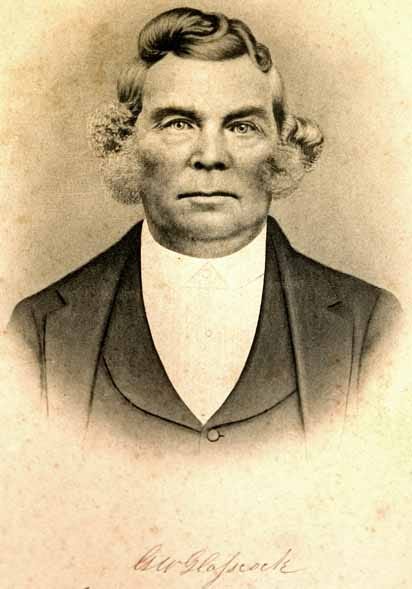
George Washington Glasscock Jr., the “Judge Glasscock” of the clipping, was the eldest son of the town’s namesake. He had served as county judge, represented the district as a state senator, and laid out the Glasscock Addition to Georgetown. He was also the “Senator Glasscock” that Sam Connell traded 308 acres to in 1890 for the two-story house. Andrew Jackson Glasscock was G.W. Jr.’s younger brother, and “the Andrew Glasscock place” was his property in the country.
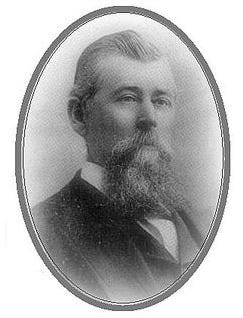
When G. W. Sr. died, Andrew was a minor and G. W. Jr. was his guardian. In January 1873, G.W. sold Andrew roughly 1,195 acres out of the Antonio Flores one-third league survey, plus 248 acres on the adjoining Porter survey, for $17,000. But G.W. retained one thing in the sale: “all the improvements.” Whatever was standing on that land in 1873 stayed with G.W. Andrew bought the acreage, but he would have to build his own house.
And that’s exactly what he appears to have done, roughly eight years later.
Georgetown’s silver mine
I need to take a minute to tell you about the silver mine, because the house and the mine are two stories unexpectedly tangled together.
In the spring of 1881, someone discovered silver ore on Andrew Glasscock’s land, “about a mile from town.” The Sun reported in May that a mining company had been organized, with Judge G. W. Glasscock himself appointed to the executive committee, and that ore samples had been sent to Leadville, Colorado, for assay. By June, the Dallas Daily Herald reported the ore was assaying at fifty dollars per ton and shares in the company had doubled.
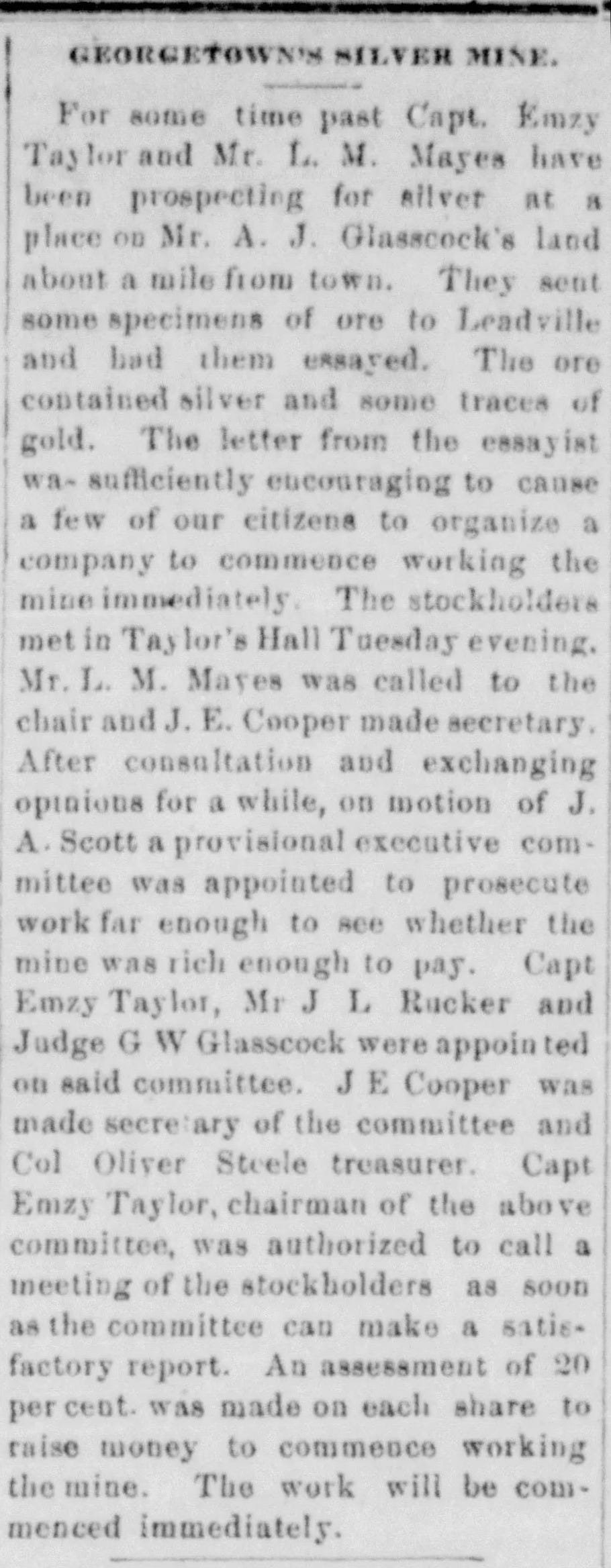
Through the summer and fall, the newspapers throughout the state tracked the excitement. Stockholders surveyed the mine and refused a buyout offer. Then, in late October, they tried to smelt two tons of ore and the furnace failed. By November, the Dallas Daily Herald noted in a section from Georgetown that “the excitement created by the prospect of a rich mine here has quieted down in great measure.” The bonanza that Georgetown had been dreaming of didn’t materialize. It seems the mine was a bust. But the excitement had placed Andrew Glasscock’s land at the center of Georgetown’s attention for six months, and it might have done something else, too. It might have given Andrew reason to believe his property was about to become very valuable, and perhaps that had even been a good reason to build a fine two-story house on it.
Reading the tax rolls
The tax rolls told me what the newspapers couldn’t. I tracked Andrew Glasscock’s Flores survey land across a decade of Williamson County assessment rolls, and the pattern was clear. From 1875 through 1881, the assessed value of about 800 acres on the Flores survey held steady at about $3,200, roughly four dollars per acre.
Then, in 1882, the value jumped to $8,000 on the same 800 acres, more than doubling the per-acre rate to ten dollars. The acreage didn’t change. The location didn’t change. Something expensive had been added to the property between the 1881 and 1882 assessments. That something was almost certainly a house.
I should note a complication: the silver mine excitement was happening on this same land at the same time, and it’s possible that the 1882 value spike reflects mineral speculation rather than construction. But the mine seems to have collapsed by November 1881, and the $8,000 assessment held into the following year. Inflated mineral values don’t usually survive a bust. A new two-story dwelling would have, though.
A homestead designation filed by Andrew in January 1883 shows the house was standing and occupied. He described it as “my homestead improvements where I now reside,” and reserved 200 acres in the northeast corner of the Flores survey as his homestead, calling the land his separate estate, inherited from his parents before his marriage.
On the other end of the transaction, Block 17 in town told its own story. The lot had been assessed at $200 to $250 through the early 1880s, bare-lot value. After the house was moved onto it in the fall of 1883, the value climbed to $400 in 1884 and then jumped to $1,250 in 1885, a five-fold increase. By January 1885, G.W. Glasscock was advertising the property for rent:
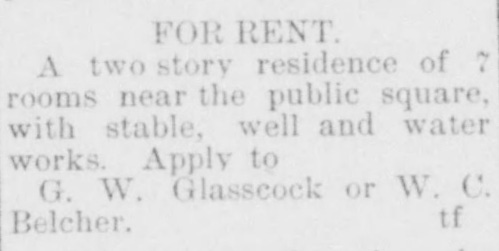
The numbers on both ends matched. Value disappeared from the country and appeared in town.
“The Andrew Glasscock place”
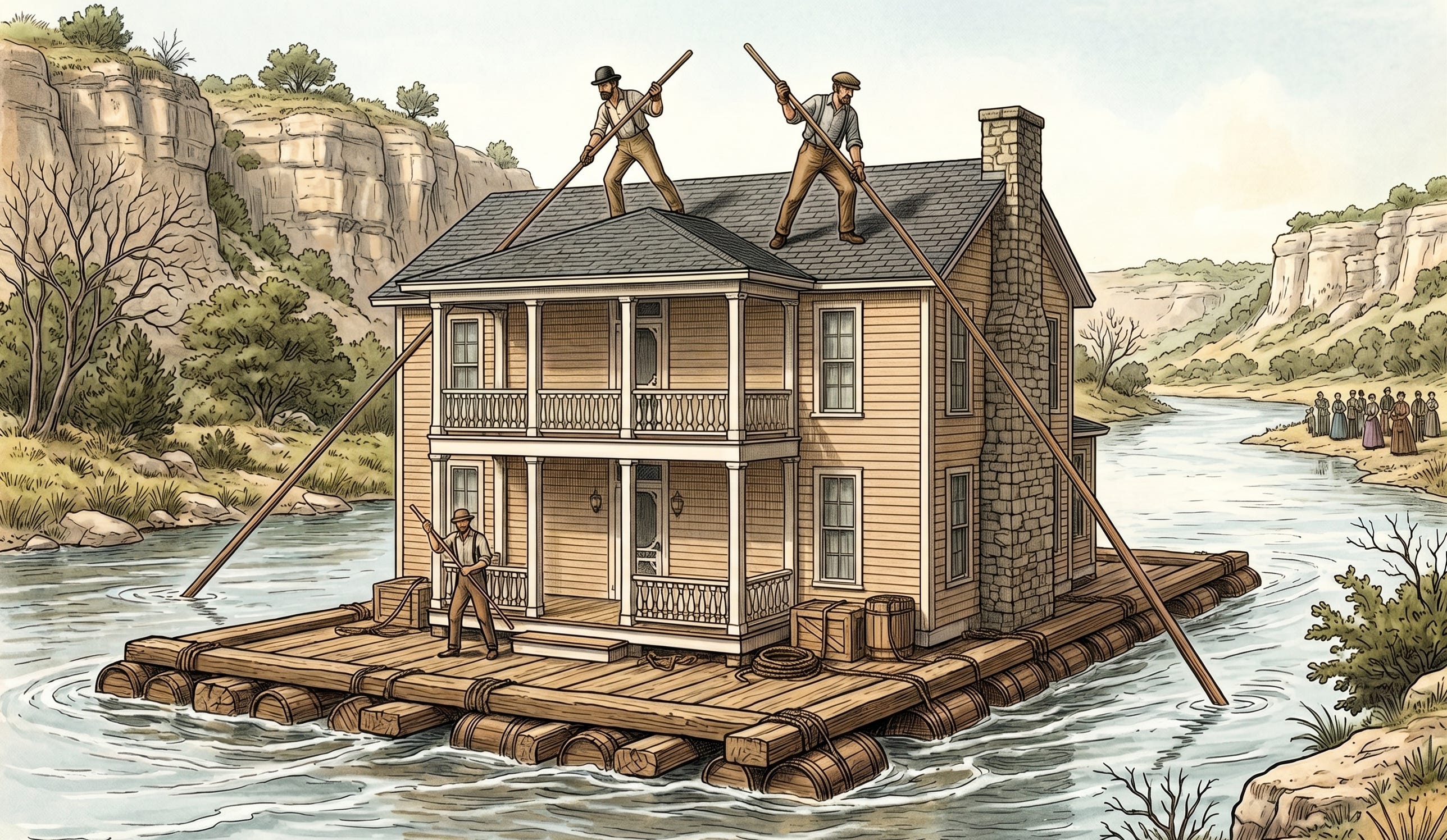
So where, exactly, was this property? The oral tradition that the house had been “floated down the San Gabriel River” conjures quite the picture: I can almost see it, the two-story frame riding the current to Georgetown, the house perched on some impossible raft, drifting past the limestone bluffs with a couple of men on the roof steering it with poles, like something out of a frontier tall tale.
The evidence told a less dramatic story. A General Land Office survey map of Williamson County places the Antonio Flores survey immediately north-northeast of Georgetown, roughly a mile from the courthouse square.
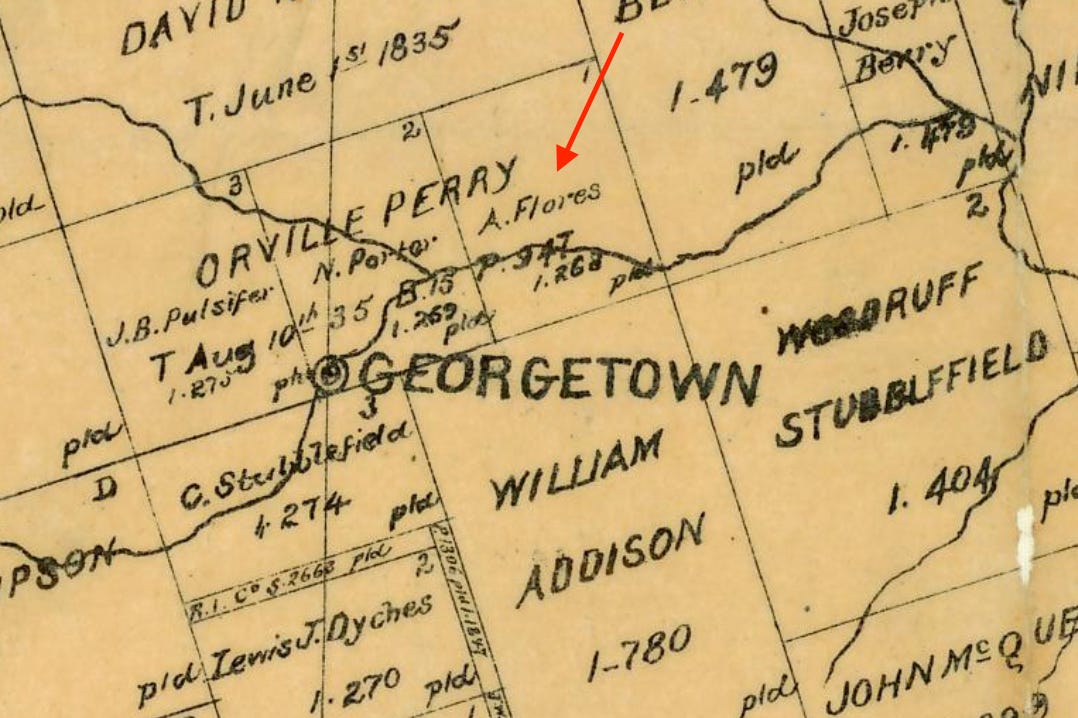
The deeds confirm it: the 1877 sale of a 76-acre tract along the river describes a starting point “at a stake in the centre of the channel of the San Gabriel River and in the East line of the Antonio Flores survey,” with Andrew’s field fence and a pecan tree twelve inches in diameter serving as landmarks. This was practically Georgetown’s back yard.
The “floated down the river” tradition likely reflects a garbled memory of the house’s riverside origin rather than its method of transport. The property bordered the San Gabriel, and the house came from near the river, but it almost certainly did not come by the river. A one-mile overland move with log rollers and ox teams was more likely given the capability of 1880s house-moving technology.
Andrew’s last years
In 1882, Andrew sold his brother George all of his interest in the Flores and Porter surveys except his 200-acre homestead. In August 1883, he sold the homestead itself for $2,000. The Sun reported:

Six weeks later, the house was being moved.
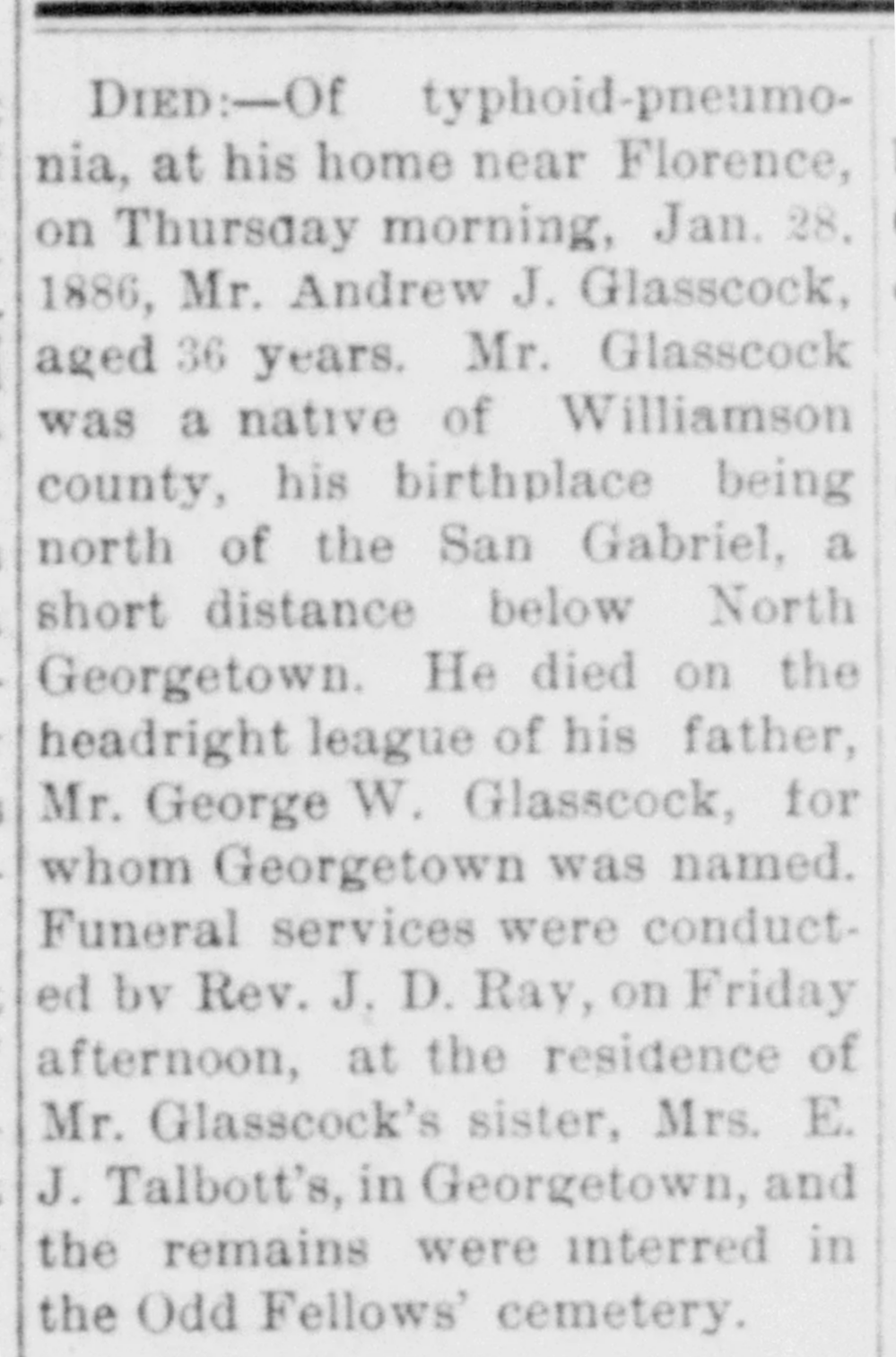
On January 28, 1886, the Sun reported Andrew’s death. Andrew Jackson Glasscock had died of typhoid pneumonia at his home near Florence. He was 36 years old.
His obituary noted that he was “a native of Williamson county, his birthplace being north of the San Gabriel, a short distance below North Georgetown,” and that “he died on the headright league of his father, Mr. George W. Glasscock, for whom Georgetown was named.” He was buried in the Odd Fellows’ Cemetery.
He had been born on the land, built a house on it, and sold it all before he turned 34. The house survived him by 140 years and counting.
What the house saw
Sam and Lillie Connell moved into this house in November 1890, the same two-story dwelling that Andrew Glasscock had built on the Flores survey and G.W. had rolled into Georgetown seven years earlier. They had just left the sheriff’s residence at the county jail after Sam lost the 1890 election, and for the first time in years, they needed a home of their own.
By 1891, Connell was already on the city’s delinquent tax list for the same lots. He filed a homestead designation on Block 17 in May 1892, trying to protect the property. In June 1893, the Sun reported: “Mr. Sam Connell has traded for the Dever livery business. He transferred his two story residence to Mr. Dever in the trade.”
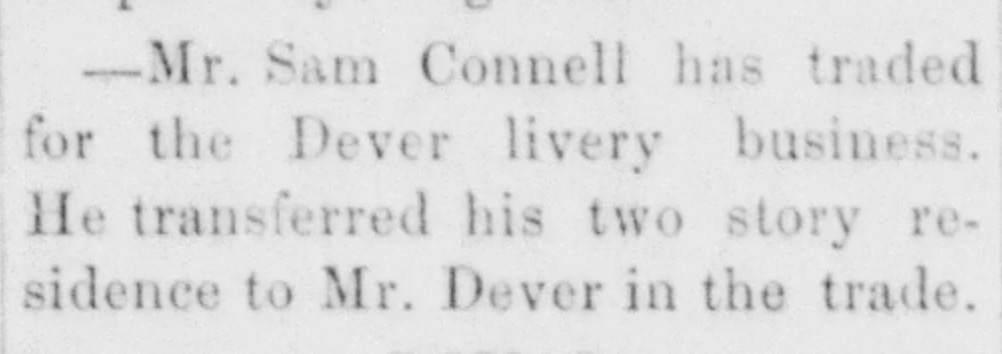
The house that Andrew Glasscock built, that Judge Glasscock moved into town, that Sam Connell traded 308 acres to acquire, was traded away again for a livery stable.
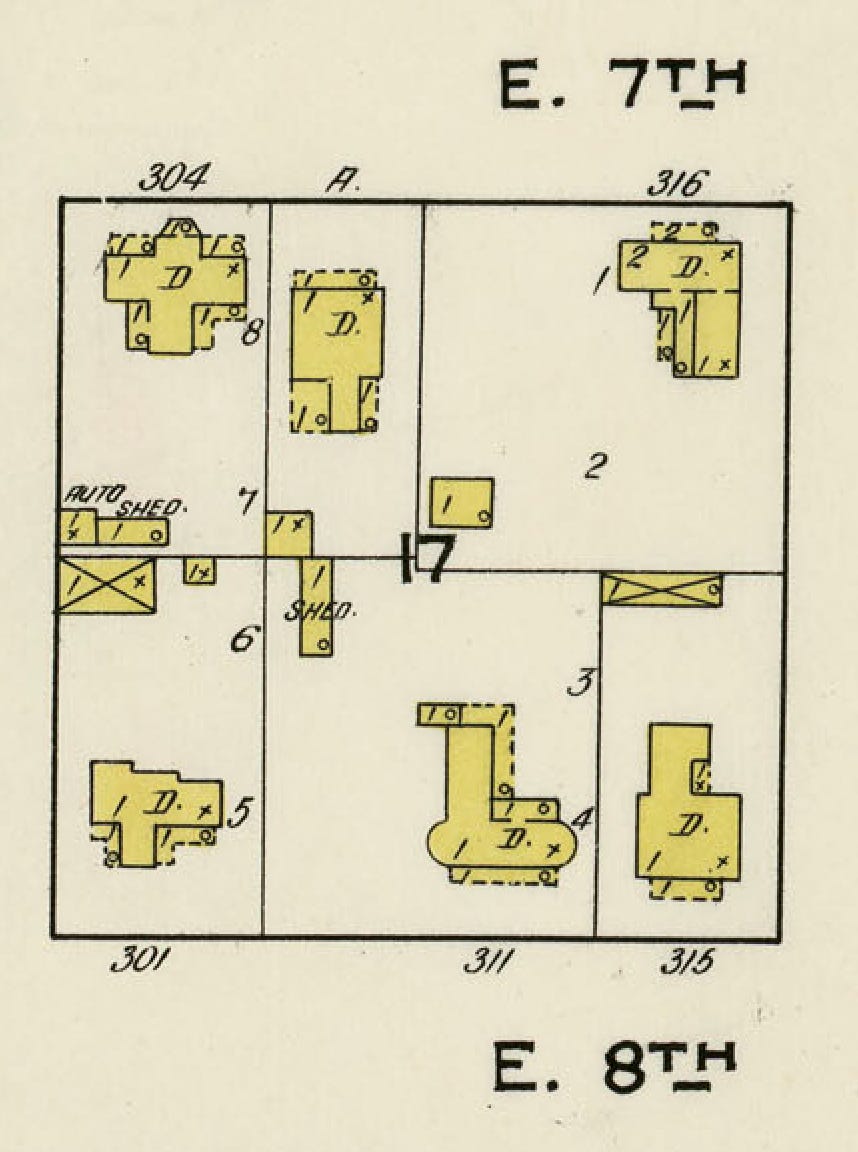
Three decades later, Block 17 appears on the Sanborn fire insurance maps for the first time with a two-story dwelling shown on the northeast corner lot where the house still stands today.
Still standing
The house passed through the Devers, the Wilcoxes, the McInneses, the Dolans, and the Estes family, who held it for more than forty years. The Kuclers bought it in 1977 and undertook a painstaking thirteen-year renovation using old materials for accuracy.
Today, the house at 316 East 7th Street still stands, 145 years after Andrew Glasscock built it on his homestead along the San Gabriel River (likely in 1881) and 143 years after his brother moved it into Georgetown.
The researchers who studied the origins of this house over the past four decades didn’t crack the origin story because the answer wasn’t in the building itself; it was in the tax rolls and the deed records and, crucially, two small and easily overlooked newspaper clippings from 1883. The house started its life on Andrew Glasscock’s homestead near the San Gabriel River the same year that Georgetown briefly dreamed of silver. When it arrived in town, the street it landed on was called San Gabriel Street. The city later renamed the street 7th. The house came from near the river and settled on the street that bore the river’s name, and even that small connection has been nearly erased by time.
I’m not sure when the house was first called the “Dever-Estes House,” or who decided on the name. The 1994 Sun article doesn’t name the home, but the 2005 home tour brochure does, so it was named sometime during that period. At the time, the Dever and Estes families had kept the home longest, and naming conventions tend to favor longevity. If I were naming it today, though, knowing what the records now show, I would call it the Glasscock-Connell House, c. 1881, for the men who built it and moved it and for the sheriff who traded 308 acres to call it home.
Both the Dever and the Estes families were good stewards, but Andrew Glasscock raised the walls, George Glasscock moved it into town, and Sampson Connell tried to build a life outside of the county jail inside its walls, and those earliest parts of its story are worth remembering.
As usual, I found some interesting material about the life of Andrew Glasscock while researching the origins of the house. It involves a young woman named Virginia Shell, an engagement, a Williamson County jury that ordered Andrew to pay dearly for his choice of words, and a historic Texas Supreme Court decision. I’ll spill the tea on that drama next time!
Thanks for reading Old Town Echoes! Subscribe for free to get new posts and support my work.
Sources & Research Notes
The House at 316 E. 7th Street
Texas Historical Commission, Historic Sites Inventory Form, 316 E. 7th St., Georgetown, Williamson County, Texas (Site No. 63, USGS Quad 3097-313); recorded by D. Moore/HHM, July 1984.
Georgetown Heritage Society, Research Data Sheet, 316 E. 7th St., Block 17, Lots 1 & 2, Glasscock Addition, Georgetown, Texas; compiled 1983/84; present owner Franole Kucler.
Georgetown Heritage Society, 1984 Survey Response, 316 E. 7th St.; in GHS research files.
“Dever-Estes House,” Georgetown Holiday Home Tour brochure, 2005; entry for 316 E. 7th St., with pen-and-ink sketch.
Newspaper Clippings
“Judge Glasscock is having a two-story dwelling moved from the Andrew Glasscock place…,” The Williamson County Sun (Georgetown, Texas), 18 October 1883; digital image, Newspaper Archive (newspaperarchive.com : accessed 1 May 2026).
“The two-story house moved by Judge Glasscock to the lot near the Presbyterian [frame] church is up…,” The Williamson County Sun (Georgetown, Texas), 22 November 1883; digital image, Newspaper Archive (newspaperarchive.com : accessed 1 May 2026).
“Judge Glasscock has purchased of Mr. Andrew Glasscock the latter’s place in the country,” The Williamson County Sun (Georgetown, Texas), 6 September 1883, p. 3; digital image, Newspaper Archive (newspaperarchive.com : accessed 1 May 2026).
“FOR RENT. A two story residence of 7 rooms near the public square, with stable, well and water works. Apply to G. W. Glasscock or W. C. Belcher,” The Williamson County Sun (Georgetown, Texas), 15 January 1885; digital image, Newspaper Archive (newspaperarchive.com : accessed 1 May 2026).
“Sheriff Connell has traded 308 acres of land between Georgetown and Hutto to Senator Glasscock…,” The Williamson County Sun (Georgetown, Texas), 9 October 1890; digital image, Newspaper Archive (newspaperarchive.com : accessed 1 May 2026).
“Mr. Sampson Connell has moved to his place a short distance east from the square,” The Williamson County Sun (Georgetown, Texas), 27 November 1890; digital image, Newspaper Archive (newspaperarchive.com : accessed 1 May 2026).
“Mr. Sam Connell has traded for the Dever livery business…,” The Williamson County Sun (Georgetown, Texas), 15 June 1893; digital image, Newspaper Archive (newspaperarchive.com : accessed 1 May 2026).
“City Delinquent Tax List for the Year 1891,” The Williamson County Sun (Georgetown, Texas), 10 March 1892, p. 2; digital image, Newspaper Archive (newspaperarchive.com : accessed 27 April 2026).
“Died:—Of typhoid-pneumonia, at his home near Florence…Mr. Andrew J. Glasscock, aged 36 years,” The Williamson County Sun (Georgetown, Texas), 4 February 1886; digital image, Newspaper Archive (newspaperarchive.com : accessed 1 May 2026).
Silver Mine Clippings
“Georgetown’s Silver Mine,” The Williamson County Sun (Georgetown, Texas), 26 May 1881, p. 3; digital image, Newspaper Archive (newspaperarchive.com : accessed 1 May 2026).
[Georgetown correspondence, silver mine update], Dallas Daily Herald (Dallas, Texas), 17 June 1881, p. 1; digital image, Newspapers.com (newspapers.com : accessed 1 May 2026).
[Georgetown correspondence, mine and railroad meeting], Dallas Weekly Herald (Dallas, Texas), 20 October 1881, p. 7; digital image, Newspapers.com (newspapers.com : accessed 1 May 2026).
[Georgetown silver mine update], Brenham Daily Banner (Brenham, Texas), 18 October 1881, p. 2; digital image, Newspapers.com (newspapers.com : accessed 1 May 2026).
[Georgetown correspondence, copper and silver mine], Dallas Daily Herald (Dallas, Texas), 26 October 1881, p. 1; digital image, Newspapers.com (newspapers.com : accessed 1 May 2026).
[Emery Taylor mining offer], Dallas Daily Herald (Dallas, Texas), 23 October 1881, p. 1; digital image, Newspapers.com (newspapers.com : accessed 1 May 2026).
[Georgetown mine, smelting attempt], Dallas Daily Herald (Dallas, Texas), 26 October 1881, p. 1; digital image, Newspapers.com (newspapers.com : accessed 1 May 2026).
[Georgetown mine assay in St. Louis], Galveston Daily News (Galveston, Texas), 16 November 1881, p. 1; digital image, Newspapers.com (newspapers.com : accessed 1 May 2026).
[Georgetown mine excitement fading], Dallas Daily Herald (Dallas, Texas), 24 November 1881, p. 4; digital image, Newspapers.com (newspapers.com : accessed 1 May 2026).
Deed Records (Williamson County)
Williamson County, Texas, Deed Records; deed, George W. Glasscock Jr. (Travis County) to Andrew J. Glasscock (Williamson County); 1,195 acres out of the Antonio Flores survey and 248 acres out of the Nicholas Porter survey, excepting tracts previously sold and “all the improvements”; $17,000; dated 22 January 1873, filed 22 January 1873, recorded 24 January 1873; Williamson County Clerk’s Office, Georgetown, Texas.
Williamson County, Texas, Deed Records; deed, Andrew J. Glasscock and Esther L. Glasscock to W.G. Pettus (Fort Bend County); 76½ acres on the Antonio Flores survey along the San Gabriel River channel; $459, paid by M.W. Northington Jr.; dated 16 June 1877, filed 16 June 1877, recorded 18 June 1877; Williamson County Clerk’s Office, Georgetown, Texas.
Williamson County, Texas, Deed Records; homestead designation, A.J. Glasscock; 200 acres out of the NE corner of the Antonio Flores survey, Williamson County; designated as homestead and separate estate acquired by descent before marriage; dated 10 January 1883, filed 30 January 1883; Williamson County Clerk’s Office, Georgetown, Texas.
Williamson County, Texas, Deed Records; deed, A.J. Glasscock and E.L. Glasscock to George W. Glasscock; 200 acres out of the Antonio Flores one-third league survey, being the grantor’s homestead in the NE corner of said survey; $2,000; dated 28 August 1883, filed 28 August 1883, recorded 30 August 1883; Williamson County Clerk’s Office, Georgetown, Texas.
Williamson County, Texas, Deed Records; deed, G.W. Glasscock to Sampson Connell; Lots 1 & 2, Block 17, Glasscock Addition; October 1890; Williamson County Clerk’s Office, Georgetown, Texas.
Williamson County, Texas, Deed Records; deed, Sampson Connell to G.W. Glasscock; 308 acres between Georgetown and Hutto; October 1890; Williamson County Clerk’s Office, Georgetown, Texas.
Williamson County, Texas, Deed Records; homestead designation, Sampson Connell; Lots 1 & 2, Block 17, Glasscock Addition; filed May 1892; Williamson County Clerk’s Office, Georgetown, Texas.
Williamson County, Texas, Deed Records; deed, Lillie Connell [or Sampson Connell] to Mrs. T.C. Dever; Lots 1 & 2, Block 17, Glasscock Addition; June 1893; Williamson County Clerk’s Office, Georgetown, Texas.
Tax Records (Williamson County)
Williamson County, Texas, Assessment Roll of Property, Years 1875–1888; entries for Glasscock, A.J. (Flores survey, Abstract 235) and Glasscock, G.W. (Block 17, Glasscock Addition); FamilySearch, “Williamson, Texas, United States records” (familysearch.org : accessed 1 May 2026).
Williamson County, Texas, Roll of Unrendered Property, Year 1884; line 36 (Glasscock), Porter survey 497, value $1,000; FamilySearch, “Williamson, Texas, United States records” (familysearch.org : accessed 1 May 2026).
GLO Map
“Map of Williamson County,” cadastral map, November 1880; General Land Office, State of Texas; digital image, The Portal to Texas History (texashistory.unt.edu : accessed 3 May 2026), University of North Texas Libraries; (https://texashistory.unt.edu/ark:/67531/metapth89070/ : accessed May 3, 2026), University of North Texas Libraries, The Portal to Texas History; crediting Texas General Land Office.”
Correspondence
Liz Weaver to Amanda Durdin, email, 27 April 2026; re: Dever-Estes house clippings and Presbyterian church location.
Kucler Renovation
“House on Holiday Home Tour required 13 years of renovations,” The Williamson County Sun (Georgetown, Texas), 23 November 1994, page 2A.
Research Notes
The THC inventory form’s estimated date of 1880 for the house at 316 E. 7th St. was unsourced and appears to have been a visual estimate based on architectural style. Tax roll analysis of A.J. Glasscock’s Flores survey land narrows the construction date to circa 1881, based on more than doubling of the assessed value from $3,200 to $8,000 between the 1881 and 1882 assessments, with no corresponding change in acreage. The 1882 value spike coincides with the Georgetown silver mine excitement on the same property (May–November 1881), which could partially account for the increase, though the sustained assessment after the mine’s collapse suggests a permanent improvement rather than speculative inflation.
The “floated down the San Gabriel River” oral tradition associated with the house does not hold up against the documentary evidence. The Flores survey is approximately one mile north of Georgetown, too short a distance for river transport. However, multiple deeds confirm the property bordered the San Gabriel River, and the tradition likely reflects a memory of the house’s riverside origin rather than its method of transport.
Sanborn fire insurance maps for Georgetown (1889 and 1900) do not include Block 17 because coverage was limited to the commercial core. The block first appears on the 1916 Sanborn map. The absence of Block 17 from the earlier Sanborn maps is not evidence that the house was not present; the mapmakers simply were not surveying residential blocks that far east.
Old Town Echoes is independently researched using primary historical sources. AI tools assist in drafting and editing; all content is reviewed, sourced, and verified by the author.