


On August 10, 1874, two days after his twenty-third birthday, Andrew Jackson Glasscock sat down and wrote a letter he likely spent the next eight years regretting.
Andrew, whom readers of last week’s story will recognize as the original builder of the house at 316 East 7th Street, was a 23-year-old bachelor that summer, and he was in a hurry. The Williamson County Sun wasn't publishing yet, so the story that followed traveled through the Austin and Dallas papers before I found it. But it got around.
Jennie
The young lady in question was Miss Virginia C. “Jennie” Shell, second daughter of John and Anzeline Shell, one of Georgetown’s founding families. The Shells had arrived from Missouri in 1849 and settled the land just east of the future university grounds; their tract still appears on modern surveys as the Shell Addition. The original 1849 limestone walls John and Anzeline laid by hand still stand inside the greenhouse at the Carothers-Thomas House at 603 East 7th Street, recently featured in a four-part series by Preservation Georgetown and, as of this writing, on the market for sale.
Jennie Shell was about 17 years old in the summer of 1874. The exact circumstances of how she and Andrew came to be engaged aren’t preserved in any document I’ve found. What we do know from court documents is that at some point in 1874 Andrew and Jennie had entered into “a mutual agreement... to marry each other.”
We also know what the letter said:
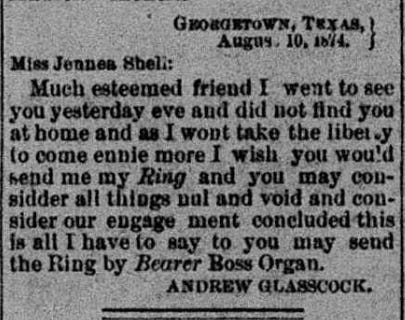
This does not seem to be the courteous breaking off of an engagement that 1874 society expected. This was a brush-off, dictated in haste, sent by messenger, demanding the ring back the same day.
Jennie Shell — and her father — kept the letter.
Another young lady
What Jennie may not have known, and what Andrew did not spell out in his letter, was the reason for his haste.
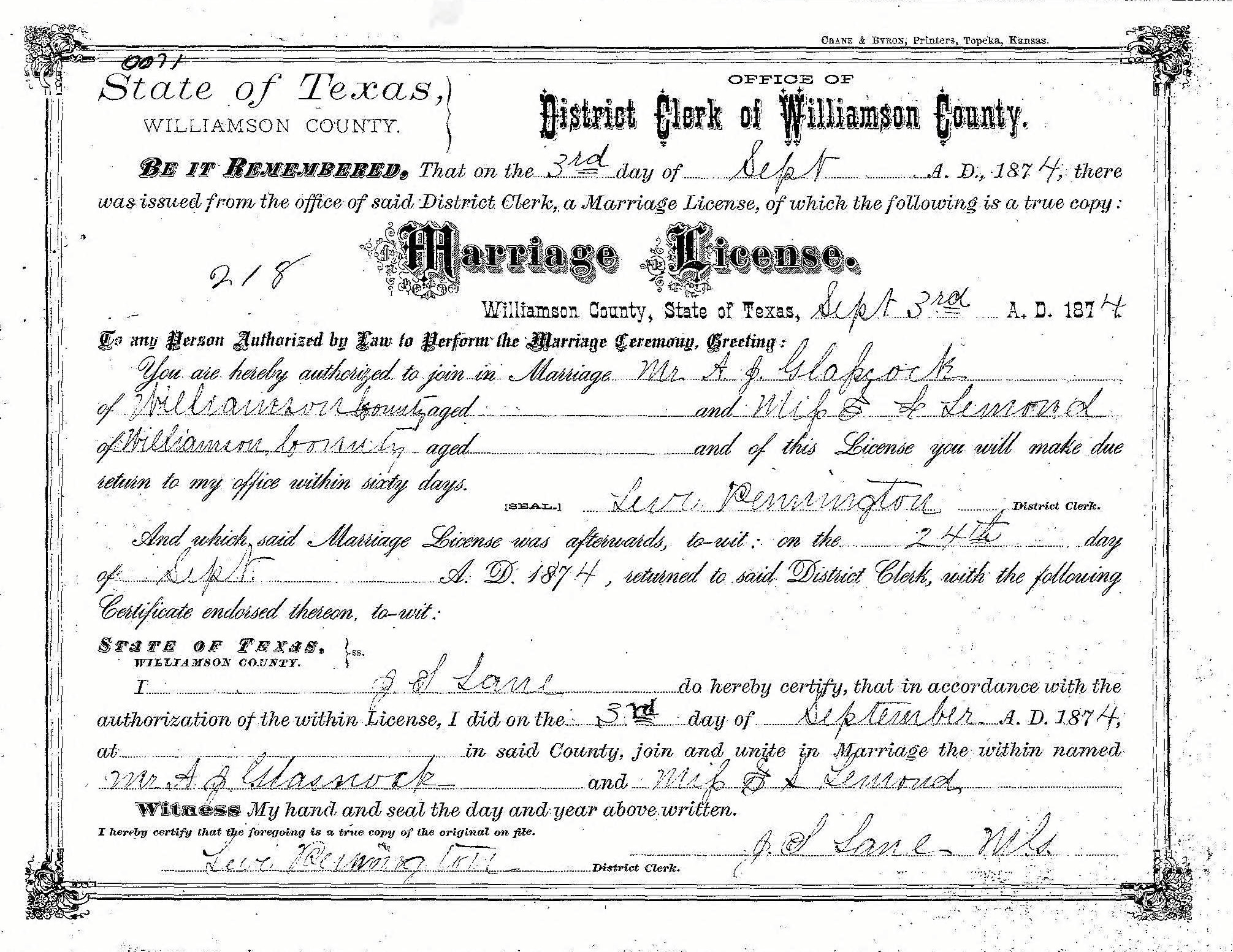
Less than a month after the letter, on September 3, 1874, Andrew applied to the Williamson County District Clerk for a marriage license. Two days after that, on September 5, he married 16-year-old Georgetown resident Esther Louisa Lemond.
Was Andrew courting both young women in the summer of 1874, or did the engagement to Esther come together suddenly in the four weeks between the letter and the wedding? All we can tell for sure is the timing. Andrew demanded his ring back on August 10. He was married to someone else by September 5. Jennie Shell got engaged, jilted, and replaced in less than a month.
The lawsuit
John Shell, “as agent and next friend” of his daughter Virginia, filed suit against Andrew J. Glasscock for breach of promise of marriage. The petition asked for $10,000 in damages, which was real money in 1874 Texas. Andrew’s entire 1,400-acre purchase from his brother eighteen months earlier had cost $17,000.
By November, Andrew had retained a small army of attorneys: Makemson & Posey, Montgomery & Peeler, and his own brother George W. Glasscock. The Shells had hired McFadin, Fisher & Dalrymple. Six attorneys, a packed courtroom, a 17-year-old plaintiff, and a one-paragraph letter.
On Wednesday, November 18, 1874, the parties came in person and announced ready for trial. A jury of “good and lawful men” was empaneled and sworn.
The arguments were, as the out-of-town papers later reported, ably presented on both sides. The case had drawn a crowd. The jury also likely knew the part of the story the lawyers may not have needed to spell out: that the defendant sitting before them had married a 16-year-old neighbor ten weeks earlier. The jury retired to deliberate. They were back in half an hour.
“We the Jurymen decide in favor of Plaintiff and assess the damages at four thousand dollars.”
Four thousand dollars. That letter was going to cost Andrew Glasscock roughly the price of a thousand acres of Williamson County farmland.
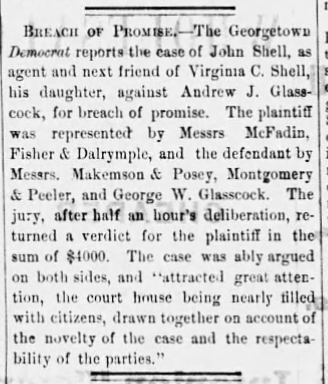
The Dallas Weekly Herald, four days later, did something the Austin papers did not. It printed the entire letter. Whatever shred of dignity Andrew Glasscock had likely hoped to preserve in Williamson County was now being read in Dallas, Austin, and presumably every front parlor between.
The motion, and the silence
Andrew’s lawyers moved for a new trial. The court overruled it. He gave notice of appeal to the Supreme Court of Texas, posted bond, and then… nothing happened for a good long while.
Life moved on, as it does. Jennie Shell married Samuel G. Anderson at her father’s house in April 1876. She was 19 years old with a $4,000 judgment still pending on appeal in her name. Whether she considered that a consolation or an aggravation is not recorded.
Esther, meanwhile, named her second daughter Virginia in 1877.
Andrew, for his part, got on with things. The silver mine excitement of 1881 came and went on his land. He built his two-story house on the San Gabriel. He sold most of his acreage to his brother George. By every indication, life was carrying on for Andrew Glasscock more or less normally.
Until it wasn’t.
The disappearance
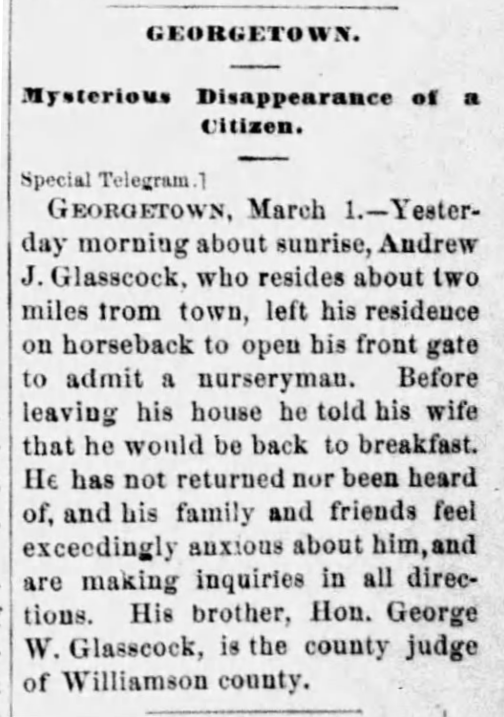
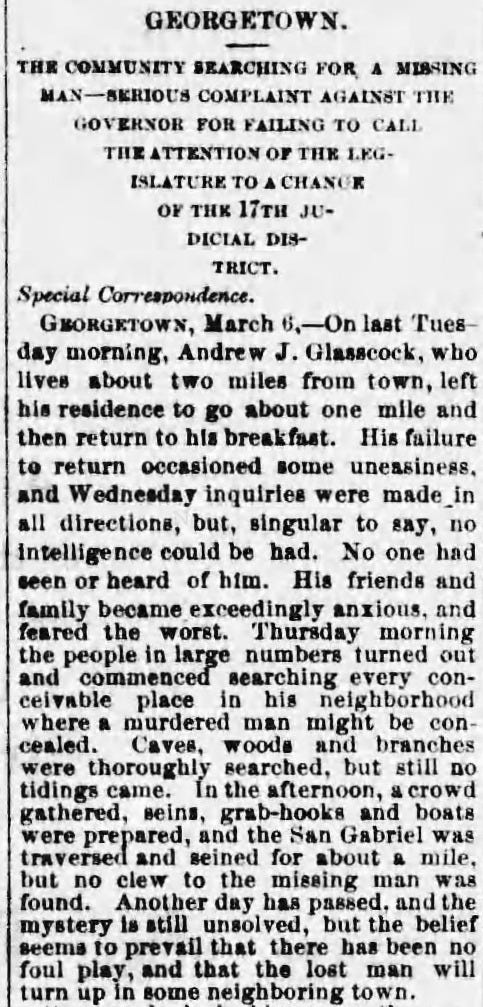
On the morning of Tuesday, February 28, 1882, about sunrise, Andrew Glasscock left his residence two miles outside Georgetown on horseback “to open his front gate to admit a nurseryman.” He told his wife he would be back to breakfast.
He did not come back to breakfast.
By Wednesday his family was alarmed enough to send a telegram to the Austin American-Statesman, which ran it the next morning under the headline MYSTERIOUS DISAPPEARANCE OF A CITIZEN.
By Thursday, the entire town was looking for him. The San Antonio Express filed a dispatch on March 6 reporting that searchers had combed caves, woods, and branches “where a murdered man might be concealed,” then assembled seines, grab-hooks, and boats and dragged the San Gabriel for about a mile. They found nothing. The dispatch ended on a curiously hopeful note: “the belief seems to prevail that there has been no foul play, and that the lost man will turn up in some neighboring town.”
The lost man did turn up in some neighboring town. The Austin Weekly Statesman of March 23 reported that Judge Glasscock had received a telegram from Abilene confirming that his brother Andrew had surfaced there. The same paper added a detail I cannot improve upon:
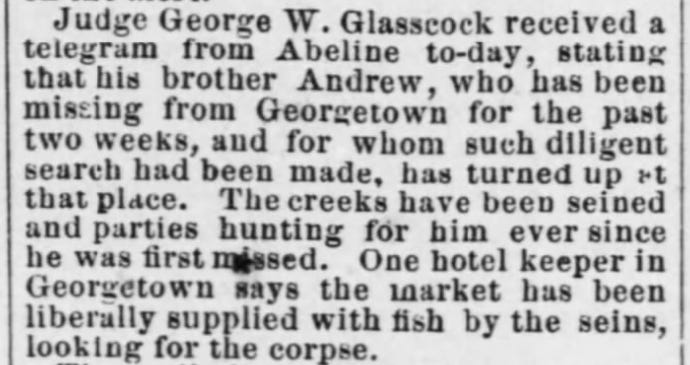
Andrew Glasscock left his house at sunrise to open a gate and turned up two weeks later in Abilene, while his hometown ate the fish his neighbors had pulled from the river while looking for his body. The papers never said what he had been doing in Abilene, why he had gone, or whether he had told anyone before he left. Andrew's older brother Albert Horton Glasscock had moved to Taylor County the year before, settling about fifteen miles south of Abilene to run sheep. The telegram to George announcing that Andrew had "turned up at that place" almost certainly came from Albert. On the question of why he disappeared and caused the whole town to search for him, we are left unsatisfied. He simply reappeared.
The Supreme Court decision
About three months after Andrew resurfaced, his eight-year-old appeal was finally argued before the Texas Supreme Court at Austin. On June 6, 1882, Justice Bonner handed down the opinion. It was, as the Austin papers noted with some satisfaction, the first breach of promise of marriage case ever decided by the state supreme court.
Andrew won on a technical point about jury instructions. The $4,000 verdict was reversed. The case was remanded to Williamson County for a new trial.
The dismissal
A new trial never came. On July 3, 1882, the parties appeared in Williamson County District Court and agreed to dismiss the case, with Andrew paying the court costs. Jennie Shell had long since married Samuel Anderson back in 1876, so maybe by then it was all just water under the bridge. Eight years after the break-up letter, after a $4,000 verdict and a Texas Supreme Court opinion, the parties walked into court and shook hands.
Sources
Newspapers
“Breach of Promise,” Austin American-Statesman, 24 November 1874, p. 2; reprinting an item from the Georgetown Democrat; digital images, Newspapers.com.
“Breach of Promise,” Weekly Democratic Statesman (Austin), 26 November 1874, p. 2; reprinting an item from the Georgetown Democrat; digital images, NewspaperArchive.com.
“In the case of Virginia C. Shell vs Andrew J. Glasscock...,” Dallas Weekly Herald, 28 November 1874; digital images, NewspaperArchive.com.
“Georgetown. Mysterious Disappearance of a Citizen,” Austin American-Statesman, 2 March 1882, p. 1; digital images, Newspapers.com.
“Georgetown. The Community Searching for a Missing Man...,” San Antonio Express, 8 March 1882, p. 3; digital images, Newspapers.com.
“Judge George W. Glasscock received a telegram from Abeline to-day...,” Austin Weekly Statesman, 23 March 1882, p. 2; digital images, Newspapers.com.
“Two important cases were decided by the supreme court...,” Austin Weekly Statesman, 8 June 1882, p. 3; digital images, Newspapers.com.
“Glasscock vs Schell, from Williamson county,” San Antonio Express, 9 June 1882, p. 3; digital images, Newspapers.com.
Court Records
John Shell as Natural Guardian and Next Friend of Virginia C. Shell, a Minor v. Andrew J. Glasscock, No. 1405, District Court Minutes, 6 November 1874; 18 November 1874; 21 November 1874; 3 July 1882; District Court, Williamson County, Texas; in “Williamson, Texas, United States records,” images, FamilySearch (https://www.familysearch.org/ark:/61903/3:1:3Q9M-CSTJ-DSC2-C : accessed April 30, 2026), Image Group Number 008340469.
A.J. Glasscock v. John Shell, next friend, 1 Tex. L. R. 292 (Tex. 1882), opinion by Justice Bonner; digital text, PlainSite (https://www.plainsite.org : accessed 2026).
Marriage Records
Marriage license and return, A.J. Glasscock and E.L. Lemond, license issued 3 September 1874, Williamson County, Texas; Texas, U.S., Select County Marriage Records, 1837–1965; digital images, FamilySearch.
Marriage license and return, Samuel G. Anderson (age 25) and Virginia C. Shell (age 19), license issued and ceremony performed 27 April 1876 at Mr. Shell’s residence by W.F. Gillespie, ordained minister, Williamson County, Texas; Texas, U.S., Select County Marriage Records, 1837–1965; digital images, FamilySearch.
Family Records
Family group record, George Washington Glasscock Sr. (1810–1868) and Cynthia C. Knight (1815–1866), with eleven children including Andrew Jackson Glasscock (1851–1886); FamilySearch family tree (KVJR-CL7), accessed May 2026.
Family group record, Esther Louisa Lemond (23 March 1858 – 28 May 1950), daughter of James Neely Lemond (1814–1879) and Virginia Jane Edwards (1824–1908), with daughters Cynthia Annie Glasscock (1875–1946) and Virginia L. Glasscock (1877–1886); FamilySearch family tree, accessed May 2026.
Preservation Georgetown, “Carothers–Thomas House Series, Parts 1–4,” documenting John and Anzeline Shell’s 1849 settlement of the Shell Addition at present-day 603 East 7th Street.
B. B. Paddock, ed., A Twentieth Century History and Biographical Record of North and West Texas, 2 vols. (Chicago and New York: Lewis Publishing Co., 1906), 2:441–42.
Earlier in the series
“The House on San Gabriel,” Old Town Echoes, 3 May 2026 (https://www.oldtownechoes.com/p/the-house-on-san-gabriel).
Old Town Echoes is independently researched using primary historical sources. AI tools assist in drafting and editing; all content is reviewed, sourced, and verified by the author.