


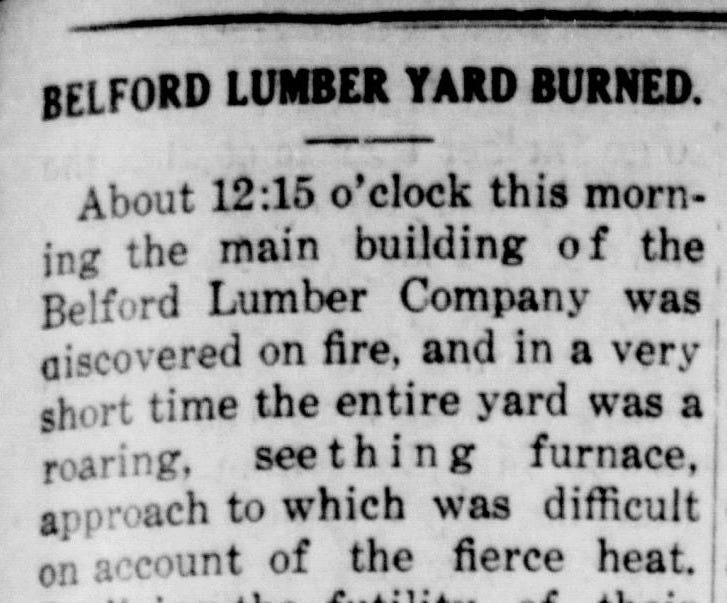
“About 12:15 o’clock this morning the main building of the Belford Lumber Company was discovered on fire, and in a very short time the entire yard was a roaring, seething furnace, approach to which was difficult on account of the fierce heat.”
That’s the Williamson County Sun of Thursday, March 11, 1909, and the “this morning” is literal. The fire broke out a little after midnight, and the paper went to press the same day with the story still warm. “The losses cannot be accurately determined at this writing,” the reporter admitted, and then gave his best guess anyway.
Block 36
The Belford Lumber Company’s yard spread over three city blocks just northwest of the courthouse square, between the square and the railroad. Its heart, and the block that burned, was the one bounded by Merchant Street on the north, San Gabriel Street on the south, Forest on the west and Rock on the east. Merchant is 6th Street today and San Gabriel is 7th. On the plat it was Block 36, and that’s what the paper called it. The warehouses across San Gabriel to the south were Belford’s too, and the yard kept growing in that direction for the next 50 years.
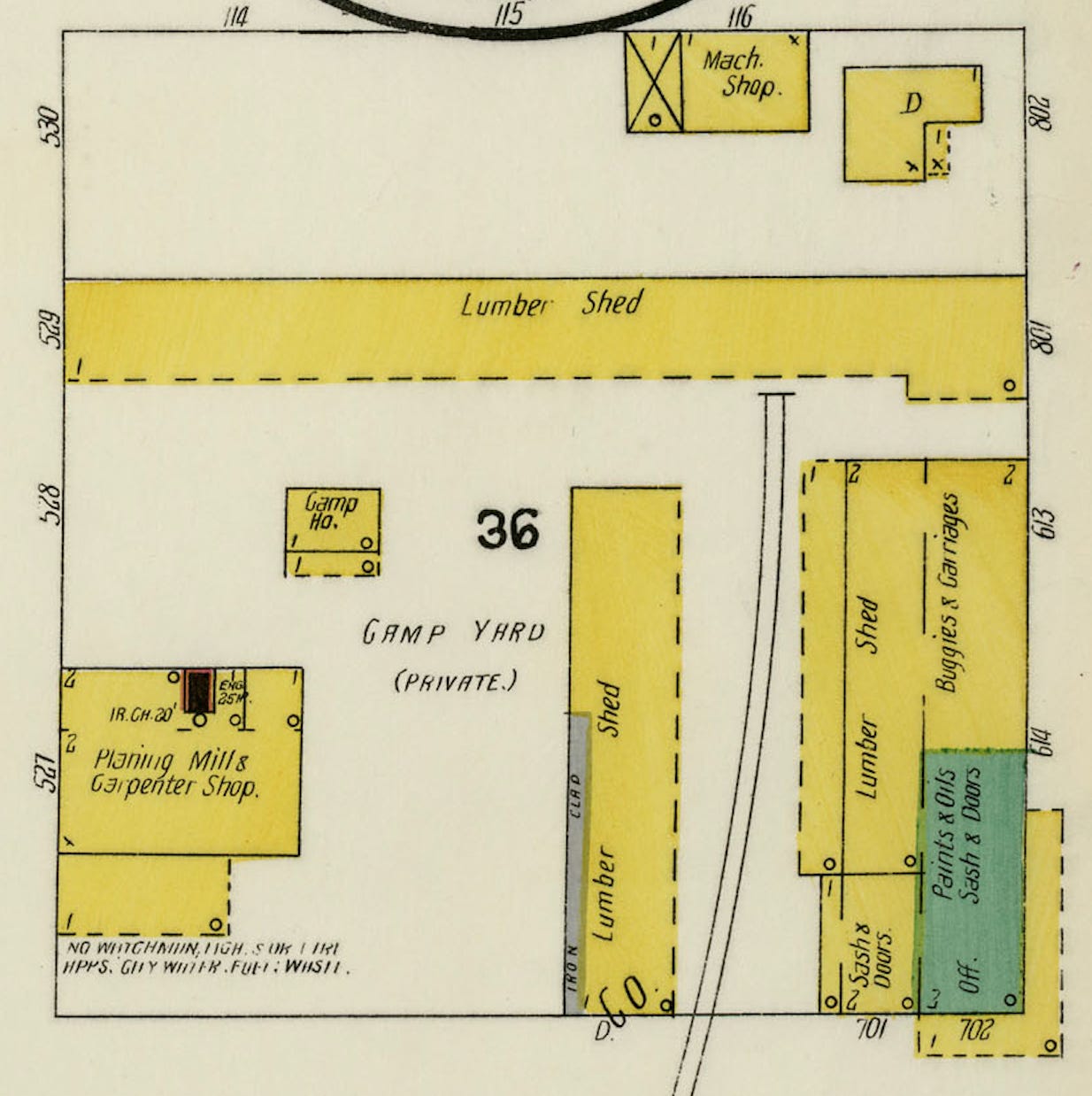
What stood on Block 36 16 months before the fire is drawn on the Sanborn insurance map of November 1905. A long lumber shed ran across the north side of the block. The planing mill and carpenter shop, with their boiler, sat on the Forest Street side. Along Rock Street were more sheds, a building marked “Buggies & Carriages,” another marked “Paints & Oils” and “Sash & Doors,” and at the corner of San Gabriel the company office. A railroad spur curved into the block from the south, so cars could be unloaded inside the yard. In the middle of it all the surveyors drew a small “Camp Ho.” inside a “Camp Yard (Private),” which I take to be a place where people hauling in from the country could put up for the night. Two of them were asleep in it when the fire started.
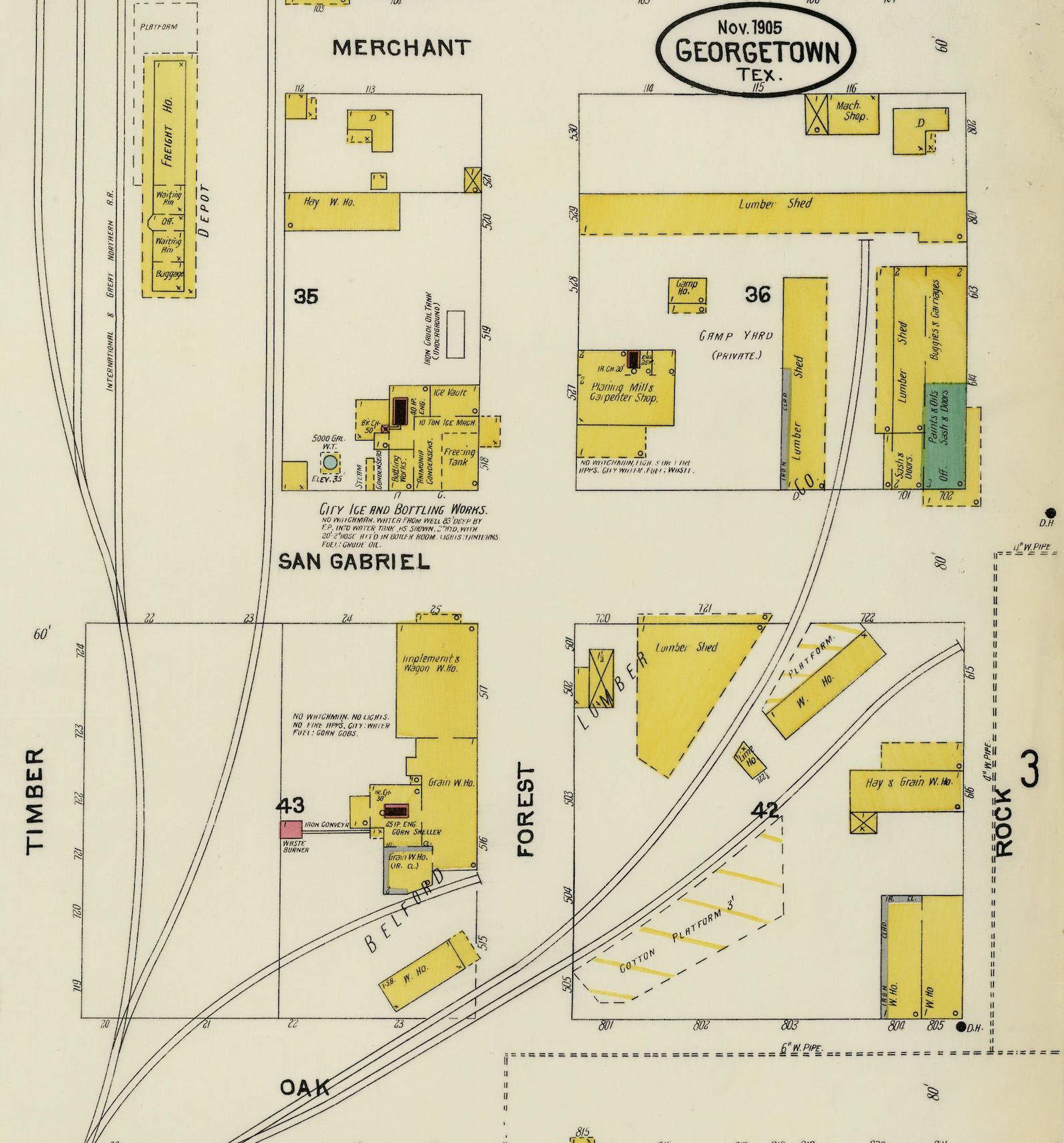
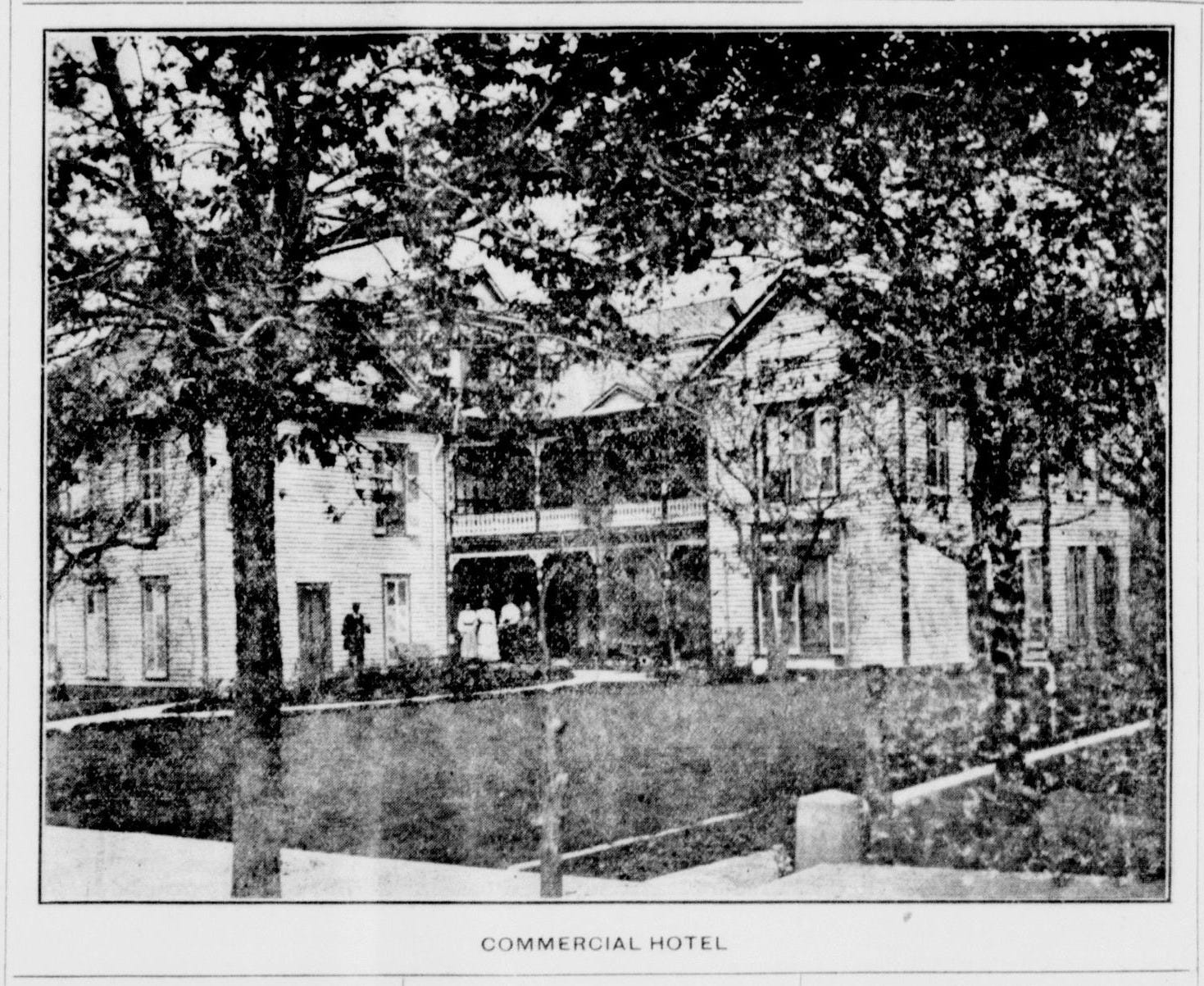
The neighbors mattered that night, so it’s worth knowing who they were. West across Forest Street was the City Ice and Bottling Works. North across Merchant was a grist mill, the old Roberts mill as the paper called it. South across San Gabriel were warehouses, some of them Belford’s. East across Rock Street stood the Commercial Hotel, a big two-story frame building on the way to the depot, where the drummers, the traveling salesmen who came in by train with their sample trunks, stayed.
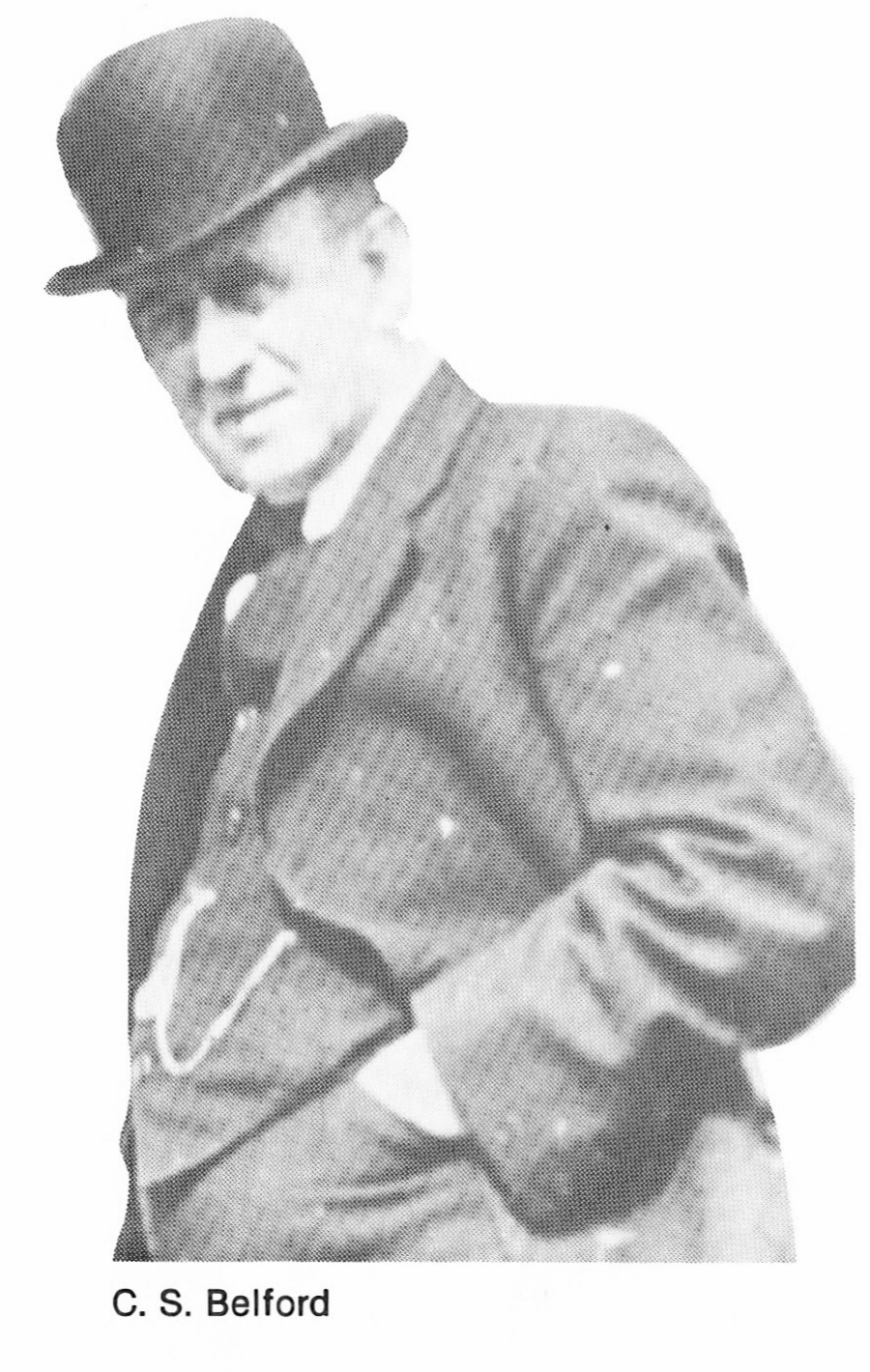
The man whose name was on the yard had been in Georgetown since 1884. Charles Sanford Belford was born in Newark, Ohio, in 1857, and the Belford Lumber Company was chartered in February 1892 as the successor to Belford & Harrel, who had bought out George Irvine’s planing mill. By 1909 it had a capital stock of $80,000 and a contracting business that had built the Methodist church, the Masonic Temple, Mood Hall and the two wings of the Annex at Southwestern, along with “a dozen or more residences” in the past year alone. If you live in an older house in Georgetown, there’s a fair chance Belford’s men built it. The yard on Block 36 was where all of that lumber came from, and it had already blown up once. On June 25, 1897, one of the boilers “bursted” and “with a terrific noise shot up 200 feet into the air,” landing a hundred feet from where it started. A workman was found nearby, unconscious, with a broken leg.
The fight
The firemen got there and saw at once that the yard was gone. The Sun says they realized “the futility of their efforts to save the lumber yard” and turned to the property around it, “principally to the Commercial hotel, a large two-story frame structure, which was afire in several places.” They held the hotel. The paper gave them a stellar line: “A gamer fight was never put up by a body of firemen and the town rings with their praise.”
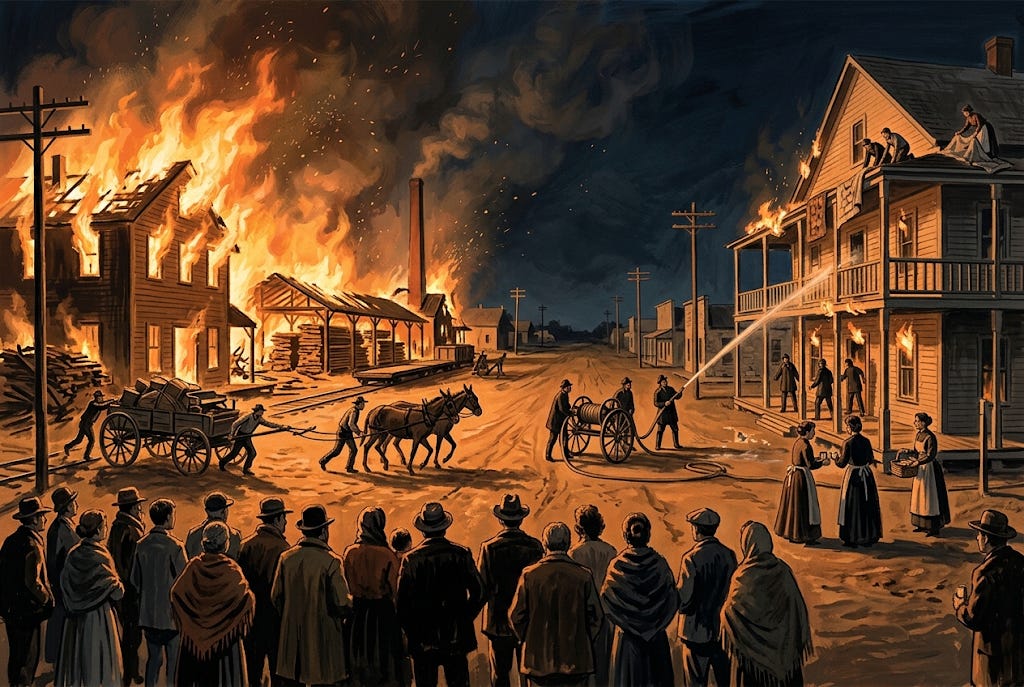
Everything else around the block was saved by whoever happened to be standing there. The ice factory on the west, which Belford also owned, caught fire several times and was held by “Ernest Ischy and others,” with the firemen helping toward the end. The grist mill on the north was “scorched and actually afire for a short time” and was saved by Louis Contat, who lived just behind it, and Jeff Logan, who “spliced together garden hose and kept a stream of water playing on it.” People in the houses nearby “covered the roofs with wet blankets and bed spreads and used their garden hose vigorously.” Across the railroad track the roof of the Black Methodist church caught from the sparks, and Black volunteers put it out with only slight damage. The paper named Esau Beard and “the Nook’s cook” as conspicuous among those who worked to save property that night, and added that there were others whose names it never got. (The Nook was a soda fountain and ice cream parlor on the south side of the square.)
A good part of Georgetown turned out to watch. The fire “was witnessed by a large proportion of the city’s population, who rushed to the scene,” and for a while it looked as if the whole north side of town would go. What saved it, beyond the firemen and the garden hoses, was the weather. “Fortunately there was little wind, what there was being from the east and blowing the flames away from the dwellings nearby.”
What burned
Block 36 “was completely destroyed.” The main building went, and with it “a large stock of buggies and other vehicles” stored on its second floor. The planing mill “down the hill, with its valuable machinery,” burned too, and it was the one part of the plant the company hadn’t insured. The cottage at the northeast corner of the block, the old Charlie Davis place, owned by Mrs. C. B. Beck and occupied by her son Will Davis, “went up in flames with nearly all its contents.”
Then there were the people who happened to have their things in the yard that night. A charcoal burner and his wife were asleep in the camp house, and they lost their wagon and its load of coal. Two big wagons loaded with clothing and dry goods belonging to Ratliff, Day & Co. of Briggs were standing in the yard. One was pulled out by hand. The other burned, and Mr. Ratliff put his loss at $3,500. John and Will McGlamery lost their tool chests, $100 apiece. The teams, the paper noted, were all gotten out.
The Sun put the total at about $30,000. The company carried $23,000 of insurance on its plant, about 85 per cent of its value, and nothing on the planing mill. The paper called the fire “one of the most destructive that ever visited Georgetown.”
The morning after
One of the best stories from the fire is the smallest, and the Sun tucked it into a follow-up a week later under the heading “Echoes of the Fire.” The charcoal burner who lost his wagon “got another next morning from the stricken company, which gave him his own time in which to pay for it.” He hadn’t quite finished paying for the first wagon. The load of coal that burned with it was going to make the last payment.
The company’s own thanks went to the fire department. At the department’s quarterly meeting the next Monday night, the chief reported that the Belford Lumber Co., the City Ice and Bottling Works, and Mrs. M. E. Hemphill had sent checks for $150, $100 and $35 “thus showing their appreciation of the work done at the fire last Wednesday morning.” One of the two sisters who ran the Commercial Hotel was a Hemphill, so the $35 may have come from the family whose hotel had been burning in several places a few hours earlier. The firemen saved a separate vote of thanks for something else. Mrs. Hemphill, Mrs. E. Makemson and the hotel had sent out hot coffee and cake, which was “served the exhausted men in the midst of their labors.”
Somewhere between the hose lines and the burning sheds, somebody was handing out coffee and cake to the firemen.
Before the ashes were cooled
“As soon as the insurance question is settled,” the Sun reported on March 18, “the Belford Lumber Company will clear away the debris left by the fire and commence rebuilding their plant.” Belford didn’t wait that long. When the paper published its Booster Edition that October, the fire got one sentence that said everything you needed to know about Charles Belford: “On March 11th of this year the lumber yard was burned, but with characteristic energy President Belford had its debris cleaned off and the work of reconstruction begun almost before the ashes were cooled; and even prior to this he was shipping in lumber and announcing to the public resumption of business.”
The company didn’t stop building houses, either. Two weeks before the fire, Belford’s men had started hauling foundation stone for the mayor’s new house on Brushy Street. The account book for that job survives, and it runs straight through March without a pause: 20 loads of stone on March 6, more on the 13th, hauling on the 20th, sand and the first mason’s labor on the 23rd. On April 1 the Sun noted that “the foundation stones of Mr. M. F. Smith’s residence are being laid.” The yard was ashes and the crews were pouring footings a few blocks south.
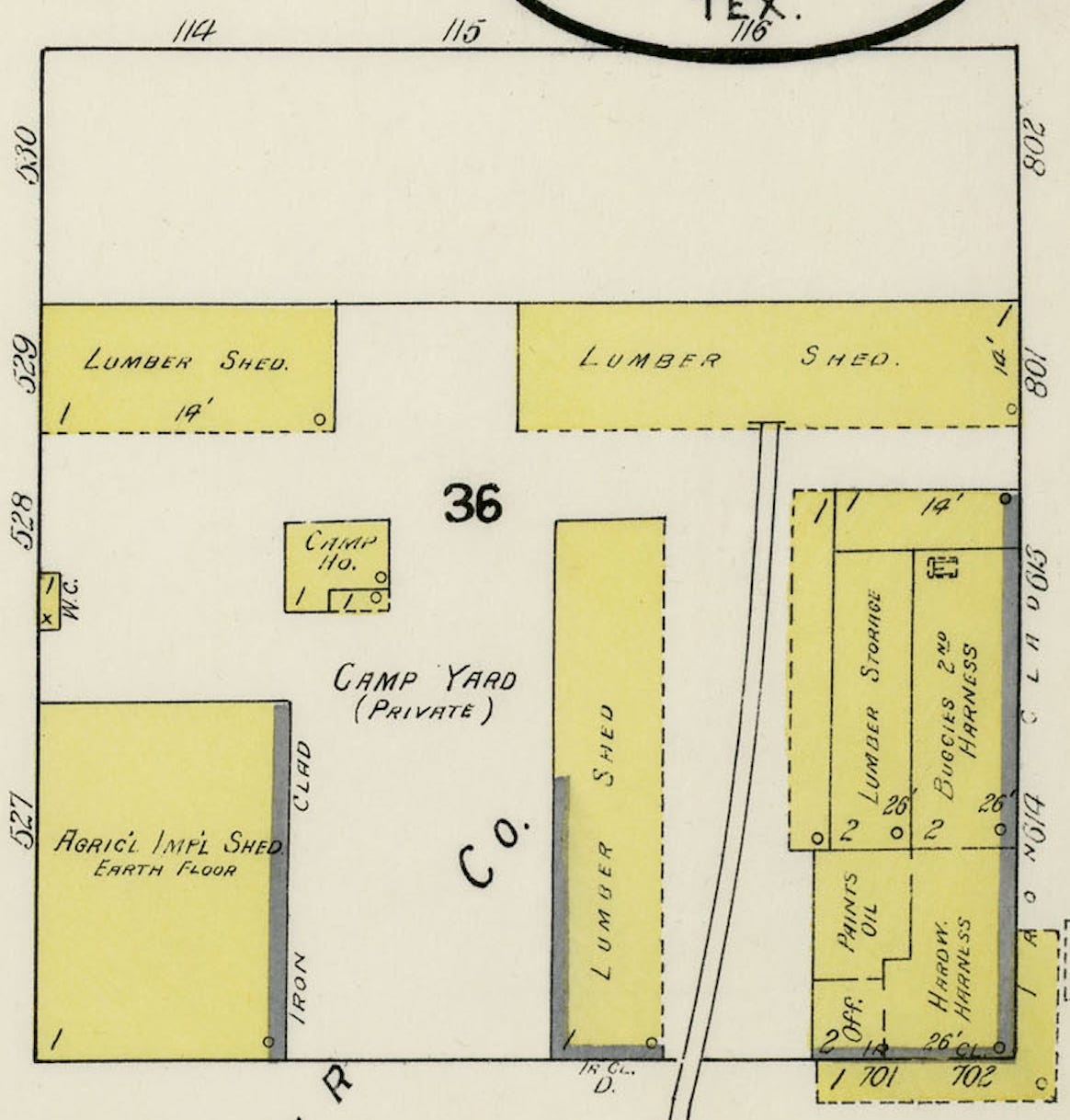
The Sanborn surveyors came back in February 1910, eleven months after the fire, and drew the new yard. New lumber sheds ran across the north side again. The office was back on its corner at San Gabriel. The buggies were back upstairs, where the map says “Buggies 2nd,” over the harness room. The northeast corner, where the Beck cottage had stood, was empty. The one real change was the planing mill, which Belford didn’t rebuild on Block 36. He moved it across the street to a block of its own, southwest of the yard, where the map notes “No Fire Apps. No Lights,” the surveyor's shorthand for a building with no fire apparatus of its own and no lighting, so no one worked there after dark.
The fires kept coming
A lumber yard that also sells grain is going to burn more than once, and this one did.
On a Friday night in April 1914, the yard’s night watchman was making his rounds about 8:30 when he found fire in the back of a storeroom on the south side of San Gabriel Street. It had started “in a pile of ear corn in the husk and was probably caused by rats.” The firemen had it out in a few minutes, and the loss was about $100. So now there was a watchman; the 1905 Sanborn, pictured above, had noted under the planing mill that the yard had none.
The next one was worse. About 11:00 on the night of December 2, 1915, the company’s grain, sash, and door warehouse south of 7th Street, “filled with oats and corn, doors and sashes,” went up and “made a terrific fire.” The firemen held it to that one building, in freezing weather, with “the splashing water at a freezing temperature,” and the paper said “the boys never flinched.” The loss was about $6,000, covered by insurance. The Sun gave part of the credit to something that hadn’t existed in 1909: “the present management of the water works deserve credit for having such fine pressure. In the old days there would have been much greater destruction.” Six years earlier the old days had meant spliced garden hoses and wet bedspreads.
A corn warehouse across the street from the main building burned at noon on December 29, 1927. A warehouse full of hay belonging to the Georgetown Grain Company, in a building leased from Belford, burned on a Sunday night in January 1940.
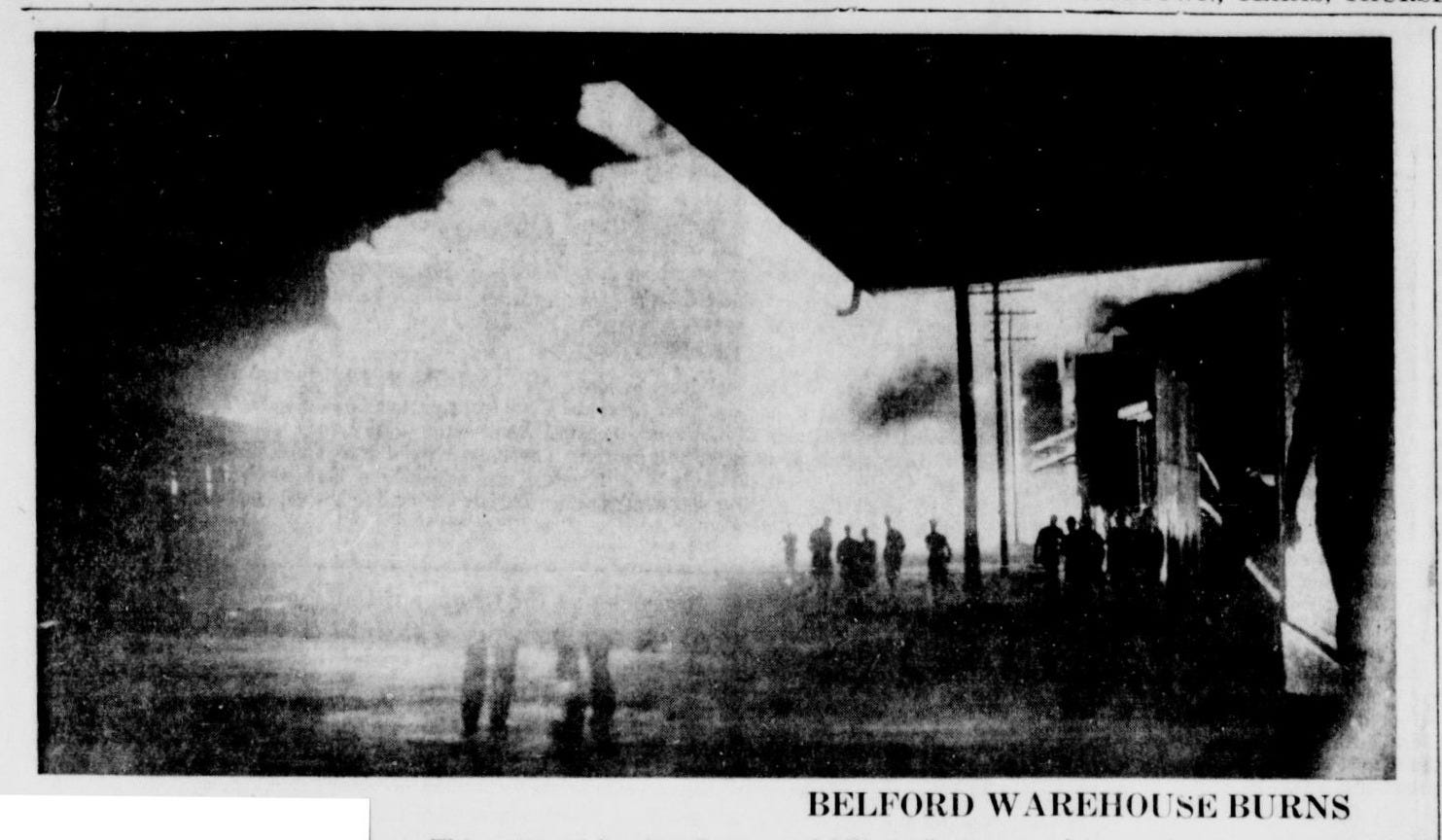
The last big one came in the early hours of Wednesday, May 23, 1962, when a Belford warehouse on 7th Street burned to the ground. This time there was a photograph. The Sun ran it on the front page under the headline “Belford Warehouse Burns,” a wall of flame and smoke with the firemen in silhouette along the bottom. The fire “cast an orange glow on low flying clouds, the glow visible for miles from Georgetown.” Volunteer firemen kept the flames “from leaping across the street into the old ice plant,” and the paper conceded that if they’d crossed, “all the Belford plant and other buildings on the whole block might well have been consumed.” Fifty-three years after Ernest Ischy and his neighbors held the ice factory, the volunteers were holding an ice plant across the street from the Belford yard.
The block the city almost bought
Less than a year after that fire, the City of Georgetown tried to buy the yard.
Rawleigh Elliott had been elected mayor in April 1962 on a write-in campaign, and his administration, as a former editor of the Sun later put it, “took its mandate to ‘Get Georgetown Going’ and rode that mandate hard.”
One of the things he wanted to get going was a new city hall, and he had his eye on the Belford property, two and a half blocks of it, one block west of the courthouse. On Monday night, April 8, 1963, the council voted 4 to 1 to let him negotiate with the Belford Lumber Company for the land, with a municipal center, a fire station and parking in mind. Councilman Edward L. Evans, who made the motion, said it “would be ideal either for a municipal center, a downtown parking lot, a city park or a number of other things.”
The one vote against came from Edgar P. Miles, and his reason was blunt: “I’m not against a new city hall. I just hate to see it located in a part of town that has been dead for 50 years.” He didn't mean the lumber yard, which had been still selling lumber recently. He meant the street it sat on. The blocks between the square and the tracks had been the town's front door when visitors arrived by train, and they had likely been fading since the automobile made the depot a place most people drove past. By 1963 the yard was the last of the old businesses still working there, and its owners were ready to sell. The Commercial Hotel had burned in 1930, 21 years after the firemen saved it. The Austin reporter who covered the vote called the neighborhood "run down," and ten years later Hamilton Wright would list the hotel, the depot, the ice factory and the Belford office among the landmarks that were gone.
Fred Belford, the founder’s son and the company’s president, agreed to sell for $22,500. Then the deal came apart. It turned out the company didn’t own all the land it had offered. The Georgetown Railroad Company owned “a good size portion” of the ground the council thought it was buying, and the resolution on the minutes didn’t describe the property or say who was authorized to sign. By the time the council met again on April 29, a group of businessmen had organized against the site, and the Austin paper’s reporter heard the objections in the room: a “run down” neighborhood, an area that needed “a lot of urban renewal,” and, from an insurance man named Sam Brady, “throwing money down a rat hole.” Two councilmen, Kennie Wilcox and A. W. Hoyt, changed their votes, and the purchase failed 3 to 2. The city attorney tendered his resignation the next day.
The Sun’s editor, Don Scarbrough, wrote that week that he’d “wager a cup of coffee that the Belford property, rejected this week at $25,000, can’t be bought for twice that sum five years from now.” Ten years later, Elliott said his “biggest disappointment” as mayor was that the city never bought the Belford property. By 1976 Scarbrough figured the bare land at $150,000 to $200,000.
A. W. Hoyt, one of the two who had switched, called the paper to defend the vote. “We now have a good city hall, a fire station and several hundred thousand dollars on the tax roll that we would not have had if the city had bought it,” he said. “Private enterprise bought the property, cleaned it up, built buildings and added to the tax roll.” Scarbrough agreed that it had worked out, named the buyers as “Jim Rehler and cohorts,” and then pointed out that the city hall and fire station it had built instead were already too small.
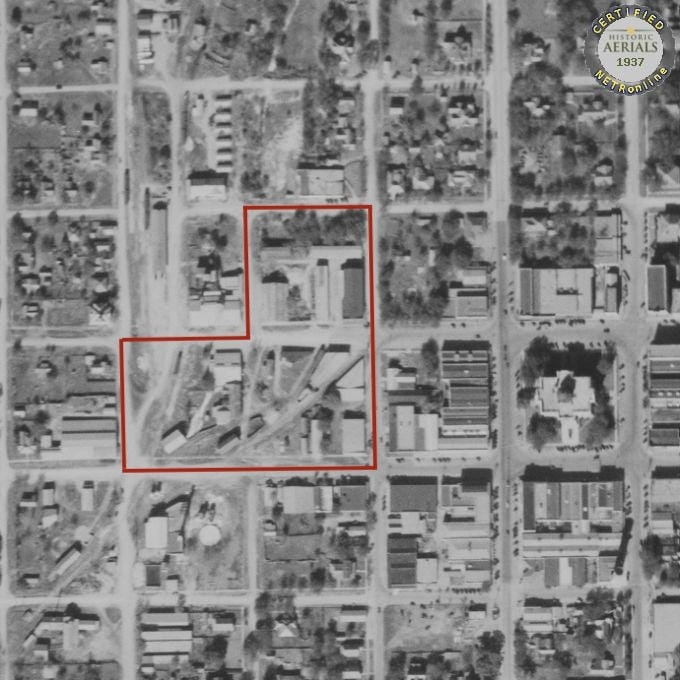
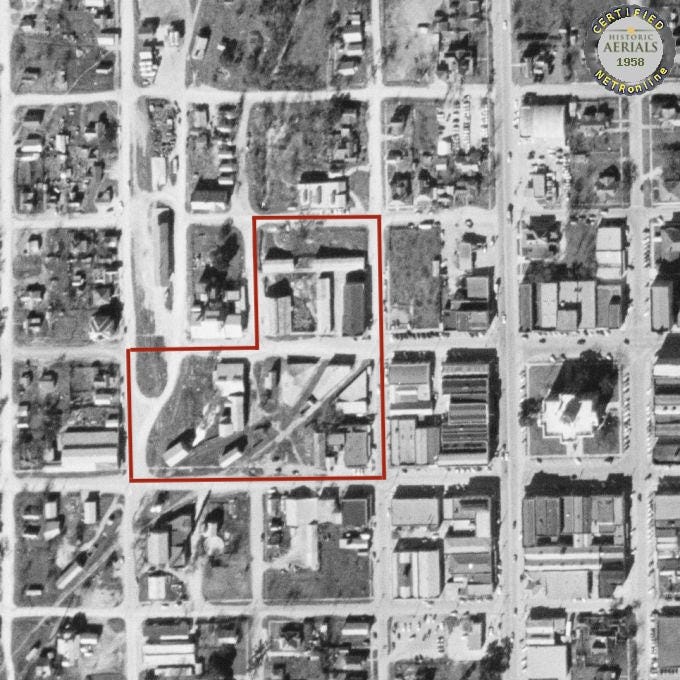
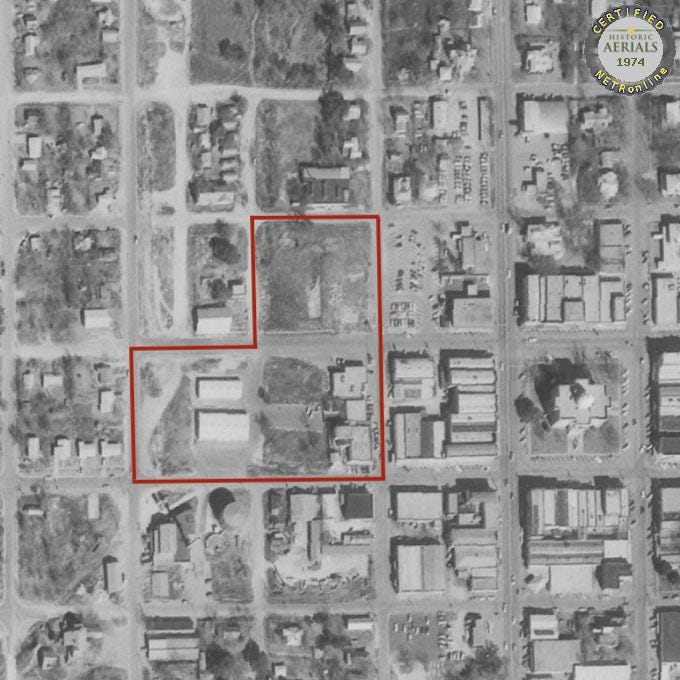
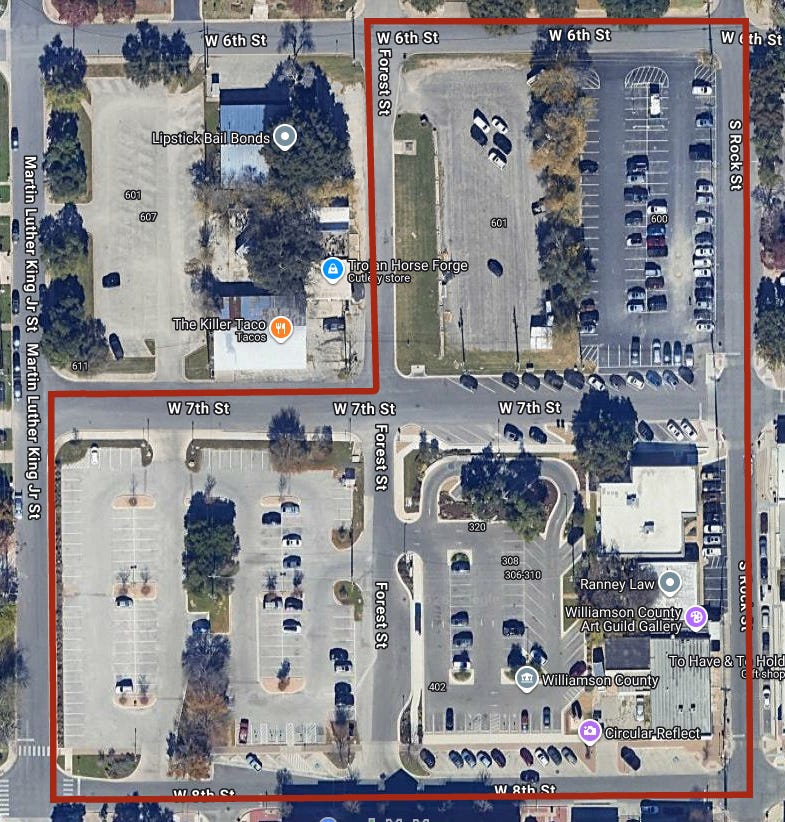
Today the ground the city passed up for a city hall and a parking lot is mostly parking, with the Sheriff’s Office across 6th Street to the north and the public library across 8th to the south. The county and the city got there in the end, on the neighboring blocks.
Gone
Hamilton Wright grew up in Georgetown in the 1890s, delivering Western Union telegrams from the depot at the foot of that street. I introduced you to him in A Well Known Citizen of Georgetown. Many of the telegrams went to guests at the Commercial Hotel, “some to Belford’s and others to the ice plant.” He remembered “lumber being unloaded by hand from rail cars and wagons loading lumber and carpenters hammering or sawing in the Belford yards,” and his schoolmate Fred Belford helping out at the office.
In February 1973, writing for the Sun at 87, he took stock of what was left on that one street between the square and the tracks. “Gone are the once famous favorite Commercial Hotel, the Belford Lumber Co office, the I&GN Railway Depot, and the original ice-factory between them.” The tracks themselves, he added, were “now torn up and junked.” The hotel, the office, the depot and the ice plant had all fit “in the space of two or three normal blocks,” and he blamed their disappearance on “fire, modernization and other accidents of change.”
On the night of March 11, 1909, the town turned out at midnight and fought for that street. The hotel and the ice plant came through, and Belford had his yard back before the ashes cooled. What the fire couldn’t take, time did. The hotel burned in 1930, and the office, the depot and the ice plant went the slower way Wright described, by modernization and the other accidents of change. Nobody rang a bell for those; the town let them go.
Sources
The Williamson County Sun
“Belford Lumber Yard Burned,” 11 March 1909, p. 3.
“Fire Department Meeting,” 18 March 1909, p. 4.
“Echoes of the Fire,” 18 March 1909, p. 8.
T. C. Gahagan, “Fire Department’s Thanks,” 18 March 1909, p. 10.
Local item on the foundation of M. F. Smith’s residence, 1 April 1909, p. 5.
“Belford Lumber Co.,” Booster Edition, 7 October 1909.
“The Commercial Hotel: Georgetown’s Leading Hotel for 22 Years,” 19 March 1914, p. 17.
“Slight Fire Friday Night,” 16 April 1914, p. 5.
“Costly Fire Occurred Last Thursday Night,” 9 December 1915, p. 2.
“Belford Warehouse Fire,” 30 December 1927, p. 3.
“Pioneer Citizen and Builder Died Monday,” 22 February 1929, p. 1.
“Warehouse Destroyed By Fire Here Sunday,” 2 February 1940, p. 1.
“Belford Warehouse Burns” (photograph and caption), 24 May 1962, p. 1.
“Council Authorizes Purchase Of Land,” 11 April 1963, pp. 1–2.
“McClain Explains His Position In City Controversy,” 16 May 1963, p. 10.
Hamilton Wright, “Familiar Georgetown landmarks disappearing,” 1 February 1973, p. 16.
John W. Cardwell, “Elliott’s administration ‘turned Georgetown around,’” 28 June 1973, sec. 3, p. 5.
Don Scarbrough, “The Passing Glance,” 23 September 1976, p. 1.
Don Scarbrough, “The Passing Glance,” Sunday Sun, 10 October 1976, p. 1.
Other newspapers
“Department Doings,” Austin Daily Statesman, 5 February 1892, p. 3.
“Terrific Explosion,” Austin Daily Statesman, 27 June 1897, p. 1.
“The Nook,” Austin Daily Statesman, 13 August 1899, pp. 12 and 4.
“Blaze Destroys Georgetown Hotel,” Austin American-Statesman, 23 April 1930, p. 2.
“George Irvine, Aged Pioneer of Georgetown, Dies,” The Austin American, 20 July 1936, p. 1.
“Georgetown Municipal Center Snags,” The Austin American, 17 April 1963, p. 19.
Wray Weddell Jr., “Council Split Over Center,” The Austin American, 30 April 1963, pp. 1 and 5.
“Belford’s Last Rites Held Today,” Austin American-Statesman, 28 August 1968, p. 23.
Maps and aerial photographs
Sanborn Map Company, Georgetown, Williamson Co., Texas, November 1905, sheets 2 and 3; February 1910, sheet 2. Dolph Briscoe Center for American History, University of Texas at Austin.
Aerial photographs of Georgetown, 1937, 1958 and 1974. Historic Aerials, NETR Online.
Other sources
Clara Stearns Scarbrough, Land of Good Water: Takachue Pouetsu, A Williamson County, Texas, History (Georgetown: Williamson County Sun Publishers, 1973), p. 318.
Belford Historic District, National Register of Historic Places Inventory–Nomination Form, 1986.
Dan K. Utley, ed., Sentimental Journey: A Guide to Preserving the Architectural Heritage of Georgetown, Texas (Georgetown: Georgetown Heritage Society, 1988), p. 48 (C. S. Belford portrait and sketch).
Belford Lumber Company account book, M. F. Smith residence, 24 February–22 December 1909. Photocopy in private hands.
Old Town Echoes is independently researched using primary historical sources. AI tools assist in drafting and editing; all content is reviewed, sourced, and verified by the author.