


In my last post, I introduced you to Mittie Pennington Ischy, the woman who lost her husband on the bridge and who might just be haunting my home on Austin Ave.
Today I want to share more of the story of Mittie’s life before she arrived at this house.
In genealogy, a death always presents the possibility of a probate file, and probate files can be absolute goldmines of genealogical detail. I decided to dig up Joe Ischy’s probate files to learn more about Mittie. A deep dive into those files unearthed a surprising detail: PJ Ischy was the owner of several properties when he died, and one of them was the old Dimmitt homestead.

The Dimmitt Homestead
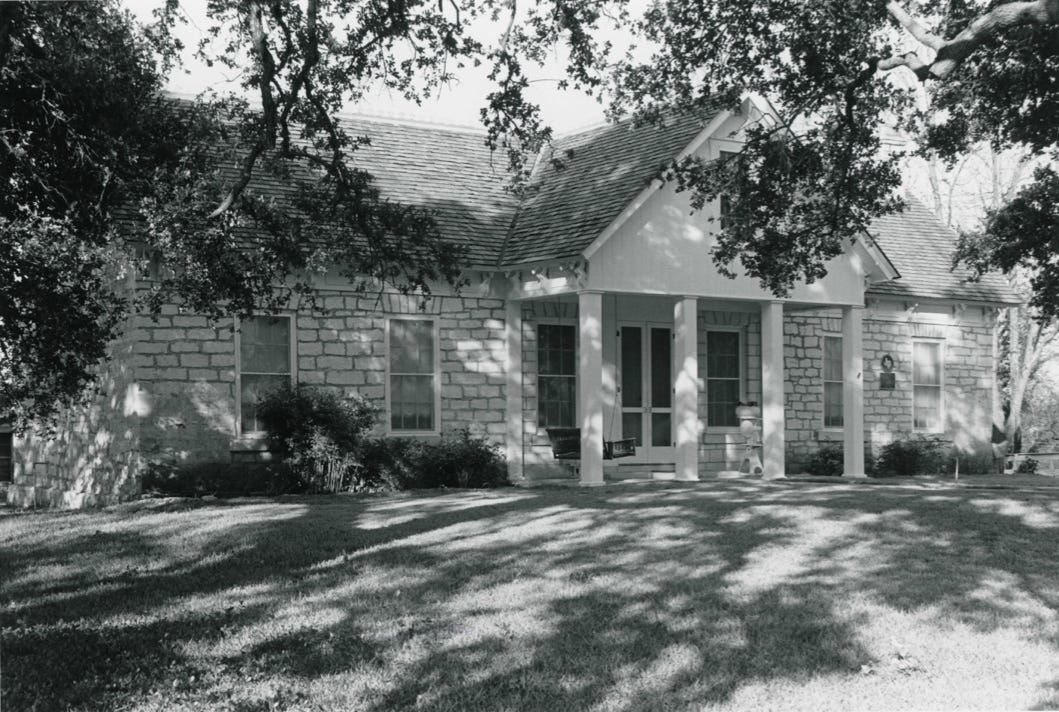
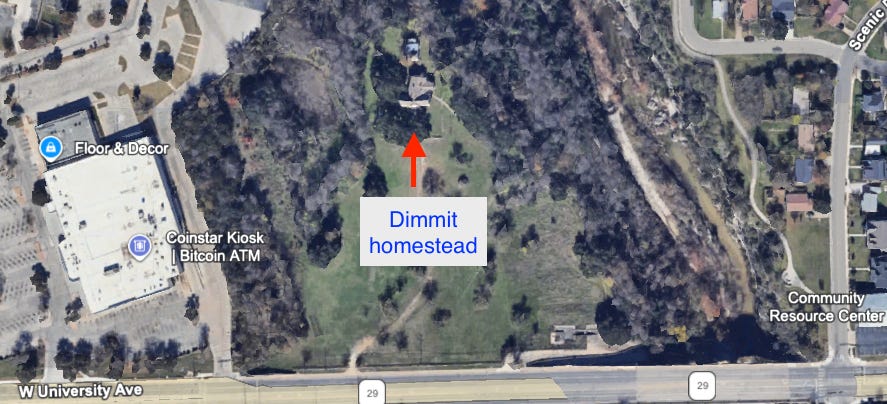
The Dimmitt homestead is one of Georgetown’s oldest surviving structures, built in 1866 by JJ Dimmitt on roughly 25 acres just west of town on the west bank of the South San Gabriel River. If you’ve spent time in the Historic Georgetown Texas Facebook group, you’ve probably seen it discussed. It’s a recognized landmark, and its history with the Dimmitt family has been the subject of recent community interest and research.
The Williamson County history page for the Dimmitt homestead states that after JJ Dimmitt died in 1884, his wife Margaret retained title until 1917, when she sold it to “Miff J. Ischy.” It then skips ahead to 1947, when Dr. R.W. and Jean Gamble acquired the house and surrounding land.
But here’s the thing… The buyer’s name wasn't Miff, the sale didn’t happen in 1917, and the jump from “Miff J. Ischy” to the Gambles erases over 30 years of the Ischy family’s connection to the property.
The woman who held the Dimmitt homestead for nearly thirty years after her husband died is reduced in the historical record to a misspelled name and a wrong date.
Thankfully, the probate and deed records give us her story.
Paul Joseph Ischy purchased the old Dimmitt homestead from Mrs. ML Dimmitt on May 3, 1909.
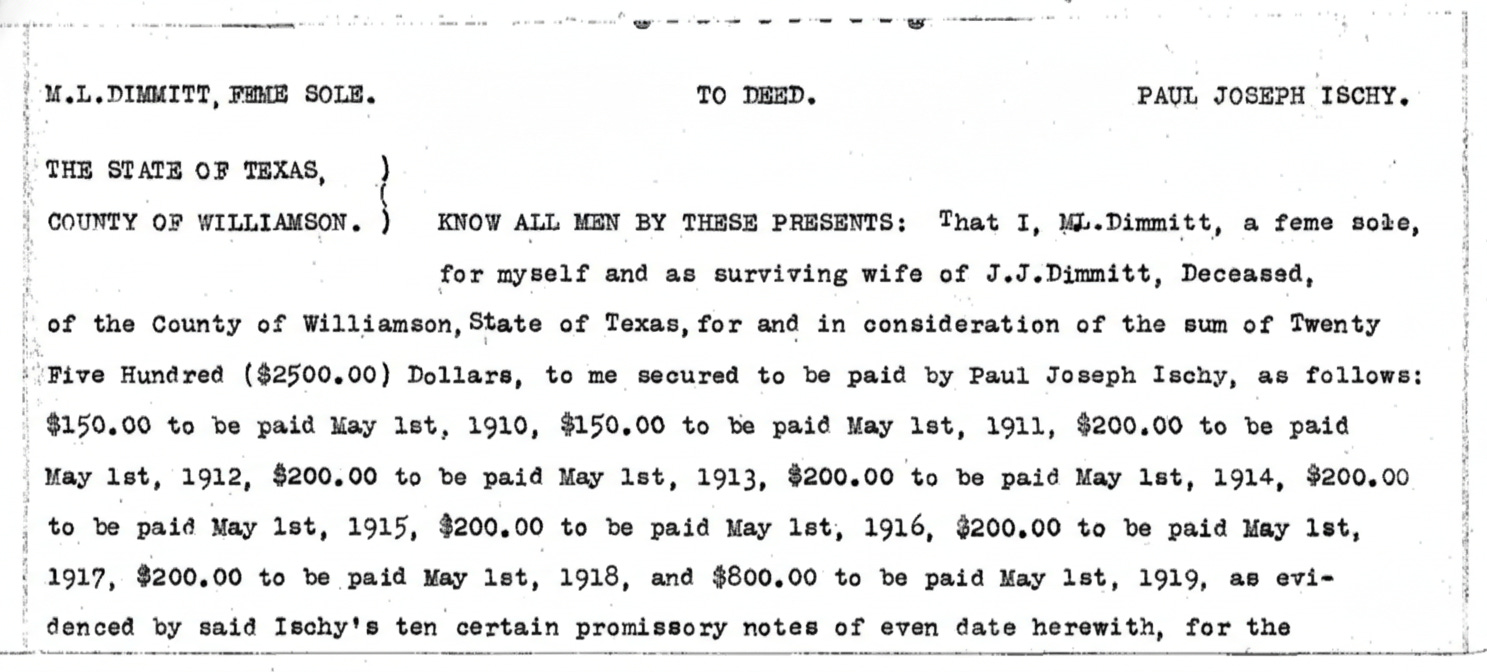
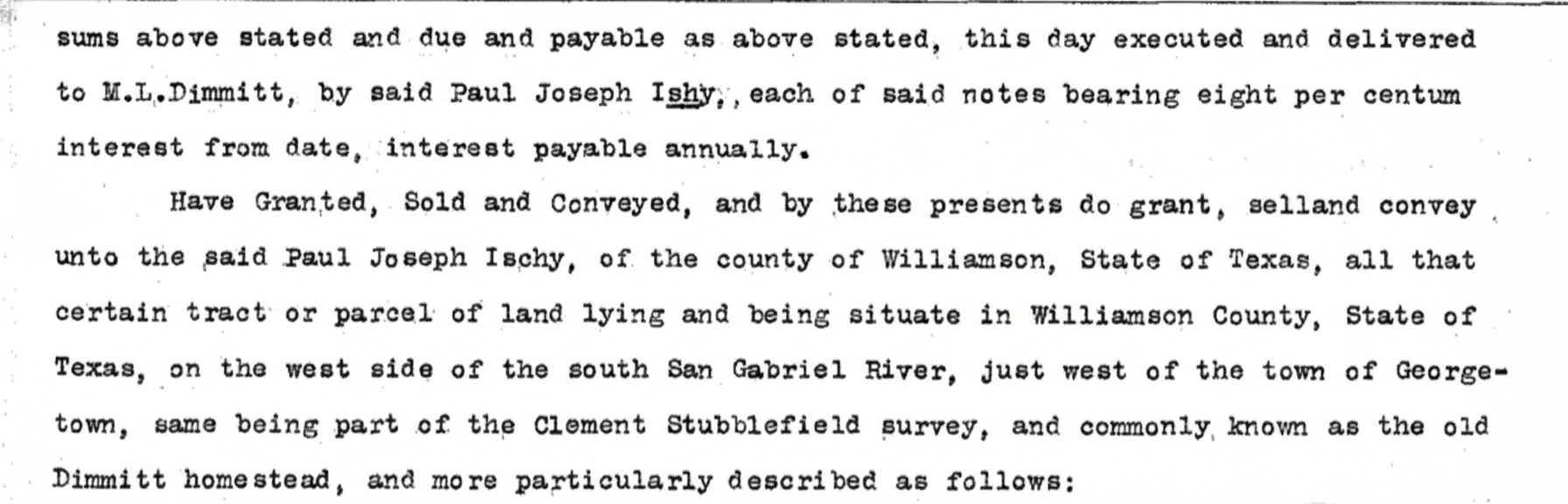
Joe didn’t pay cash. He executed a series of ten promissory notes to Margaret Dimmitt. Margaret retained a vendor’s lien on the property until every note was paid in full.
A vendor’s lien was the early twentieth-century equivalent of seller financing; the seller, not a bank, held the debt. The total purchase price was $2,500, payable in annual installments through 1919. It was a manageable plan… on paper.
It doesn’t seem to have gone according to plan.
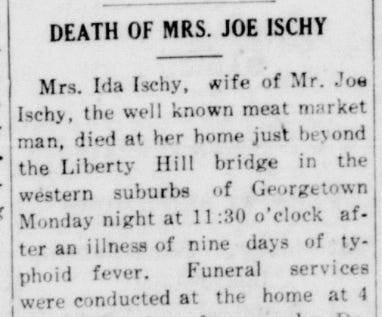
Joe moved his family to the Dimmitt homestead after purchasing the property. The 1910 US census suggests they were already on the homestead. In 1913, Joe's first wife died. Her death notice confirms they were living on the old Dimmitt homestead based on the description of their home.
Two years after Ida’s death, three-year-old Irene Ischy died of diphtheria. By the time Joe married Mittie in June of 1916, he was a widower with three surviving children, a sizable debt on the family home, and significant financial strain.
According to deed records, he had only managed to pay off two of the ten notes, totaling $300, by 1917. The remaining eight, representing $2200 in principal plus years of accrued interest at eight percent, were still outstanding.
Something had to change.
The Ides of March?
What happened next took place in March of 1917, and the coordination of it tells its own story; it doesn’t seem to have been a series of coincidences. It must have been a plan.
On March 7, 1917, Joe and Mittie together transferred a vendor’s lien note from the Pennington family involving 78.5 acres in the John Berry league to B.W. Bullock. The vendor’s lien note represented Mittie’s share of her father’s homestead. Essentially, Mittie sold the debt to Bullock in order to turn a paper asset into a liquid asset.
On March 26, 1917, Joe signed an extension agreement with Margaret Dimmitt. In this document, he acknowledged that Notes 1 and 2 had been fully paid and discharged but that the remaining eight notes were still outstanding. Margaret agreed to extend the payment deadline to on or before January 1, 1925.
On March 27, 1917, one day later, Margaret Dimmitt transferred those same eight outstanding vendor’s lien notes to Mittie E. Ischy for the sum of $2200 cash in hand. The deed states, in language that matters enormously under Texas law, that Mittie paid this sum “out of her separate property and estate.”
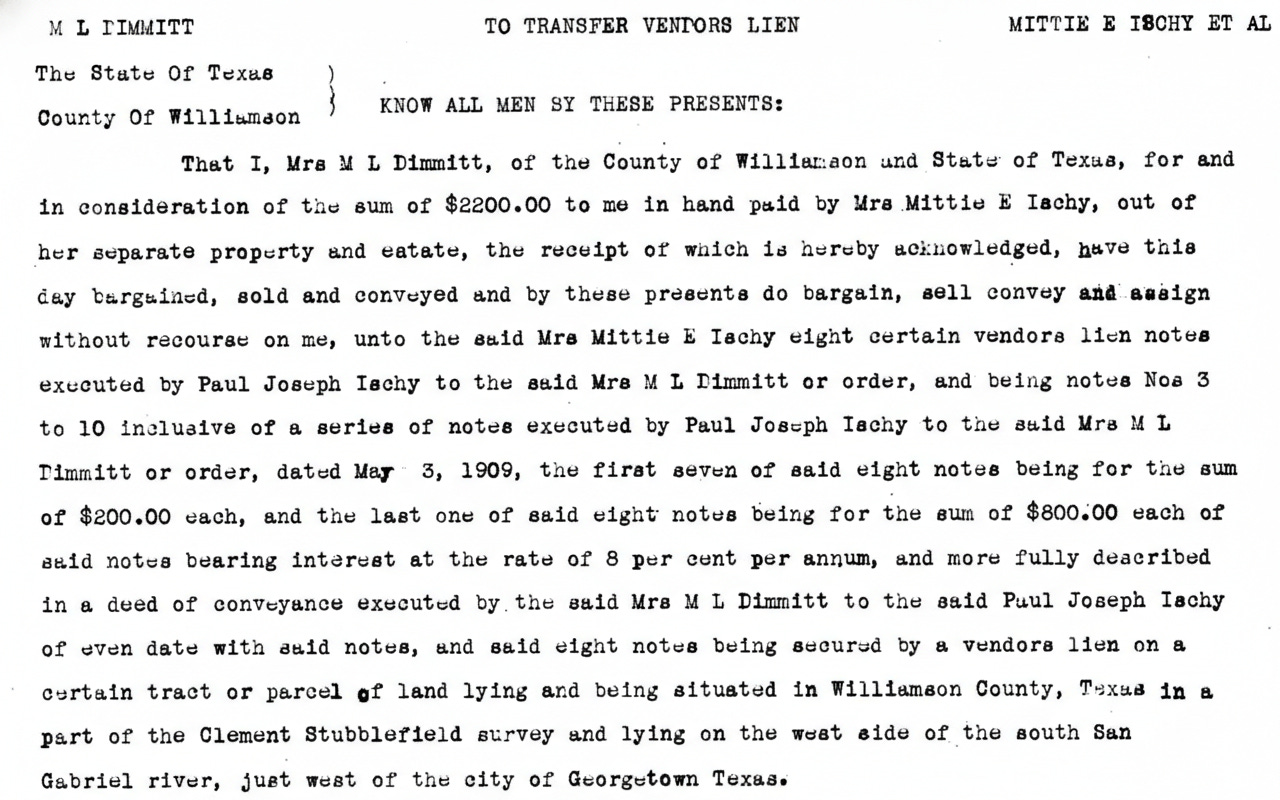
On March 28, 1917, all three documents were filed for record in the Williamson County courthouse at virtually the same time: the original 1909 deed of conveyance (which had never been recorded in the eight years Joe had been living on the property), the extension agreement, and the transfer of notes to Mittie. The original deed and extension were filed at 11am. The note transfer was filed at 5pm the same day.
Here’s what the March activity accomplished… Joe’s creditor, Margaret Dimmitt, was paid off and removed from the picture. Joe received a generous extension on his debt, now owed to his own wife. Mittie, by purchasing the notes with her separate funds, ensured that the debt belonged to her personally, not to the marital community. Under Texas community property law, this distinction was critical. As Joe’s second wife with no biological children in the marriage, Mittie occupied a legally precarious position. If Joe died without a will, Texas intestacy law (that law that dictates who inherits an estate when there’s no will) would not just hand her everything. His children from his first marriage had inheritance rights, too. By holding the notes as her separate property, Mittie had secured a claim against the estate that a probate court could not set aside.
Whether this was foresight, financial prudence, or something else, the records don’t say. However, six months after this carefully orchestrated restructuring, Joe Ischy was dead.
What did Joe know?
Joe knew Mittie had cashed out her claim on her father’s lands, so he knew she had the money. Did he ask her to pay off his debt to Margaret Dimmitt and save their home? Was that his plan? If so, the last document filed that day tells a different story.
Mittie didn’t pay off Joe’s debt. She purchased it. The question of whether Joe understood that distinction, whether he knew that his wife now held a secured claim against his property rather than having simply cleared his obligation, is one the records don’t answer.
What happened that evening on the bridge?
The Williamson County Sun and the Taylor Daily Press both reported Joe’s death, and their accounts differ in interesting ways.
The Sun’s account, dated September 27, 1917, reported the accident this way:
About 8 o’clock yesterday evening the entire community was shocked by the news that Mr. Joe Ischy had been killed when his auto ran off the new South Gabriel bridge. Inquiry revealed its truth and the circumstances. Mr. Ischy was returning to his home which is on the west bank of the South Gabriel, just at the western end of the new bridge. He had reached within about twenty feet of the last span of the bridge. His wife and daughter were on the front porch and had recognized his car. He was riding alone and was coming at a good gait. Suddenly his auto turned to the left and his startled wife and daughter saw it crash through the railing and plunge to the bottom of the stream. They rushed to him and found that he had fallen clear of the auto and was a few feet away. He was lying perfectly still on his face when his wife reached him. She raised his head and found that he was not breathing and endeavored to start respiration again by blowing in his face, but in vain.
The Taylor Daily Press account, published the following day, described it differently:
A frightful accident occurred last Wednesday night about 8 o'clock when the automobile driven by Mr. Joe Ischy, proprietor of the Ischy Meat Market, plunged off the bridge over the South Gabriel breaking the wooden railing and going down over the embankment about twenty-five feet, killing Mr. Ischy instantly. His neck, right arm and jaw bone were broken and he was otherwise injured. Death was instantaneous. Mrs. Ischy and the children, Misses Loise and Myrtle and Philip, were waiting for Mr. Ischy to arrive for supper from the market and heard the crash on the bridge, when the car went off the home being only about 150 yards from the structure. The car was demolished and his body crushed under it and physicians arrived after life was extinct.
The Sun says they were watching from the porch. The Taylor paper’s account says they only heard the crash. There are also two different versions of what Mittie saw when she reached Joe. The Sun says he had fallen clear of the auto and that Mittie raised his head and tried to revive him. The Taylor account says he was crushed underneath the car.
The Sun account is the only one that says the car suddenly turned to the left before driving off the bridge.
Why were the two accounts so different?
Neither account offers a cause for the swerve. Neither mentions mechanical failure, another vehicle, an obstruction in the road, or any other explanation. The car just turned to the left, and Joe went off the bridge. Joe’s death certificate lists his cause of death as an accident — “automobile fell off bridge.”
There’s another detail worth noting from the probate. In addition to several other life insurance policies, Joe carried an additional $2000 accidental death policy with the Southwestern Surety Insurance Company. When did Joe purchase this policy? The records don’t say. The company initially refused to pay without a court-appointed administrator. The policy eventually paid, but the refusal raises its own question: was it purely procedural, or did the company have reason to look more closely at the circumstances?
Where Was the Bridge?
A 1916 Sanborn fire insurance map of Georgetown shows a bridge crossing the South San Gabriel further north than the current University Avenue bridge, roughly at the 10th Street level. This location is considerably closer to the Dimmitt homestead than the current bridge (which is about 250 yards from the old Dimmitt place), and it aligns with the 150-yard estimate in the Taylor paper.
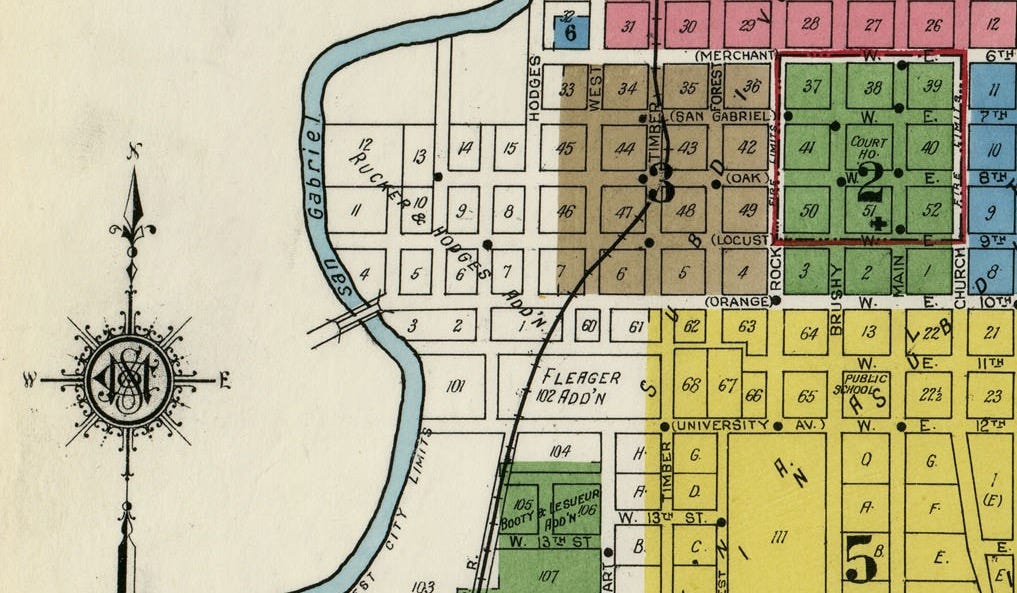
Satellite imagery of the area between the current bridge and the Dimmitt homestead reveals remnants of a bridge across the riverbed: stone or concrete structures consistent with old bridge abutments or pilings, with traces on both the east and west banks that suggest an old road alignment running roughly east-west across the river. These features fall in a line that corresponds to the Sanborn map’s bridge location. Additionally, the street that extends north from 10th is now Bridge St. Just like Railroad Ave now exists where the old rail line was in the above image, the name of Bridge St. is also telling us a story, if we’re paying attention.
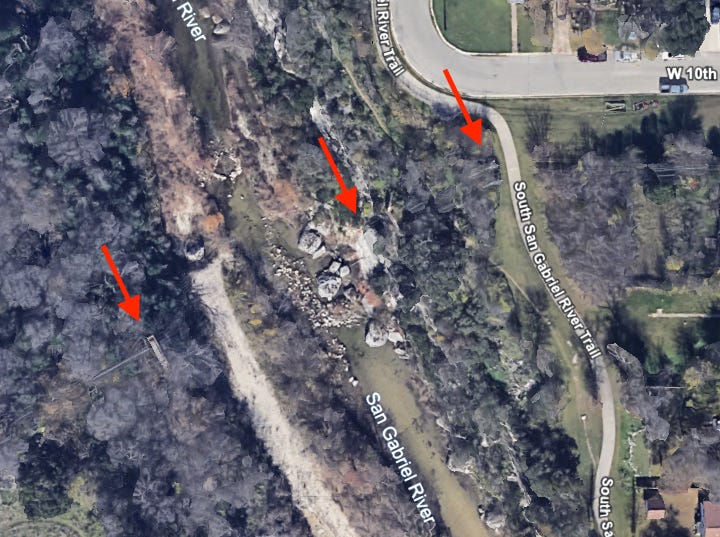
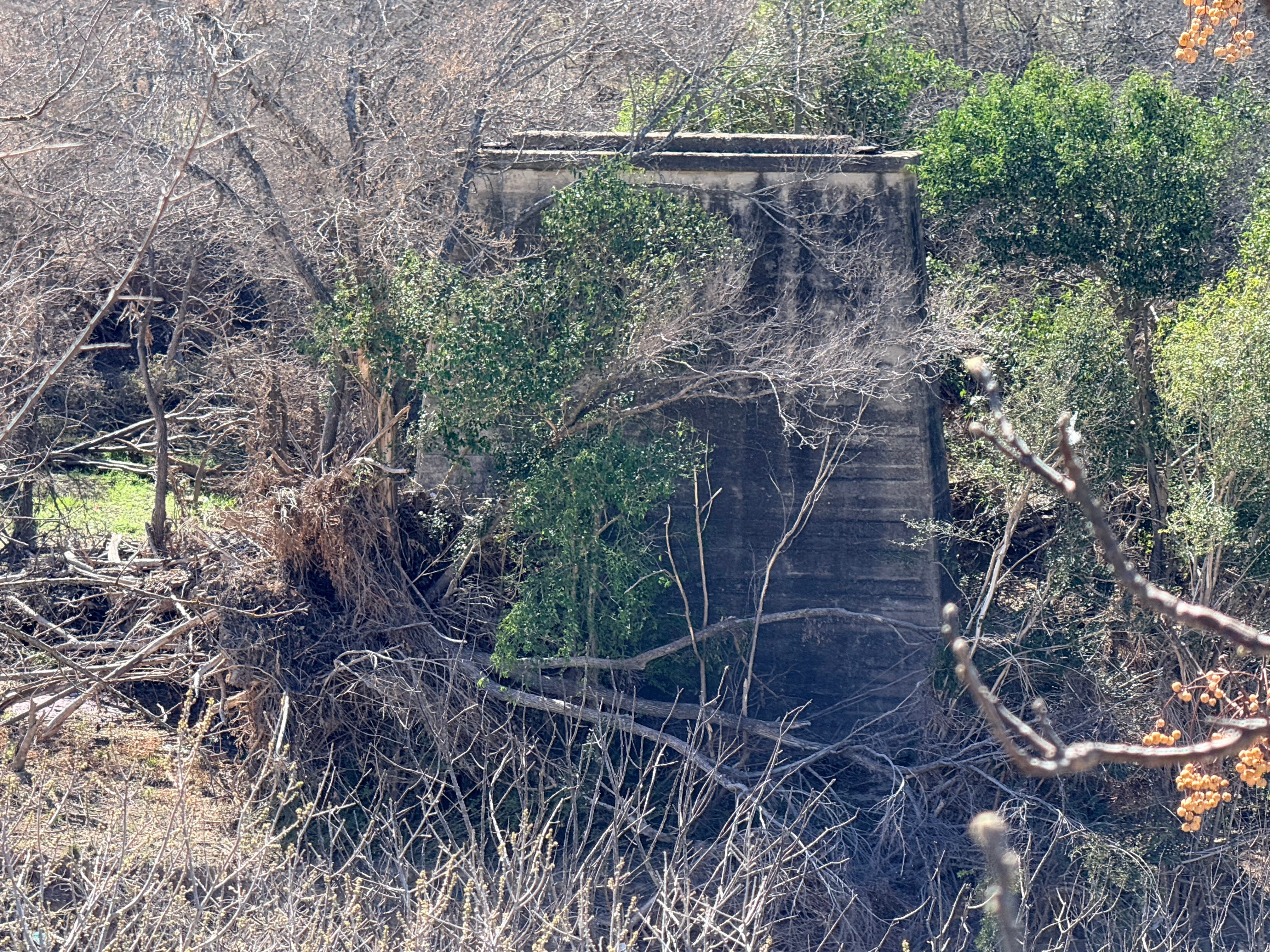
Joe was coming from the meat market in town. He was traveling westbound, crossing the bridge toward home. The Sun says his auto “turned to the left.” For a westbound driver, a left turn means south, across any oncoming traffic lane and off the opposite side of the bridge from his natural line of travel. If fatigue, distraction, or a mechanical failure caused the car to drift, the more natural direction would be to the right, off the near edge and toward his own side of the road. A leftward turn across the road is a different thing entirely.
I won’t presume to assign intent to a man who has been dead for more than a century based on the direction his car turned in its final seconds. However… The geometry of the accident is interesting. He went off the bridge away from the direction of his home, where his family was waiting and maybe even watching. Alongside the financial pressure, the accumulated losses, the accident insurance, and the coordinated legal transactions, it’s a thought-provoking set of events.
How was Joe’s estate untangled?
Joe died intestate. He left no will. Administration of his estate was opened as Cause No. 2078 in the Williamson County Court. The estate was described as being largely in debt.
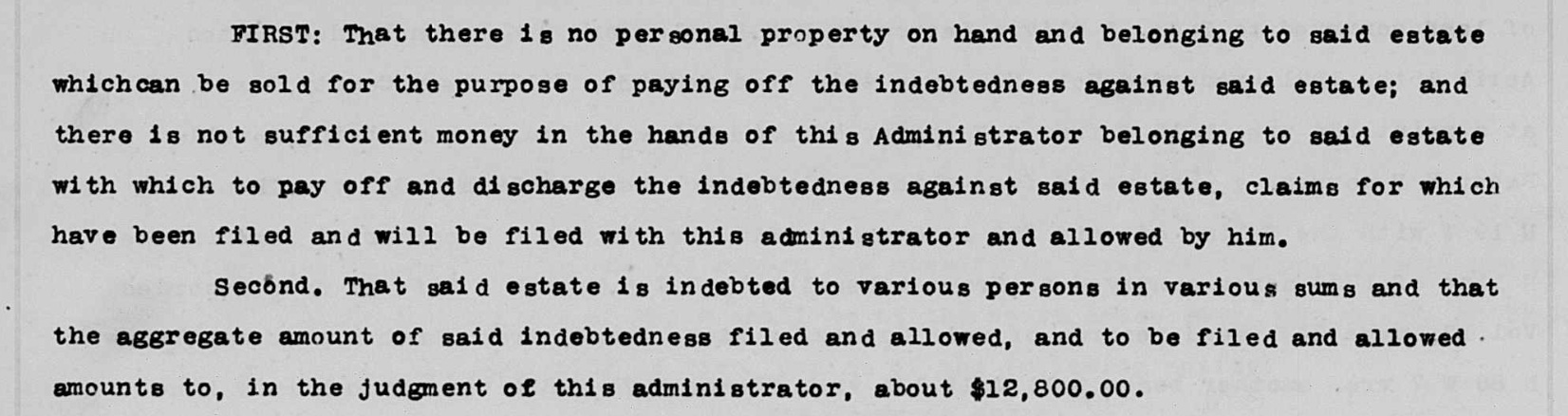
Because Mittie held the vendor’s lien notes that she purchased from Margaret Dimmitt as her separate property, the estate owed her the money, not Mrs. Dimmitt. On January 2, 1920, Joe’s estate sold the 25 acre Dimmitt homestead to Mittie for $2500. She didn’t pay cash; the purchase price was offset against what the estate already owed her on the notes. She traded the debt for clear title to the homestead.
The probate accounting tells its own story. The estate’s total receipts, or assets, came to $18,398.01. Its disbursements, including debts, costs, and expenses, totaled $17,166.11, leaving a balance of only $1,231.90. Interestingly, without the $2000 accident insurance payout, the estate would have been insolvent.
Did Mittie stay at the old Dimmitt homestead?
Records indicate that Mittie raised Joe’s children on the homestead where their father had died.

By 1930, the Ischy children were grown, married, and living elsewhere. The census finds Mittie still at the Dimmitt homestead, renting to the Thomas F. Guthrie household. Why is she listed as a lodger? Under 1930 census rules, when a homeowner rented out the majority of the house, the renter was listed as head and the owner as a lodger. Mittie still owned the place. She was just sharing it.


A 1936 Texas Power and Light easement confirms that a residence occupied by Mrs. Mittie Ischy stood on the Stubblefield Survey land.
By 1940, Mittie is again listed as owner and head of household. Residents listed as renting from her are her widowed sister, Flora Rader, Flora’s daughters Eunice and Ruth, and Ruth’s husband.

Mittie was still there. Still on the same porch, still within sight of the river, still 150 yards from the place where Joe’s car went through the railing.
In 1944, at the age of 66, Mittie finally sold the Dimmitt acreage and moved into town. She bought the Victorian cottage on South Austin Ave, the first owner since the Hodges family to actually live in it.
What the Record Misses
The Williamson County history page reduces Mittie to a misspelled name and a wrong date. “Miff J. Ischy” purchased the property in “1917.”
In fact, Paul Joseph Ischy purchased the property in 1909. His widow, Mittie Elizabeth Pennington Ischy, acquired clear title through probate in 1920 and held the land until 1944. That is not a minor correction; it’s the difference between a footnote and a life.
Here’s what I’ve learned over and over as a genealogist: women are often lost in historical records. We belonged to our fathers and then to our husbands. We lost our family names, which helped to sever the paper trail leading back to our roots. We often couldn’t own property unless we were widowed, and even that wasn’t always straightforward. Against those odds, Mittie held on to her birthright from her father and used it to secure her future, and, despite lingering questions that can likely never be answered, the bones of her story are there in the records for anyone willing to look. Still, she was almost forgotten.
I felt like that needed correcting; Mittie’s husband died just beyond her front porch, and she navigated his debts, raised his children, and held their land through the Depression and the Second World War before finally selling and walking away.
I have the probate and the deeds and the maps, but I still have more questions than answers swirling around in my head regarding the events of Mittie’s surprise marriage to Joe Ischy, the March financial transactions, and the accident on the bridge. But I also have a better picture of a woman named Mittie who carried all of it into a house on Austin Avenue, the house where I live now, where she stayed until she died.
If you read the last post, you know about this house: the bangs, the doors that rattle when no one is there, the objects that don’t always stay put. I’m still not saying I’m sure the ghost of 1604 Austin Avenue is Mittie Ischy…
But I do feel like I know her a little now. And maybe that’s enough.
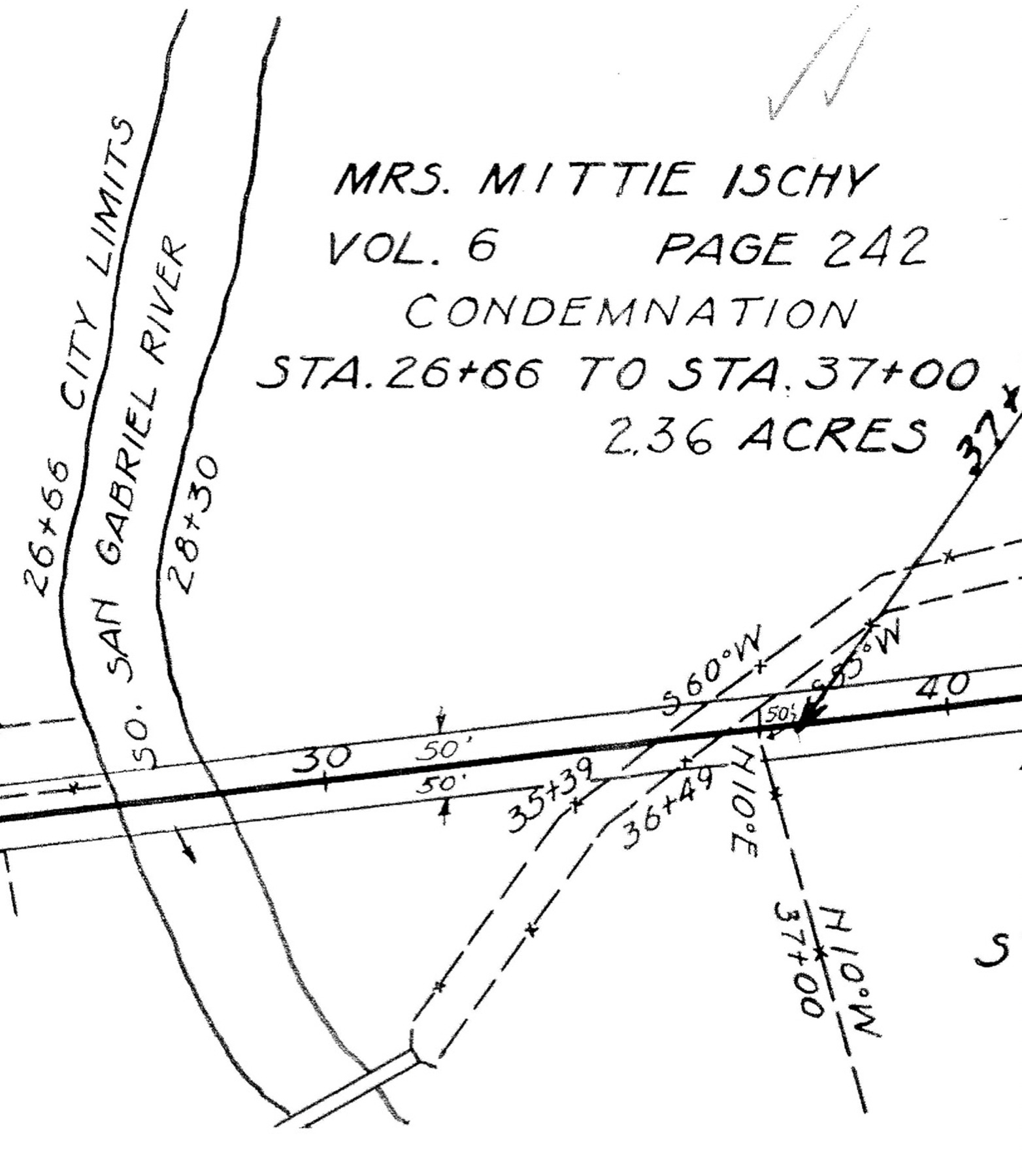
Update [19 March 2026]: Since publication, I discovered the existence of a Texas Department of Transportation right of way map for the Highway 29 corridor through Georgetown. The map documents the condemnation of 2.36 acres from the Dimmitt homestead property for the state highway right of way. The parcel is labeled "Mrs. Mittie Ischy" and references a condemnation proceeding recorded in Vol. 6, Page 242. The right of way runs along the South San Gabriel River, cutting through the same land where Mittie lived for nearly three decades. The road built on that condemned strip is the one you drive today when you cross the river on University Avenue. The map shows the old bridge.
Thanks for reading Old Town Echoes! Subscribe for free to receive new posts and support my work.
Sources & Research Notes
The Dimmitt Homestead
Williamson County, Texas, Deed Records, Vol. 179, p. 619; M.L. Dimmitt to Paul Joseph Ischy, 3 May 1909, recorded 28 March 1917; Williamson County Clerk’s Office, Georgetown, Texas.
Williamson County, Texas, Deed Records, Vol. 67, p. 868; extension of vendor’s lien, P.J. Ischy and M.L. Dimmitt, 26 March 1917, recorded 28 March 1917; Williamson County Clerk’s Office, Georgetown, Texas.
Williamson County, Texas, Deed Records, Vol. 180, p. 272; M.L. Dimmitt to Mittie E. Ischy, transfer of vendor’s lien notes, 27 March 1917, recorded 28 March 1917; Williamson County Clerk’s Office, Georgetown, Texas.
Williamson County, Texas, Deed Records, Book 179, p. 555; P.J. Ischy and Mittie E. Ischy to B.W. Bullock, transfer of vendor’s lien note (Pennington tract, John Berry League), 7 March 1917; Williamson County Clerk’s Office, Georgetown, Texas.
David Moore, “John J. Dimmitt House,” National Register of Historic Places Registration Form, Site No. 96000076, prepared for Hardy-Heck-Moore, Austin, Texas, July 1984, revised December 1995; digital image, Texas Historical Commission Atlas (https://atlas.thc.texas.gov/NR/pdfs/96000076/96000076.pdf : accessed 26 February 2026).
“John J. Dimmitt House, Williamson County, Texas,” Williamson County Texas History (https://williamsoncountytexashistory.org/john-j-dimmitt-house-williamson-county-texas/ : accessed 26 February 2026). This page states that Margaret Dimmitt sold the property to “Miff J. Ischy” in 1917. The name, the date, and the absence of any reference to Mittie Ischy or the probate transfer are the errors corrected in this article.
Source of Mittie’s Funds
Williamson County, Texas, Deed Records, Vol. 152, p. 197; Isabelle Pennington and Flora B. Rader to J.P. Pennington Jr., 11 December 1913; Williamson County Clerk’s Office, Georgetown, Texas.
Census Records
1910 U.S. census, Williamson County, Texas, population schedule, Justice Precinct 1, ED 115, sheet 16A, line 40, Joe Ischy household; digital image, Ancestry (https://www.ancestry.com : accessed 5 March 2026); citing NARA microfilm publication T624.
1920 U.S. census, Williamson County, Texas, population schedule, Justice Precinct 1, Georgetown, ED 150, sheet 30A, line 20, dwelling 277, family 279, Mrs. Mittie Ischy household; digital image, Ancestry.com (https://www.ancestry.com : accessed 5 March 2026); citing NARA microfilm publication T625.
1930 U.S. census, Williamson County, Texas, population schedule, Precinct 1, Georgetown and Liberty Hill Road, ED 246-5, supervisor’s district 24, sheet 12A, line 2, Mittie Ischy (lodger in Thomas F. Guthrie household); digital image, Ancestry.com (https://www.ancestry.com : accessed 5 March 2026); citing NARA microfilm publication T626.
1940 U.S. census, Williamson County, Texas, population schedule, ED 246-4, sheet 3B, line 46, house 41, Mittie Ischey household, North of South San Gabriel; digital image, Ancestry.com (https://www.ancestry.com : accessed 5 March 2026); citing NARA microfilm publication T627.
The Ischy Family
“Death of Mrs. Joe Ischy,” The Williamson County Sun (Georgetown, Texas), 3 July 1913, p. 7; digital image, Newspaper Archive (newspaperarchive.com : accessed 23 February 2026).
“Little Irene Ischy Dead,” The Williamson County Sun (Georgetown, Texas), 24 June 1915, p. 1; digital image, Newspaper Archive (newspaperarchive.com : accessed 26 February 2026).
Travis County, Texas, Marriage License No. 871, Paul Joseph Ischy and Mittie Elizabeth Pennington, 1 June 1916; marriage performed 4 June 1916 by W.A. Hamlett, Austin, Texas; returned and filed for record 17 June 1916; digital image, “Texas, U.S., Select County Marriage Records, 1837-1965,” Ancestry (ancestry.com : accessed 26 February 2026).
“Ischy-Pennington,” The Williamson County Sun (Georgetown, Texas), 15 June 1916; digital image, Newspaper Archive (newspaperarchive.com : accessed 26 February 2026).
Joe Ischy’s Death
“Auto Plunges from Bridge; Joe Ischy Killed Instantly,” The Williamson County Sun (Georgetown, Texas), 27 September 1917, p. 9; digital image, Newspaper Archive (newspaperarchive.com : accessed 20 February 2026).
“Joe Ischy Killed in Auto Accident,” Taylor Daily Press (Taylor, Texas), 28 September 1917, p. 1; digital image, Newspaper Archive (newspaperarchive.com : accessed 20 February 2026).
Texas Department of State Health Services, death certificate no. 26539 (1917), Joe Ischy; digital image, Ancestry.com (https://www.ancestry.com : accessed 24 February 2026).
Accident Insurance
Williamson County, Texas, County Court, Cause No. 2078, Estate of P.J. Ischy, Deceased; application for temporary administration, filed 8 October 1917; images, “Williamson, Texas, United States records,” FamilySearch (familysearch.org : accessed 22 February 2026); Image Group Number 005788505; Texas County Court (Williamson County).
Probate of P.J. Ischy’s Estate
Williamson County, Texas, County Court, Cause No. 2078, Estate of P.J. Ischy, Deceased; administration records, 1917-1920; images, “Williamson, Texas, United States records,” FamilySearch (familysearch.org : accessed 22 February 2026); Image Group Numbers 005788504 and 005788505; Texas County Court (Williamson County).
Bridge Location
Sanborn Map Company, Georgetown, Williamson County, Texas (New York: Sanborn Map Company, 1916); digital image, accessed via the Perry-Castaneda Library Map Collection, University of Texas at Austin.
Satellite imagery (Google Earth, accessed February 2026) shows features in the riverbed at this location that are consistent with remnants of old bridge abutments.
Mittie’s Later Years
Texas Power and Light Company easement, recorded 1936, Williamson County, Texas, Deed Records.
Williamson County, Texas, Deed Records; Mittie Ischy to Clark, sale of Dimmitt homestead acreage, 1944; Williamson County Clerk’s Office, Georgetown, Texas.
“Mrs. Mittie Ischy Dies Saturday; Rites Sunday,” The Williamson County Sun (Georgetown, Texas), 3 November 1966; digital image, Newspaper Archive (newspaperarchive.com : accessed 20 February 2026).
Old Town Echoes is independently researched using primary historical sources. AI tools assist in drafting and editing; all content is reviewed, sourced, and verified by the author.
Discovered your blog recently, and just love reading these stories! I love the rssearch you’ve done and how you turn it into an engaging and very human story! ❤️