


If you attended the Home Tour last December, you saw 1408 Olive Street, the Amos-Godbey House—the one with the massive gambrel roof that looks like nothing else in town. The tour book told the story of the house and its owners, and it mentioned that the man who built it, Professor Martin C. Amos, took his own life in the summer of 1911. What the tour book didn’t tell you, because a home tour isn’t the place for it, is the full story of how he got there.
This is that story.
The Professor
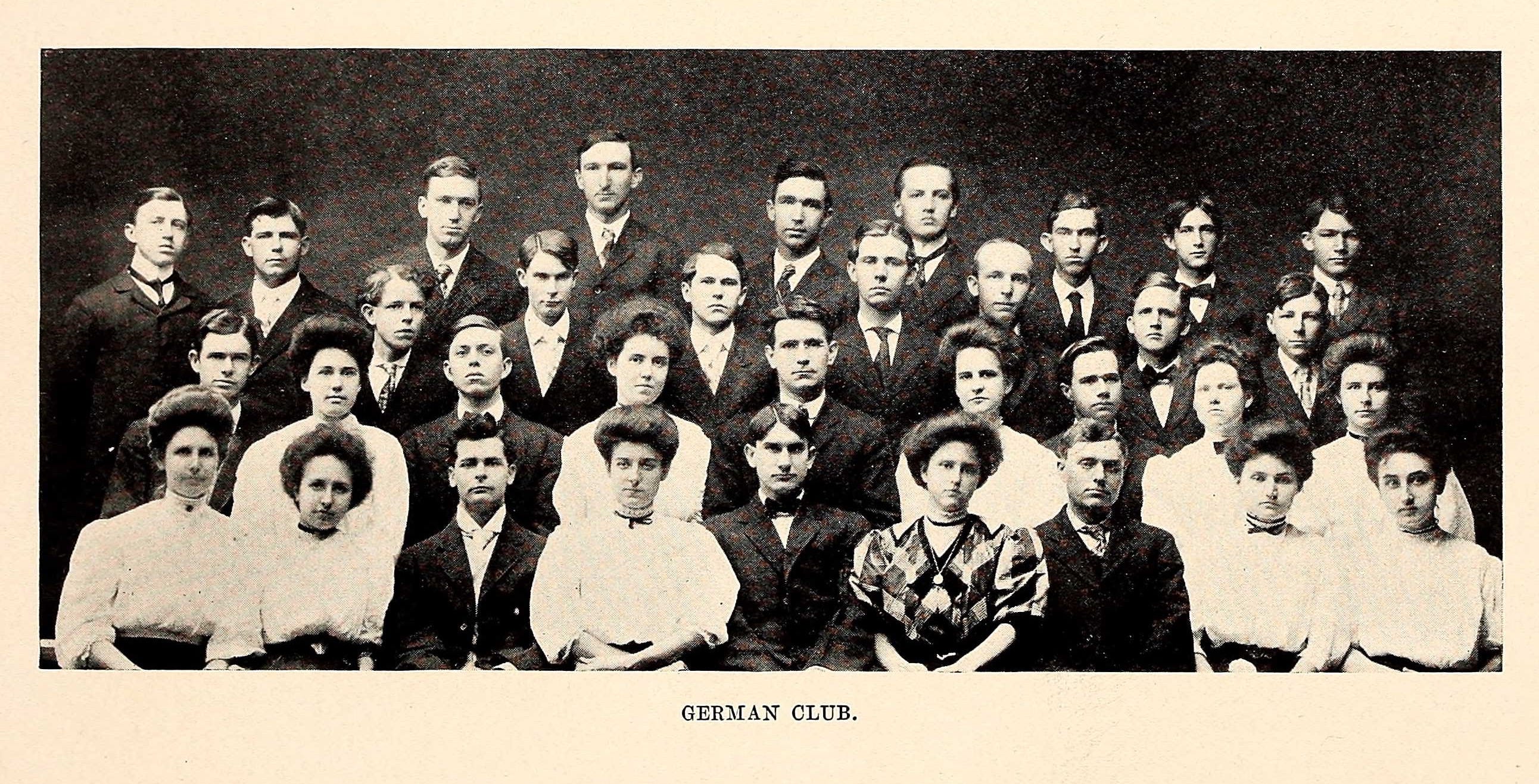
Martin C. Amos was born in Cologne, Germany, in 1879. He came to the United States as a young man and proved to be an exceptional student, graduating with honors from Butler College in Indianapolis before earning a graduate degree and fellowship at the University of Chicago, where he studied German language and literature. In 1905, Southwestern University elected him Chair of Germanic Languages. He was 26 years old.
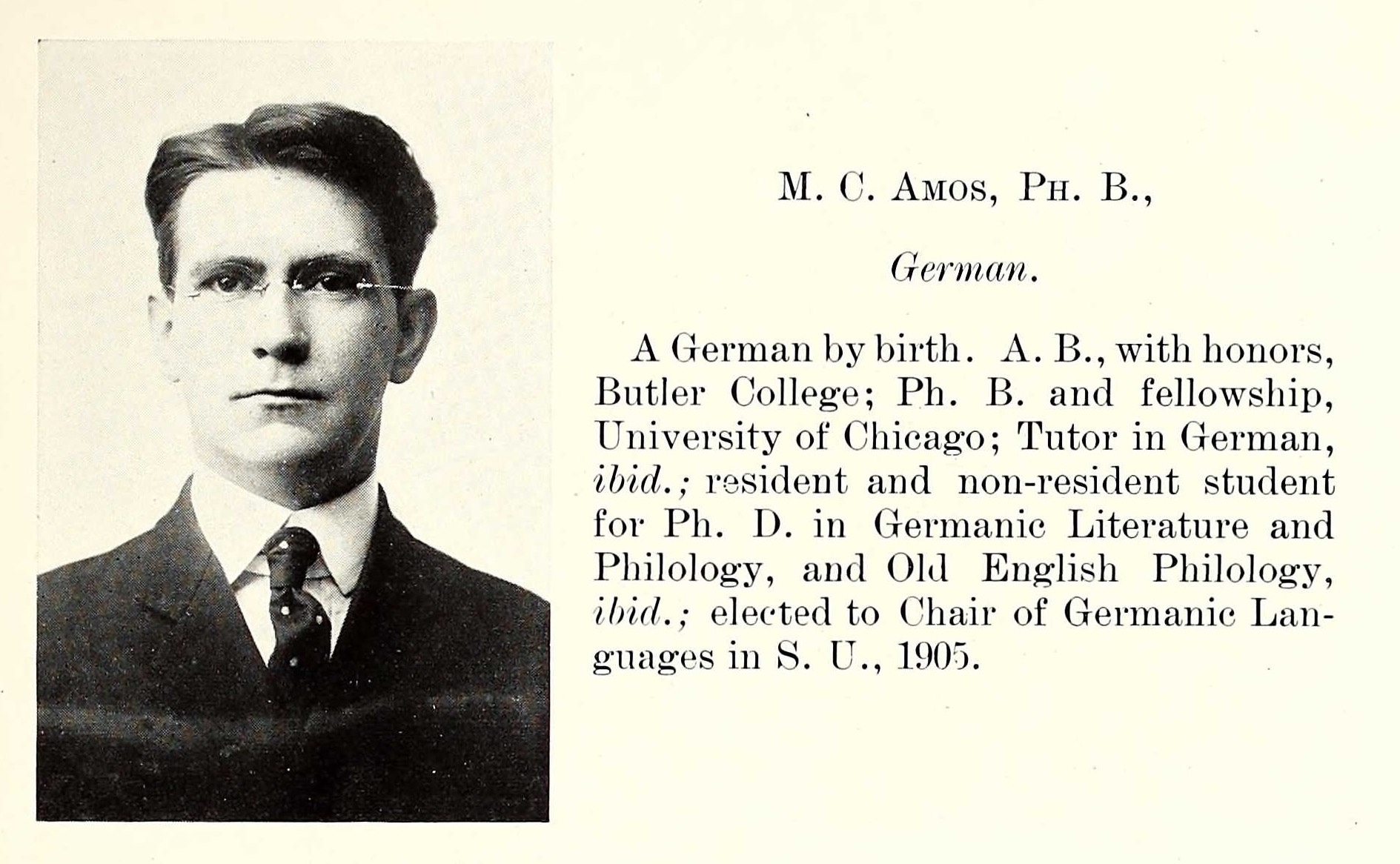
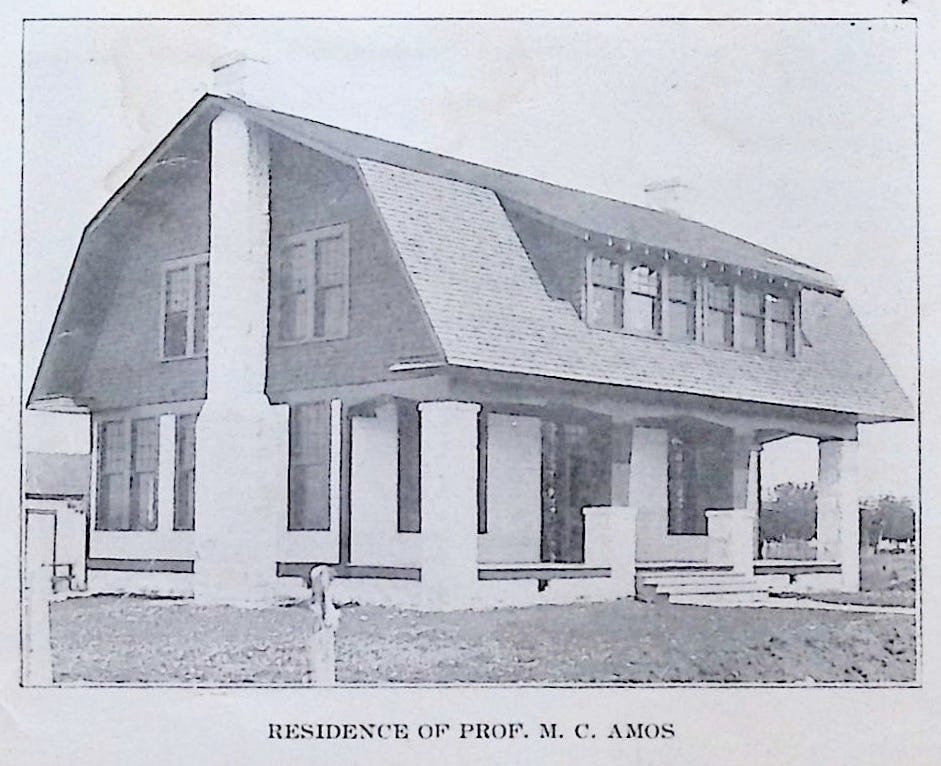
He married Mary Lewen Rutledge, whose family lived in Palestine, Anderson County, Texas. Their daughter Ruth was born in December of 1906. By the end of 1908, Amos had saved enough to purchase a lot on Olive Street and commission the C. S. Belford Lumber Company to build a home. The house that went up in 1909 was a two-story Shingle Style dwelling with a sweeping gambrel roof, stone chimneys, and a broad front porch. It appeared in the Georgetown Citizens Club book that same year, captioned simply “Residence of Prof. M. C. Amos.” He was 30 years old, with a prestigious academic post, a young family, and a brand-new home. Everything seemed to be falling into place.
The Fight for Southwestern
What happened next had nothing to do with Martin Amos and everything to do with him.
Southwestern University was Georgetown’s crown jewel, the oldest institution of higher learning in Texas, sponsored by the Methodist Episcopal Church South, and the economic and cultural engine of a small town. The university’s president, Dr. Robert S. Hyer, was a physicist of genuine distinction who had built one of the first X-ray machines in Texas and experimented with wireless telegraphy from campus. He had overseen major construction and enrollment growth during his tenure.
But by 1910, powerful voices within the Methodist church were questioning whether Georgetown was the right home for a major university. The push began with a letter from Hiram A. Boaz, president of Polytechnic College in Fort Worth, to Regent Hyer on March 7, 1910, proposing that Southwestern be relocated to Fort Worth. The idea soon shifted toward Dallas, where boosters dangled serious money. Dallas had reportedly been assured of $400,000 in cash and a forty-acre campus site if the university would come to them.
Georgetown fought back hard. Clara Scarbrough, in her history of the county, described it as a controversy that became a statewide affair. A committee of Georgetown citizens — including Lee J. Rountree, Mayor R. E. Ward, Dave Wilcox, Colonel W. K. Makemson, and C. S. Belford, the very lumberman who had built Amos’s house — traveled to Dallas to protest what they called the stealing of Southwestern University.
The Board of Trustees met in a long session in mid-June 1910, voting 21 to 13 to keep the school in Georgetown. But the vote didn’t end the argument. The controversy simmered and occasionally erupted for a year or more afterwards. Newspapers across Texas carried the debate. Methodist officials weighed in from all directions. The situation didn’t ease until 1911, when the Methodist church reaffirmed its commitment to Georgetown. Hyer resigned and moved to Dallas, where he became the first president of a brand-new institution: Southern Methodist University.
The university stayed. But by the time that was settled, it was too late for Martin Amos.
The Last Days
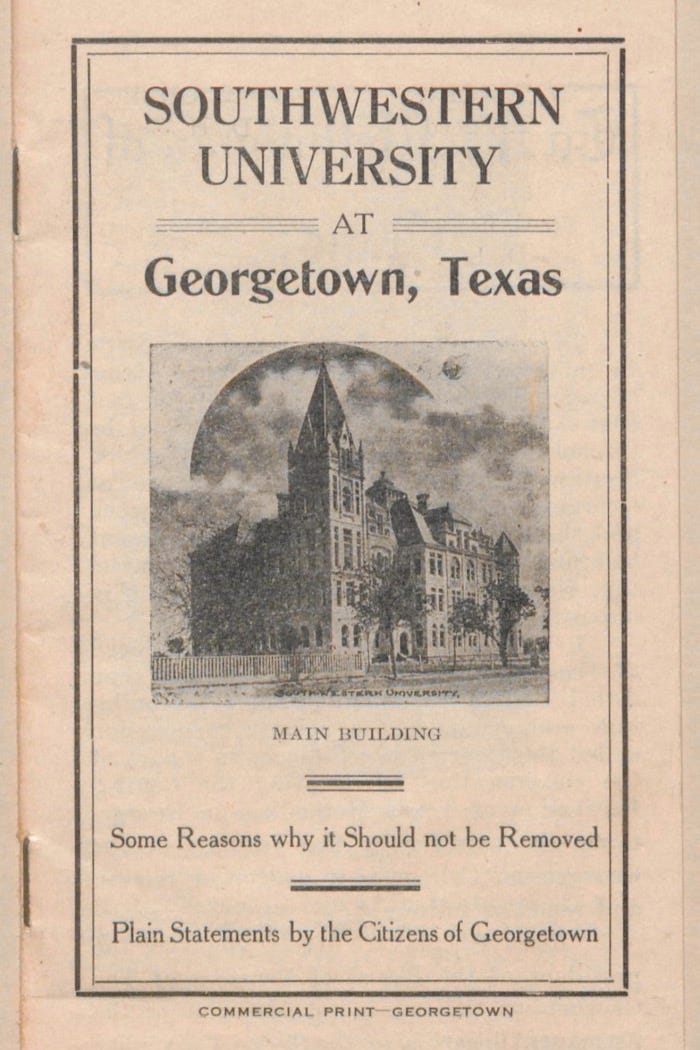
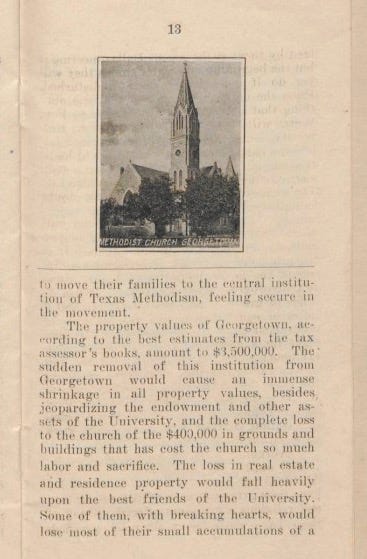
For a professor who had staked his family’s future on a new home he hadn’t finished paying for, the relocation crisis seemed existential. If Southwestern left Georgetown, his position would likely evaporate and his house, the biggest investment of his life, would be worth a fraction of what he owed on it. This was, in fact, one of the things they had warned about in the removal pamphlet authored by Booty, Lockett, and Gillett.
By the summer of 1911, Amos was unraveling. He grew despondent over the situation at Southwestern. On Monday, June 19, he confided in his summer school class that his worries had kept him from sleeping regularly. He told them he had slept only three hours in six days.
That night, he cashed a check for $50 from J. W. Long, telling Long that his child was sick and he was going to visit her at his wife’s family home in Palestine. It wasn’t true. Long subsequently learned that no such message had been received and that Amos’s child had not been reported ill.
Amos drove by car to Round Rock, where he caught the train to Palestine. He arrived at the home of his father-in-law, Ed Rutledge, on the morning of Tuesday, June 20, 1911.
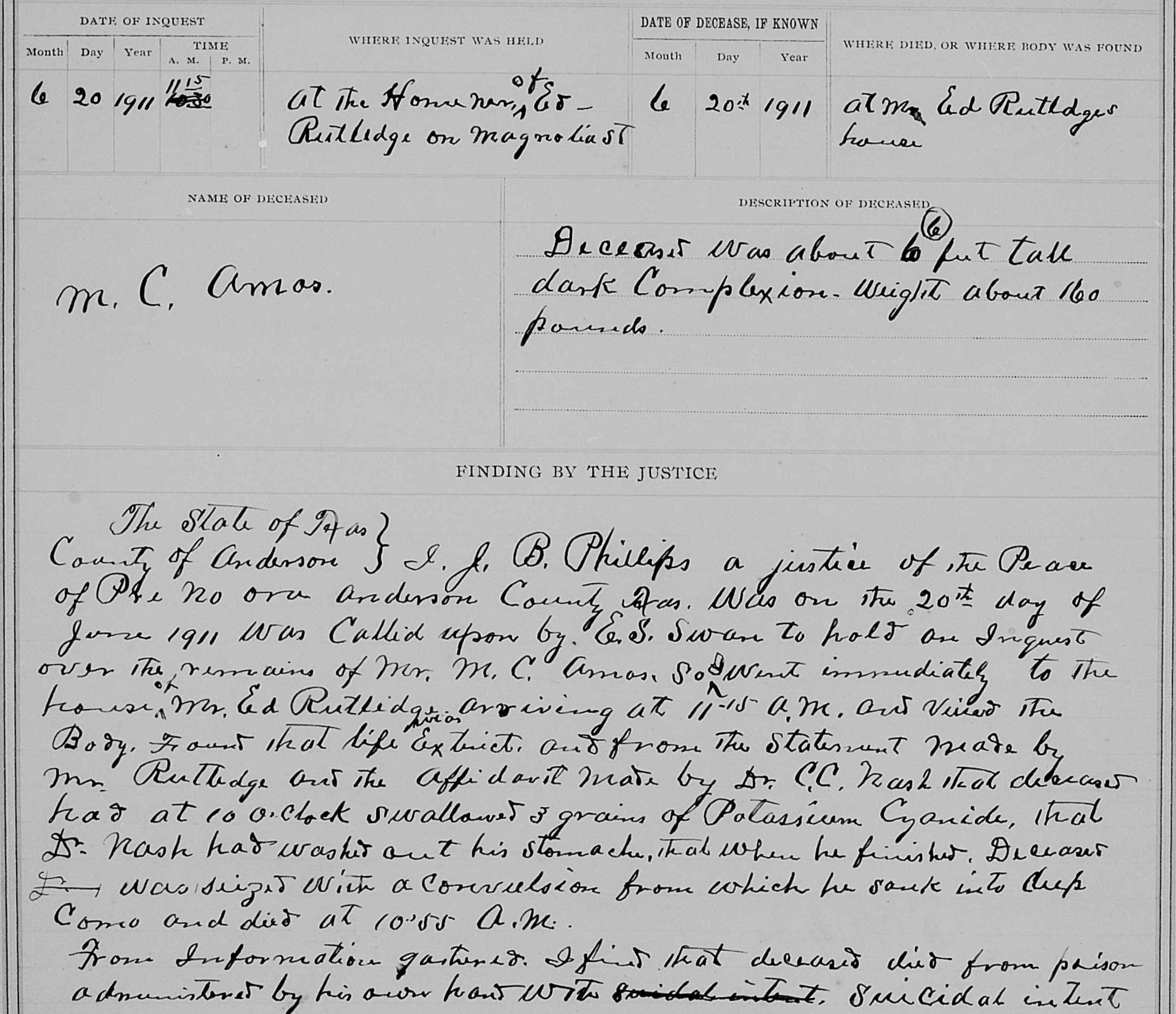
There, in the presence of his wife, Martin C. Amos ingested poison. The initial news dispatch reaching Georgetown reported strychnine, but later private information indicated cyanide of potassium was the substance used. The coroner’s inquest, conducted that same day by J. B. Phillips, Justice of the Peace for Anderson County, recorded that Phillips was called to the Rutledge home at about eleven o’clock that morning. He viewed the body and took statements from Mrs. Rutledge and the attending physician. The finding: Amos had taken the poison deliberately, gone into convulsions, and died at approximately 10:45 a.m. He was described as about six feet tall, dark complexion, weighing about 140 pounds. The justice ruled the death a suicide.
He was 32 years old.
The News Reaches Georgetown
Georgetown learned what had happened through a telegram. Mary Amos wired her friend Mrs. Weisser. The message was blunt: “Martin has killed himself. Come at once.”
Mrs. Weisser left on the first train for Palestine. Dr. C. C. Cody followed her that night.
The Williamson County Sun ran the story on June 22, 1911, under the headline “Suicide of Prof. Amos.” The Houston Post ran it the same day:

The San Antonio Express reported it under a starker headline: “Poison Kills a Professor.” The Palestine paper noted that Amos had formerly taught in the public schools there and had many friends in the city, and that his death had caused a profound sensation.
The Sun reported that while J. W. Long said he noticed nothing wrong and that Amos had been in ordinary good spirits, friends disagreed. They said he was subject to fits of despondency and had acted queerly for several days. The obituary attributed his death to the unsettled state of affairs at the university and his fear of losing both his job and his home, adding that these things and the great heat were believed to have unsettled his mind.
Amos’s funeral and burial were held in Palestine, at the home of Mr. and Mrs. Ed Rutledge, though he was a resident of Williamson County at the time of his death. The Palestine paper noted that his death would cause sorrow not only locally but across the state, given the wide acquaintance he had made as a professor of languages at Southwestern.
After
Martin Amos died without a will. Mary filed papers regarding his estate on January 23, 1912, in the Williamson County Court. The probate application, filed by the attorneys Wilcox & Graves, described the community estate between Mary and Martin and asked the court to appoint appraisers. The court granted community administration that same day.
Six days later, Mary sold the family home to S. E. Wilcox.
No death certificate for Martin Amos has ever been located. The coroner’s inquest above is the closest thing to an official record of his death.
The Amos Women
The 1988 Recorded Texas Historic Landmark application research noted that efforts had been made to discover what happened to Mrs. Amos and her daughter Ruth but that the records were not conclusive. However, the trail didn't stay cold forever. Time, and a few online databases, have filled in the gaps.
After selling the house, Mary took Ruth back to Palestine. In 1919, she filed for guardianship of Ruth’s estate in the Anderson County Court; Ruth, then 13, had inherited property near Palestine and a share of her grandfather’s estate in Indiana, together valued at $2,500. A month later, Mary married Charles A. Hoffman, and they had one daughter, Katherine, in 1920. Mary died in Houston in 1931. She was 49. She was buried in Palestine.
Ruth boarded at a school in Palestine, likely St. Mary’s Academy, and married Charles Cowper Clarke Jr. in Harris County in 1924. The Houston Post wedding notice identified her as the daughter of Mr. and Mrs. C. A. Hoffman. The couple settled in the San Marcos area, where their son, Charles Rutledge Clarke, was born in 1926. His birth certificate listed his mother’s birthplace as Georgetown.
Charles Cowper Clarke died in 1938, from injuries sustained in an accident in San Antonio on June 20, the same date Ruth’s father had died twenty-seven years earlier.
Ruth married again, this time to a Dewey Bruton, and had two daughters. She died in San Antonio in 1960 at the age of 53. She was buried at Roselawn Memorial Park. Her death certificate listed her father’s name as “Unknown.”
What Stayed
The house on Olive stayed. That’s the thing about houses… They outlast the people who build them, and they outlast the crises that sometimes undo those people. The gambrel roof that Martin Amos commissioned from C. S. Belford in 1909 is still the most distinctive roofline on Olive Street. The stone chimneys still stand at the gable ends. The porch columns still frame the front door.
After Amos, the house passed through a quick succession of owners — the Wilcoxes, the McDonalds, W. W. Jenkins — before finding its long-term steward in Dr. John C. Godbey, who bought it in 1925 and lived there for 43 years. The Stegers followed, restoring and protecting it for another 36 years and securing the Recorded Texas Historic Landmark designation in 1988.
The university stayed, too, of course. The fight that lead to the death of Martin Amos ended with the school exactly where it had always been. Hyer left for Dallas and built SMU. Georgetown kept Southwestern. The thing Amos seemed to have feared most, the loss of everything, never came to pass. By the time resolution arrived, though, he was already buried in Palestine.
Sources
Martin C. Amos — Biographical
“M. C. Amos, Ph. B.,” Southwestern University faculty listing, Southwestern University Yearbook (Georgetown, Texas), 1909.
“Residence of Prof. M. C. Amos,” Georgetown Citizens Club Book (Georgetown, Texas), 1911.
The Relocation Controversy
Clara Stearns Scarbrough, Land of Good Water: A Williamson County, Texas, History (Georgetown, Texas: Williamson County Sun Publishers, 1973), 249–250, 389.
Booty, A. A.; Lockett, M. B. & Gillett, E. G. Southwestern University at Georgetown, Texas: Some Reasons why it Should not be Removed., pamphlet, ca. 1909; Georgetown, TX (https://texashistory.unt.edu/ark:/67531/metapth802477/ : accessed March 21, 2026); University of North Texas Libraries, The Portal to Texas History; crediting Southwestern University.
Death of Martin Amos
“Suicide of Prof. Amos,” The Williamson County Sun (Georgetown, Texas), 22 June 1911, p. 17; digital image, NewspaperArchive.
“M. C. Amos Ended Life: No Cause Assigned for Rash Act of Georgetown Professor,” Houston Post (Houston, Texas), 20 June 1911, Newspapers.com.
“Poison Kills a Professor: M. C. Amos of Southwestern University Dies at Palestine,” San Antonio Express-News (San Antonio, Texas), 21 June 1911, p. 9; digital image, Newspapers.com.
“Palestine News Budget” [funeral notice for Prof. M. C. Amos], Houston Post (Houston, Texas), 22 June 1911, Newspapers.com.
Inquest on the body of M. C. Amos, 20 June 1911, J. B. Phillips, Justice of the Peace, Anderson County, Texas; in “Anderson, Texas, United States records,” images, FamilySearch (familysearch.org/ark:/61903/3:1:3Q9M-C3SX-895N-5), image 79 of 1085.
Probate — Williamson County
Application of Mary Amos, surviving wife of Martin C. Amos, deceased, for community administration; and Order granting community administration, No. 1737, 23 January 1912; County Court, Williamson County, Texas; in “Williamson, Texas, United States records,” images, FamilySearch (familysearch.org/ark:/61903/3:1:3QS7-L9XQ-XDJR), image 115 of 657.
Mary and Ruth Amos — After 1911
Application of Mary L. Amos for guardianship of Ruth Amos, minor, No. 2500; Appointment of guardian; Bond; Inventory and appraisement; and List of claims, October Term A.D. 1919; County Court, Anderson County, Texas; in “Anderson, Texas, United States records,” images, FamilySearch (familysearch.org/ark:/61903/3:1:3QS7-L9QS-KWC9), images 260–262 of 1668.
Mary Amos–Charles A. Hoffman marriage, 23 November 1919, Anderson County, Texas; in “Texas, U.S., Select County Marriage Records, 1837–1965,” Ancestry, document no. 8625.
Death certificate, Mrs. Mary Hoffman, 29 May 1931, Harris County, Texas; Texas State Department of Health, Bureau of Vital Statistics, Ancestry.
“Wedding” [Ruth Amos–C. Clark Jr.], Houston Post (Houston, Texas), 8 June 1924, p. 31, Newspapers.com.
Marriage license, Chas. Clark Jr. and Miss Ruth Amos, 4 June 1924, Harris County, Texas, Ancestry.
Birth certificate, Charles Rutledge Clarke, 23 July 1926, Hays County, Texas; Texas State Board of Health, Bureau of Vital Statistics, file no. 787, Ancestry.
Death certificate, Charles Cowper Clarke, 25 June 1938, Frio County, Texas; Texas Department of Health, Bureau of Vital Statistics, registrar’s no. 27724, Ancestry.
Death certificate, Ruth Bruton, 1 February 1960, Bexar County, Texas; Texas Department of Health, Bureau of Vital Statistics, state file no. 6934, Ancestry.
U.S. Federal Census, 1920, Anderson County, Texas, Palestine, ED 6, sheet 11A, line 31, Ruth Amos; digital image, Ancestry.
RTHL Application Research
“The Amos-Godbey House,” Recorded Texas Historic Landmark application research, Charles and Jodie Steger, ca. 1988; typescript pages consulted in project files.
Old Town Echoes is independently researched using primary historical sources.
AI tools assist in drafting and editing; all content is reviewed, sourced, and verified by the author.
Thanks for reading Old Town Echoes!
Subscribe for free to receive new posts and support my work.