


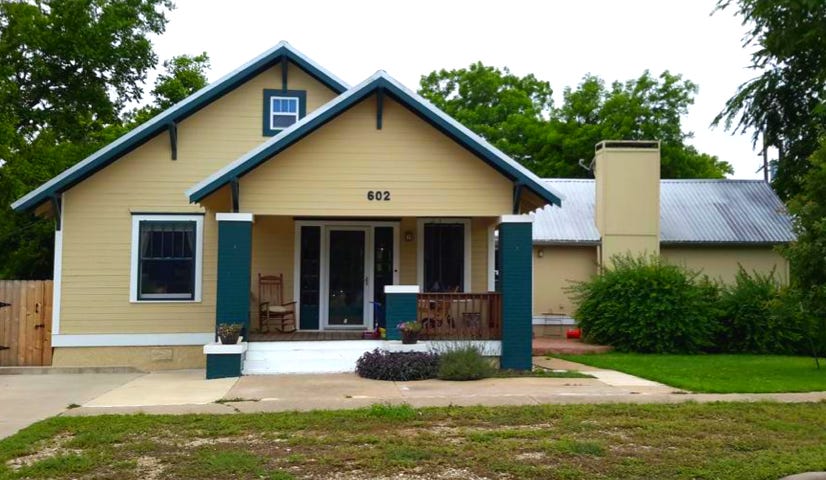
I found Hays Gee the way I find most people in Georgetown’s past: through a house. I was researching a historic plaque order for a home on College Street, working through the chain of title, when the name Hays C. Gee surfaced in the deed records. He and his wife Annie bought the lot in 1922 and built a house on it. They were a young couple putting down roots in Georgetown, and it looked like a straightforward house history.
Then I started researching Hays in the Williamson County Sun, and straightforward went out the window.
Hays Gee was arrested for murder just before his twentieth birthday. At twenty-one, he was acquitted. The same year, he enlisted in the U.S. Army under a false name and then deserted. None of this history was relevant to the house on College Street, but it was fascinating nonetheless.
The Gee Family
Hays’s father, C.H. Gee, a courthouse man, was a highly-regarded clerk and official in Caldwell before moving his family to Georgetown in 1889. The Sun once noted that “Charley Gee is a ‘born clerk.’ There isn’t a better one in Texas.” He served in various deputy roles for decades before being elected District Clerk in 1918, a position he held until his death.
C.H. married Mary Ella Rowland of Lexington in 1876. They had three children: two sons, Xenocles and Hays, and a daughter, Beatrice.
Hays Charles Gee was born on January 2, 1883, in Caldwell. He appeared on the Georgetown public school honor roll in 1891, where he was listed among the second graders.
By the fall of 1902, the family had left Georgetown. C.H. had purchased a hotel in Stroud, a small town in Oklahoma Territory. The Stroud Star announced the sale in September.
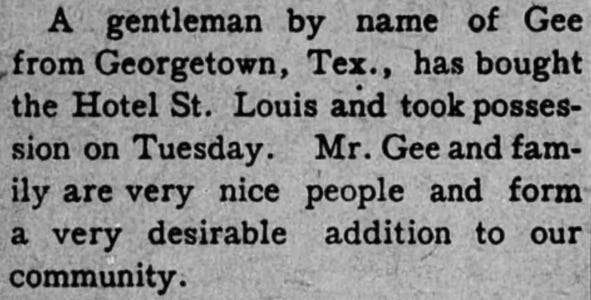
What happened next would follow the family for years.
The Hotel St. Louis
On December 1, 1902, a cattleman named S.R. Evans of Wagoner, Indian Territory, was shot and killed in the office of the Hotel St. Louis. Both C.H. and Hays were arrested and taken to the jail at Chandler, the county seat.

The Stroud Tribune printed two very different versions of what happened that night. The first described Evans arriving late, very much intoxicated, refusing to go to bed, cursing and threatening to kill the Gees, kicking at the door of the room where C.H. and his family were sleeping. At the foot of the stairway, Evans allegedly threatened to kill Hays, and the 19-year-old shot him.
The second version told a different story. It maintained Evans was not drunk at all. According to this account, the elder Gee and Evans were disputing over room arrangements when C.H. reached under the counter, drew out a hickory club about two feet long, and raised it as if to strike. Evans jerked the club away. At that moment, Hays appeared and fired the fatal shot without a word. The account noted that an hour passed before anyone outside the hotel learned what had happened, and that the night watchman eventually found Evans lying in a pool of blood that had already begun to clot, with a portion of an unchewed fig between his teeth.
In the Cage
The case moved slowly. While waiting for trial, Hays was involved in a jailbreak attempt that nearly got him killed.
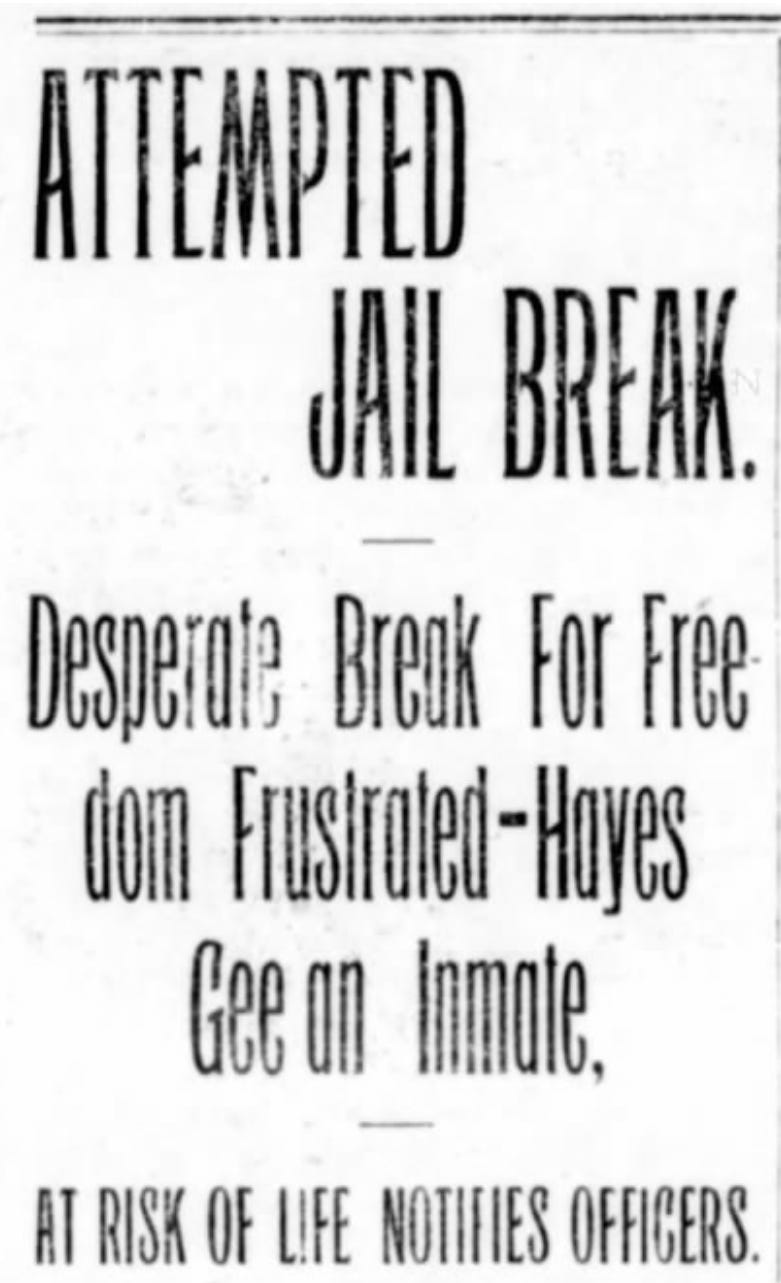
On the night of August 22, 1903, the prisoners in the cage pulled up iron bars from the floor and were preparing to pry up the boards. There were twenty prisoners confined in the jail at the time, nine of them in the cage. Hays discovered the plot and gave the signal to a nearby jailer who had noticed suspicious behavior among the prisoners for a day or two. When the other prisoners realized what Hays was doing, they tried to prevent him from reaching the door and threatened to “brain him” with the iron bar. He shoved them aside and pushed a note through the grate, beyond their reach. The jailer summoned deputies, who entered the cage well armed and put down the escape, “none too soon,” the Chandler Daily Publicist reported, “for young Gee was being very roughly handled.” The paper credited both the officers and “young Gee for his bravery in heading off the break.”
The Stroud Star reported in October 1903 that Hays had been released on bond, noting that during his confinement he had “shown such exemplary behavior and has also won the good will of the officers by preventing a jail break that he was admitted to bail.” The paper called it unusual: Judge Burford had previously refused to permit persons charged with a similar offense to give bond for their appearance.
On April 16, 1904, a telegram from Charlie Cameron to Chester Olive in Georgetown brought the news: Hays Gee had been acquitted. The Fort Worth Record-Register published a brief account. Only the son had been tried. The town received the news as “gratifying.”

The Gees returned to Georgetown by 1905. C.H. resumed his courthouse career. Hays seemed to drift: visiting friends, fishing trips, small notices in the Sun’s columns. By 1907, the family relocated briefly to San Antonio, but they were back in Georgetown by the end of 1908.
Finding Roy Collins
What happened next didn’t make the Georgetown papers until it was nearly over. The Sun reported in 1909 that through the efforts of a Congressman Burleson, young Hays Gee’s “time” had been reduced.
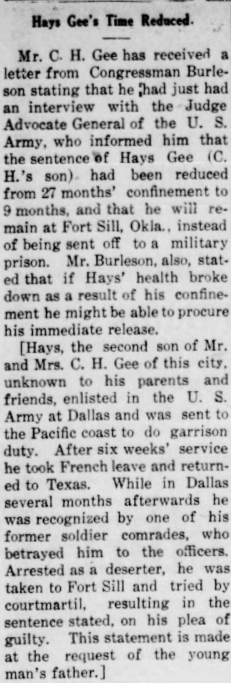
That was enough to send me looking for more of the story. I contacted the National Archives to request the court-martial file for Hays Gee, but NARA had no record of a Hays Gee court-martial.
I kept digging. In an Adjutant General’s Office correspondence index, I found a cross-reference card filed under “Gee, C.H.”
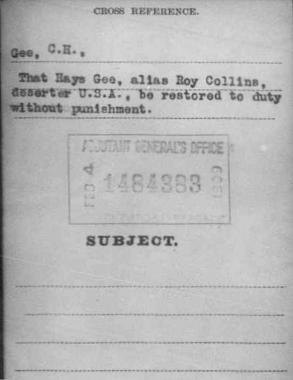
Hays had enlisted under an alias, Roy Collins, which meant there would be a file after all.
I sent the alias back to NARA. This time, they found it: RG 153, Entry 15AA, Court-Martial Case Files 1894–1917, File 60867, Collins, Roy.
Private Roy Collins
In August of 1904, Hays Gee traveled to Dallas and enlisted in the United States Army using the alias Roy Collins. He was assigned to Company I, 19th Infantry, and sent to Vancouver Barracks, Washington, for garrison duty.
Six weeks later, in September of 1904, Private Roy Collins deserted.
He returned to Texas. He avoided detection for more than four years. Then, in Dallas, a former comrade recognized him and turned him in. Hays was apprehended in January of 1909 and taken to Fort Sill, Oklahoma.
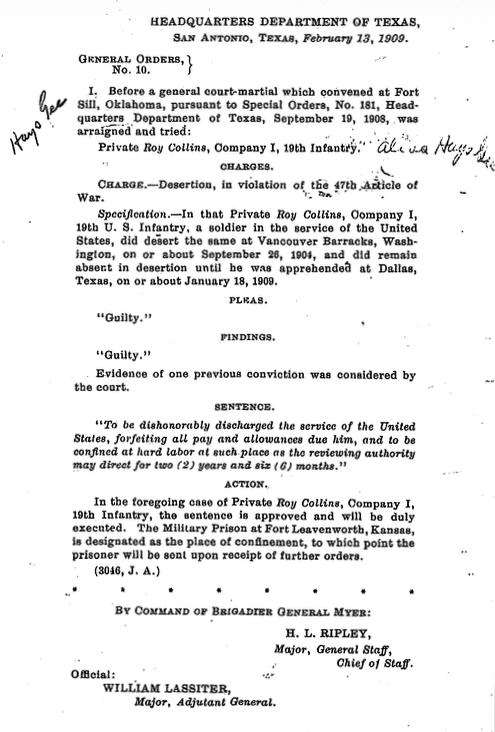
The trial was convened on February 5, 1909. Private Roy Collins, Company I, 19th Infantry, was arraigned on a single charge: desertion, in violation of the 47th Article of War. To the specification: “Guilty.” To the charge: “Guilty.” The accused had no testimony to offer and no statement to make. The trial lasted a single afternoon. The court sentenced Private Roy Collins to be dishonorably discharged, to forfeit all pay and allowances, and to be confined at hard labor for two years and six months at Fort Leavenworth in Kansas.
Dear Mama
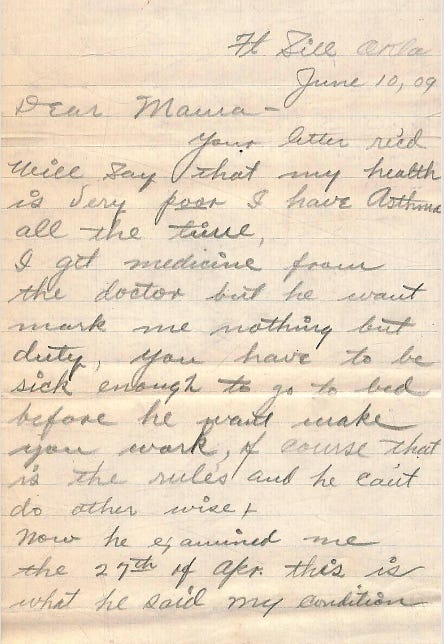
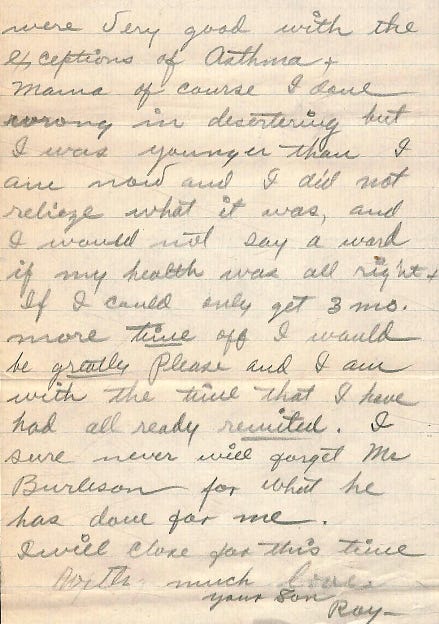
Among the most remarkable documents in the court-martial file is a handwritten letter from Hays at Fort Sill on June 10, 1909, addressed to “Dear Mama.”
He wrote that his health was very poor, that he had asthma all the time. The doctor had examined him and said his condition was “very good with the exceptions of Asthma.” Then this: “Mama of course I done wrong in desertering but I was younger then I am now and I did not relieze what it was, and I would not say a word if my health was all right.”
A week later, his mother sat down in Georgetown and wrote to U.S. Congressman A.S. Burleson in Washington, D.C. “I know you have been our best and dearest friend,” she wrote. “I have no one but you in this world.” She reported that Hays suffered from asthma and asked whether a petition signed by the Governor might do any good. “Now please try once more for his old mother.” She was 54 years old; perhaps the ongoing adventures of her second son were making her feel older.
Burleson forwarded the letters to the Judge Advocate General. “The appeal of this distressed mother is so pitiful that I feel I cannot ignore it,” he wrote.
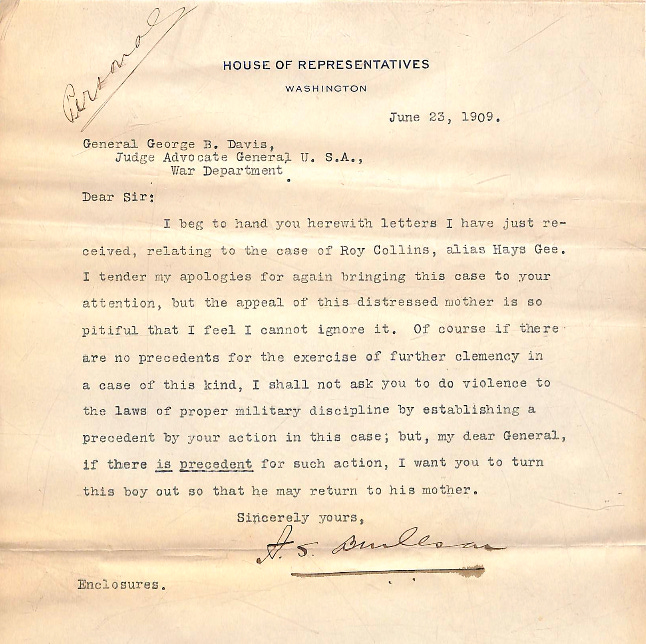
The sentence was reduced. Hays would remain at Fort Sill rather than being sent to Fort Leavenworth. The Williamson County Sun reported on Hays’s homecoming.

Coming Home
What followed was, on the surface, the life that Hays’s parents probably wanted for him all along. He married a woman named Annie Brown McCrabb, a widow from Cuero with two young sons from her first marriage. By 1913, they had a third son together, Charles H. Gee Jr., born at Inez in Victoria County. That summer, the Houston Chronicle reported that Mr. and Mrs. Hays Gee and family had “gone to their farm near Cuero for the summer.” The farm was Annie’s, land she had held since her first marriage. When Hays married Annie, he didn’t just gain a wife; he gained a family and a foothold.
They bought land and farmed near Georgetown, lost everything in a house fire in 1916 when a gasoline range exploded, and started over. By 1919 they were hosting parties at the C.H. Gee home on University Avenue. By 1921, Hays was named a director of the newly organized Federal Loan Bank Association in Georgetown. The boy who stood trial for murder in Oklahoma and then was court-martialed for desertion by the US Army was now sitting on a bank board.
The House on College Street
In June 1922, Hays and Annie bought a lot in the Glasscock Addition for $500 cash. The Houston Post reported in July that “Hays Gee this week began the erection of a new residence at the corner of Seventh and College avenues.” By September, the San Antonio Light noted it was nearing completion. A mechanics lien with Griffith Lumber Company for $3,300 secured the construction. That house at 602 South College is how I found their story.
They didn’t hold on to it long. By September 1925, having paid only interest on the construction note, they sold the property to Hays’s father for $4,000. C.H. assumed the debt. Three weeks later, he turned around and sold it to Hedges Agnew for $4,000. The father had stepped in, bought his son’s debt, and passed the property to a buyer who could actually carry it. It was the kind of quiet family rescue that doesn’t make the newspaper.
After the house was sold, Hays turned his restless energy toward something new. Through the late 1920s and into the 1930s, Hays reinvented himself as an independent oil operator, spending years chasing leases across Central Texas. A test well near Fiskville drew local headlines, and he continued drilling throughout the region, but none of them seem to have made him rich.
By the mid-1930s, the Gees were dividing their time between Georgetown and Seguin, and Hays appeared on the Georgetown delinquent tax roll in 1934. Their financial footing seems to have never been solid.
A Father’s Unforeseen Legacy
C.H. Gee Sr. died in September of 1937, at the age of 83. The Houston Chronicle ran his obituary with the headline “Veteran Official of Williamson County Expires.” He had served as a public official or deputy for forty-five years.
C.H. had lived at 415 West 12th St (University Ave), on the corner of what is now University and Martin Luther King Jr St, since 1912. The Sun noted the family’s move into the new home in May of that year. It was the house where Ella Gee had died in 1924, the house where Annie had thrown surprise birthday parties, the house that anchored the Gee family through over two decades of Georgetown life.
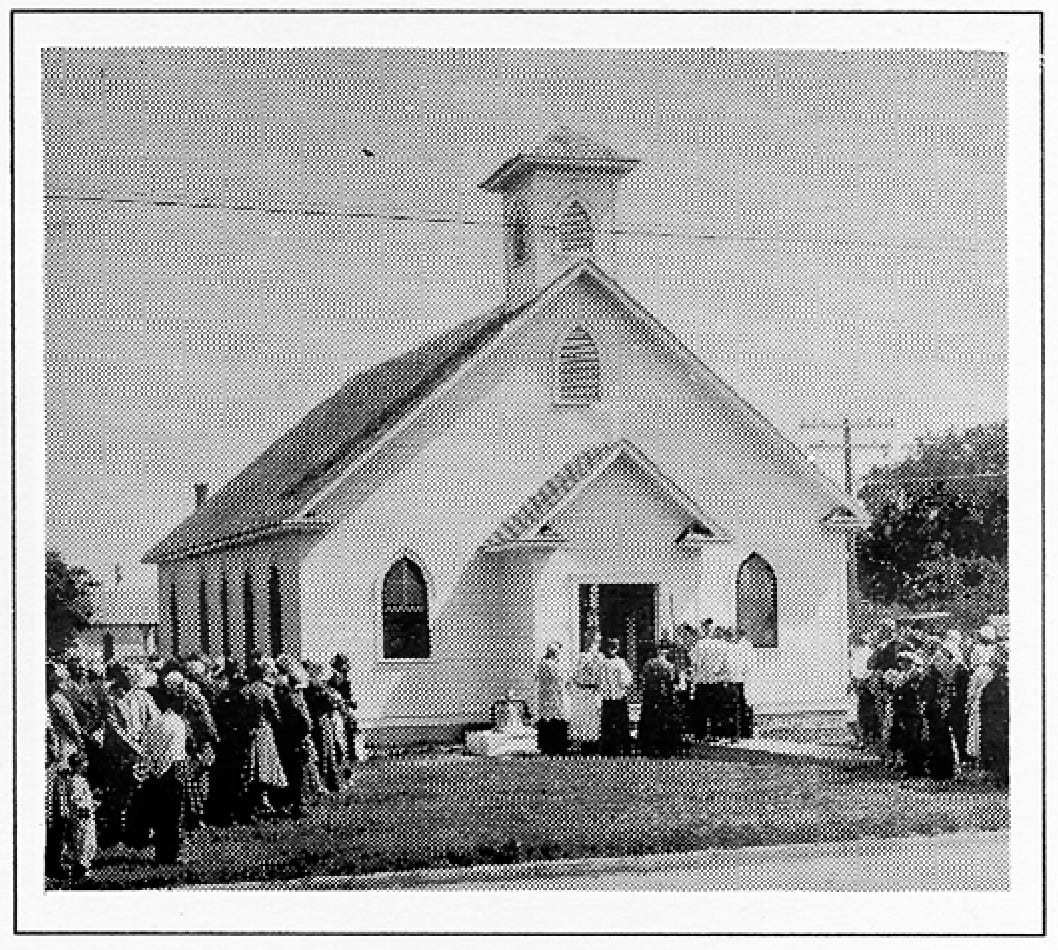
By the early 1930s, C.H. had a new neighbor. A TxDOT right-of-way map dated August 1932 shows the Catholic Church already established on its own lot on the northwest corner of 12th and Timber, with C.H.'s property on the northeast corner directly across the street. Local accounts dates the original St. Helen's to 1931, and the 1932 map confirms the church was there by that date, on its own parcel, while C.H. was still alive and living next door.
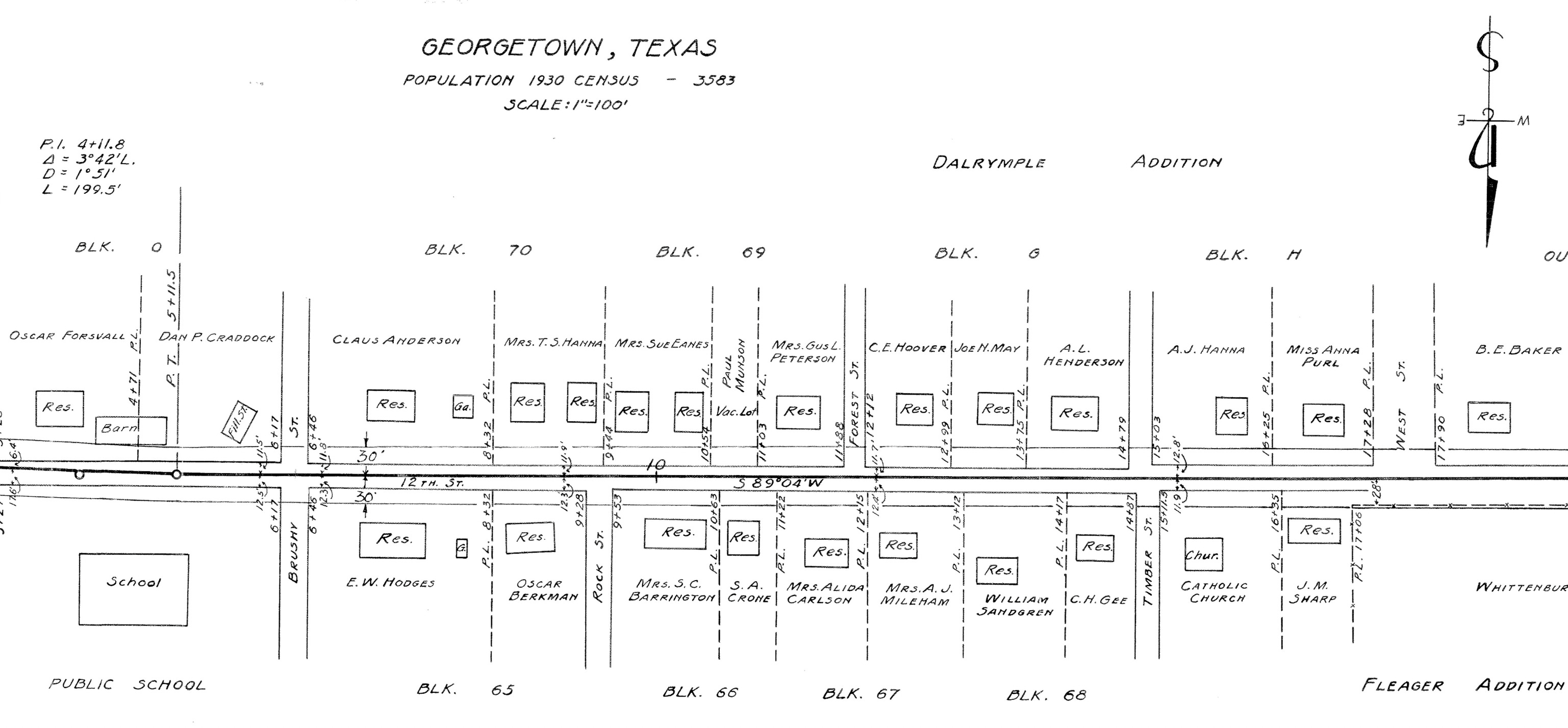
After C.H.’s death, his sons conveyed the homestead to the Rt. Rev. C.E. Byrne, Bishop of the Catholic diocese in Galveston. The 1937 deed expanded the diocese's footprint at that intersection, adding the Gee homestead on the northeast corner to the church property already across the street. City directories confirm St. Helen's was located at 415 W. 12th, the same address that C.H. and Ella Gee had lived at for all those years.
What happened to the Gee home? Did the church keep it and use it for a rectory or other auxiliary building, or did they tear it down to make way for the sanctuary? If you know, please tell us in the comments!
The combined property gave a marginalized community a permanent and expanded place in the city’s geography. For three decades, this site functioned as a sanctuary, a school, and a cultural fortress for Georgetown’s Hispanic residents.
Both buildings, the home and the church, are gone now. The property on the northeast corner of University and MLK is an empty parking lot, and St. Helen’s Catholic Church now has a large presence just east of town.
This section has been updated with information imparted to me by Helen Cordes of Hidden HerStories and MoreStories. The original version mistakenly assumed that the Gee property became the founding site of St. Helen’s. The TxDOT map confirms the church was already established on its own adjacent lot before C.H. Gee’s death. Thanks for the information, Helen!
Austin Avenue
In his last days, C.H. had done one more thing for Hays by securing a property at Lot 5, Block 2 of the Logan Addition, now commonly known as 1611 South Austin Ave. It was likely intended as a landing spot for Hays and Annie upon their return from Seguin, because by 1938 the property was described in the Sun as the Hays Gee residence. Even near death, C.H. was still arranging things for his son.
That house, by the way, sits on the same block as my current residence on South Austin Ave, two houses down and across the street, and is currently undergoing renovations. If the Gees had stayed a few years longer, they would have welcomed their new neighbor across the street, Mrs. Mittie Pennington Ischy, formerly of the old Dimmitt homestead.
In December 1938, the Gee residence on South Austin Ave was listed for sale. The Georgetown chapter was closing.

Still in the Game
Hays kept working. When he resurfaced in the San Antonio oil columns in 1938, it was under the banner “Tarver and Gee,” a partnership with Jack Tarver that was drilling in Medina County. Their No. 1 Roos showed oil sand at 520 feet. In August, the Houston Chronicle reported they were running casing and “operators expect to make a well.”
By 1940, Hays and Annie were living in San Antonio in the household of Annie’s oldest son, Josephus McCrabb. In September, the San Antonio Light reported a new gas field in Bexar County, fifteen miles southwest of the city. A wildcat had tested at an estimated million cubic feet of gas per day. The operators under contract were Kirk, Fred Beatty, and Hays Gee of San Antonio. It was a long way from Georgetown and its small town society, but Hays was still in the game.
They followed their youngest son next. C.H. Gee Jr. graduated from Southwestern University with a chemistry degree and then went to work for LaGloria Corporation in Corpus Christi. By 1944, he was an ensign in the Naval Reserve, and his parents were listed at his Corpus Christi address. They eventually moved to Shreveport, Louisiana, likely following young C.H.
A Georgetown Son
Hays Gee died on April 11, 1962, at the age of seventy-eight. His obituary in the Shreveport Journal described him as a retired independent oil operator and a native of Williamson County, Texas. It listed him as a member of the First Baptist Church of Georgetown. He had been gone more than twenty years, but he was still a Georgetown son.
Annie died about a year later, on July 24, 1963. They’re buried together at Forest Park Cemetery in Shreveport, far from Georgetown and the pages of the Williamson County Sun.
Hays Gee had a rocky start by any measure. Marriage seemed to give him direction. Annie brought land, family, and a measure of steadiness that Hays hadn’t seemed to find on his own. Whether the ambition was his or hers or something they built together, his trajectory changed when Annie entered the picture.
He never quite landed the big strike, but Hays kept moving: Georgetown to Seguin to San Antonio to Corpus Christi to Shreveport, always chasing the next lease, the next well, the next deal. His obituary called him a retired independent oil operator, and that was true as far as it went; his story is that of a man who seems to have never stopped reaching for something just out of his grasp.
Next time on Old Town Echoes: The story of Annie Brown McCrabb Gee, who buried her first husband before she turned twenty-two, farmed alone, raised two sons, and then bet on a Georgetown man who had already seen more trouble than most people see in a lifetime.
Sources
The Stroud Hotel Shooting and Trial
“Hotel purchase,” The Stroud Star (Stroud, Oklahoma Territory), 19 September 1902.
“Both Sides: Two Stories of the Stroud Hotel Tragedy Gleaned From Different Sources,” Stroud Tribune (Stroud, Oklahoma Territory), 10 December 1902.
“Shooting report,” Lincoln County News (Chandler, Oklahoma Territory), 11 December 1902.
“Hays Gee released on bail,” The Stroud Star (Stroud, Oklahoma Territory), 2 January 1903.
“Bail refused; Hays Gee in county jail,” Stroud Messenger (Stroud, Oklahoma Territory), 1 May 1903.
“Attempted jailbreak,” Stroud Messenger (Stroud, Oklahoma Territory), 28 August 1903, p. 1; reprinting Chandler Daily Publicist (Chandler, Oklahoma Territory), 22 August 1903.
“Bond granted after jailbreak,” The Stroud Star (Stroud, Oklahoma Territory), 9 October 1903.
“Trial set,” Chandler Daily Publicist (Chandler, Oklahoma Territory), 17 September 1903, p. 3.
“Hays Gee acquitted,” Fort Worth Record-Register (Fort Worth, Texas), 17 April 1904, p. 3.
“Telegram reporting acquittal,” The Williamson County Sun (Georgetown, Texas), 21 April 1904, p. 13.
The Court-Martial
RG 153, Entry 15AA, Court-Martial Case Files, 1894–1917, File 60867, Collins, Roy; National Archives and Records Administration, Washington, D.C.
Adjutant General’s Office correspondence index, cross-reference card, “Gee, C.H.” re: Hays Gee, alias Roy Collins, in “United States records,” images, FamilySearch (https://www.familysearch.org/ark:/61903/3:1:3Q9M-CSB7-V988-T, image 21 of 2770).
“Hays Gee returns home,” The Williamson County Sun (Georgetown, Texas), 9 December 1909, p. 15.
The Gee Family
1891 Georgetown Public School honor roll, The Williamson County Sun (Georgetown, Texas), 2 April 1891, p. 6.
1908 San Antonio City Directory, listing for Gee, C.H. and Gee, Hays, 710 S. Presa.
[Local notice: C.H. Gee moved into new home], The Williamson County Sun (Georgetown, Texas), 16 May 1912, p. 15; digital image, Newspaper Archive (newspaperarchive.com).
“Gee home burned,” The Williamson County Sun (Georgetown, Texas), 22 June 1916, p. 6.
“Big Loss in Georgetown Fire,” San Antonio Express (San Antonio, Texas), 24 June 1916, p. 10.
“Veteran Official of Williamson County Expires,” The Houston Chronicle (Houston, Texas), 20 September 1937, p. 13.
“C.H. Gee obituary,” The Austin American (Austin, Texas), 23 September 1937, p. 10.
“Hays C. Gee Dies Here at Age 78,” The Shreveport Journal (Shreveport, Louisiana), 11 April 1962, p. 8.
“Mrs. Annie L. Gee Succumbs at 84,” The Shreveport Journal (Shreveport, Louisiana), 24 July 1963, p. 8.
The House on College Street
Deed, Mrs. M.J. Suttles to H.C. Gee, 19 June 1922; Part of Lots 1 and 2, Block 35, Glasscock Addition, Georgetown; Williamson County Deed Records, Williamson County Clerk’s Office, Georgetown, Texas.
Mechanics lien, H.C. and Annie Gee to Griffith Lumber Company, 6 July 1922; Williamson County Deed Records, Williamson County Clerk’s Office, Georgetown, Texas.
“Much Building Activity Is Noted at Georgetown,” The Houston Post (Houston, Texas), 17 July 1922, p. 16.
“Home Contract Let,” San Antonio Light (San Antonio, Texas), 1 September 1922, p. 2.
Deed, H.C. and Annie Gee to C.H. Gee, 10 September 1925; Williamson County Deed Records, Williamson County Clerk’s Office, Georgetown, Texas.
Deed, C.H. Gee to Hedges Agnew, 1 October 1925; Williamson County Deed Records, Williamson County Clerk’s Office, Georgetown, Texas.
Social Life
“Birthday dinner,” The Houston Post (Houston, Texas), 16 March 1924, p. 35.
“Pretty Shower for Bride,” The Williamson County Sun (Georgetown, Texas), 28 November 1924, p. 8.
“42 Luncheon,” The Williamson County Sun (Georgetown, Texas), 29 June 1928, p. 6.
“Bridge Club,” The Williamson County Sun (Georgetown, Texas), 8 November 1929, p. 13.
Federal Loan Bank
“Loan Bank at Georgetown,” San Antonio Express-News (San Antonio, Texas), 13 December 1921, p. 10.
Oil Ventures
“Oil in Water Well Starts New Test,” Austin American-Statesman (Austin, Texas), 28 June 1928, p. 1.
Oil and gas subdivision plat, Hays Gee, 16 July 1931; Williamson County Deed Records, Cabinet A, Slide 136, Williamson County Clerk’s Office, Georgetown, Texas.
“Georgetown Wildcat Has Good Showing,” Taylor Sunday Press (Taylor, Texas), 30 August 1931, p. 6.
“Tarver and Gee No. 1 Roos,” San Antonio Express-News (San Antonio, Texas), 25 May 1938, p. 13.
“Tarver and Gee, Medina County,” San Antonio Express-News (San Antonio, Texas), 3 June 1938, p. 15.
“Medina Test Resumes,” The Houston Chronicle (Houston, Texas), 28 August 1938, p. 25.
“Noake gas well,” San Antonio Light (San Antonio, Texas), 3 September 1940, p. 21.
Legal
“Gee v. Steck, 125th District Court,” The Austin American (Austin, Texas), 18 December 1938, p. 20.
The Next Generation
“Farm near Cuero,” The Houston Chronicle (Houston, Texas), 13 July 1913, p. 17.
“Ensign C.H. Gee Jr.,” Corpus Christi Times (Corpus Christi, Texas), 6 August 1944, p. 31.
The 1937 Estate and Property
Williamson County, Texas, Deed Records, Vol. 289, p. 127; affidavit/proof of heirship, Hays C. Gee and Xenocles Gee; establishing C.H. Gee died intestate 18 September 1937, with heirs Hays C. Gee, Xenocles Gee, and Charles Cooper Cameron (grandson); dated 12 November 1937; Williamson County Clerk’s Office, Georgetown, Texas.
Williamson County, Texas, Deed Records, Vol. 289, p. 590; affidavit, Xenocles Gee and Hays C. Gee; establishing heirship of both Mary Ella Gee (died intestate 1925) and C.H. Gee (died intestate 18 September 1937); conveyance of University Avenue homestead to Rt. Rev. C.E. Byrne, Bishop of Galveston; dated 6 December 1937, filed 7 December 1937; Williamson County Clerk’s Office, Georgetown, Texas.
Williamson County, Texas, Deed Records, Vol. 288, p. 94; deed, H.C. Gee to Annie Lee Gee; Lot 5, Block 2, Logan Addition, Georgetown; dated 25 September 1937; Williamson County Clerk’s Office, Georgetown, Texas. Recorded one week after C.H. Gee Sr.’s death; property commonly known as 1611 South Austin Avenue.
St. Helen Catholic Church
Helen Cordes, “Mighty Hispanic Leaders,” Hidden HerStories and MoreStories (blog), 23 September [n.d.]; (https://www.hiddenherstories.com/blog/mighty-hispanic-leaders : accessed 10 March 2026). Describes the founding of St. Helen Mexican Mission and St. Helen Catholic Church, including the ruse used to purchase the land, and dates the original church to 1931. Deed records indicate the Gee heirs conveyed the University Avenue property to the Diocese of Galveston in December 1937.
Later Years and Property
“Delinquent tax roll,” The Williamson County Sun (Georgetown, Texas), 26 January 1934, p. 6.
“House for sale notice,” The Williamson County Sun (Georgetown, Texas), 2 December 1938, p. 8.
1940 U.S. census, Bexar County, Texas, population schedule, San Antonio, enumeration district (ED) 259-213, sheet 14A, household 314, Hays Gee; digital image, Ancestry.com (ancestry.com : accessed 10 March 2026); citing National Archives microfilm publication T627, roll 3995.
Texas Historical Commission, Historic Resources Survey Form, 602 S. College St., Georgetown, Williamson County, Texas; 2016 Survey ID 125106; recorded by CMEC, 2 May 2016; digital image (https://gisstaticwebfiles.blob.core.windows.net/gis/WebMaps/HistoricPlaces/Surveys/125106.pdf : accessed 10 March 2026). Construction date listed as 1920 (WCAD); deed records indicate lot purchase June 1922 and construction lien July 1922.
Old Town Echoes is independently researched using primary historical sources. AI tools assist in drafting and editing; all content is reviewed, sourced, and verified by the author.