


If you walked through the house at 1810 South Main Street on last year’s Home Tour, you already know it was built around 1915 by Marcus Lafayette Langford and his brother-in-law Claud Byron Lunsford, a builder and a carpenter, who put up homes and public buildings across Central Texas. Today’s story isn’t about the house on Main, though, it’s about the woman who raised one of the men who built it, Mark’s mother, Claud’s mother-in-law, and one of the most remarkable people I’ve come across while researching this remarkable town.
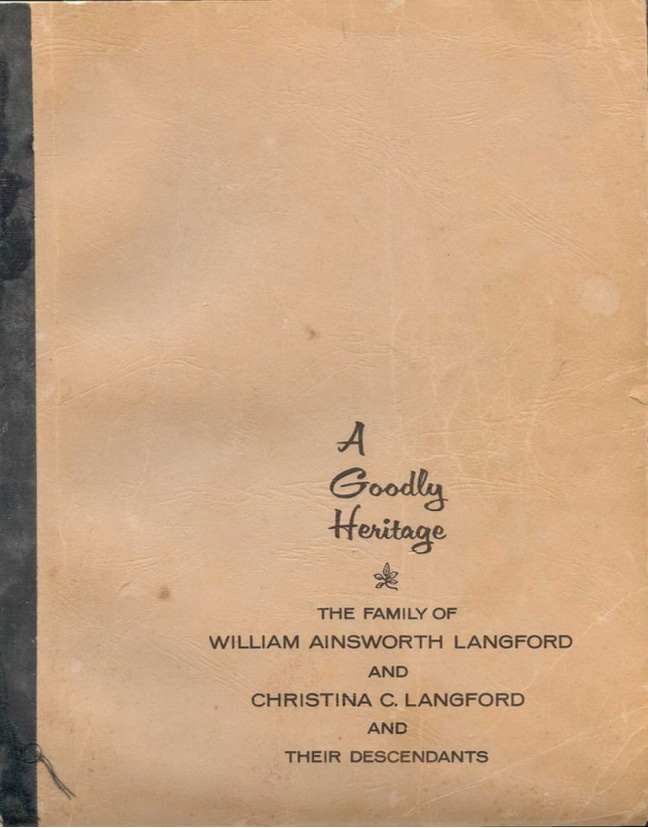
Much of what we know about her comes from A Goodly Heritage, a family history compiled in 1967 by her grandson Ernest Langford.
When Ernest went searching for the right way to describe Christina Catherina Johnson Munson Langford, the word that kept surfacing wasn’t resilient or tough. It was cheerful. Jovial. Back in the old country, they had called her Kristina Klang — a Swedish joke about her talkativeness, since klang means something like “clang” or “clamor.” Christina never met a stranger, never stopped talking, and never stopped moving forward, not when the ocean nearly killed her, not when bandits killed her first husband, and not when her second marriage turned into something to survive rather than celebrate.
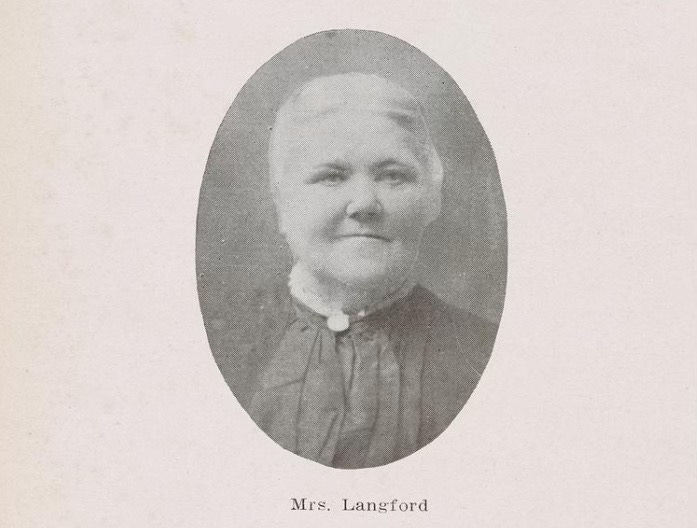
Her story starts, as so many Georgetown stories do, somewhere very far away.
From Småland to Boston
Christina Johnson was born in March 1834 in the parish of Barkeryd, in Småland province, south of Stockholm. On July 16, 1852, at 18 years old, she boarded a sailing ship in Göteborg bound for Boston, Massachusetts. She traveled in a large company of Swedish emigrants, many of whom would become the earliest Swedish settlers in Central Texas. Among them were Andrew Munson, the man she would one day marry, and her brother Gustaf Johnson.
They were three months at sea. The crossing was brutal. Nineteen passengers died during the voyage. When the ship finally reached Boston, 20 more were carried to the hospital at Deer Island, Christina among them. All of the hospitalized passengers from the ship died except her.
The healthier passengers, Andrew Munson included, had continued on to Texas. Christina stayed behind in Boston for four years, working and saving. In April 1856, she finally made her way south.
She arrived in Austin and married Andrew Munson on the very same day: April 21, 1856. The couple rented a small farm south of Austin. In Central Texas at that time, there were probably no more than ten Swedish families in the entire region, but Christina, always happy and courageous, dove into pioneer life.
A Widow on the Frontier
Then the Civil War broke out. Andrew Munson served as a freighter, driving wagon trains between the southern states and Mexico, hauling goods along routes that stretched as far as the coast and back. He was away from home most of the time. Christina was left to manage the farm and their growing family alone — by the mid-1860s, they had six children, the eldest only about ten.
After the war, Munson and some other Swedes took up freighting between Round Rock and Huntsville in East Texas, hauling limestone from one place and building materials from the other. Munson had rigged a special hollow in the axle of his wagon where he hid his money, mostly in the form of gold.
It was on one of these trips, around July 1866, that Andrew Munson died near a place called Red Top, in the vicinity of present-day Benchley in Brazos County. Two brothers-in-law, John Nelson and Gustaf Johnson, were traveling with him. Gustaf Johnson rushed to bring Christina the news. She hurried by horseback to her husband’s side, but by the time she arrived, he was already dead and buried.
Christina’s son-in-law, Ernest C. Ischy, recalled decades later that the family understood that Munson had been “waylaid and killed by bandits.” South Texas officers eventually found his body but no trace of his wagons or teams. Christina herself would say that her husband left home on a Friday and was killed on a Friday, and because of that she was superstitious about Fridays for the rest of her life. She would never let anyone leave on a trip on a Friday.
At 32, Christina was a widow with six small children in a land she’d come to only a decade earlier. By November 1868, she had bought 34½ acres of land from J.G. Caldwell about five miles from Georgetown. Her brother Gustaf Johnson was nearby. Neighboring Swedes helped her raise a log house. She would farm that property for nearly 40 years.
A Second Marriage, A Harder Chapter
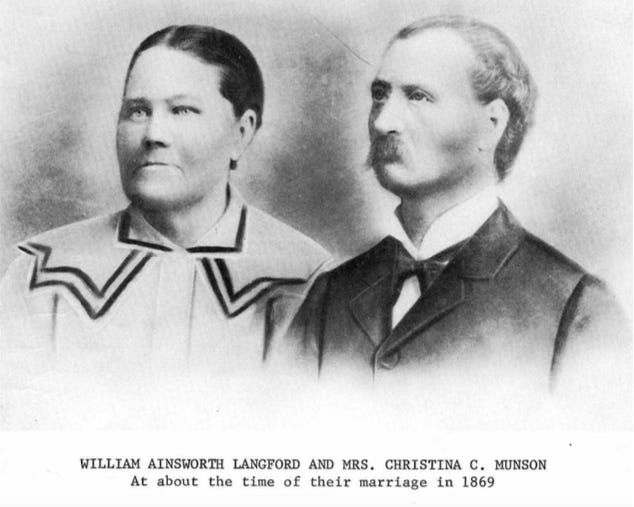
In August 1869, Christina married again. William Ainsworth Langford was a Civil War veteran that had come to Texas from Tennessee shortly after the war, though exactly when and why he arrived in Williamson County, nobody seemed to know. Together they had five more children: Marcus Lafayette (born 1870), Josephus Forrest (1872), Tennessee (1874), Georgia Ann (1875), and Maud Hannah (1879). All were born near Georgetown.
The family memoir written decades later by Christina’s grandson Ernest Langford paints William as a colorful frontier character: a man of few words, a great marksman who carried his Winchester everywhere (even strapped to his cultivator when he plowed), a lawman who ran down bandits. He never sat with his back to a door, drew the shades at night, and kept his gun within reach while he slept. The first joint of his left thumb was missing, shot off while cleaning his gun. He considered that more humiliating than actually getting shot, so when anyone asked about it, he always claimed he’d worn it down dealing cards.
Some of that is surely true. However, the Williamson County court records tell a far more complicated story, one the younger generation of the family either didn’t know about or chose not to pass down.
Within a year of the marriage, William was already in financial trouble, with a $267 default judgment for an unpaid debt. By 1871, he had enough local standing to be appointed bailiff to the grand jury. That trust didn’t last. In 1872, the grand jury indicted him three times — cow theft and unlawfully removing livestock. He was convicted on two charges, fined, and sentenced to an hour in the county jail. Remarkably, while the cow theft case was still pending, he was again sworn in as bailiff.
It got worse. In 1874, with three Langford babies at home and six Munson stepchildren besides, William was indicted for aggravated assault and then for robbery. He couldn’t make bail. He sat in the Williamson County jail while Christina managed the farm and nine children on her own. He was convicted on the assault, and there are strong indications he was convicted on the robbery as well. He appealed, but the Texas Court of Appeals affirmed the conviction in May 1878.
Meanwhile, Christina was protecting what she had. In August 1878, she voluntarily waived her rights as natural guardian of her five Munson minor children and asked the court to appoint her eldest son, John E. Munson, as their legal guardian.
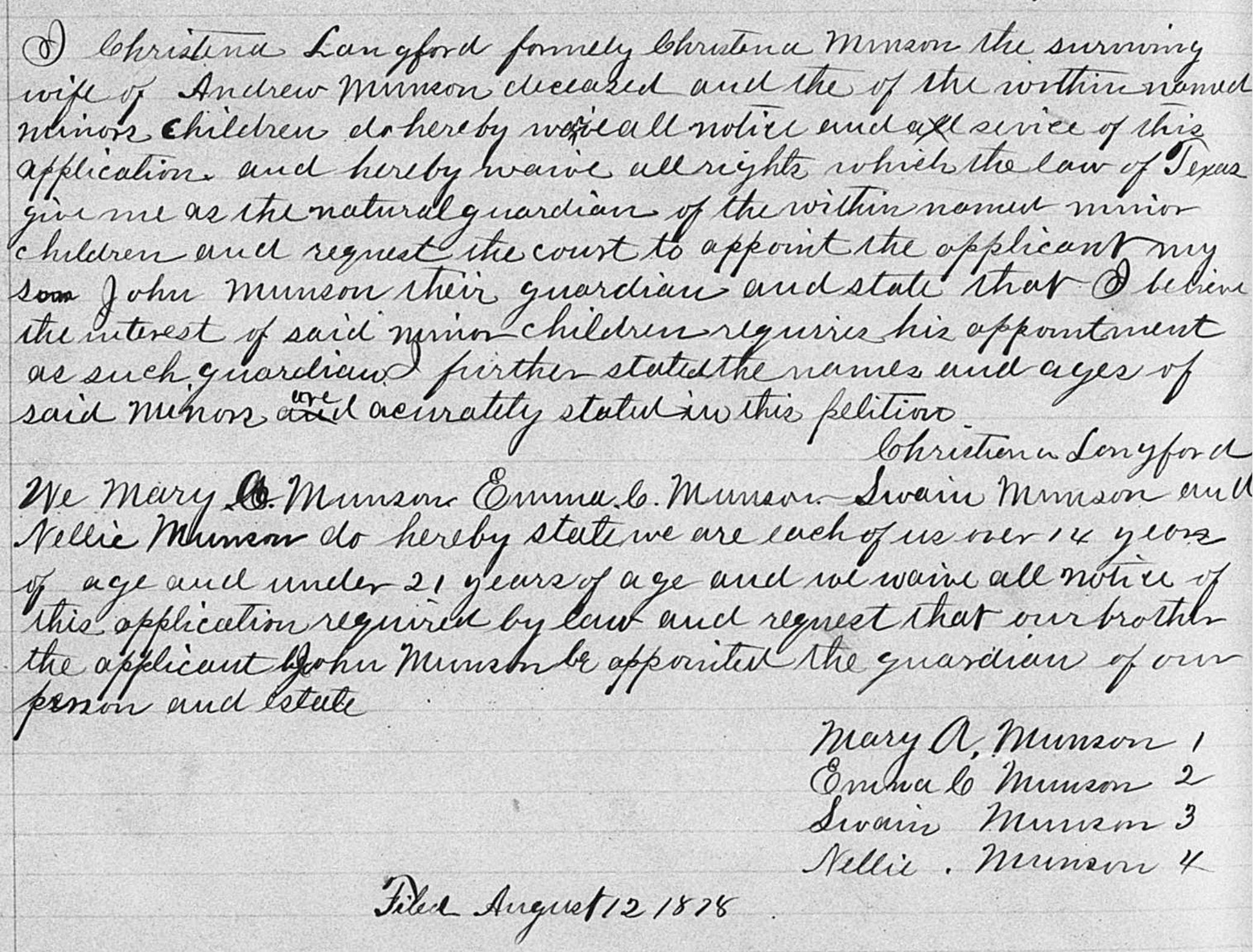
Christina had bought the homestead herself after Andrew’s death, but the Munson children held cattle and a fractional interest in the land. By placing those assets under John’s guardianship, Christina walled them off from her second husband’s creditors and habits. An 1881 inventory confirmed the arrangement: the homestead was held in common, half to Christina and half split among the Munson children. The legal architecture was airtight; William Langford had no interest in the Munson property.
A Revealing Divorce Filing
In 1883, divorce was still vanishingly rare in America; the national rate was less than one per one thousand. But on August 15, Christina walked into the Williamson County District Court and filed for one. Her petition laid out the private reality behind the public facts: William had come home drunk and struck her while she was sick in bed, he had drawn a large knife on her and threatened to kill the children and their “god damned mother,” and he had threatened to kill “all the Munsons” and tried to take her wagon and horse. She told the court she had raised a small crop of cotton and corn, bought three horses with her own labor, and owned four cows and nine hogs. William, she alleged, was “a dissipated and indolent man, spending most of his time, and wasting his substance in and around the bar rooms in the City of Georgetown,” who had not provided for the children in years.
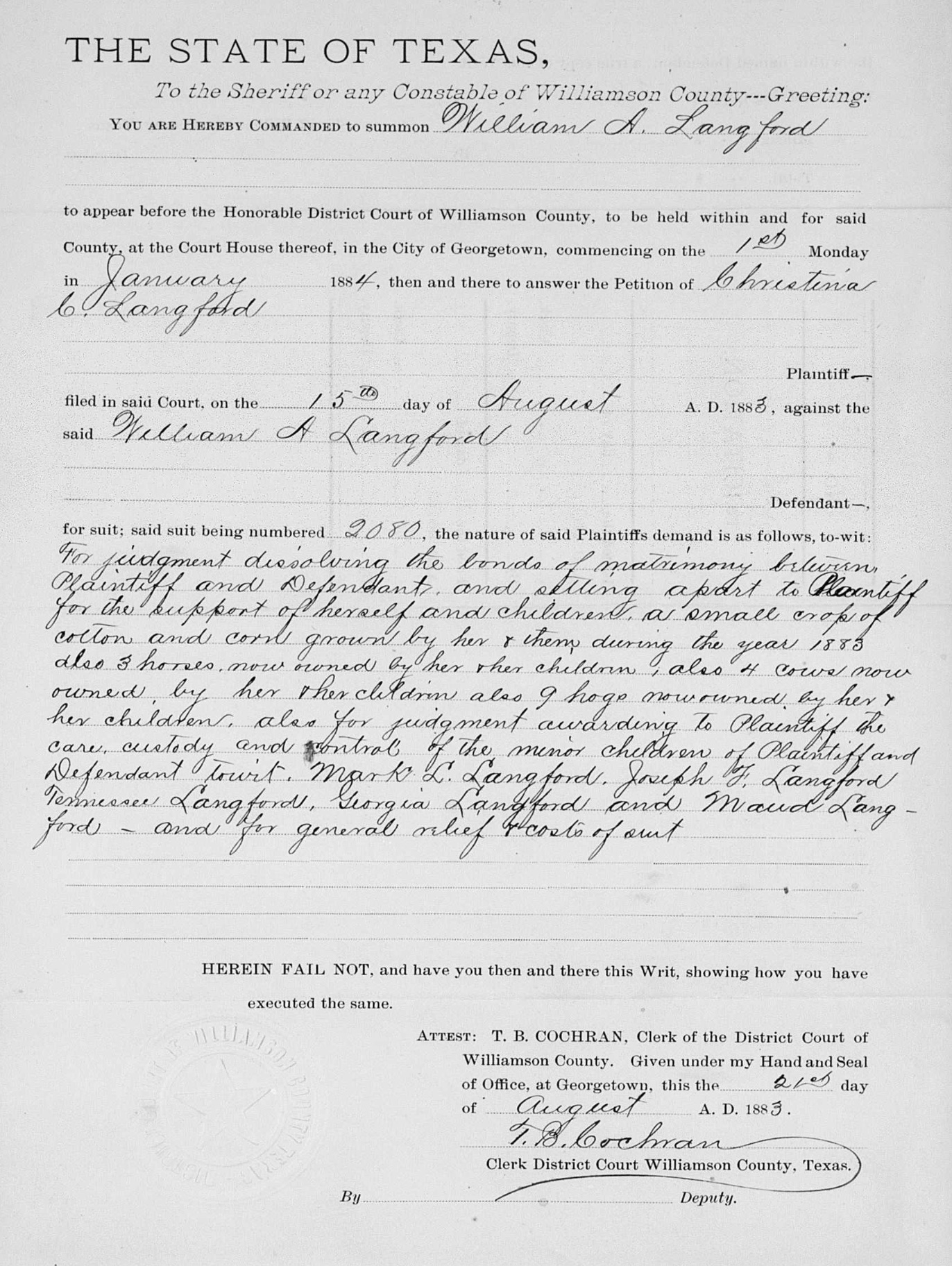
The court granted an injunction restraining William from the property and placed all five Langford children in Christina’s custody. But then, at the very term of court set for trial, Christina dismissed the suit.
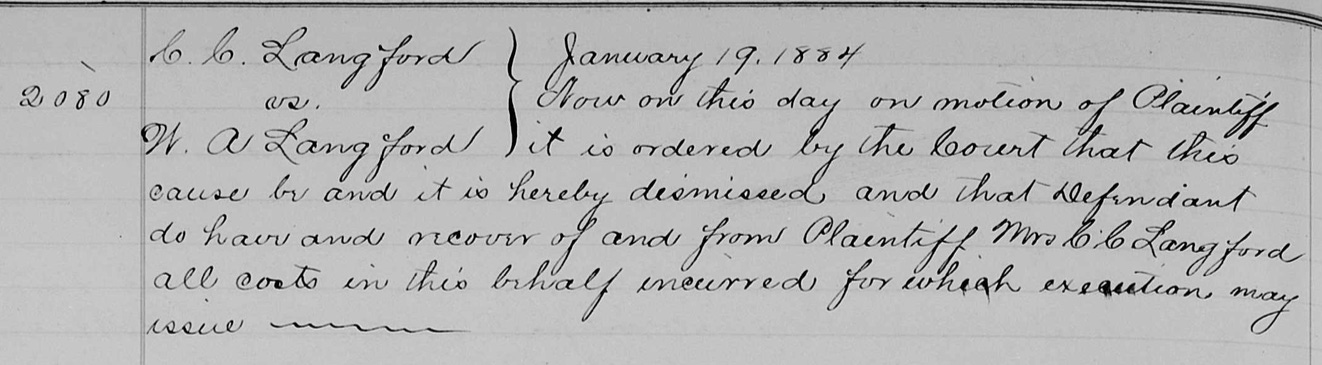
Why? We can only speculate. She still had five children under 14. A divorced woman with no income beyond what she could grow would have been in a precarious position, even with the homestead. The injunction had already given her the practical relief she needed. The social cost of actually completing the divorce, in a time when so few women dared to try, could have been a real concern. By dismissing the suit, Christina preserved her legal status as William’s wife and, eventually, her eligibility for his Civil War pension.
The marriage continued for 11 more years. By the late 1880s, William seems to have reinvented himself as a deputy county sheriff, doing real law enforcement work. This was frontier Texas, where the line between outlaw and lawman could be surprisingly thin, and where a man could cross it more than once in a lifetime.
By 1888 he had branched out further: an October 1888 ad in the Sun announced that W. A. Langford was serving Berwick Bay and Select Plant Oysters on the square at low rates. He was deputy sheriff one year, oyster man the next.

William Langford died on March 26, 1895, at Georgetown. He was 53. Christina filed for and received his widow’s Civil War pension. She had earned it.
The House on Timber Street
After William’s death, Christina was a widow for the second time — but she was far from helpless. By the 1900 census, she was head of household, living with her daughter Nellie.
In 1907, Christina orchestrated a remarkable family transaction. Her Munson children, scattered across the US from Oklahoma to Montana, signed over their inherited interest in the old homestead to their mother, each for a dollar “and the further consideration of the love and affection that I have for my mother.” With clear title in hand, Christina and Nellie sold the homestead for $900. Weeks later, she spent that $900 on a house in town: Block No. 68, in the Lost Addition to the City of Georgetown, bounded by Cedar Street and Timber Street (present-day Martin Luther King Jr St). She was 73 years old, and she was done with farm life.
The 1910 census places her on Timber Street, owning her home free and clear. Living with her were Nellie, who had never married or lived independently, and her daughter Georgia Johnson with two grandsons. Her youngest daughter Maud and son-in-law Claud Byron Lunsford were nearby on the same block.
Just next to Christina’s house, facing south on 12th St at 415 12th, stood the home of her closest neighbor, C.H. Gee, a name that will be familiar to my local readers as longtime Williamson County District Clerk and father to Hays Gee. Georgetown was a small world back then, and it keeps getting smaller the more you get to know the cast of characters! For instance, Christina’s daughter Tennessee married Ernest Charles Ischy, a first cousin of P.J. Ischy, who was the husband who drove his car off the bridge in The Widow of 1604.
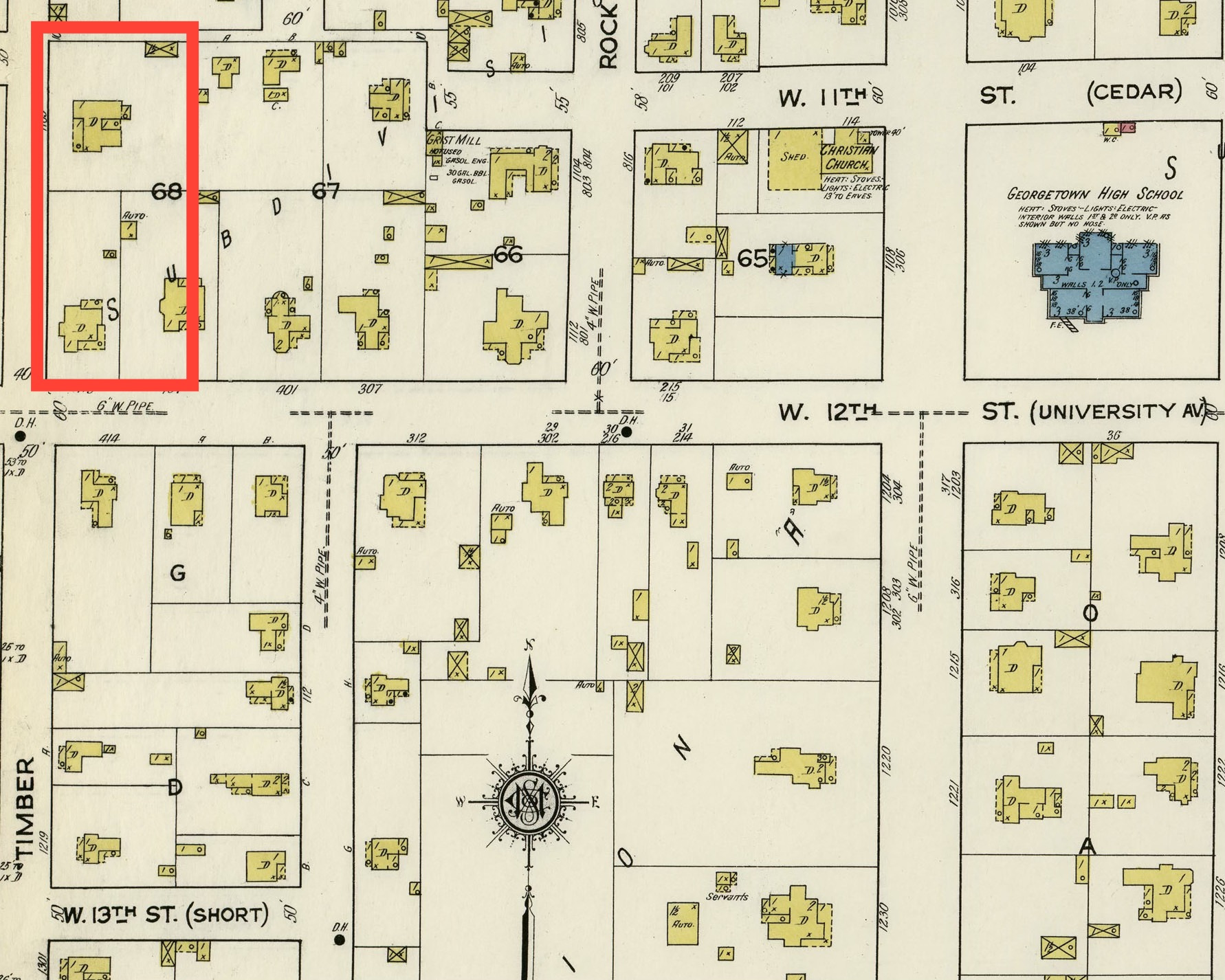
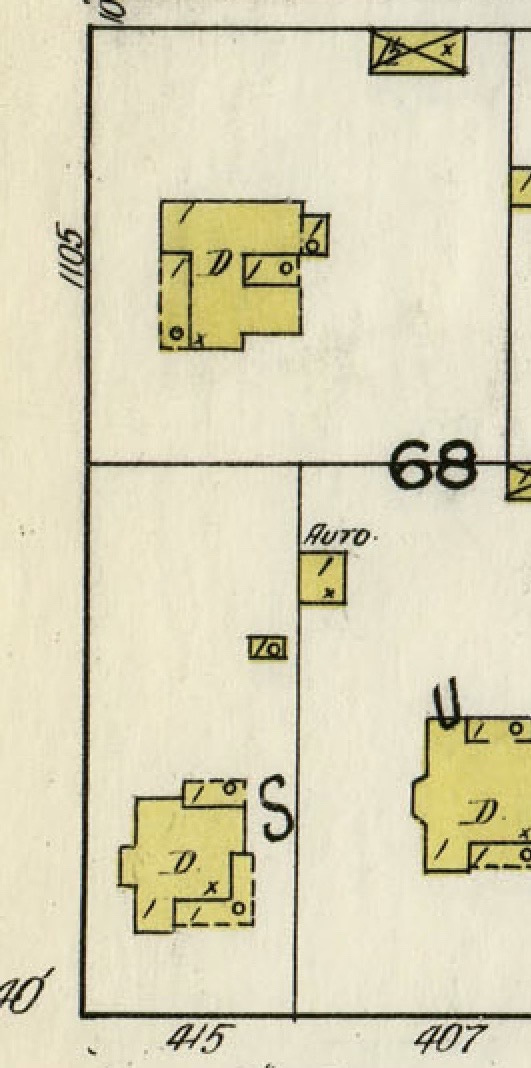
The Timber Street property was Christina’s last home, and the one where she would live out her final decade. She was a fixture of Georgetown life in the early 1900s. She kept an old horse everybody called “Old Charley,” as gentle a horse as ever pulled a buggy, who was seemingly as old as Christina herself. The grandchildren loved riding him around her back yard. In 1917, at about 83 years old, Christina was still placing ads in the Williamson County Sun: “FOR SALE My gentle buggy horse, gentle for children to drive, works anywhere and scares at nothing whatever. Apply to Mrs. C. C. Langford.”
Grandmother Langford
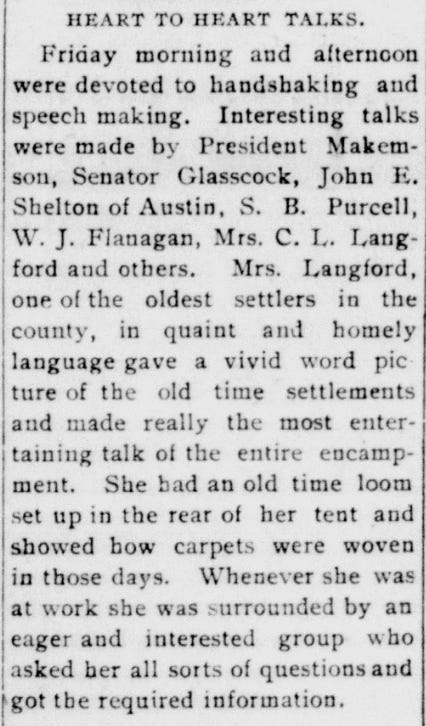
Christina spoke her native Swedish all her life, read Swedish newspapers, and sang Swedish nursery rhymes to grandchildren who didn’t understand a word. She loved nothing more than sharing stories of her youth, the long journey across the Atlantic, and her early years in Texas. A report in the Sun on the third annual meeting of the Old Settlers Association in 1907 describes Christina as a speaker alongside other prominent names such as Senator Glasscock.
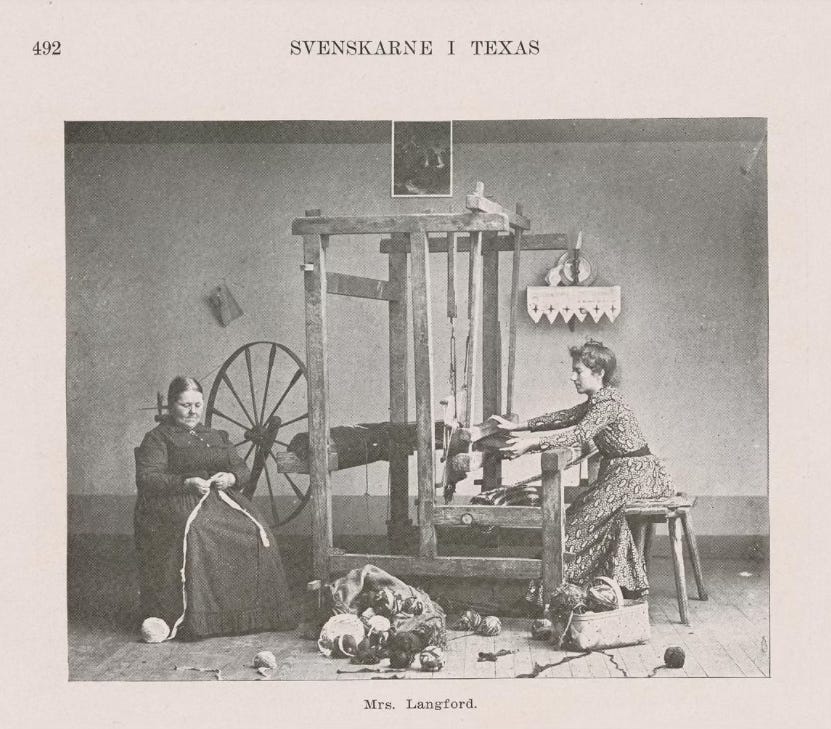
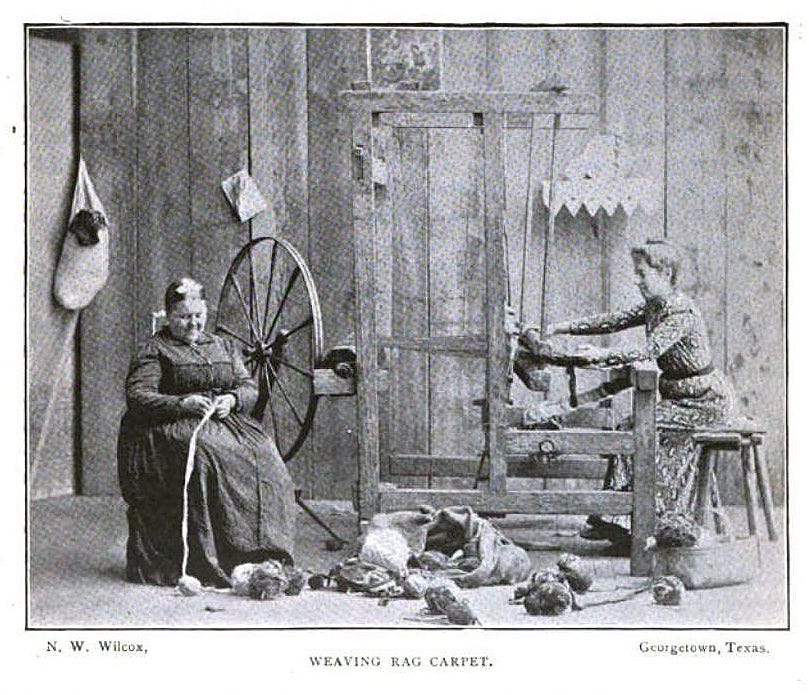
She was a weaver; a photograph from the book Svenskarne I Texas shows her sitting at her loom. A similar photograph, credited to Georgetown photographer N.M. Wilcox, was published nationally in Wilson's Photographic Magazine in July 1894 under the title 'Weaving Rag Carpet.'
Ernest Langford recalled that she must have woven enough carpeting to cover a good part of Williamson County.
A Last Will and a Legacy
On March 7, 1917, Christina signed her last will. The third clause reveals where Christina’s heart was heaviest; it provides specifically for “my afflicted daughter Nellie Alice Munson,” placing her entire estate, valued at about $1,500, in trust with her son Mark Langford for Nellie’s care. Only after Nellie’s death would the estate be divided among Christina’s five Langford children. Everything she owned was to serve, first and above all, the child who could not care for herself.
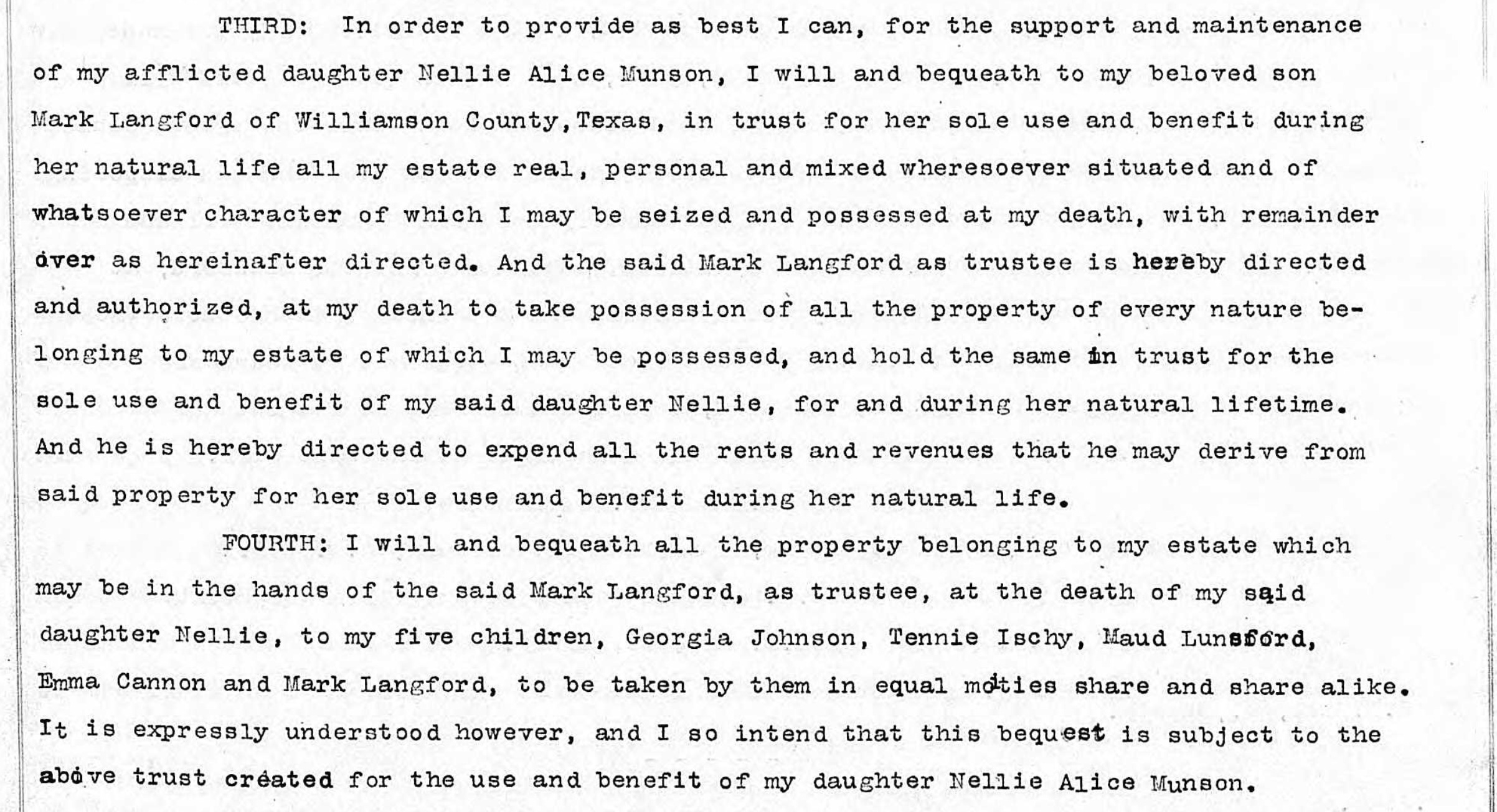
Notably absent are the surviving Munson children. They had signed over their homestead interests a decade earlier to help their mother move to town. The Timber Street house was bought with those proceeds. Yet the estate built from that transaction went to the Langford children, not the Munsons who had made it possible. The documents don’t explain why, but it’s a silence worth noting.
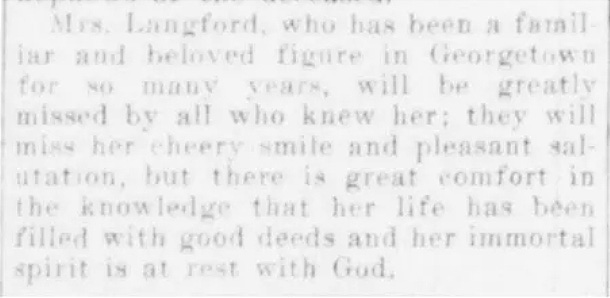
Christina died on September 15, 1918, at her home in Georgetown, at 84 years old. Her obituary in the Williamson County Sun described her as “a familiar and beloved figure.” The pallbearers were all Munsons, nephews of the deceased. She was buried in the Odd Fellows Cemetery.
Nellie
There is one person in this story who never gets to speak for herself, yet whose presence shapes nearly every legal document Christina left behind.
Nellie Alice Munson was born around October 1863, the fifth of Christina’s six children with Andrew Munson. She appears in the 1878 guardianship petition alongside her older siblings, about 14, nothing in the document suggesting anything unusual. But by the time John filed his final guardianship settlement in 1884, the other Munson children had married or come of age. Nellie, at 21, was simply “living in this County with her Mother.” Whatever was different about Nellie’s life was beginning to be visible in what the records didn’t say.
In 1907, when the homestead was sold, Nellie was a party to the deed; she made her mark, and Texas law would have required her to understand the transaction. At 43, she seems to have been considered legally competent. Christina’s 1917 will, just ten years later, called her “afflicted.” By 1919, Mark Langford described her as “wholly incapable to take charge of and care for the estate devised.”
One account offers a possible explanation: when Nellie was a young girl, William Langford came home drunk and found her in bed with a raging fever. Thinking he could break it, he threw a bucket of cold water on her. The shock, combined with the illness, possibly scarlet fever, left her permanently impaired. I haven’t been able to verify this account, but it is consistent with what the court records tell us about William. If true, it would give Christina’s lifelong protectiveness of Nellie an even deeper motivation.
The family honored Christina’s wishes after her death, to a point. Around 1925, Nellie was admitted to Austin State Hospital, formerly the Texas State Lunatic Asylum. She lived there for nearly 13 years. When she died in January 1938, the informant on her death certificate was not a family member but “Austin State Hospital Records.” Her four-sentence obituary named only one survivor: “a brother-in-law, C. B. Lunsford of Georgetown.” Her full sister Emma Cannon was still alive, as were her brothers John and Sven Alfred, yet the hospital apparently knew of no one else. She was buried at Oakview Cemetery in Austin, not beside her mother in Georgetown.
What the documents suggest, taken together, is someone who had become profoundly isolated by the end of her life. Whether the family visited, whether they stayed in touch with the hospital, whether the distance and the years simply wore the connections away, we don’t know. But the paper trail at the end of Nellie’s life is strikingly bare for a woman whose mother had built her estate around the promise of her daughter’s care.
Christina had done everything she could. She kept Nellie at home for as long as she was alive to do it. She made the house itself a vehicle for Nellie’s care. When she couldn’t do it anymore, her children carried the obligation forward, however imperfectly.
The House on Timber Street
When Christina died, the Timber Street property was encumbered by the obligation to care for Nellie. In the weeks after the will was probated in 1919, the Langford children conveyed their remainder interests to Maud, Christina’s youngest, for ten dollars and the promise to provide Nellie “a home and the necessaries of life for the remainder of her life.” Even Tennessee’s children, who had inherited their mother’s share after Tennessee’s death in 1918, signed separate deeds over the next several years, each one carrying the same Nellie care clause.
With Nellie’s death in 1938, the obligation was finally released. In 1941, Maud and Claud Lunsford sold the Timber Street property to L.L. Huie for $1,600, nearly double what Christina had paid for it in 1907, but a modest sum for a house that had sheltered a family’s beloved matriarch.
The Langford Legacy on South Main
Mark Langford grew up to build the house at 1810 South Main; he later reinvented himself as a Texas Ranger on the Mexican border. His grandson Ernest Langford became a professor at Texas A&M and the compiler of A Goodly Heritage, the book that preserves the gentler version of Christina’s story. He ended that volume with a Swedish blessing: Vile hon i frid! — May she rest in peace.
The court records tell the harder version, but both versions ring true. Christina was the cheerful grandmother who sang Swedish nursery rhymes and wove carpeting on her loom, and she was the woman who filed for divorce alleging her husband had drawn a knife on her and threatened to kill the children. She was the beloved figure in the obituary and the plaintiff who told the court she’d bought her own horses with money earned doing washing. She held it all together — the farm, the children, the property, the promise to care for Nellie — across 66 years of Texas life.
The house on Timber Street, just like the C.H. Gee house next door, is gone now. Also like the Gee house, the Timber Street house was sold to the Catholic Church. The church purchased it in 1978, and aerial photographs show the house was gone by 1981.
The house at 1810 South Main still stands, though. It and many others were built by Christina’s family, people who had grown up learning from her resilience, and that’s a piece of the legacy inside those walls.

A note on names: Christina’s name appears in many variations across the historical record: Christina, Christiana, Christine, Kristina. Her maiden name is rendered as Johnson and Johanson. Her first husband’s surname appears as both Monson and Munson. I’ve generally used the spellings that appear most consistently in the primary sources, but readers may encounter other versions in their own research.
Sources
Christina’s Life and Family Memoir
A Goodly Heritage: The Family of William Ainsworth Langford and Christina C. Langford and Their Descendants, compiled by Ernest Langford (1967).
Ernest Severin et al., Svenskarne I Texas I Ord Och Bild, 1838–1918, Volume 1 (Austin, 1919), pp. 179, 492; digital images, The Portal to Texas History (texashistory.unt.edu/ark:/67531/metapth1433684/); crediting McCulloch County Historical Commission.
Marriage Records
Texas marriage record, Andrew Monson and Christina Johnson, April 21, 1856, Travis County, Texas.
Texas marriage record, William A. Langford and Christina Munson, August 29, 1869, Williamson County, Texas.
Census Records
U.S. Federal Census, 1860, 1870, 1880, 1900, 1910; Williamson County, Texas.
William Langford — Court Records
Brown Lee Collier v. W.A. Langford, Case No. 931 (1870), District Court, Williamson County, Texas.
State of Texas v. W.A. Langford, multiple cases (1872–1877), District Court, Williamson County, Texas.
W.A. Langford v. The State of Texas, No. 449, Texas Court of Appeals, Austin Term, affirmed May 4, 1878.
Divorce Proceedings
Christina C. Langford v. W.A. Langford, Case No. 2080 (filed August 15, 1883; dismissed January 19, 1884), District Court, Williamson County, Texas.
Deputy Sheriff
“Called Back,” Daily American (Nashville, Tennessee), January 22, 1887.
“W. A. Langford" [advertisement], Williamson County Sun , October 25, 1888.
Civil War Pension
U.S. Civil War Pension Index; Veterans Administration pension payment cards; William A. Langford, pension no. 640604.
Guardianship of Munson Minors
Guardianship of Mary A. Munson et al., Case No. 161 (1878–1885), County Court, Williamson County, Texas; in “Williamson, Texas, United States records,” images, FamilySearch (familysearch.org/ark:/61903/3:1:3QS7-L9X3-YHPN).
Property Records
Deed, J.G. Caldwell to Christine Munson, November 30, 1868, recorded December 21, 1868; Williamson County, Texas.
Deed, Langford to Caldwell (1874); Dalrymple to Langford (1889); Munson children to Langford (1907); Langford/Munson to Johnson (1907); Thompson to Langford (1907); Williamson County, Texas.
Langford children to Maud Lunsford (1919); Ischy heirs to Lunsford (1920, 1923, 1925); Lunsford to Huie (1941); Williamson County, Texas.
Affidavit of Christina Langford, proof of heirship for Andrew Munson (1911), Williamson County, Texas.
Affidavit of Sillure and Harris (1941), Williamson County, Texas.
Probate — Christina Langford
Estate of C.C. Langford, Case Nos. 2202–2203 (1919), County Court, Williamson County, Texas.
Obituaries and Death Records
“Death of Mrs. Langford,” Williamson County Sun, September 20, 1918.
“Munson” [obituary], Austin American-Statesman, January 26, 1938.
Texas death certificate, Nellie Alice Munson, 25 January 1938, Travis County, Texas.
Georgetown Life
“The Old Settlers Reunion,” Williamson County Sun, 5 September 1907.
“FOR SALE My gentle buggy horse…,” classified advertisement, Williamson County Sun, 1917.
Nellie Munson — Family Account
FamilySearch, Nellie Munson (LVNR-S8L), “Brief Life History” contributed by user.
Maps and Visual Sources
Sanborn Fire Insurance Maps, Georgetown, Texas, 1916.
1810 S Main, Texas Historical Commission, Historic Resources Survey, 2016.
Find A Grave memorial #8492948, Christina Catherina Johnson Langford.
"Weaving Rag Carpet" [photograph by N.W. Wilcox, Georgetown, Texas], Wilson's Photographic Magazine, vol. 31, no. 7 (July 1894), p. 295.
Old Town Echoes is independently researched using primary historical sources.
AI tools assist in drafting and editing; all content is reviewed, sourced, and verified by the author.
Thanks for reading Old Town Echoes!
Subscribe for free to receive new posts and support my work.