


The social columns of early twentieth-century Georgetown recorded women’s lives in a particular way. They told you what Mrs. Hays Gee served at her luncheon. They told you she was in the bridge club that met at Mrs. R.L. Logan’s home and that she hosted bridal showers with cream chicken and mint ice.
They didn’t tell you that she owned 1,148 acres in Jackson County before she ever met Hays Gee. They didn’t tell you she ran a farm alone at the age of twenty-one or that she managed two estates through probate courts. The newspapers always called her Mrs. Hays Gee. Even her obituary led with “widow of Hays Gee.”
The newspapers provide some clues to who she was, but the records that give her back her name aren’t the newspapers, they’re the deeds and the court minutes. Her name was Annie Lee Brown.
This is a companion piece to “The Many Lives of Hays Gee,” which followed Annie’s husband through a murder trial in Oklahoma Territory, a military desertion under a false name, and a long career chasing Texas oil. That post closed with a promise to tell Annie’s side of the story.
The Horse at Navidad
Annie Lee Brown was born on August 1, 1878, in Austin, Texas, the youngest daughter of Oscar S. Brown and Mary J. Lloyd. Annie grew up in DeWitt County, in the South Texas lowlands between the Guadalupe River and the Gulf. Her family was large. The Brown family tree shows at least nine siblings with Annie as the baby of the family.
In 1896, at the age of 18, Annie married John W. “Buck” McCrabb in DeWitt County. They settled in Jackson County, where their first son, Joseph Oscar McCrabb, was born in 1897. A second son, Tyson, followed in 1899.
Then, in October 1899, Buck McCrabb died at their home in Navidad, Jackson County. A horse fell on him while he was running a hog. He lingered, unconscious, until the following night. His body was taken to Cuero on the afternoon Southern Pacific train for burial in the family graveyard.
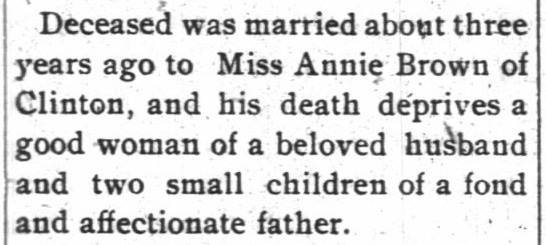
Annie was twenty-one years old. Her sons were two and nine months.
A Feme Sole
The 1900 census finds her in Jackson County, Precinct 5. Head of household. Occupation: Farmer. She was running the farm with two babies and an aging father in the house. Her father would die two years later.

That same year, the Brown family partitioned the estate of Annie’s father, Oscar S. Brown, through a deed recorded in DeWitt County. Annie received her share of the Brown family land in her own right. This matters because everything Annie inherited from her father was her separate property under Texas law, not community property with any future husband.
On October 20, 1906, she signed a deed in DeWitt County conveying land to her brother. The notary’s acknowledgment identifies her as “Annie L. McCrabb, a feme sole.”

For most of American history, a married woman had no independent legal existence. Under the common law doctrine of coverture, her property, her contracts, her capacity to sue or be sued, all were absorbed into her husband’s identity. Texas was better than most states on this front; its community property system, inherited from Spanish law, gave married women stronger property protections than the common law provided, but even in Texas a married woman couldn’t sell her own separate property without her husband joining the deed, and she had limited standing in court without his participation. Those restrictions weren’t fully removed until 1967, when Texas amended its constitution to let a married woman convey her separate property on her own authority.
A feme sole stood outside that structure. The term designated an unmarried woman who could own property outright, enter contracts, and appear in court on her own authority. For Annie, widowhood had conferred something the law otherwise reserved for men and single women: full legal personhood. For the next five years, every document she signed carried that designation. She was not Mrs. anybody. She was Annie L. McCrabb, a feme sole, managing properties, paying taxes, repairing fences, and traveling to Edna to see about the land and collect rent.
The Guardian’s Report
The most revealing document of Annie’s widowhood is a guardianship exhibit she filed in DeWitt County Court in 1912, looking back over the entire period since she had taken charge of her sons’ affairs. It reads like an accounting of a life lived on almost nothing.

The children’s estate included 1,148 acres of land in Jackson County (the John McCrabb survey, appraised at roughly six dollars an acre), $945 in cash from the inventory, and two horses valued at $54. There was also a claim for money owed by J.F. McCrabb, the previous guardian of the estate who was now deceased.
Annie’s disbursements for the first two years tell the story of daily survival. Board at $10 per month for each child. Drugs and doctor bills: $25. School books and supplies: $25. Clothing for two wards for two years: $150. Total: $650.
After August 1909, the expenses changed. The boys began boarding in Georgetown at $12.50 each per month. The exhibit lists clothing at $230, school books and supplies at $30, washing at 50 cents per week. There is a line for “drugs and doctor bills to be charged to Tyson, who was accidentally shot,” at $65. Two bicycles: $30. And a line for the guardian’s own expenses: traveling to Edna to see about the property and collect rent, $30.
Oh, and the shooting incident that appears between entries for school books and bicycle purchases as if it were just another cost of raising two boys in early twentieth-century Texas? The Houston Post reported in November 1910 that a man named Dever had waived examination in Georgetown justice court and was placed under a $500 bond on a charge of assault. “The defendant claims the shooting of Young Tyson McCrab, in the left ankle, was accidental.”
The Georgetown Connection
Why Georgetown? The probate records don’t explain the choice, but the family tree does.
Annie’s older sister Bettie Minnie Brown had married a man named J.C. Cameron. Bettie died young, in 1887, but her son, J.C. Cameron Jr., eventually married Beatrice Gee, the daughter of C.H. Gee of Georgetown and the sister of Hays. Annie was the aunt of Hays Gee’s brother-in-law. The Brown and Gee families were already entangled before Annie and Hays ever met.
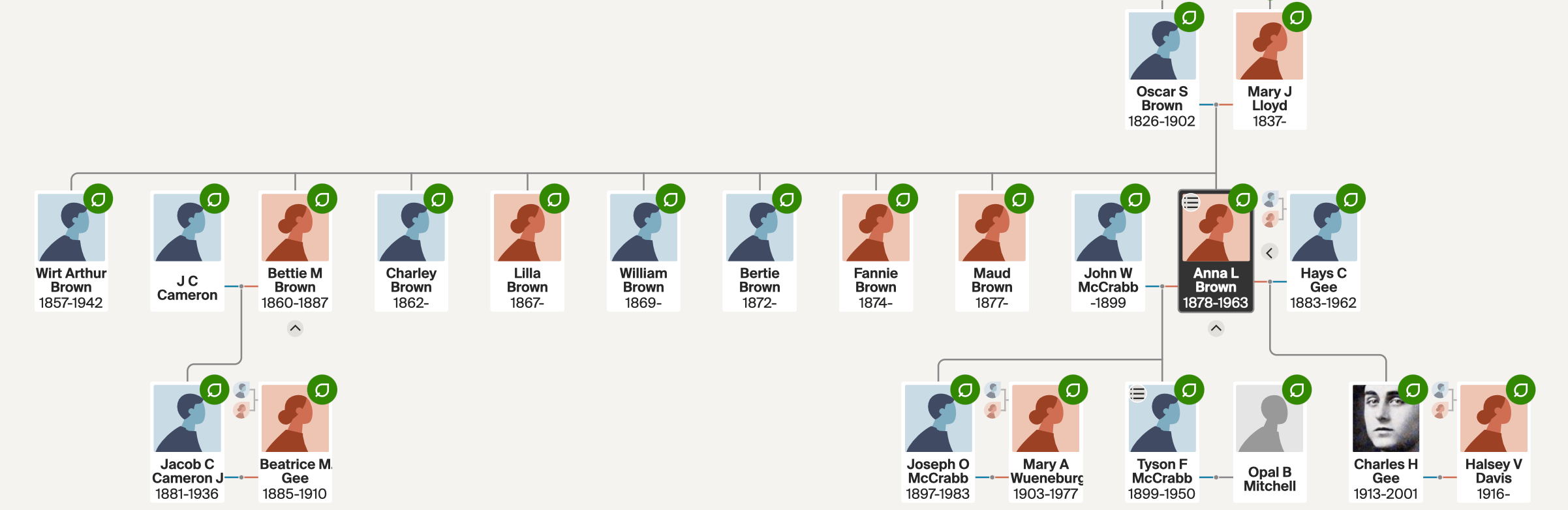
And there was an even older connection: the 1870 census shows Annie’s father Oscar Brown farming in Georgetown. That combination of family history and family connection almost certainly explains why the McCrabb boys were boarding in Georgetown by 1909 and why Annie herself eventually followed. In 1910, the census shows her still in DeWitt County, but a November 1911 legal document identified her as a resident of Williamson County. She had moved to Georgetown. She was thirty-three years old.
Name Changes
Sometime in the next few months, Annie married Hays Charles Gee.
I have not found the marriage record. I’ve searched DeWitt County, Williamson County, and neighboring counties without success.
This is the point early on where the research on Annie nearly hit a brick wall; I don’t have a marriage record linking Hays Gee to Annie. There’s no document that connects her maiden name to her second husband. If it weren’t for her sons, her identity before Georgetown might have remained a mystery. Joe and Tyson McCrabb appear in census records alongside Hays and Annie, and they show up in newspaper columns about the Gee household. Their surname didn’t match their stepfather’s, and that mismatch is what made Annie’s earlier life recoverable. The McCrabb surname led to a marriage record for Annie L. Brown and J.W. McCrabb in the 1896 DeWitt County marriage index, which opened the door to the Brown family, the guardianship, the partition deed, and the rest of Annie’s past.
While the marriage record is missing, the probate records help to pinpoint the timeframe for the marriage.
On November 24, 1911: Annie L. McCrabb, a feme sole.
On April 11, 1912: the Williamson County Sun reported “Mr. and Mrs. Hays Gee are here,” the first newspaper reference to the couple.
Then, on January 21, 1913, the court record reads: “Mrs. Annie McCrabb Gee, guardian of the estate of Joseph Austin McCrabb and Tyson Frederick McCrabb, minors.”
There it is, the name change, entered into the minutes of the DeWitt County Court. From that point forward, every probate document identifies her as Annie McCrabb Gee. She didn’t drop her first husband’s name. She added to it. In the legal record, she carried both marriages with her.
She was four years older than Hays. She had two sons, a farm, and over a decade of self-sufficiency. He was 28 or 29 with a past that my Hays Gee piece has already described. She almost certainly knew all about his past through the Cameron-Gee family connection. Given that, as well as her autonomy as a widow, it’s interesting that she decided to enter into a marriage with Hays.
There’s another interesting piece to Annie’s story around the time she married Hays. As guardian of her sons’ estates, Annie had petitioned the court for permission to sell 574 acres of the McCrabb land in Jackson County. The land was unimproved pasture, and she argued that the personal property had been exhausted and the sale was necessary to fund the boys’ support and education.
The buyer was C.H. Gee, Hays’s father, at $18 per acre. The total price was $9832, but the first sale fell through. The January 1913 court entry records that the purchaser refused to consummate the transaction. Annie filed a new report of sale in April 1913, and this time C.H. Gee completed the purchase at a lower price of $10 per acre.
So, the picture is this: Annie married into the Gee family, and within months, her father-in-law purchased her children’s land through the probate court where Annie was the guardian executing the sale. The transaction was legal and court-supervised, but the intertwining of the two families’ finances had begun, and it would continue for decades.
Her Separate Estate
In August 1915, Annie purchased Block 31 of the Glasscock Addition in Georgetown for $4,000. The deed specifies that the cash portion, $2,800, came “out of her separate funds,” and that the property was to become part of her separate estate. This was not a joint purchase. This was Annie, acting in her own legal capacity, investing money she controlled.
She held the lot for five months. On January 29, 1916, she and Hays sold it to A. Clowlin for $4,000. The day before, Clowlin and his wife had signed a deed selling the Gees a 120-acre farm south of Georgetown for $9,000, with $4,000 in cash and the balance in promissory notes. Both deeds were filed on the same day. The transactions were coordinated: Annie’s town lot became the down payment on the farm.
But there was an important difference between the two purchases. The Glasscock Addition property had been Annie’s separate property. The farm deed named both H.C. Gee and wife Annie McCrabb Gee as grantees, making it community property. Annie’s separate money had funded a joint asset. Under Texas law, that changed who controlled it and who could lose it.
Six months later, on a June morning, the farm house was destroyed by fire. The San Antonio Express reported that Mrs. Gee lost jewelry and diamonds amounting to about $750.
When Annie filed her guardianship report the following January, she told the DeWitt County Court that “there is no way in which she can give an itemized account of the expenditures, for the reason that her dwelling with all contents was burned, and that all account books and receipts of monies paid out for said minors were destroyed.” All she could report was the balance on hand: $1,155.
In June 1922, they bought another lot in the Glasscock Addition and contracted with Griffith Lumber Company to build the house at 602 South College Street. As you know from last week, they had to give up that house three years later because they were unable to pay down the principal. C.H. stepped in to buy the debt and pass the house to a new owner.
Mrs. Hays Gee
After the sale of the College St house, Annie rebuilt a social life, if not a financial foundation. This is the period where the Williamson County Sun knew Annie best, and knew her least. Mrs. Hays Gee hosted a 42 luncheon. Mrs. Hays Gee was in the bridge club. Mrs. Hays Gee threw a bridal shower. In March 1924, she and Hays hosted a birthday dinner. Meanwhile, Hays chased oil leases across Central Texas. They visited Joe and his family in San Antonio. Tyson and his wife came from Seattle. The social columns recorded all of it under the name Mrs. Hays Gee.
Her Boys
By 1940, Hays and Annie had left Williamson County entirely. The census finds them in San Antonio, in the household of Annie’s firstborn son, Joe McCrabb, now 42 years old. Joe had built a respectable life there as a builder with a family of his own. The circle that began when Annie was a young widow farming alone in Jackson County had come around: she lived in her son’s house now.
Annie’s youngest, C.H. Gee Jr., had done well too. He graduated from Southwestern University with a chemistry degree, took a position with LaGloria Corporation in Corpus Christi, and was commissioned as a Naval Reserve ensign during the war. By 1944, Annie and Hays were living at his address on Glendale Drive. Two of the three boys Annie raised had landed on solid ground.

The third had not. Tyson McCrabb’s life after Georgetown is difficult to summarize and harder to imagine living through as his mother. In 1922, at twenty-three, he was convicted under the Mann Act in Seattle and sent to the federal penitentiary at McNeil Island. His intake record listed his crime as “white slavery” and his mother in Georgetown as his contact. After his release, he drifted through Northern California, accumulating arrests for battery, hotel burglaries, and petty theft across San Francisco, Oakland, Palo Alto, Redwood City, and Stockton. In May of 1926, he struck a taxicab head-on in San Francisco, killing the driver; he was charged with manslaughter. By 1932, he was at Folsom. The 1940 census found him at the Louisiana State Penal Farm. He used at least three aliases. California prison records trace a path through McNeil Island, Folsom, Baton Rouge, and San Quentin over a span of more than twenty years.
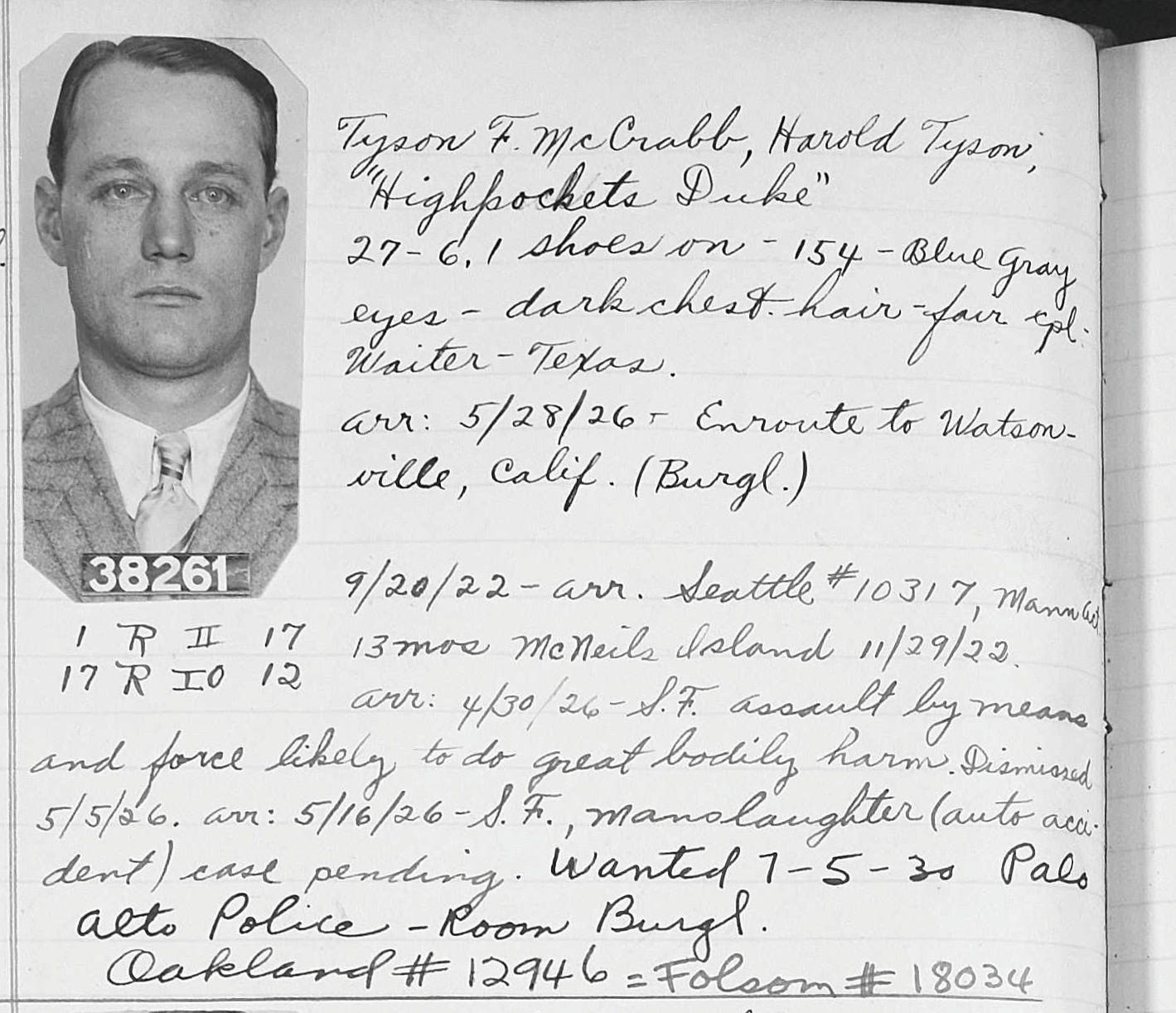
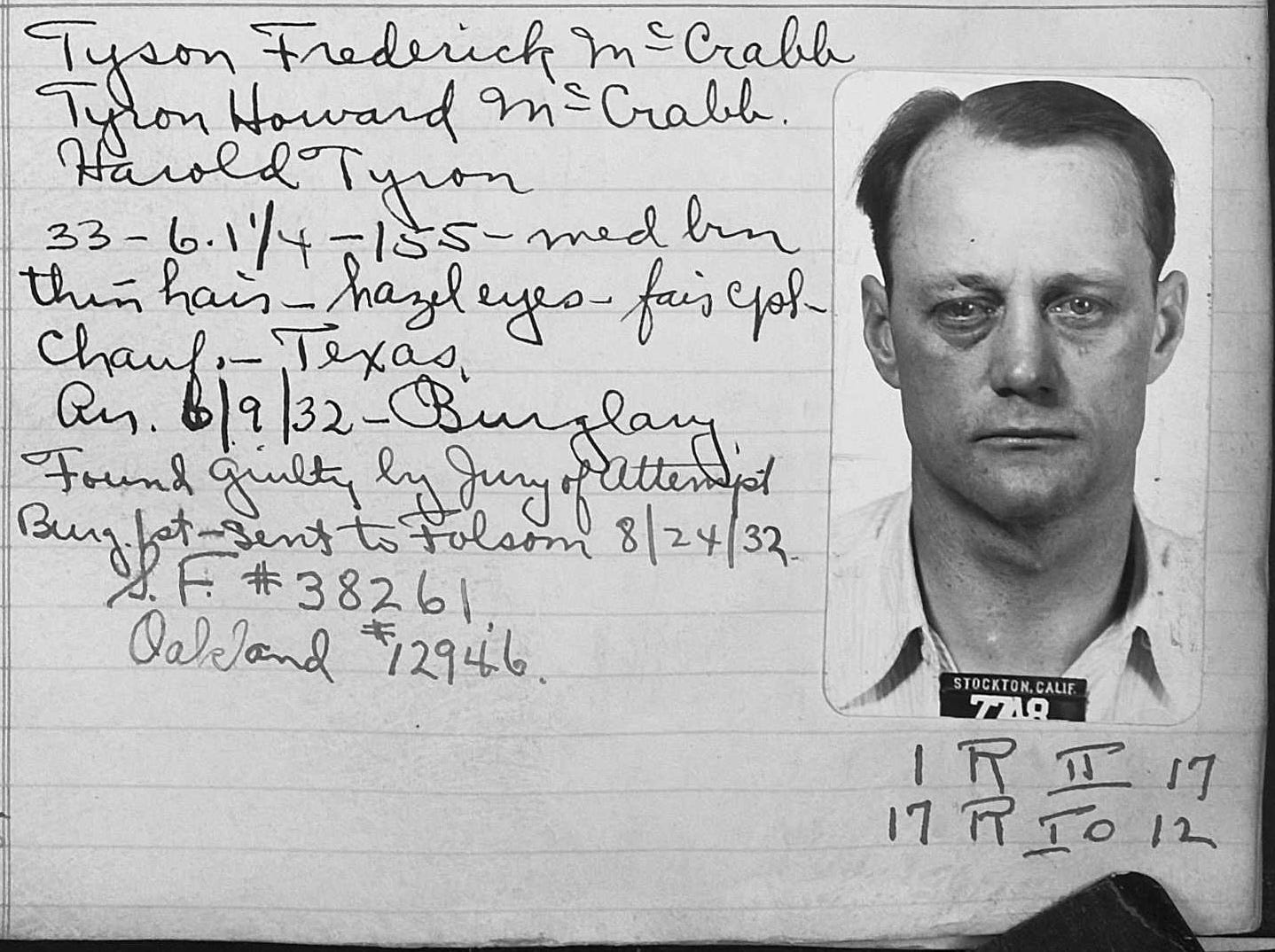
In 1937, Tyson turned up in Cuero, Annie’s home county, where he sustained a 24 inch abdominal wound in a knife fight. In 1947, he married again in San Antonio. He died on January 7, 1950, in San Francisco, at the age of fifty. His obituary listed his occupation as the travel bureau business. Survivors included his mother, Mrs. Annie Lee McCrabb Gee.
The guardianship exhibit that Annie filed in 1912, with its careful accounting of school books and boarding fees and the $65 for Tyson’s gunshot wound, reads differently in light of what followed. She spent a decade scraping together the money to raise and educate those boys. One of them became a builder. One of them became an ensign. And one of them spent most of his adult life in and out of prison.
Who Was Annie Lee Brown?
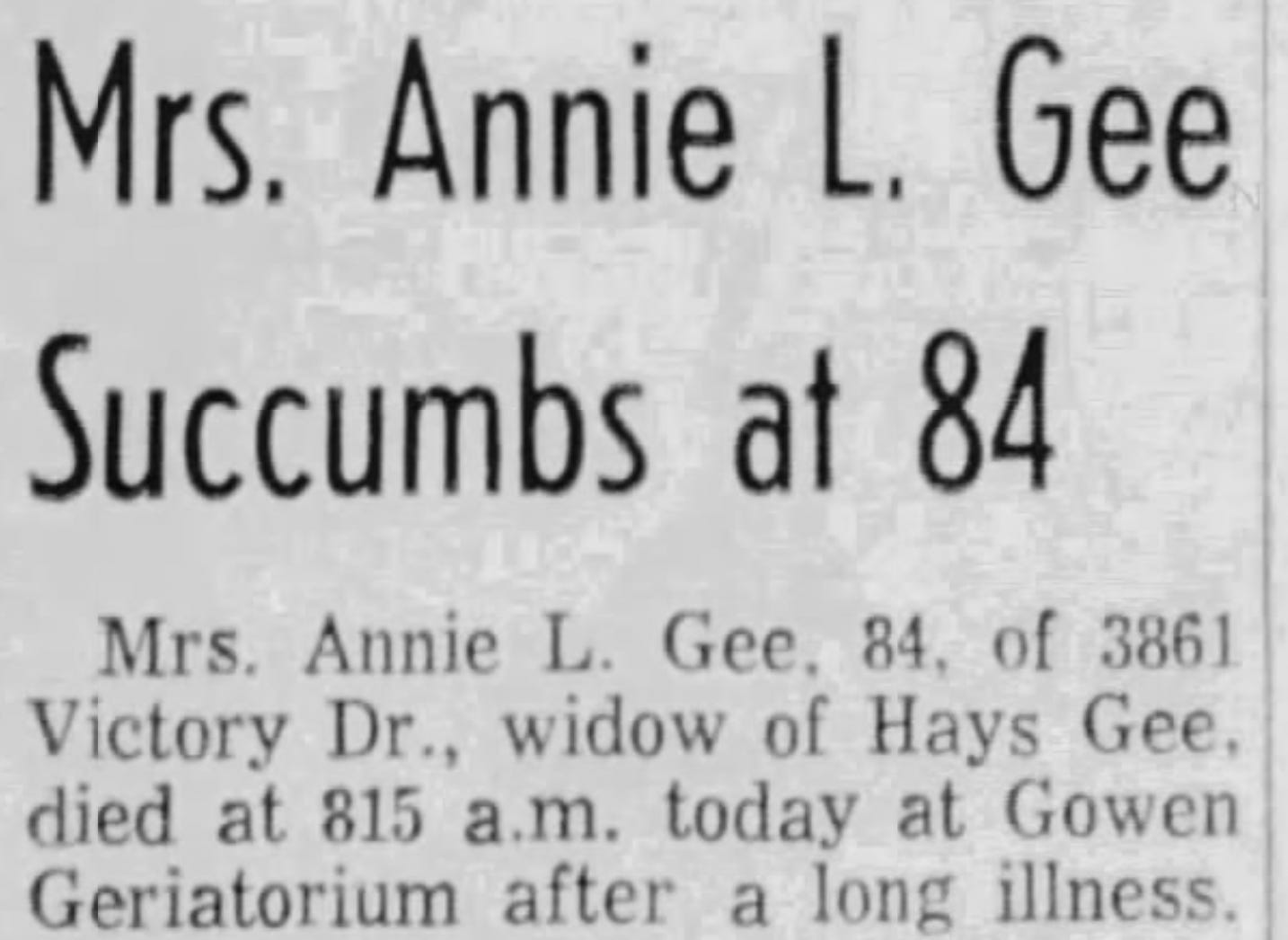
Annie died in 1963, at Gowen Geriatorium in Shreveport, after a long illness. She was 84. The Shreveport Journal said: “Mrs. Annie L. Gee, 84, of 3861 Victory Dr., widow of Hays Gee.” A native of Cuero, Texas. Survivors: two sons, C.H. Gee of Shreveport and Joe McCrabb of San Antonio. Five grandchildren, four great-grandchildren, two great-great-grandchildren. Burial in Forest Park Cemetery.
The Williamson County Sun published hundreds of column inches about the Gee family between 1889 and 1938. In all those years, Annie was identified only as Mrs. Hays Gee. Before that, she was Mrs. Annie McCrabb. While her first husband’s obituary did name her as “Miss Annie Brown of Clinton,” her own obituary identified her as “widow of Hays Gee.”
Who was Annie as a woman, a wife, a mother? The records and newspaper articles don’t tell us that—but we do know her name. Anna L. Brown. Annie L. McCrabb. Annie McCrabb Gee. Annie Lee Gee.
The probate court in DeWitt County is where she exists most fully as a person: a woman managing land, settling claims, boarding her children, paying for their school books, collecting rent on the property she maintained. A feme sole. A guardian. A woman who owned things and did her best to hold on to them.
She was born Anna Lee Brown, but she always went by Annie. She married twice, buried one husband and outlived the other, raised three sons, farmed alone, managed estates, hosted luncheons, lost a house to fire and another to debt, and moved six times across Texas and into Louisiana.
The newspapers called her Mrs. Hays Gee. Her name was Annie Lee Brown.
This post is published during Women’s History Month. It is dedicated to the women in the historical record who were identified only by their husbands’ names and also acknowledges the clerks, notaries, and court reporters who, in the course of ordinary legal business, recorded women’s names for posterity.
Sources & Research Notes
Coverture, Community Property, and Feme Sole
Marylynn Salmon, Women and the Law of Property in Early America (Chapel Hill: University of North Carolina Press, 1986). General treatment of coverture doctrine and married women’s legal status under English common law, including the feme sole designation.
Kathleen Elizabeth Lazarou, Concealed Under Petticoats: Married Women’s Property and the Law of Texas, 1840–1913(New York: Garland Publishing, 1986). Development of Texas married women’s property rights within the community property framework inherited from Spanish civil law.
Joseph W. McKnight, “Texas Community Property Law: Its Course of Development and Reform,” California Western Law Review 8, no. 1 (Fall 1971): 117–158. Traces the evolution of Texas community property law, including restrictions on married women’s capacity to convey separate property without spousal joinder.
Tex. Const. art. XVI, § 15, amended 1967. Removed the requirement that a married woman obtain her husband’s joinder to convey her separate property, granting her independent authority over her separate estate.
Annie L. Brown McCrabb Gee
“Annie L Brown,” Texas, U.S., Select County Marriage Index, 1837–1965; marriage to John W Mc Crabb, 23 December 1896, DeWitt County, Texas; image, Ancestry.
“J.W. (Buck) McCrabb,” obituary, Cuero Daily Record (Cuero, Texas), 23 October 1899; digital image, The Portal to Texas History (texashistory.unt.edu).
1900 U.S. census, Jackson County, Texas, population schedule, Precinct 5, ED 60, Annie McCrabb [listed as McNabb], head of household, widowed, farmer; digital image, Ancestry; citing NARA microfilm publication T623.
1910 U.S. census, DeWitt County, Texas, population schedule, Annie McCrabb household; digital image, Ancestry; citing NARA microfilm publication T624.
“Anna L Brown,” Ancestry profile, tree “Families of Historic Georgetown, Texas”; birth 1 August 1878, Austin, Texas; death about 1963; parents Oscar S. Brown and Mary Lloyd. This profile is maintained by the author and represents the current state of the research.
The Brown Family
1870 U.S. census, Williamson County, Texas, population schedule, not stated, dwelling 135, Brown, Oscar, household; farmer, real estate $600, personal estate $250; born Virginia; post office Georgetown; digital image, Ancestry. Oscar Brown, age 43, with wife Mary (32, Missouri) and children Wirt, Bettie, Charley, Lillie, and William. Annie not yet born.
DeWitt County, Texas, Deed Records, Vol. 48, pp. 220–228; partition deed, O.S. Brown et al.; dated 26 July 1899, recorded in DeWitt County; FamilySearch digital image (familysearch.org), Image Group Number 005861541.
McCrabb Guardianship (DeWitt County Case No. 1024)
Annie L. McCrabb to W.A. Brown, deed, DeWitt County, Texas; dated 20 October 1906, recorded 22 October 1906; Vol. 58, p. 31, Deed Records of DeWitt County. Annie identified as “a feme sole.”
Application for temporary guardianship, Mrs. Annie McCrabb; County Court, DeWitt County, Texas; 16 October 1909; Probate Minutes, p. 515.
Bond and oath, Annie McCrabb, temporary guardian; approved 25 October 1909; Probate Minutes, p. 526. Sureties include W.A. Brown.
Order appointing Annie McCrabb permanent guardian; January Term, 1910; Probate Minutes, p. 553.
Bond and oath, Annie McCrabb, permanent guardian; approved 25 January 1910; Probate Minutes, p. 577.
Inventory and appraisement, Estate of McCrabb Minors; filed 1 March 1910; Probate Minutes, p. 582. Lists 1,150 acres in Jackson County (John McCrabb survey) appraised at $6,900; two horses at $54; cash on hand $945.
Application for sale of cattle; 3 December 1909; Probate Minutes, p. 531.
Annie L. McCrabb to release, vendor’s lien; dated 24 November 1911, acknowledged 8 December 1911 before C.R. Faubion, Notary Public, Williamson County; recorded 9 January 1912, DeWitt County Deed Records, p. 434. Annie identified as “a feme sole, formerly of the County of DeWitt... but now of the County of Williamson.”
Order for sale of real estate, Estate of McCrabb Minors; 15 October 1912; Probate Minutes, p. 546. Annie still identified as “Mrs. Annie McCrabb.”
Guardianship exhibit, Mrs. Annie McCrabb, Guardian; October Term 1912; Probate Minutes, p. 547. Detailed financial accounting of receipts and disbursements, 1908–1912.
Report of sale, Mrs. Annie McCrabb; 19 October 1912; acknowledged before L.A. Strickland, Notary Public, Williamson County; Probate Minutes, p. 561. C.H. Gee purchased 574 acres at $18/acre ($9,832). Sale confirmed October 26, 1912.
Order rescinding sale confirmation; 21 January 1913; Probate Minutes, p. 602. First appearance of “Mrs. Annie McCrabb Gee” in the court record.
Report of sale, Mrs. Annie McCrabb Gee, Guardian; April Term 1913; Probate Minutes, p. 10. C.H. Gee purchased 574 acres at $10/acre ($5,740 cash). Sale confirmed April 19, 1913.
Citation to file account, Estate of McCrabb Minors; October Term 1916; Probate Minutes, p. 607. Annie identified as “Mrs. Annie McCrabb Gee.”
Report and account, Mrs. Annie McCrabb Gee, Guardian; January Term 1917; Probate Minutes, p. 50. Reports dwelling and all account books destroyed by fire; balance on hand $1,155.
The Tyson McCrabb Shooting
[Assault charge, Tos Dever, shooting of Tyson McCrabb], The Houston Post (Houston, Texas), 18 November 1910, p. 5; digital image, Newspapers.com. Dever placed under $500 bond; claimed shooting of Tyson McCrabb in the left ankle was accidental.
Census Records: Gee Family
1920 U.S. census, Williamson County, Texas, population schedule, ED 149, sheet 8B, Gee, Hays, household; digital image, Ancestry; citing NARA microfilm publication T625.
1930 U.S. census, Williamson County, Texas, population schedule, Georgetown, Gee, Chas. H. household including Hays Gee and family; digital image, Ancestry; citing NARA microfilm publication T626.
1940 U.S. census, Bexar County, Texas, population schedule, San Antonio, McCrabb, Josephus household, including Gee, Hays; digital image, Ancestry; citing NARA microfilm publication T627.
1950 U.S. census, Nueces County, Texas, population schedule, Corpus Christi, ED 258-129, Gee, Hays C. household; digital image, Ancestry.
Marriage and Family
[Local notice: Mr. and Mrs. Hays Gee are here], The Williamson County Sun (Georgetown, Texas), 11 April 1912, p. 26; digital image, Newspaper Archive. First newspaper reference to the couple.
[Local notice: move to Jackson County], The Williamson County Sun (Georgetown, Texas), 26 June 1913, p. 5; digital image, Newspaper Archive.
[Georgetown correspondence: Gee farm near Cuero], The Houston Chronicle (Houston, Texas), 13 July 1913, p. 17; digital image, Newspapers.com.
[Birth notice: son born in Inez], The Williamson County Sun (Georgetown, Texas), 11 December 1913, p. 5; digital image, Newspaper Archive.
[Local notice: Mr. and Mrs. Hays Gee and children to Pittsburg], The Williamson County Sun (Georgetown, Texas), 11 February 1915, p. 5; digital image, Newspaper Archive.
The Separate Estate and Farm
Williamson County, Texas, Deed Records, Vol. 171, p. 532; W.L. Price and Ernest Johnson to Annie McCrabb Gee; Block 31, Glasscock’s Addition, Georgetown; $4,000 ($2,800 cash “out of her separate funds,” assumption of $1,200 note); dated 16 August 1915, filed 18 August 1915; Williamson County Clerk’s Office, Georgetown, Texas. Property designated as Annie’s separate estate.
Williamson County, Texas, Deed Records, Vol. 172, p. 297; H.C. Gee and wife Annie McCrabb Gee to A. Clowlin; Block 31, Glasscock’s Addition, Georgetown; $4,000 ($2,500 cash, assumption of $1,200 note plus interest); dated 29 January 1916, filed 29 January 1916; Williamson County Clerk’s Office, Georgetown, Texas.
Williamson County, Texas, Deed Records, Vol. 172, p. 298; A. Clowlin and wife L.V. Clowlin to H.C. Gee and wife Annie McCrabb Gee; two tracts in Williamson County (120 acres, Batres survey); $9,000 ($4,000 cash, three promissory notes for $1,800 and two at $2,000); dated 28 January 1916, filed 29 January 1916; Williamson County Clerk’s Office, Georgetown, Texas. The farm south of Georgetown destroyed by fire June 1916.
The House Fire
“Hays Gee’s Home Burned,” The Williamson County Sun (Georgetown, Texas), 22 June 1916, p. 6; digital image, Newspaper Archive.
“Big Loss in Georgetown Fire,” San Antonio Express (San Antonio, Texas), 24 June 1916; digital image, Newspapers.com(newspapers.com). Reports loss above insurance at $1,500 and jewelry/diamonds at $750.
The College Street House
Williamson County, Texas, Deed Records, Vol. 205, p. 417; Mrs. M.J. Suttles to H.C. Gee, part of Lots 1 and 2, Block 35, Glasscock Addition, Georgetown; $500 cash; dated 19 June 1922; Williamson County Clerk’s Office, Georgetown, Texas.
Williamson County, Texas, Mechanics Lien Records, Vol. 6, p. 344; H.C. Gee and wife, Annie Gee, to Griffith Lumber Company; $3,300 in two promissory notes; dated 6 July 1922; Williamson County Clerk’s Office, Georgetown, Texas.
“Much Building Activity Is Noted at Georgetown,” The Houston Post (Houston, Texas), 17 July 1922, p. 16; digital image, Newspapers.com.
“Home Contract Let,” San Antonio Light (San Antonio, Texas), 1 September 1922, p. 2; digital image, Newspapers.com.
Williamson County, Texas, Deed Records, Vol. 224, p. 344; H.C. Gee and wife, Annie Gee, to C.H. Gee; Block 35, Glasscock Addition; $4,000; dated 9 September 1925; Williamson County Clerk’s Office, Georgetown, Texas.
Williamson County, Texas, Deed Records, Vol. 222, p. 559; C.H. Gee to Hedges Agnew; Block 35, Glasscock Addition; $4,000; dated 1 October 1925; Williamson County Clerk’s Office, Georgetown, Texas.
Social Life
[Surprise birthday party for Mrs. C.H. Gee, hosted by Mrs. Hays Gee], The Williamson County Sun (Georgetown, Texas), 16 March 1919; digital image, Newspaper Archive. Guest list includes Mrs. S.K. Brown, likely a relative of Annie Gee (née Brown).
[Birthday dinner for Mrs. Suttles and Mrs. C.H. Gee], The Houston Post (Houston, Texas), 16 March 1924, p. 35; digital image, Newspapers.com.
“Pretty Shower for Bride,” The Williamson County Sun (Georgetown, Texas), 28 November 1924, p. 8; digital image, Newspaper Archive.
“42 Luncheon,” The Williamson County Sun (Georgetown, Texas), 29 June 1928, p. 6; digital image, Newspaper Archive.
“Bridge Club,” The Williamson County Sun (Georgetown, Texas), 8 November 1929, p. 13; digital image, Newspaper Archive.
[Local notice: Mrs. Annie McCrabb of Cuero visited her sister], San Antonio Express (San Antonio, Texas), 27 August 1911; digital image, Newspapers.com.
The Separate Estate
Williamson County, Texas, Deed Records, Vol. 288, p. 94; deed, H.C. Gee to Annie Lee Gee; dated 25 September 1937; Williamson County Clerk’s Office, Georgetown, Texas. Recorded one week after C.H. Gee Sr.’s death.
Tyson McCrabb
Washington, U.S., U.S. Penitentiary McNeil Island, Photos and Records of Prisoners Received, 1887–1939; Records of Prisoners, 1922; prisoner no. 4295, Howard Tyson McCrabb; crime: White Slavery; received 25 November 1922; discharged 1 October 1923; digital image, Ancestry.
“Wooer Betrayed Her, Girl Asserts,” San Francisco Chronicle (San Francisco, California), 18 October 1922, p. 7; digital image, Newspapers.com.
“Rescued Girl Bares Vice Trap,” San Francisco Examiner (San Francisco, California), 18 October 1922, p. 9; digital image, Newspapers.com.
“Two Missing Girl Witnesses Found in Yreka,” Tacoma Daily Ledger (Tacoma, Washington), 21 October 1922, p. 2; digital image, Newspapers.com.
“Didn’t Like Their Manners, Kayos 2,” San Francisco Chronicle (San Francisco, California), 1 May 1926, p. 5; digital image, Newspapers.com.
“Tyson McCrabb Gets Crabby But Police ‘Crab’ Act,” San Francisco Examiner (San Francisco, California), 1 May 1926, p. 5; digital image, Newspapers.com.
“1 Dead, 2 Hurt in Gay Party Auto Crash,” San Francisco Examiner (San Francisco, California), 17 May 1926; digital image, Newspapers.com (newspapers.com). Tyson McCrabb charged with manslaughter in death of taxicab driver Thomas Moore. See also: “1 Killed, 4 Hurt in S.F.,” Oakland Post Enquirer (Oakland, California), 17 May 1926, p. 7; digital image, Newspapers.com.
“Divorces Asked,” Seattle Union Record (Seattle, Washington), 28 September 1926, p. 17; digital image, Newspapers.com. Gladys from Tyson McCrabb, desertion.
“Hotel Burglar Suspect Taken,” Redwood City Tribune (Redwood City, California), 26 February 1927, p. 5; digital image, Newspapers.com.
“Alleged Hotel Thief Out on Bail of $2,500,” Redwood City Tribune (Redwood City, California), 3 March 1927, p. 1; digital image, Newspapers.com.
“Burglar Suspect Alleged to Have Lengthy Record,” Redwood City Tribune (Redwood City, California), 5 March 1927, p. 1; digital image, Newspapers.com. California Bureau of Criminal Identification report; aliases Howard Tyson McCrabb, Harold Tyson, and “Highpockets Duke.” See also: “Local Burlingame Suspect Has Lengthy Record Police,” Redwood City Standard (Redwood City, California), 10 March 1927, p. 8; digital image, Newspapers.com.
“Hotel Burglars Face Trial Here,” Woodland Daily Democrat (Woodland, California), 18 December 1929, p. 1; digital image, Newspapers.com.
“Dixon Burglars Identified,” Independent-Leader, 27 December 1929, p. 5; digital image, Newspapers.com.
[Solano County conviction notice], Red Bluff Tehama County Daily News (Red Bluff, California), 9 January 1930, p. 3; digital image, Newspapers.com.
“Given Six Months in Jail,” Solano County Courier (Suisun, California), 30 January 1930, p. 1; digital image, Newspapers.com. Percy Wormer and Tyson McCrabb, petit larceny.
“Rubano un paio di pantaloni,” La Voce Del Popolo (San Francisco, California), 15 August 1930, p. 5; digital image, Newspapers.com. Joseph Dunn and Tyson McCrabb arrested for theft at 157 Powell Street.
“Burglary Case Continued to September 11,” Peninsula Times Tribune (Palo Alto, California), 4 September 1930, p. 1; digital image, Newspapers.com. Stanford Court Hotel burglary.
“Trio Arrested as Robber Suspects,” San Francisco Chronicle (San Francisco, California), 30 November 1930, p. 81; digital image, Newspapers.com.
“Confessed Robber Denied Probation,” Oakland Tribune (Oakland, California), 26 March 1931, p. 23; digital image, Newspapers.com. Tyson McCrabb serving sixty days in city jail for receiving stolen property.
“Jail Sentence Imposed,” The Fresno Bee (Fresno, California), 2 April 1932, p. 2; digital image, Newspapers.com. Tyson McCrabb, alias May; vagrancy; thirty days.
“Alleged Burglar Identified, Jailed,” The Record (Stockton, California), 9 June 1932, p. 17; digital image, Newspapers.com. Santa Fe Hotel burglary; attempted burglary charge leading to Folsom.
“Two San Antonians Make Assault Bond,” San Antonio Express-News (San Antonio, Texas), 19 May 1937, p. 9; digital image, Newspapers.com. Tyson McCrabb dangerously wounded in Cuero; knife wound 24 inches across abdomen.
“Man Who Robbed Hotel Here Sent to Pen for Theft,” The Shreveport Journal (Shreveport, Louisiana), 6 May 1938, p. 21; digital image, Newspapers.com (newspapers.com). See also: “10-Year Sentence,” The Town Talk (Alexandria, Louisiana), 6 May 1938, p. 1; digital image, Newspapers.com. Ten years, Louisiana penitentiary; also wanted in San Antonio, Corn City, and by Folsom authorities.
1940 U.S. census, West Feliciana Parish, Louisiana, population schedule, State Penal Farm, ED 63-9, sheet 28B, McCrabb, Tyson; digital image, Ancestry; citing NARA microfilm publication T627.
California, U.S., Prison and Correctional Records, 1851–1950; San Quentin State Prison, Prison Registers, 1945–1947; prisoner no. 18034, Tyson McCrabb; received 10 July 1945; crime: attempted burglary, first prior; term: 0–20 years, San Joaquin County; digital image, Ancestry.
“$600 Jewel Theft Charged,” San Antonio Light (San Antonio, Texas), 15 August 1946, p. 24; digital image, Newspapers.com (newspapers.com). Tyson McCrabb charged with theft of auto from Mrs. Odie Martindale of Schertz.
“Marriage Licenses Issued,” The News (San Antonio, Texas), 27 February 1947, p. 13; digital image, Newspapers.com(newspapers.com). See also: San Antonio Light (San Antonio, Texas), 27 February 1947, p. 26; digital image, Newspapers.com (newspapers.com). Tyson T. McCrabb and Opal B. Mitchell.
“Tyson F. McCrabb,” obituary, The News (San Francisco, California), 9 January 1950, p. 22; digital image, Newspapers.com (newspapers.com). Survivors include mother Mrs. Annie Lee McCrabb Gee; stepfather H.C. Gee of Corpus Christi; brothers Joseph O. McCrabb of San Antonio and half-brother C.H. Gee of Shreveport.
Later Years
[House for sale notice], The Williamson County Sun (Georgetown, Texas), 2 December 1938, p. 8; digital image, Newspaper Archive.
“Ens. C.H. Gee,” Corpus Christi Times (Corpus Christi, Texas), 6 August 1944, p. 31; digital image, Newspapers.com(newspapers.com). Notes parents Mr. and Mrs. Hays C. Gee living at 112 Glendale Drive.
Obituaries
“Hays C. Gee Dies Here at Age 78,” The Shreveport Journal (Shreveport, Louisiana), 11 April 1962, p. 8; digital image, Newspapers.com.
“Mrs. Annie L. Gee Succumbs at 84,” The Shreveport Journal (Shreveport, Louisiana), 24 July 1963, p. 8; digital image, Newspapers.com.
Old Town Echoes is independently researched using primary historical sources.
AI tools assist in drafting and editing; all content is reviewed, sourced, and verified by the author.
Thanks for reading Old Town Echoes!
Subscribe for free to receive new posts and support my work.